Oct 25, 2007 | US Mint
Yesterday, I asked if anyone knew what a “Three Lens” was because it appeared in the Product Schedule page of the US Mint’s online catalog. User Mint News Blog said that the boxes the Mint sells to store proof coins sets to accommodate the three cases used in the 2007 proof sets with 14 coins. Today, the Mint made this box available on their website.
I learned that the Mint calls the cases for proof sets “lenses.”
Oct 24, 2007 | US Mint
I was looking at the US Mint’s online catalog Product Schedule page for when the James Madison Dollar Coins will be released (November 15). As I was scanning the list, I noticed that on October 25 (tomorrow), there are product called “Collector’s Box.” One says “Collector’s Box—Quarter Rolls.” and the other says “Collector’s Box-Dollar Coin Rolls.“ Based on the name, I suspect that these are boxed set of rolls for the complete 2007 set of 50 State Quarters and the Presidential $1 Dollar Coins.
However, one entry reads “Collector’s Box—Three Lens.” I’m stumped… what could “Three Lens” be? I know we will find out tomorrow, but I am curious today! Do you have a guess?
Oct 18, 2007 | coins, gold, US Mint
Yesterday was a busy day in the coin industry. Aside from the announcements from the American Numismatic Association, the US Mint resumed selling bullion coins. The newly priced American Gold Buffalo and American Gold Eagle proof coins have had their prices adjusted and can now be ordered. Based on a comparison of the new price, the prices are up $75 per ounce. Gold closed at $767.80 on October 18.
Here are the new prices compared with the old:
| Coin(s) |
Old Price |
New Price |
| American Buffalo One Ounce 24 Kt. Gold Proof |
$825.95 |
$899.95 |
| American Eagle One-Ounce Gold Proof |
$789.95 |
SOLD OUT |
| American Eagle Half-Ounce Gold Proof |
$399.95 |
$459.95 |
| American Eagle Quarter-Ounce. Gold Proof |
$209.95 |
$239.95 |
| American Eagle Tenth-Ounce Gold Proof |
$104.95 |
$116.95 |
| American Eagle Four Coin Gold Proof Set |
$1,449.95 |
$1,649.95 |
It’s a good thing I received my 2007-W proof Buffalo over the summer, before the prices went up!
Oct 15, 2007 | coins, gold, platinum, US Mint
When I decided to take a week off, I did not think that there would be much news in the numismatic community. I knew that the US Mint would issue the 28-coin 2007 Mint Set with a satin finish. I figured that would be all of the news from the Mint until the release of the James Madison Dollar. But it seems that precious metals prices have had an effect on Mint products.
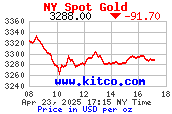 As the dollar weakens, investors are running to precious metals to protect their assets. This is driving up the prices for gold and platinum. The increased interested gold caused its spot price to reach $711.40 on September 12. Because the margin decreased, the Mint suspended sales of American Eagle gold coins on September 13.
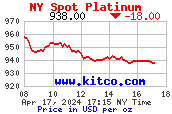 Platinum has also been surging. As of the market close on Friday, October 5, platinum closed at $1365—up over $300 this year— as gold closed at $741.30. When the markets opened on Monday, the Mint suspended sales of the platinum American Eagles and American Buffalo gold proof coins. The next day, bulk sales to dealers were halted. Only the silver and platinum proof American Eagles are still available.
Dave Harper of Numismatic News speculates that the Mint acts when the threshold between the cost of the metals and the spot prices are within $100 of the Mint’s sales price. While he has no evidence of this, it is a plausible theory based on recent events as all bullion sales ceased when gold and platinum spot prices were within $100 of the Mint’s sales price.
Before the Mint can reprice these coins, they are required to publish the new prices in The Federal Register. Nothing has been announced. Market volatility may make this more difficult for the Mint than expected. It could take the Mint until the end of the month to set new prices to allow the market to settle.
Oct 5, 2007 | US Mint
Hi, I am a human being, and I made a mistake!
I am not talking about a tragic mistake. I am talking about not using the right credit card to buy proof sets from the US Mint.
With the release of the silver proof set and the Jefferson cover, I decided it was time to place an order before these items are sold out. I logged into my account on the Mint’s website and entered my order. The process proceeded as expected until I was at the final page asking how I wanted to pay for the order. Since the Mint had my credit card stored from my last purchased, I clicked the approval button with the comfort that my order would be processed.
Unfortunately, between my previous order and this new order I had accidentally left the card at a cash register and had that card canceled. I had forgotten that I used that card with the Mint. So the Mint tried to process the order using a canceled credit card.
Obviously, the credit card transaction was denied. In fact, the US Mint tried to charge that card twice only to be met with failure. The Mint suspended the order did nothing. The order stayed suspended for three weeks until I checked its status when I wonder why my coins had not been delivered.
Rather than send a letter to the address provided or send an email note to that address provided, the US Mint does nothing. Thankfully, the items I ordered were still available, but the Mint should allow me to fix the situation. In this case, I was able to provide the new account number to complete the order. But what would have happened if a product sold out during the wait time?
Unless the Mint verifies the account number during the transaction, they should notify the customer if the credit card authorization fails. Sure, it was my fault for fusing the account number associated with a lost card. But I should be given the opportunity to rectify the issue without the potential for losing the order.
Giving me the opportunity to fix my mistake is good customer service—something the Mint need to learn!
Sep 21, 2007 | coin design, dollar, legislative, US Mint
The White House announced that President Bush signed H.R. 2358, the “Native Americans $1 Coin Act.” Now the law, it will require the US Mint to issue Sacagawea Dollars with new reverses in commemoration of Native Americans beginning in 2009.
Between the Presidential Dollar coins and the new Sacagawea reverse designs, these coins will continue to be a curiosity to the general public and another entry into collections while the $1 Federal Reserve Note continues to be printed. It is time for the United States to join the rest of the world and eliminate the paper-based unit currency to allow the less expensive coinage to take its place.
Although many understand and accept the reason for discontinuing the $1 note, it will not happen. I will explain why in a future posting.
Sep 19, 2007 | BEP, Eagles, US Mint
We collectors of US coins cannot live without the US Mint since they are the government’s exclusive manufacturer of coins. They run the world’s largest coin factory in Philadelphia, second largest in Denver, and they control the market for present-day collectibles. Last week, the Mint suspended the sale of uncirculated American Gold Eagles with the “W” mintmark because of the rising price of gold. It was reported that sales of gold American Eagles will be repriced and returned to sale on or after September 27.
Today, I visited the Mint’s website to order proof sets. On their front page is a graphical changing area that tells the web surfer about available coins. The first banner was for the uncirculated gold American Eagle coins. When I clicked on the image, I was sent to the on-line catalog that shows that these coins are are “not available.”
Even though I am not in the market for gold American Eagle coins, I found it distressing that the Mint would announce the situation to the media and leave the publically accessible website to provide conflicting information. The Mint public relations department should be more diligent at ensuring the website as the correct information, especially since the Mint wants more people to use it rather than the telephone services.
Since the recent growth in the collecting market, I have not had problems with orders from the US Mint. I once had problems with the Bureau of Engraving and Printing that was blamed on their mishandling of technology. But this example of conflicting information and careless treatment of public information can cause problems for some customers. As a government agency with exclusive manufacturing rights to our coinage, the Mint must be held to a higher standard for the integrity of the country they represent.
Sep 12, 2007 | CFA, coin design, coins, legislative, state quarters, US Mint
In the final step before becoming a law, congress presented the president with H.R. 2358, Native American $1 Coin Act, for his signature. Introduced in the House of Representatives by Dale Kildee (D-MI 5th), and expected to be signed by the president, the bill calls for the reverse of the Sacagawea Dollar be redesigned every year to commemorate “of Native Americans and the important contributions made by Indian tribes and individual Native Americans to the development of the United States and the history of the United States.” The obverse will continue to have the Sacagawea design.
The bill calls for the denomination to be inscribed as “$1,” making it consistent with the Presidential dollars. The bill also calls for the same edge lettering used by the Presidential dollars to include the date and mint mark along with the inscriptions E Pluribus Unum and In God We Trust. As for the reverse designs, the bill calls for the Mint to consult the Committee on Indian Affairs of the Senate, the Congressional Native American Caucus of the House of Representatives, the Commission of Fine Arts, and the National Congress of American Indians, along with the usual bureaucracy of the Citizens Coinage Advisory Committee to vet the coin design. With the burden of this bureaucracy, the bill changes the start date to January 1, 2009 if enacted after August 25, 2007.
An interesting clause in the bill says that the design are to be issued “in the chronological order in which the Native Americans lived or the events occurred.” Since there is no specific end date to the program, it appears that the bureaucratic hurdles the Mint is being asked to jump for this program will need the extra year to determine a schedule. And if that was not enough, congress, who is not shy in making its own design suggestions, included the following potential designs in the bill:
- the creation of Cherokee written language
- the Iroquois Confederacy
- Wampanoag Chief Massasoit
- the “Pueblo Revolt”
- Olympian Jim Thorpe
- Ely S. Parker, a general on the staff of General Ulysses S. Grant and later head of the Bureau of Indian Affairs
- code talkers who served the United States Armed Forces during World War I and World War II
In addition to these new reverses, change to the circulating coinage will include new reverses on the Lincoln cent and Presidential Dollars with the reverses honoring, William Henry Harrison, John Tyler, James K. Polk, and Zachary Taylor. Non-circulating legal tender coins will include the Abraham Lincoln and Louis Braille commemoratives, special 2009 cent with the original copper composition, and the First Spouse gold coins honoring Anna Harrison, Letitia and, Julia Tyler, Sarah Polk, and Margaret Taylor. Finally, if H.R.392 is passed in the Senate (it passed in the House last January), the 50 State Quarters program will be extended to include the District of Columbia and the five territories.
It looks like 2009 could be a great year in numismatics!
Aug 16, 2007 | coins, dollar, grading, US Mint
With a light work load, I was able to take the afternoon off and travel to 9th Street, NW in Washington, DC, the headquarters of the United States Mint. The building is a plain, white stone office building at the corner of 9th and H Streets, a block away from Chinatown and the Verizon Center. It has the official US Mint seal over the front door, flags flying overhead, and a sandwich board sign announcing the sales counter sitting on the street near the front door.
I made the trek downtown after noon by taking the Capital Beltway to the George Washington Parkway. The GW Parkway is owned by the National Park Service and is a nice drive through the trees along the Virginia side of the Potomac River. A turn to North I-395 and I was heading into downtown DC. Driving in downtown DC is not like other big cities. The streets are wider, cleaner, and you have to watch for double-parked vehicles in strange places. But I made it to the Mint’s headquarters.
When I entered the lobby, there were several people in line for the sales counter. I joined the line so I could purchase a 2007 proof set. Next to the line were three change machines, the type you might see at an arcade or laundromat. As I scanned the machines from right to left, the first machine dispensed Sacagawea Dollars. Insert any bill, and the machine would drop the equivalent amount in Sacagawea Dollars. The next machine to its left was filled with Idaho quarters. With Idaho being the current issue in the 50 State Quarters program, this machine changed four quarters for one paper dollar. Ironically, this machine did not accept one-dollar coins.
Finally, with a queue of its own, was a machine set up to dispense presidential dollars. With today being the first day of issue for the Thomas Jefferson Dollar, people were lined up to obtain this coin. As I waited to purchase a proof set, I watched as someone with a backpack and a fist-full of twenties feed the machine. As the coins were dropped in the outside bin, he placed the coins into white plastic trays. When a tray was full, he placed the coins into a plastic zip bag and into his backpack. It appeared as if the tray was the size of five rolls. He was filling his third tray as I was leaving.
When it was my turn at the counter, I was told that the last proof set was sold while I was waiting. Ironically, I was at the Philadelphia Mint last week trying to purchase a proof set when the power went out. The Mint did not reopen that day and I went home without a proof set. I guess I will have to order the set online. Then I set my sights on the machines. Three twenty dollar bills and one five dollar bill later, I had my stash of Jefferson dollars and left… after stopping for two dollars of Idaho quarters and eight Sacagawea dollars.
I returned home to a hungry dog who needed a walk. After taking care of his needs, I went to my computer, opened the blinds, turned on the Ott Lite, and started to examine the coins. First they were separated by type, then by mint mark. I found 29 Jefferson dollars from Philadelphia and 36 from Denver. Only one of my eight Sacagawea dollars were from Philadelphia and all of the Idaho quarters were from Denver. Not bad for being closer to Philadelphia! Then I focused on the Jefferson dollars. Any coin with a visible nick or problem was set aside. I was looking for clean surfaces, no visible scarring on the high points, and good luster. Finally, I used my loupe to find the best.
In the end I found 22 coins I was confident would do well under NGC’s scrutiny. I logged on to NGC’s website and filled in the online order form. With the coins, order form, and a check packaged, I drove to the nearby Post Office, which is the main distribution station for the region, and was told that Express Mail was a two-day guarantee delivery to Sarasota. I wonder if this has anything to do with Sarasota being referred to as “the Redneck Riviera” according to MSNBC’s Joe Scarborough.
All that work for the First Day of Issue designation on the holder. The last time I did this was for the Washington dollars. The next time will be for Abraham Lincoln. To borrow a phrase from Billy Joel, “You may be right/I may be crazy,” but I am having fun!
Aug 15, 2007 | coins, dollar, US Mint
I just spoke with a friend who brought his two children attended the introduction of the Jefferson Dollar coin. The festivities were held this morning at the Jefferson Memorial, a beautiful marble structure with a bronze statue of our third president in the middle. The renovated structure now has a bookstore, restrooms, and concessions. But on this day, Mint Director Edmund Moy, President of the Thomas Jefferson Foundation Daniel P. Jordan, and a Jefferson re-enactor held a Thomas Jefferson quiz along with the release of the coin.
I was told that the event included about 100 school-age children who had taken part in the Jefferson quiz. With parents, chaperons, onlookers, and the press, my friend estimated about 250-300 people attended the festivities. About $50 in coins were given to children who answered questions. Following the press conference, people were given the opportunity to exchange up to $5 in currency for coins. My friend reported that few of the Mint’s employees followed that rule and allows some to even purchase rolls at face value.
Rolls were popular amongst the speculators looking for edge errors. My friend opened his roll in his car to check the edges. Although he did not find any errors, he did receive a roll of coins struck in Denver.
For the rest of us, the coins will be released into circulation tomorrow, August 16. I will be playing hooky to go to the Mint’s headquarters in the District in order to stuff the in-lobby machine with $5 bills to trade for Jefferson coins. From there, I will be heading to the main Post Office on Massachusetts Avenue, the one next to the National Postal Museum, to send the coins directly to NGC for First Day of Issue grading.
Yes, the First Day of Issue designation is a bit crazy, but I think there is an “oh neat” factor at work. Besides, I have other plans for these coins. Stay tuned!


 Loading ...