Jul 18, 2007 | gold, history, quarter, rareties, US Mint
One of my favorite television shows is History Detectives, the PBS show where four people who have interests in various areas of antiques, history, and sociology research the background and history of artifacts people have found or had handed down to them by family members. Rather than determining the worth of an item like they do in Antiques Roadshow, the concentration is to learn about the item and its significance, or insignificance in history. Two of the History Detectives, Elyse Luray and Wes Cowen, have appeared on Antiques Roadshow.
Now in its fifth season, my local PBS television station showed the new second episode. One of the investigations was Dr. Gwendolyn Wright researching a Continental Currency $6 bill found by an Omaha, Nebraska family in a book. The story allows Dr. Wright to step outside of her area of architectural history to learn the historical significance of this note.
Rather than recap the segment here, you should visit the episode information on the History Detectives website to watch the eight minute video and read the transcript. I think you will find it as fascinating as I did.
When History Detectives are aired, the segments are concluded with another history detective giving more information about the general topic with more information. After the Continental Currency segment, Wes Cowen talked about the interesting history of US coins. Unfortunately, the two stories they used provided incorrect information.
The first mistake was saying that there was a public outcry from the public regarding the nudity on the Standing Liberty Type 1 Quarter. This myth was debunked by researcher Roger Burdette in his book Renaissance of American Coinage 1916-1921. Burdette writes that according to records from the US Mint and National Archives, designer Hermon A. MacNeil requested the change to make Lady Liberty look stronger in the face of the Great War (World War I).
The second mistake was the claim that the only legal 1933 Saint-Gaudens Double Eagle was smuggled out of the country. Although the coin was smuggled out of the Philadelphia mint, the State Department issued a legal export permit for a representative of King Farouk to carry the coin to Egypt. The State Department might have made a mistake, but that does not mean the coin was smuggled out of the country. To read more about this coin, I highly recommend the book Illegal Tender by David Tripp.
Even with these mistakes, I will continue to watch and recommend this show.
Jul 11, 2007 | coins, commemorative, US Mint
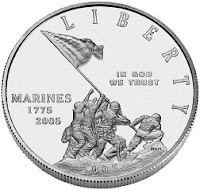
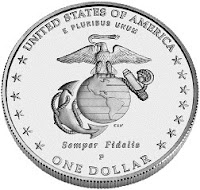 On July 2, the publisher of World Coin News announced that the 2005 Marine Corps 230th Anniversary Silver Dollar has been named “Coin of the Year” (COTY). This commemorative coin features an engraving by United States Mint Sculptor-Engraver Norman E. Nemeth of the Joe Rosenthal Pulitzer Prize winning photograph of the Marines raising the flag over Iwo Jima in 1943. The reverse features the official emblem of the Marine Corps engraved by United States Mint Sculptor-Engraver Charles L. Vickers.
The US Mint issued their press release today.
Coin of the Year is selected from winners of ten categories. The Marine Corps commemorative was the winner of the “Best Crown” category. Other US coins in winning categories include the 2005 Oregon State Quarter as the “Best Trade Coin” and the 2005 American Bison Nickel as the “Most Popular” coin.
COTY was created by the editors of World Coin News to “encourage and honor creativity in the coinage issues of the mints of the world.” World Coin News delays the selection to allow coins to be nominated and reviewed.
Jun 13, 2007 | coins, dollar, state quarters, US Mint
The US Mint turning June into a busy month for collectors by releasing a lot of products. It started on June 4 with the Idaho quarters bags and two-roll sets. Yesterday, the Mint released the John Adams Coin Cover. Today, June 13, the 2007-W uncirculated American Silver Eagle bullion coin is now on sale. Next Tuesday, July 14, the proof and uncirculated First Spouse gold coins honor Martha Washington and Abagail Adams will be on sale. The Mint will also produce 1 5/16-inch bronze medals using the First Spouse designs without a denomination. Finally, on June 21, the Mint will release the Presidential $1 Coin Proof Set.
If you collect everything the Mint produces, the month of June will be expensive. As for me, I am interested in the American Silver Eagles and the Adams Coin Cover. I am not excited about the First Spouse coins. Aside from being expensive, I am not excited about the theme. I am not planning on purchasing the bronze medals.
As for the Presidential $1 Coin Proof Set, I will probably purchase a few sets since first issues tend to resell at a good premium. But the Mint has not said whether the proof, silver proof, and mint sets would contain the Presidential $1 coins. I will hold onto one until the Mint announces what they will do with those annual sets.
Is this too much product for the Mint? If you watch the releases from the Royal Canadian Mint, you may say that the US Mint is quite austere in their offerings. Although I wish the Mint would try to show more class, but their product offerings are regulated by law. Since the law requires the Mint to sell these products, it is difficult to blame them for legally implementing the policies forced upon them.
Jun 1, 2007 | coins, commemorative, US Mint
Every month, the US Mint’s History In your Pocket (H.I.P) program chooses one coin to feature and provides education materials for teachers to use in teaching history using numismatics. This month’s coin is the 1915 Panama-Pacific $50 commemorative coin.

 Minted to commemorate the 1915 Panama-Pacific Exposition in San Francisco that celebrated the opening of the Panama Canal and rebuilding of San Francisco following the Great Earthquake of 1906. The Mint created five different commemoratives for the exposition including an octagonal gold coin with a $50 face value. Its unusual shape makes it intriguing.
Robert Aitken, a New York artist born in San Francisco, was selected to design the fifty dollar round and octagonal coins. The obverse is based on the Roman goddess Minerva and an owl on the reverse to symbolize wisdom. Although the coin was ridiculed as not having American symbols. But the designs are well executed and appreciated by collectors today.
May 25, 2007 | cents, coins, history, US Mint
People lined the streets in front of the Philadelphia Mint on May 25, 1857 so that they can trade their foreign coins for newly minted Flying Eagle small cents. The scene must have pleased Mint Director James Ross Snowden, whose push for the coinage law passed by congress on February 21, 1857 allowed him to drive out all foreign coins from circulation.
When Snowden became Mint Director in 1853, he was faced with the issue that the price of copper and the increasing labor costs were making the large cent uneconomical to make. Snowden also knew that for the nation to continue to thrive, the lower denomination foreign coins that were still being used in the United States had to be removed from the economy. Aside from the large cent not being popular with the public, Snowden also believed that the value of subsidiary coinage can be based on trusting the government as the issuing authority and not necessarily the intrinsic value of the metals used.
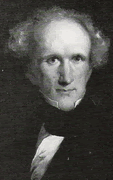 Snowden tasked James B. Longacre with designing a smaller coin to replace the large cent. Longacre borrowed the Christian Gobrecht/Titian Peale design that was used on pattern dollars twenty years earlier to create a unique obverse. For the reverse, Longacre adapted the wreath he made for the 1854 one and three dollar gold coins. Snowden ordered 1,000 of these 1856 Flying Eagle Cents to struck in order to distribute to congress and other politicians as part of his lobbying effort to allow for their regular production.

 At least 634 of these pattern coins were distributed amongst official Washington. Although many of the politicians liked the coins, it did not produce immediate action. Snowden continued to lobby congress for the new coin and the demonetization of foreign coins circulating in the United States until the coinage law was passed.
Without waiting for the bill to be singed by President Franklin Pierce, Snowden ordered news dies to be made and a large number of coins to be struck. Although the exact number ordered is lost to history, it is estimated that between two or three million Flying Eagle cents were struck.
On May 25, 1857, the Mint constructed temporary wooden teller windows to trade the new cents for subsidiary foreign coins that were demonetized by the new law. The new coins were a success and the Mint went on to strike over 42 million of these coins driving all demonetized foreign coinage out of the market.
Longacre’s design was difficult to strike because of the relief and the placement of the eagle over the reverse elements. So the Flying Eagle design lasted two years with attempts at a die change in 1858. Snowden changed the design in 1859 to the Indian Head cent claiming the relief was too high and the design was not accepted by the public. Although the explanation has been disputed, Snowden was successful with introducing a coin that was accepted by the public and driving out foreign coins—150 years ago today.
Longacre portrait courtesy of uspatterns.com
May 12, 2007 | CCAC, coins, commemorative, gold, US Mint
It was a busy week for me and the US Mint. While I was toiling to help another government agency from failing on one job, the Mint was demonstrating why it is the world’s largest manufacturer of numismatic items. So let’s look at the news…
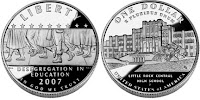 On May 4, the Mint announced that it will begin to take orders for the Little Rock Central High School Desegregation 50th Anniversary Silver Dollars on May 15, starting at noon. This coin commemorates the historical significance of the desegregation of Little Rock Central High School following the landmark 1954 Brown v. Board of Education decision by the US Supreme Court. For more about this coin, read my article “Little Rock Central High Commem Design.”
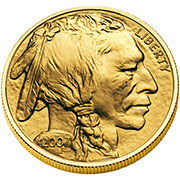 The Mint quietly dropped the discussion of producing fractional American Buffalo 24-karat Gold Coins and extended the potential release date until June. It is suspected that the Mint may require congress to pass necessary legislation in order to authorize the production fractional Buffalo coins, although this has not been confirmed by the Mint. Uncirculated 2007 Buffalo coins can be purchased from dealers and on the secondary market.
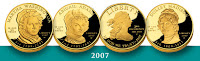 Earlier this month, the Mint advertised that they would sell the First Spouse gold coins by the set at $1,675.95. But the Mint announced this week that they will begin to sell First Spouse gold coins individually started at noon on June 19, 2007 for the Martha Washington and Abigail Adams coins. Jefferson’s Liberty coin will be for sale on August 16 and the Dolley Madison coin on November 15. No set will be offered. Individual coins will sell for $429.95 as proof coins and $410.95 as uncirculated coins.
The Mint also announced that the Citizens Coinage Advisory Committee (CCAC) will meet Tuesday, May 15, at the Philadelphia Downtown Marriott Hotel at 9 A.M. On the agenda is the design of the Congressional Gold Medal to honor the Dalai Lama as well as the proposed design for the 2008 American Bald Eagle Commemorative Coins.
Time to go take some pictures so I have some fun stuff to talk about.
All images from the US Mint.
May 4, 2007 | gold, RCM, US Mint
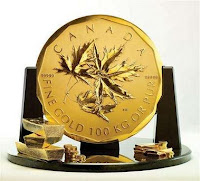 The Royal Canadian Mint announced they will be issuing a very large gold coin with a C$1 million denomination. At 100 kilograms (3215 troy ounces) and 53 centimeters (21 inches) it is the largest legal tender coin in existence. It will be made of .99999 pure gold making this coin the purest gold coin on the market. The obverse of the coin will feature Queen Elizabeth II with the reverse will feature a “new, elegant maple leaf design.”
As part of this project, RCM announced they will be producing a more affordable one troy ounce coin that will be 30 mm and made from .99999 pure gold. This coin will have a face value of C$200. RCM has not released the final pricing for these coins.
It is an ambitious project for RCM. Gold this pure can be difficult to strike because of the softness of the metals. Pricing will be an interesting issue. At today’s 4:00 PM New York gold price of $686.90, the 3215 troy ounce coin contains $2,228,990.50 in the value of the metal. I am guessing that RCM may charge $3 million for this coin.
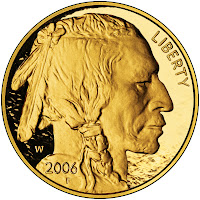 RCM could price the new one troy ounce coin more competitively with the market. Their nearest competitor will be the US Mint’s American Gold Buffalo, which is one avoirdupois (regular) ounce of .9999 pure gold making the RCM coin lighter than the Gold Buffalo (1 troy ounce = 1.0971 ounces). RCM may price their coin competitively with the Gold Buffalo—which the US Mint announced will it will charge $850 for a 2007 proof coin. Bullion sales appear to average $75-100 over the spot price of gold.
It is an interesting publicity gimmick for the RCM. I would be surprised if they sold more than a dozen of the C$1 million coins.
Canadian coin image from the Royal Canadian Mint
American Gold Buffalo image from the US Mint
Apr 25, 2007 | Eagles, gold, US Mint
Building on the success of last year’s program, the US Mint announced that the uncirculated 2007-W American Eagle Gold coins will go on sale April 27, 2007. These uncirculated coins minted in West Point for collectors will be struck on specially burnished planchets to give them a satin-like finish. Each coin will be encapsulated in a plastic capsule and come with a Certificate of Authenticity from the US Mint.
These coins can be ordered from the Mint via the phone (800-USA-MINT) or from their online catalog in one-ounce ($749.95), half-ounce ($379.95), quarter-ounce ($195.95), and tenth-ounce ($89.95) varieties. Also available is the American Eagle Gold Uncirculated Four-Coin Set for $1,379.95. The prices represent more than a 4-percent increase over last year to account for the rising cost of gold. The Mint charges $4.95 for standard shipping.
Apr 25, 2007 | coins, state quarters, US Mint
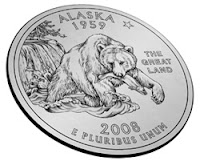 Alaska Governor Sarah Palin unveiled the design for the quarter that would represent Alaska as part of the 50 State Quarters® program. The design will feature a bear wading in a stream with a salmon in its mouth and the caption “The Great Land.” An addition design element is the star that will appear to the right of the state name acknowledging Alaska’s place as our northern most state.
Governor Palin will forward the design to the US Mint for inclusion in the program. Once called Seward’s Folley for Secretary of State William H. Seward Jr., who promoted the purchase in 1867. Alaska was seen as a frozen waste and too far from the mainland of the United States. Later, the abundance of natural resources, including petroleum, redeemed Seward from eternal scorn. Alaska entered the union in 1959 as the 49th state. Its quarter is scheduled to be issued during the summer of 2008.
Coin image from the Alaska Commemorative Coin Commission.
Apr 17, 2007 | coin design, legal, US Mint
The U.S. Mint announced that they have set the final rule to limit the exportation and melting, or treatment the cent nickel coins in order “to safeguard against a potential shortage of these coins in circulation.”
Basics have not changed from the interim rule (and press release): melting of one-cent and five-cent coins is prohibited; individuals may carry $5 of coins out of the country; and dealers may ship up to $100 of numismatic coins out of the country. The civil fine will remain at $10,000 per incident, incarceration of up to 5 years in a federal prison, or both. Details are published in the Federal Register [PDF]



 Loading ...