Jul 16, 2008 | coins, dollar, legislative, US Mint
I am back, feeling better, and ready to look what has happened in the world of numismatics. Two items of interest are the National Parks Quarter Bill and the availability of the Presidential Dollar Uncirculated Set.
Last week, the House of Representatives, passed H. R. 6184, America’s Beautiful National Parks Quarter Dollar Coin Act of 2008, with a 419-0 vote. If the bill passes the Senate and is signed by the President, it will give us 11 more years of changing quarters. There are some interesting tidbits in the report from the Congressional Budget Office. I will write about this report in a few days.
The US Mint announced that the Presidential $1 Coin Uncirculated Set will be available on July 24, 2008. The set will cost $15.95 and contain coins from both Philadelphia and Denver with coins honoring James Monroe, John Quincy Adams, Andrew Jackson, and Martin Van Buren. Coins will be encased in a blister-type package so that the edge lettering can be seen with biographical sketches about each president. I think I’ll pass on this one for the entire uncirculated set.
Thank you to those who have remained subscribed to the RSS or email feed. More good stuff is to follow!
Jul 5, 2008 | coins, errors, US Mint
Now that we have seen the fireworks and enjoyed our barbecues, it is time to add a numismatic touch to the celebration. This one is a new purchase of a 1976 Type 2 Eisenhower Dollar with an error at the US Mint.
Struck in 1975 and 1976, the dollar, Kennedy Half-Dollar, and Washington Quarter were minted with the dual date 1776-1976 and commemorative reverses designed by Dennis Williams to honor the nation’s bicentennial. In 1975, the lettering on the Eisenhower Dollars had a bolder reverse that did not strike well. For 1976, the dies were changed and the letters were thinned giving us the Type 2 variety.
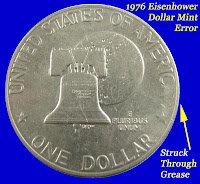 Thirty-two years later, I purchased a 1976 Type 2 dollar with an error from the US Mint. The dollar in the image on the right, you can see the lettering in “AMERICA” disappearing. The star after the word is also missing. This error is called strike through grease filled dies.
Strike through grease errors are relatively common and only add a small premium to the value of the coin. They occur during the Minting process when Mint employees apply a thin layer of grease on the dies to prevent the newly struck coins from sticking to the die after being hit with more than 40 tons of pressure. When the grease is not applied evenly, it creates a buildup. Those areas where the grease is applied too thickly prevents raised elements from striking properly.
This is not a commentary on the US Mint or the Independence Day celebration. Just something neat I found to add to the patriotic definition of the day. Enjoy your weekend and I hope you find something neat in coins, too.
Jul 1, 2008 | coins, gold, US Mint
While checking the US Mint’s Public Release RSS Feed, there was an announcement for the coming sale of the American Buffalo fractional coins. However, the press release pointed to by the feed does not exist. There is no listing for these coins in the online catalog and the product release schedule does not announce a date for their release.
The information in the RSS feed was as follows:
Washington – The United States Mint announced today that it will begin accepting orders for fractional denominations of the American Buffalo Coin, now available in proof and uncirculated versions, on July 15, at 12 noon Eastern Time. Both versions of the coin will be offered in four sizes – one ounce, one-half ounce, one-quarter ounce and one-tenth ounce, as well as a four-coin set which contains one coin in each size.
I am looking forward to see how the Mint treats the fractional Buffalo coins. Let’s see what happens over the next few days regarding this pseudo announcement.
Jun 27, 2008 | ANA, coins, gold, US Mint
Another reason to attend the World’s Fair of Money® at the end of July in Baltimore is to be there for the unveiling of the 2009 Ultra High Relief Double Eagle Gold Coin.
The US Mint announced that US Mint Director Ed Moy will participate in the show’s opening ceremony and then officially open the Mint exhibit that will feature the one ounce gold coin that will go on sale in 2009.
The coin&rsqou;s design will be a high-relief $20 gold piece on a double-thick, 24-karat gold planchet (sometimes called a piefort) 27 millimeters in diameter. The design will feature Augustus Saint-Gaudens original 1907 design where the date will be in roman numerals (MMIX). The inspiration for this coin came from 1907 when the Mint tried to strike an experimental double eagle using two stacked $10 eagle planchets. When it was realized that congress would have to approve the striking of the coin for circulation, the project was abandoned and the test pieces were melted.
Aside from the date, the only difference between the 1907 test pieces and the 2009 bullion issue is that the the motto “In God We Trust” will be added over the rising sun as it appeared in 1908.
Jun 19, 2008 | CCAC, CFA, coin design, coins, dollar, US Mint
Simcha Kuritzky, Treasurer of the Montgomery County Coin Club and past president of the Maryland State Numismatic Association, attended the June 18, 2008 meeting of the Citizen Coinage Advisory Committee. The agenda was to review the possible reverses for the Native American $1 Coins.
Simcha reported that for the 2009 reverse, the CCAC chose the design representing the three sisters: maize, beans, and squash, which are grown together. As required by law (Public Law 110-82 [PDF]), the date will be removed from the obverse and placed on the edge so that all circulating dollar coins will have edge lettering.
There were three reverses that had substantial support: a woman planting seeds with three corn plants in the background; three woman’s faces with the respective plants intertwined in their hair; and three sets of plants with a shining sun. The first and last designs had the most support from Native American groups. The main arguments at the meeting were over the novelty of design: the three faces design was a fresh approach and some members wanted greater artistic vision, while others were concerned that most people wouldn’t understand the design. The woman planting design had support because it showed agriculture (as opposed to nature) and women’s roles in the native economy, but the plants were small and may not show up well on the actual coin.
The designs and CCAC recommendation will be submitted to the U.S. Commission of Fine Arts for their opinion. The Director of the US Mint as proxy for the Secretary of the Treasury will make the final decision.
Jun 19, 2008 | US Mint
On May 21, I reported that the US Mint hired Andrew D. Burnhart as Deputy Director. I had noted that prior to this job, Mr. Burnhart was General Manager for the Washington Suburban Sanitary Commission (WSSC), a community owned utility providing water and sewer services to the Maryland’s suburbs of Washington, DC.
WSSC has been in the news this week following a major water main break on Sunday, June 15. The rupture of a 48-inch main in a remote area of Montgomery County caused a significant portion of the WSSC service area to be on usage restrictions until this evening. The sale of bottled water has skyrocketed over the last few days.
WSSC has blamed an aging infrastructure. But this 48-inch water main was put into service in 1969 and the county has older water mains that have been recently inspected was deemed safe. Further, inspection and warning systems put into place to notify the WSSC and the public of problems failed.
In a radio interview, Montgomery County Executive Isiah “Ike” Leggett told reporters that the county had discussed making improvements to the system over the last five years while economic times have been better. WSSC had resisted discussions with Leggett, then Montgomery County Council President, to create a strategic plan to upgrade the system. Rather, WSSC officials continue to prevent Montgomery County from auditing the utility. Although Leggett did not mention names, he was clear that the issue rested directly with the reluctance of the WSSC General Manager.
Why am I discussing this in a coin collectors blog? Because the person responsible for keeping the system up to date and working, pipes inspected, and make recommendation to the governments who own WSSC was Andrew D. Burnhart, now Deputy Director of the US Mint.
“His expertise in organizational change will help the United States Mint achieve its strategic goals and become a more results-oriented organization,” reads the Mint’s press release announcing Burnhart’s hiring.
WSSC has underperformed financially. WSSC will not let their books be audited by one of the counties that own the utility. And WSSC’s performance during a water main break—which they should expect to happen at some point—shows that this hire by the US Mint may be a result of the spoils system and not one of competence.
I hope this does not negatively effect the Mint in the future.
Jun 14, 2008 | coins, US Mint
After nearly six months of searching, I found a 2008-P Jefferson Nickel in pocket change. I noticed the shinier-than-usual nickel in the pile that was removed from my pocket on Thursday, June 12. Not including State Quarters, this is the latest I have seen circulating coins for any year.
The slow economy is also slowing coin production. Numismatic News is reporting that even the production of Presidential Dollars are slower than the equivalent time period after the introduction of the Sacagawea Dollar. Although the US Mint does not provide monthly production figures, the total mintage figures for 2008 through May is less than one-third of the 2007 totals.
Hopefully, I will find a penny and dime soon.
Jun 13, 2008 | coins, legislative, quarter, US Mint
In a grand announcement, Rep. Mike Castle (R-DE) announced that he introduced H.R. 6184, America’s Beautiful National Parks Quarter Dollar Coin Act of 2008 that would change the reverse of the quarter dollar coins to be “emblematic of a national park or other historic site in each State, the District of Columbia, and each territory of the United States.”
Castle, who authored the 50 State Commemorative Coin Act, noted that the program will make more than $6.2 billion in revenue, which will be $3.7 billion more than non-state quarters.
Note to Rep. Castle: ENOUGH!
We know that the 50 State Quarter program was a success. Aside from the income, it helped introduce more people to collecting. The process brought good designs and bad designs. It introduced the coin making process to the public while allowing the states to create designs to allow them show off. After the states are completed, the District of Columbia and territories are get their turns next year.
During that time, we celebrated the Westward Journey by redesigning the nickel and started honoring our past presidents with a one dollar coin. Next year, we honor Abraham Lincoln with four different Lincoln Cents reverses and a special 2009-S VDB collectible. Even the reverse of the Sacagawea Dollar will undergo a change to honor Native American heritage.
Note to Rep. Castle: ENOUGH!
These programs have been nice. But maybe it is time for a break.
The Presidential Dollar program has waned, mainly because the coins are not circulating. Coins are not circulating because there is a perception that the paper Federal Reserve Note is easier to deal with. But it is known that congress will not change the law to end the one dollar note until the Bureau of Engraving and Printing can make up for the lost production. One way to do that is to print currency for other countries.
Note to Rep. Castle: what about helping BEP find foreign customers so that they are not relying on the printing of $1 FRN? Why not provide the environment so that BEP can bring in new business? Can you help the BEP do what it takes to print the polymer notes that many foreign countries are demanding?
Are you doing what is right or are you looking for a few dollars? Is there a call for this series or are you looking for a few dollars? Are you afraid that there may be some fatigue in this idea, or are you looking for a few dollars?
There seems to be a “collectors’ fatigue” with the number of offerings from the US Mint. It is time to give the collecting community a small break and allow congress to fix some of the other issues that fact the Mint.
Jun 10, 2008 | Eagles, legal, legislative, US Mint
We have been in for a wild time here in the Washington, DC area. Severe thunderstorms and high winds swept through the area on Wednesday and Saturday providing the electric companies with quite a bit of work to do. During that time, I am reminded once again that computers cannot function without electricity.
While the rest of us were sweating and fixing our homes, the US Mint and Treasury policy implementers were downtown trying to figure out how to throttle the sale of silver on the open market. In fact, the Mint has been slowing the sale of American Silver Eagle bullion coins since April.
According to a letter sent to authorized bullion purchasers, the Mint has experienced “unprecedented demand” for silver bullion coins. While the demand for silver has risen, the Mint’s supply has not been able to keep up with the demand. So the Mint will be increasing production at the expense of collector American Eagles and while limiting the sales to bullion dealers.
Although sale of silver bullion has surpassed expectations, expectations by the US Mint should have been higher. With the economy waning, it should not surprise the Department of the Treasury that people would hedge their money against inflation through the purchase of precious metals. This is one of the oldest strategies in investing. Yet, the Mint all but admits to being caught short by this. Why?
Many have commented on the Mint’s shortsightedness while others argue that the Mint is acting illegally. I think it is mired in politics.
Since the seating of the 110th Congress, there has been a subtle show of acrimony between the Mint and the new congressional majority. US Mint Director Edmund Moy has made it clear that he thinks the Mint should have the power to determine the content and design of US coins. The House of Representatives responded by introducing H.R. 3956 that would give this power to the US Mint.
After H.R. 3956 was introduced, fellow members and watchdog groups question whether the bill would be constitutional since it will pass off to the executive branch the power “To coin Money, regulate the Value thereof…” (Article I, Section 8). To fix these issues, H.R. 5512. In H.R. 5512, congress would continue to determine the composition and design of coins while the Mint would become advisors.
When the bill passed the House, Moy was quick to disagree with H.R. 5512 by suggesting that the Mint should have more control over the composition and design of the coins. He also requested that the bill be changed to provide more time to implement the requirement for copper-colored steel cents. The current bill requires the change to occur in 90 days. Moy said that the conversion would require 18-24 months.
There may be more to this than just one bill. Following the passage of the Native American $1 Coin Act, the Mint thought they had a loophole that would prevent them from minting Sacagawea Dollars in 2008. Letters were exchanged between Congress and the Department of the Treasury explained the law that was passed and said that the Mint should strike Sacagawea Dollars immediately. Sources report that contentious discussions suggested that the Director would be in violation of the law if the Mint did not strike Sacagawea Dollars. Allegedly, this conversation occurred two weeks before the availability of 2008 Sacagawea Dollars.
Moy again by proposing the Mint strike 2009 Double Eagle Gold $20 ultra-high relief coin based on 1907-1908 design by Augustus Saint-Gaudens. When introduced to the Citizens Coinage Advisory Committee, Moy stated that 31 U.S.C. § 5112(i)(4)(C), the authorization of the American Eagle program, gave the Mint the authorization to strike these coins. Congress disagrees because everything about the coin, from composition to design, is not codified in the law. Rather than argue with the Director, both the House and Senate introduced appropriate legislation to authorize this coin.
Now, when the Mint was questioned on the distribution problems with silver, the Mint responded with a brief statement that said in part, “By law, the United States Mint’s American Eagle silver bullion coins must meet exacting specifications and must be composed of newly mined silver acquired from domestic sources.” (emphasis added) The problem is 31 U.S.C. § 5112(e) and 31 U.S.C. § 5112(f), the laws that authorizes the bullion program does not say that the coins must be made of newly mined silver. In fact, the law does not require that the silver be purchased from US-based mines. All it requires is that the silver used be purchased at market value and the bullion sold at a value based on the silver market.
It appears that Director Moy is using a pedantic reading of the law to make his point. Rather than working with congress to resolve these issue, Moy would rather use politics to make his point hoping citizens would complain to congress. Sources say that Rep. Luis Gutierrez (D-IL) has emphatically told both Moy and Treasury Secretary Henry Paulson to resolve the situation. Rep. Gutierrez is Chairman of the Domestic and International Monetary Policy, Trade and Technology Subcommittee which has oversight responsibility over the Mint.
Individually, these policy moves by Director Edmund Moy do not seem significant. Together, they represent a pattern that shows the Director is looking to increase his power over the Mint. Moy needs to remember that he is the boss of the manufacturing operation charged with the responsibility to strike coins as prescribed by the 535 member Board of Directors (congress) and approved by the Chief Executive Officer (president). Moy’s actions are insolent and should be the subject of disciplinary actions by the Board of Directors.
May 23, 2008 | commemorative, dollar, US Mint
Following the Civil War, many communities set aside one day to honor those who lost their life in this nation’s worst war. As time went on, many of the celebrations were merged into one Decoration Day. The first day proclaimed as “Memorial Day” was in 1862. Decoration Day was recognized as a federal holiday beginning in 1868 but was not celebrated in the south. Many southern states celebrated Confederate Memorial Day on different dates.
Memorial Day was not widely recognized until after World War II.
Memorial Day was traditionally celebrated on May 30. When the Uniform Holidays Bill (sometimes referred to as the “Monday Holliday Act”) came into effect in 1971, Memorial Day was moved to the last Monday in May.
With overseas wars on two fronts and remembering all of the past conflicts, I would like to take this opportunity to honor the memory of all who gave the ultimate sacrifice for the country. I recognize that without their sacrifice I would not have the freedom to write this blog.
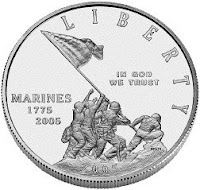
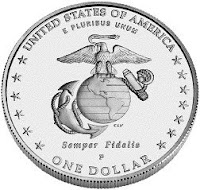 To honor their service, I re-introduce the 2005 Marine Corps 230th Anniversary Commemorative Silver Dollar. The obverse features the National Marine Corps War Memorial (sometimes referred to as the “Iwo Jima Memorial&rdquo) and the reverse has the Marine Corps emblem. This powerful design allowed the US Mint to capture the 2007 Coin of the Year Award.
Between now and Monday, please make sure that you take at least one moment to remember those brave men and women.
Images courtesy of the US Mint.



 Loading ...