
Those Cheap Silver Eagles Are A Chinese SCAM!

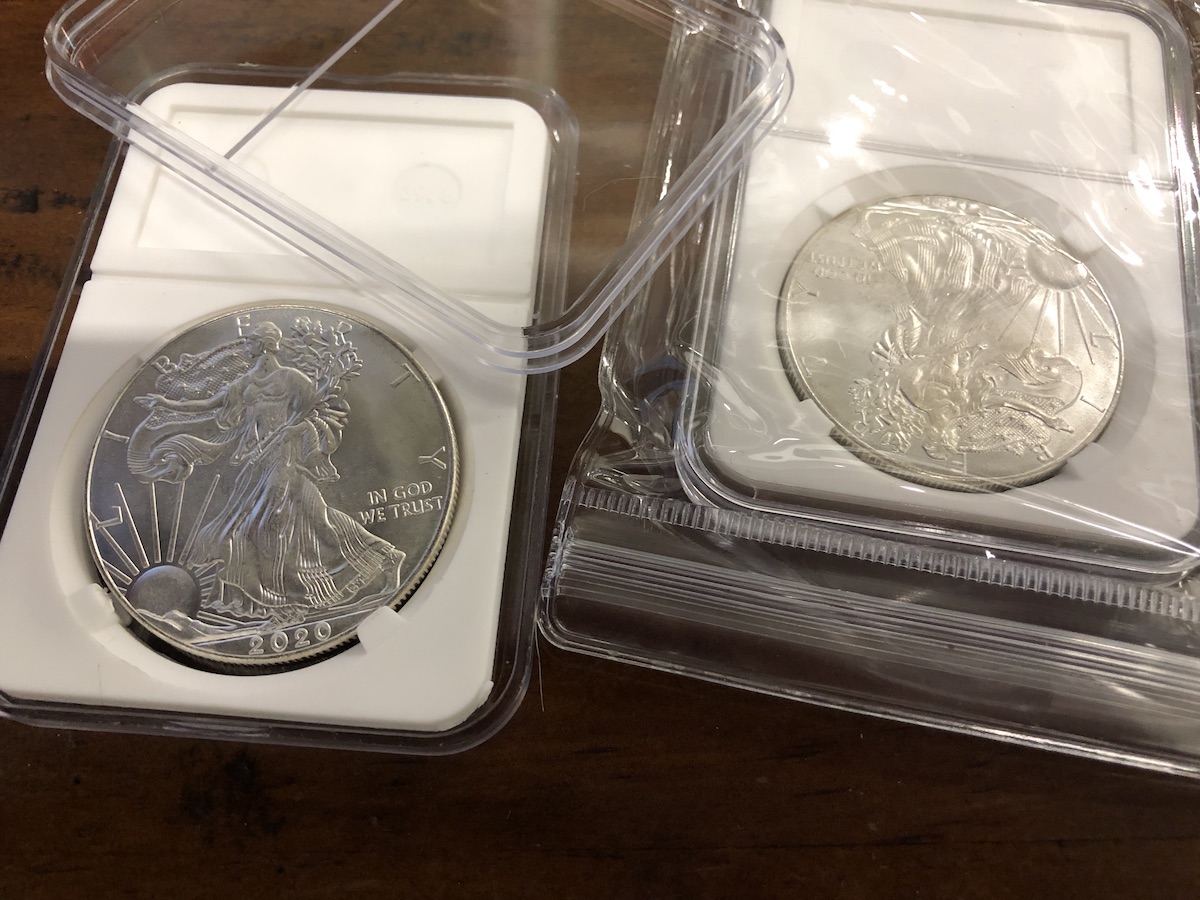
Two counterfeit American Silver Eagles purchased from LIACOO, a company based in China.
- The scammers are in Shenzen, China
- It may be more than one person behind the scam, but they are working together.
- There appears to be a pocket of these scammers in the Middle East. Early analysis suggests they are in Doha, Qatar.
- All email addresses are either on Gmail or use Google’s professional services that allow Gmail to look like a real domain.
- Any of these sites that have a U.S.-based telephone number are using burner phones. For those not familiar with the term, a burner phone is one on a pay-as-you-go plan. The phones are cheap, easily disposed of, and are difficult to trace.
- Any of these sites that use a U.S.-based physical address use a dropbox service from a logistics company. The dropbox service is a locker that the company pays as a way to manage shipping remotely. There are legitimate uses for these dropbox services, but these scammers use them to make it look like they are located in the United States.
- The scammers are using branded gift cards to pay for these services.
While investigating these sites, I learned that there are five tips that, if followed, you will avoid being scammed.
- NO LEGITIMATE DEALER IS SELLING BULLION COINS FOR BELOW THE SPOT PRICE!
The current price of silver is $23.43 per troy ounce. If anyone is selling American Silver Eagles for less, they are likely trying to sell counterfeit coins. - IF THE DEAL IS TOO GOOD TO BE TRUE, IT LIKELY IS NOT A GOOD DEAL!
When purchasing bullion and coins from dealers, the price between the spot price and the price the dealer will sell the coins for is called the spread. The spread can change based on inventory, availability, and other market forces. It is rare when the spread is less than 5-percent. Some of the largest dealers will lower their spread for their better customers or as a special to lure other customers. A good deal is when the spread is less than 5-percent. However, the spread is rarely less than 2-percent. If a legitimate dealer sells metals for less than 2-percent over the spot price, that is a good deal. These companies are not in business to lose money. Be very worried if someone is trying to sell bullion coins for less. - IF THE DEALER DOES NOT IDENTIFY THEMSELVES ON THEIR WEBSITE, THEY ARE LIKELY HIDING SOMETHING.
On every website that is likely selling counterfeit coins, they have a wonderfully written “About Us” page that says nothing. The Of the four websites that readers have sent to ask if they were legitimate, all of the “About Us” pages were copies. A web search using sample passages from the page yielded thousands of results. - IF THE CONTACT PAGE DOES NOT HAVE LEGITIMATE CONTACT INFORMATION, THEY ARE LIKELY HIDING SOMETHING.
One of the indicators of a site owned by Chinese scammers is if they give you hours in HKT or Hong Kong Time. These scammers are not in Hong Kong but are in Shenzen, which is in the same time zone. - IF THE SITE IS “POWERED BY SHOPLAZZA,” IT IS LIKELY A SCAMMER SITE.
Go to the bottom of any page. If there is a copyright statement followed by “Powered by Shoplazza,” then run away. Shoplazza is a newly created service out of China that seems to be a Shopify clone made by reading Shopify’s HTML. While looking at the HTML code, there are indications that the site was created quickly. During a quick look at three sites highly suspected of selling counterfeit American Silver Eagle coins, I was able to confirm that their sites are hosted on Shoplazza.
Since my first post about these Chinese scammers, I have received at least five notes per week saying they bought ten coins from these websites. Everyone that received the coins and was able to weigh them found they weigh only 25 grams. A real American Silver Eagle coin should weigh 31.103 grams.
Yes, I bought two coins from one of the sites, but I did so for educational purposes. I suspected that these would be counterfeit, and I wanted the coins to learn more about them. I believe they are silver plated. As for what is under the silver plate, I have to wait until I can visit a dealer with one of those devices that can analyze coins.
Please do not buy from them.
-
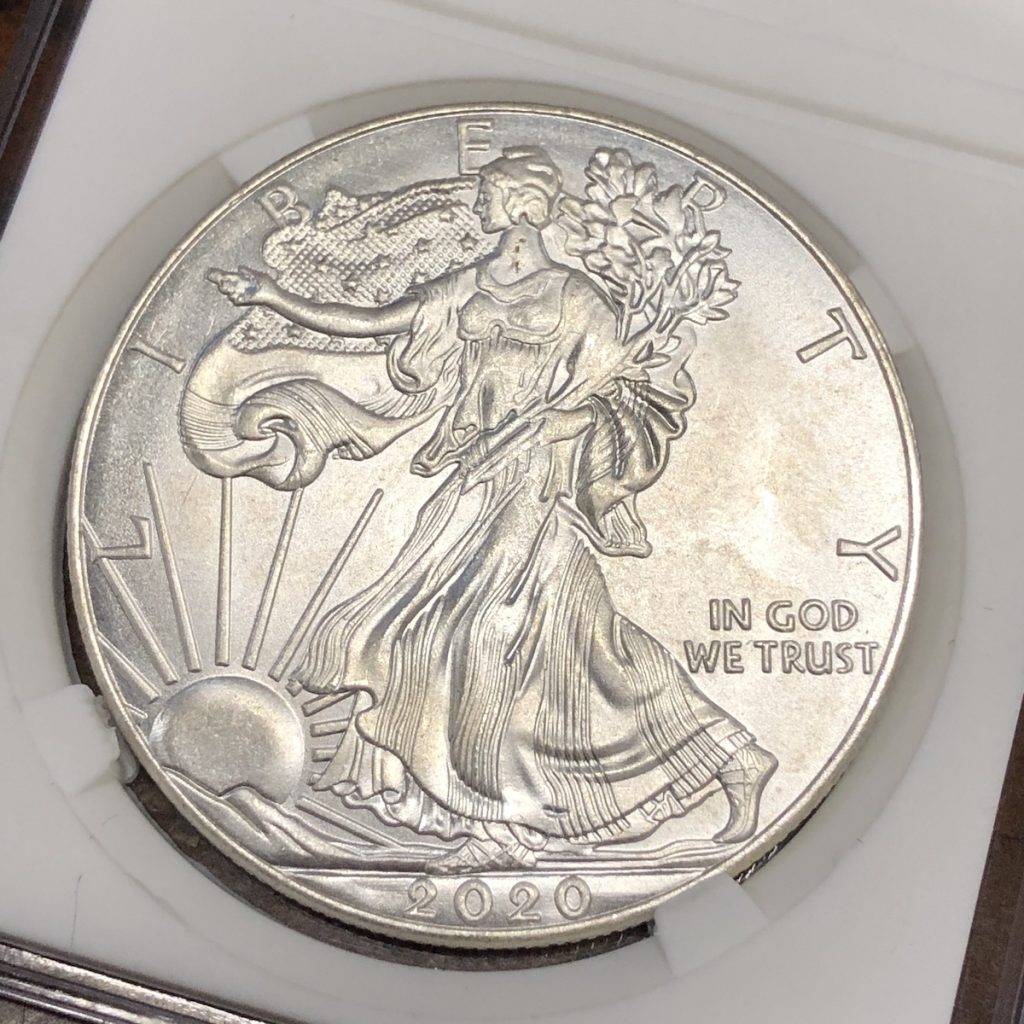
- The font for LIBERTY is too thin. Also, the stars in her flag draped over the shoulder are too small.
-
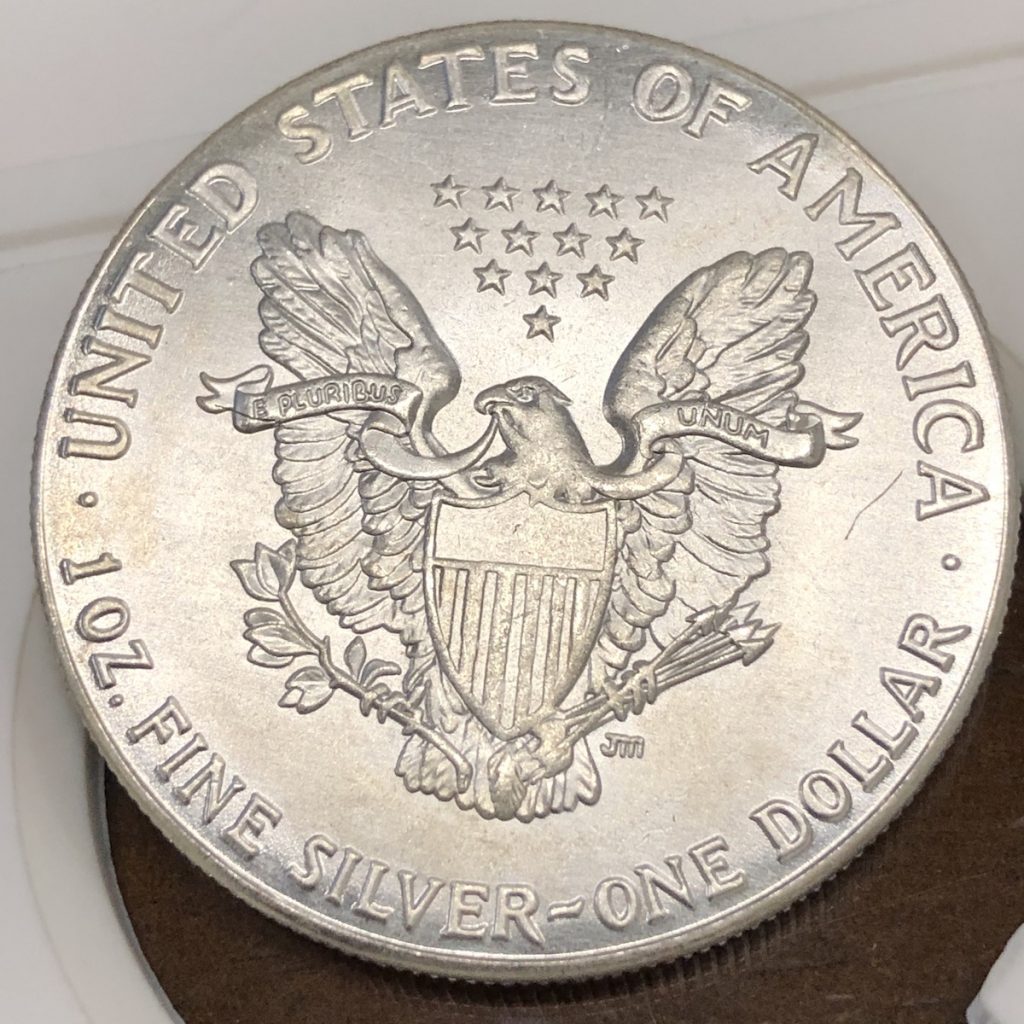
- Aside from the rims being to thin, look at the U in United and the dash between SILVER and ONE. These are not correct for the 2020 ASE.

Philadelphia Mint Tour Open
The new visitor lobby at the Philadelphia Mint
Eleven members of the media were invited to see the new tour area, access to the Mint floor, Mint employees, and other areas of the Mint not accessible by the public.
Tom Jurkowsky, Director of Public Affairs, was sure to point out that the project was, “on time and on budget.”
Finally, the Philadelphia Mint held an opening ceremony to 250 invited guests and Mint employees. Speaking at the ceremony included Associate Mint Director Dick Peterson and Treasurer of the United States Rosie Rios. The ribbon was cut by Rios flanked by Peterson and Jurkowsky.
You can download the brochure A Handbook to the Self-Guided Tour of the United States Mint [PDF] from the U.S. Mint’s website.
The U.S. Mint recently provided a video about the opening of the new tour area. You can watch it here:
Anyone attending the World’s Fair of Money next week in Philadelphia may want to consider taking the new tour and adding your comment about it here!
New for Currency Collectors
Although my collection consists mostly of coins, I have been branching out into some areas of currency. Other than collecting Israeli currency, I am not sure what direction I want to go. Since 2007, the Bureau of Engraving and Printing has issued a yearly $2 Single Note Collection where each folder has a $2 note from each of the Federal Reserve branches and the serial number begins with the year, allowing for only 10,000 collectibles per Fed branch (YYYY0000-YYYY9999). This year, the Single Note is just being issued for the Federal Reserve Band of Kansas City. This is not good for someone who has only purchased the notes from the New York Fed.
This year represents the sesquicentennial of the Bureau of Engraving and Printing. Formed as a result of the National Currency Act, the Department of the Treasury opened the National Currency Bureau in a basement office of the Treasury Building on August 29, 1862 to cut and manage the fractional currency that was being printed for the government. With the passage of the National Bank Act of 1863 centralizing currency production with the federal government, the office became its own bureau with a mission to print currency and other security documents. The name was changed a few times before it was settled on the Bureau of Engraving and Printing.
The U.S. Mint and the BEP have combined to sell the Making American History Coin and Currency Set to celebrate the 150th anniversary of the BEP and 220th Anniversary of the U.S. Mint. The set will contain a 2012-S American Silver Eagle Proof coin and a Series 2009 $5 note from the Federal Reserve Bank of San Francisco with a “unique serial number” that begins with “150.”
Sales of the set will be handled by the U.S. Mint and scheduled to begin on August 7, 2012, at 12:00 Noon. Sets will cost $72.95 with no purchase or production limits announced. Considering that the serial number is eight digits long, the de facto limit will probably be 100,000 sets.
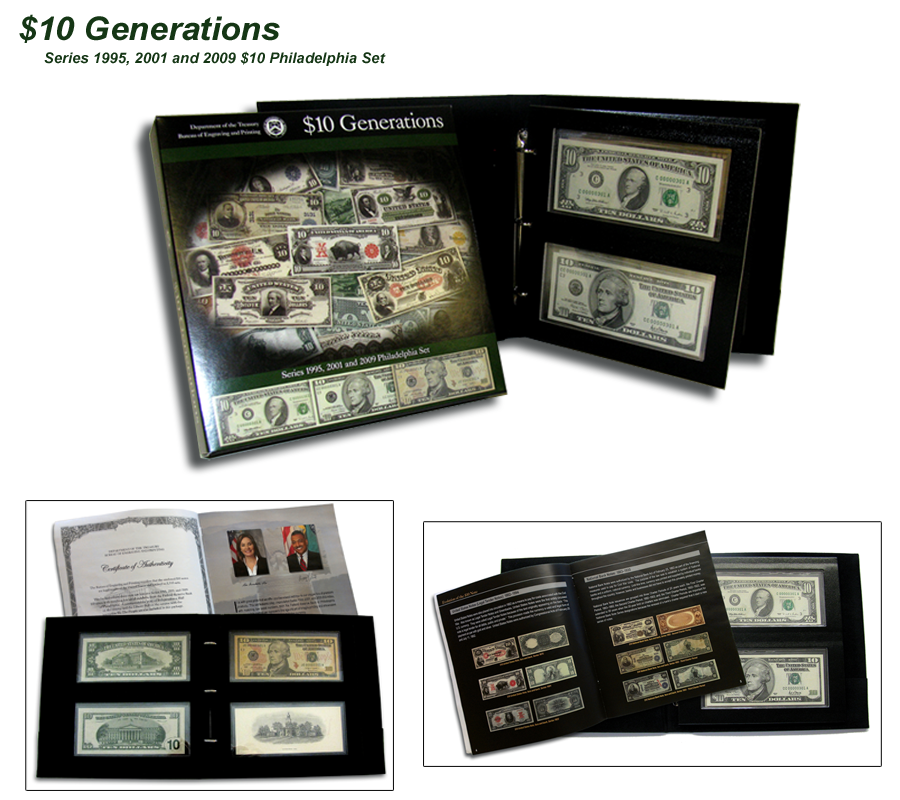
Limited edition, three-note set features Series 1995, 2001 and 2009 $10 notes, with matching low serial numbers, from the Federal Reserve Bank of Philadelphia.
BEP began printing the small-sized notes starting in 1928 with the Series 1929 notes. Since then, the basic designs had note changed until the re-design effort that began in 1996. The $1 Federal Reserve Note continues to use the design similar to that first circulated in 1929.
The set will be in a leatherette binder with the notes stored in acid-free polymer sleeve. Included in the set will be a commemorative print of Independence Hall with the Liberty Bell and “We the People” on the reverse. It will also include a booklet about the history of the $10 note since 1861.
Sales will begin on August 7, 2012. There will be a limit of 3,333 set priced at $149.95, $135 for purchasing ten or more with a 25 set purchase limit the first week.
Since August 7 is the first day of the World’s Fair of Money in Philadelphia, I wonder if the U.S. Mint and the Bureau of Engraving and Printing will have sets there for sale?
Significant Legislation Effecting Numismatics
There has been a lot of legislation passed by Congress that affects the coin and currency production in the United States. While some of it has been as mundane as changing the composition of coins or the approval of a commemorative coin, there are some that has had a significant impact on coin and currency production. Here is a list of those laws that had a major impact.
- Coinage Act of 1792
- The first coin-related law passed by congress and signed by President George Washington on April 2, 1792, establishes a mint, says that congress is the regulating authority of coins, and establishes the dollar as the unit of money. It made the United States one of the first countries to use a decimal system for currency and established legal tender laws. It is the foundation for the creation of the money production in the United States.
- Act of April 10, 1806
- This act regulates the legal tender value of foreign coins used in the United States.
- Act of April 21, 1806
- This act establishes the penalty for counterfeiting coins to be between three and five years of hard labor. Although there was no law regarding counterfeiting coins before this act, it was assumed that penalty was death because of the statements printed on colonial currency.
- Coinage Act of 1834
- This act changed the ratio of silver-to-gold weight from 15:1 that was established in the Coinage Act of 1792 to 16:1, setting the price of an ounce of gold to $20.67. This was done to strengthen the financial system after the Panic of 1833 and stem the tide of paper currency in favor of “hard money.” President Andrew Jackson signed this bill into law on June 27, 1834.
- Coinage Act of 1849
- Signed into law by President James K. Polk as one of his last acts as president on March 3, 1849, it established the use of gold for a $1 coin and the $20 gold double eagle coin. This act also refined the variances that were permissible for United States gold coinage. This act came largely because of the California Gold Rush.
- Coinage Act of 1857
- Signed into law by President Franklin Pierce February 21, 1857, this act repealed the legal tender status for foreign coins in the United States. It required the Treasury to exchange foreign coins at a market rate set by Treasury. This act discontinued the half-cent and reduced the size of the one-cent coin from 27mm (large cent) to the modern size of 19.05mm (small cent) that is still being used today.
- National Bank Act of 1863
- Originally known as the National Currency Act and signed into law by President Abraham Lincoln on February 25, 1863, it created a single currency standard for the United States where the notes would be backed by the United States Treasury and printed by the federal government. The result of this act lead to the establishment of the National Currency Bureau which was later rename to the Bureau of Engraving and Printing.
- Coinage Act of 1864
- This act changed the composition of the one-cent coin to bronze (0.95 copper, 0.05 tin and zinc) from 0.88 copper and 0.12 nickel. It authorized the minting of the two-cent coins with the motto “In God We Trust” to appear the first time on a United States coin. President Abraham Lincoln signed this act into law on April 22, 1864.
- Coinage Act of 1873
- Sometimes referred to as the “Crime of ’73,” demonetized silver and set the standard for gold as the backing of the national currency. This act placed the U.S. Mint under the jurisdiction of the Department of the Treasury and officially established four branch mints at Philadelphia, San Francisco, Carson City, and Denver. Two assay offices were established in New York and Boise City, Idaho. The act also ended the production of the half-dime, silver three-cent piece, and two-cent coin. President Ulysses S. Grant signed this act on February 12, 1873.
- Bland-Allison Act
- Named for Rep. Richard P Bland (D-MO) and Sen. William B. Allison (R-IA), the act required the Treasury Department to buy silver from western mines and put them into circulation as silver dollars. The act authorized the striking of the Morgan Dollar. President Rutherford B. Hayes vetoed the bill but congress overrode his veto on February 28, 1873.
- Sherman Silver Purchase Act
- Signed into law by President Benjamin Harrison on July 14, 1890 and named for Sen. John Sherman (R-OH), the law increased the amount of silver the government was required to purchase from western silver mines.
- Federal Reserve Act of 1913
- President Woodrow Wilson signed the Federal Reserve Act into law on December 23, 1913 that allowed the creation of the Federal Reserve System as the central bank of the United States. It also granted the Federal Reserve authority to issue Federal Reserve Notes and Federal Reserve Banknotes.
- Pittman Act
- Named for Sen. Key Pittman (D-NV) and signed into law by President Woodrow Wilson on April 23, 1918 authorized the conversion of up to 350 million silver dollars into bullion for sale or to be used to strike subsidiary coinage. The act required the government to buy all silver mined in the United States at a fixed price of $1 per ounce above market rate.
- Gold Reserve Act of 1934
- Even though Franklin D. Roosevelt as part of Executive Order 6102 ordered the withdrawal of gold from the economy on April 5, 1933, there was one challenge and one reissue of the executive order. Congress felt that the executive order needed codification and passed this act on January 30, 1934. Roosevelt signed the law the same day. The law withdrew all gold and gold certificates from circulation and outlawed most private possession of gold with the exception of some jewelry and collector coins. This act established the nominal price of gold to $35 per troy ounce.
- Public Law 84-851 (70 Stat. 732, H.J.Res. 396)
- On July 30, 1956, this law established the national motto of the United States to be “In God We Trust.” While the motto appeared on most coins of the time, the Bureau of Engraving and Printing phased it in on currency between 1957 and 1965.
- Coinage Act of 1965
- In response to the coin shortages caused by the rising silver prices, the act eliminated silver from circulating dimes, and quarters while reducing the amount of silver used to strike half-dollars from 90-percent to 40-percent for five years. After five years, the half-dollar would be struck using the same copper-nickel clad composition as the lower denominations. The act forbade the striking of silver dollars for five year ending an experiment with the striking of Peace Dollars in 1964. Finally, the act made all coins and currency produced in the United States and certain bank issues as legal tender–which reversed the 1876 demonetization of the Trade Dollar. Signed into law on July 23, 1965 by President Lyndon B. Johnson, it is seen as the dividing line between “classic” and “modern” coinage.
- Hobby Protection Act or 1973
- Signed into law by President Richard Nixon on November 29, 1973, this act requires that replica collectibles, including coins, be marked “plainly and permanently” with the word “COPY” to indicate that the item is not genuine. This act grants the Federal Trade Commission permission to take action against suppliers who violate this act.
- Statue of Liberty-Ellis Island Commemorative Coin Act—Title II: Liberty Coins
- Signed by President Ronald Reagan on July 9, 1985, Title II of this act allowed for the U.S. Mint to establish the American Eagle Silver Bullion Program.
- Gold Bullion Coin Act of 1985
- A few months after the passage of the act to allow for silver bullion coins, this act was enacted on December 17, 1985 that lead to the establishment of the American Eagle Gold Bullion Program.
- 50 States Commemorative Coin Program Act
- Considered one of the most significant act affecting circulating coinage since the Coinage Act of 1965, this act lead to the very successful 50 State Quarters Program. Section 4 of the act, named the “United States $1 Coin Act of 1997” changed the composition of the one dollar coin to be “golden in color” which lead to the creation of the Sacagawea “Golden” Dollar. President Bill Clinton signed this bill into law on December 1, 1997.
Help The Fight Against Fakes
Maybe you have seen them or have heard about them, but counterfeit coins primarily from China is a problem in the numismatic industry. But collectible coins are not the only problem. Great Britain has been having problems since the issue of new £1 coins entering circulation starting in 2010. Even though arrests have been made, there remains an undetermined amount of counterfeit coins in circulation.
Recently, counterfeiters were arrested in Greece and Turkey for producing fake 2 Euro coins. These counterfeits look very similar to the standard 2 Euro coin with the standard Greece reverse. A real 2 Euro coin is a bi-metalic coin that does not separate. The counterfeits will separate and are lighter than the real version.
Canada recently made a move to prevent counterfeiting of their new $1 (Loonie) and $2 (Toonie) coins. New Loonies and Toonies produced by the Royal Canadian Mint will have micro-engraved images of a maple leaf and a virtual image using an angled design. The RCM hopes these fine details added to the Loonie and Toonie will prevent them from being counterfeited.

Source: Uploaded by user via CoinsBlog on Pinterest
While the United States does not have a problem with counterfeit circulating coins yet, it is a problem for collectible coins. Why counterfeit a quarter when you can make more money counterfeiting a Morgan or Trade dollar by selling it online to unsuspecting online buyers?
The problem perpetuates itself when the buyer looks to cover the money spent turns around and tries to resell the coin. Some people will purposely buy better counterfeit coins that will begin to fool dealers and try to resell them in the United States using a U.S. address to try to give the coin an air of credibility.
Currently, the Hobby Protection Act (15 U.S.C. §§2101-2106 and 16 CFR 304) does not allow for enough protection for the buyer. Aside from requiring the word “COPY” to appear on a copy, it does not allow for buyers or the government to take action against resellers, only the manufactuers.
When the Hobby Protection Act was first enacted in 1973 and updated in 1988, the online world did not exist the way it does today. It was easier to trace the manufacturers and the overseas sellers than the distribution channels are today. By the time a counterfeit coin reaches the United States, it could have been bought and purchased several times before being noticed. Then there is no remedy for those who have been duped.
Another problem is that the counterfeiters are learning to counterfeit slabs. Both NGC and PCGS have seen their slabs counterfeited or altered holding counterfeit coins. Both NGC and PCGS have the same problems with trying to protect their brands against counterfeiters.
A significant step forward would be to update the Hobby Protection Act!
Last month, H.R. 5977, the Collectible Coin Protection Act was introduced in the House of Representatives by Representatives Lamar Smith (R-TX) and Fred Upton (R-MI). Since then, Representatives Pete Sessions (R-TX), Henry Waxman (D-CA), and Bill Cassidy (R-LA) has signed on as co-sponsors.
The introduction of the bill is the result of the work of the Industry Council for Tangible Assets (ICTA) and Gold and Silver Political Action Committee (GSPAC), and the numismatic community working with key representatives to craft an effective legislation. It is also written to ensure support from congress. Benefits of the new law are as follows:
- Include the distribution and sale of items not properly marked as being a COPY
- Expands the provisions to include “any person who provides substantial assistance or support to any manufacturer, importer, or seller” who knowingly engages in any act or practice that violates the Act;
- Expands the ability for those who were sold counterfeit items to include the counterfeiter, their agent in the United States, or anyone who knowing “transacts business” in violation of this Act;
- Extend trademark violations and remedies to help third-party certification services protect against counterfeit holders.
These new provisions will allow collectors, dealers, and grading services to bring legal actions that are much more effective, with much stronger remedies than previously existed. It will allow those harmed to work with the Justice Department to bring criminal actions, where apporpriate.
WE NEED YOUR HELP
The only way to ensure that H.R. 5977 becomes law, especially since we are approaching the end of this session in an election year, is to contact your member of congress will let them know that the numismatic community supports this Act and that their support is important.
To contact your representatives, visit house.gov and enter your Zip Code at the top right of the page. When you contact your representative, you should mention that H.R. 5977 is revenue neutral and will not require additional appropriations. The bill will go a long way in combating counterfeit rare coins in the marketplace, saving collectors and investors millions of dollars in fraudulent transactions.
DISCLAIMER; I am working as Political Coordinator for the Gold and Silver PAC.
Images courtesy of the Gold and Silver PAC.
New Feature: U.S. Coin and Currency Production
 Continuing my research into numismatic topics and some writing I am doing, I had created a information page for all of the United States federal government agencies, departments, and commissions, that are involved in the production of coins & currency. Rather than search all over the web for this information, here it is one one place.
To see the fruits of my labor, click on the top tab that says “U.S. Coin & Currency Production.” There you will find a snapshot of the information about the U.S. Mint, Bureau of Engraving and Printing, Federal Reserve Board, Commission of Fine Arts, Citizens Coinage Advisory Committee, and the Department of the Treasury including where they are located and tour information.
If you find any errors or omissions, please feel free to contact me with the updated information.
Support the Coin Collectors Blog
 Buy me a coffee
Thank you for your support!
Let Me Know What You Think
Are you going to the World's Fair of Money
Total Voters: 17
 Loading ...