
Weekly World Numismatic News for July 12, 2020
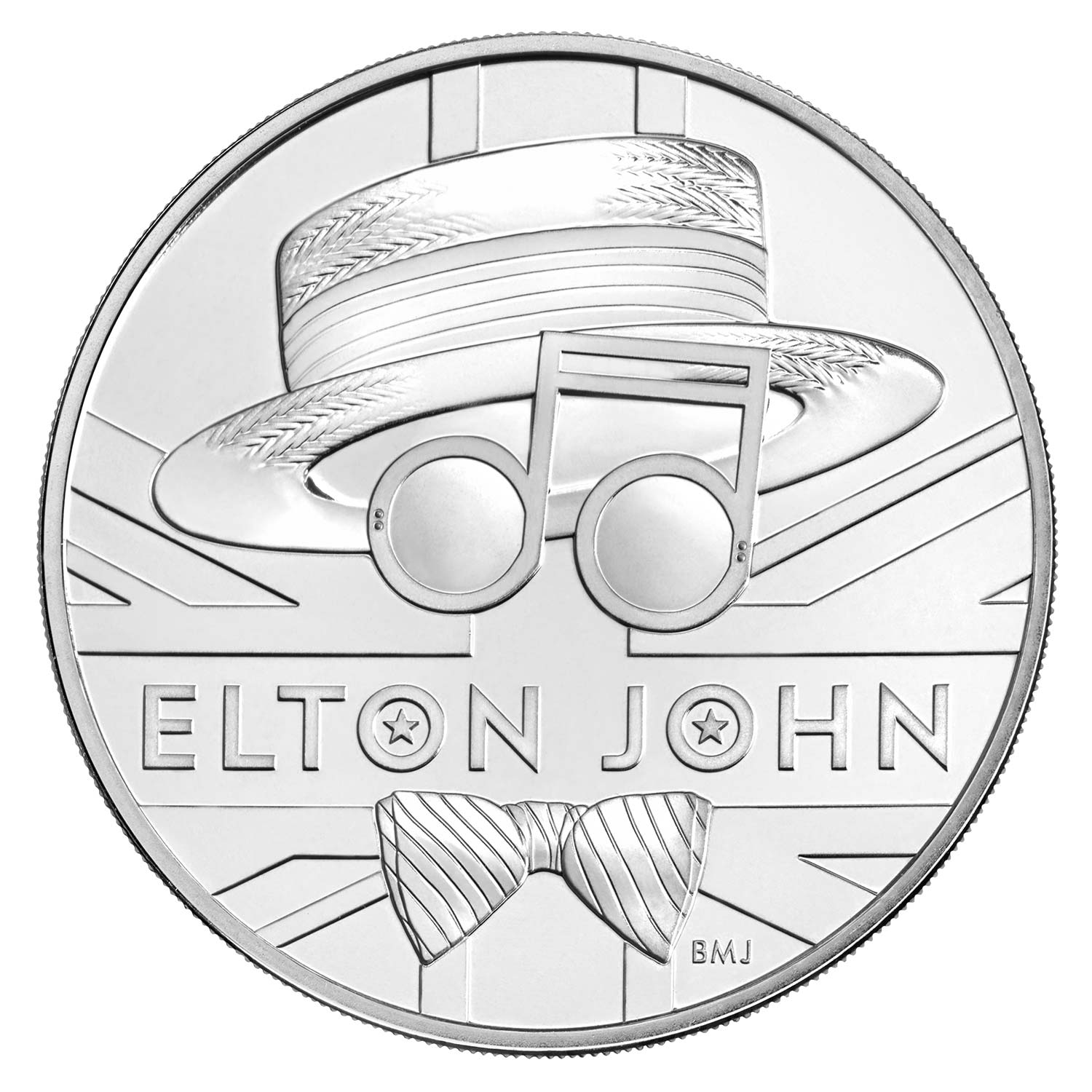
Reverse of the 2020 Elton John Uncirculated Coin (Courtesy of the Royal Mint)
Coins are available from the Royal Mint in gold, silver, and uncirculated. Uncirculated coins come in a special folder honoring Elton John.
There will be those that will complain that these coins hurt the hobby. To borrow a term from our British friends: RUBBISH! If these coins bring people into the hobby, then they are great.
What is bad for the hobby is buying surplus coins from the U.S. Mint and calling it a hoard! For years, the U.S. Mint has been selling off its excess inventory or melting precious metals. This time, someone bought them, sent them to be slabbed, and would jack up the prices under the guise of something special. When the buyer goes to sell them and finds out that they are not worth what they paid, that will have people running away from the hobby. It is similar to the overpriced crap sold on television during the 50 State Quarters program.
Even GovMint.com is getting into the junk selling hype. They have been on satellite radio hawking the emergency production bullion coins struck at Philadelphia after COVID-19 temporarily closed the West Point Mint. Their ad for “P-Mint designated” coins touts them as something special. They are not unique or rare, as the commercial insinuates. Bullion coins are struck at Philadelphia. The difference is that there was a way to determine which mint struck these coins.
What is more damaging to the hobby, selling over-priced bullion or common leftover coins or non-circulating legal tender (NCLT) coins with themes that some old-timers do not seem to like?
Here, let me make some of you upset. I visited the website for the Royal Mint and found something that I will add to my collection:
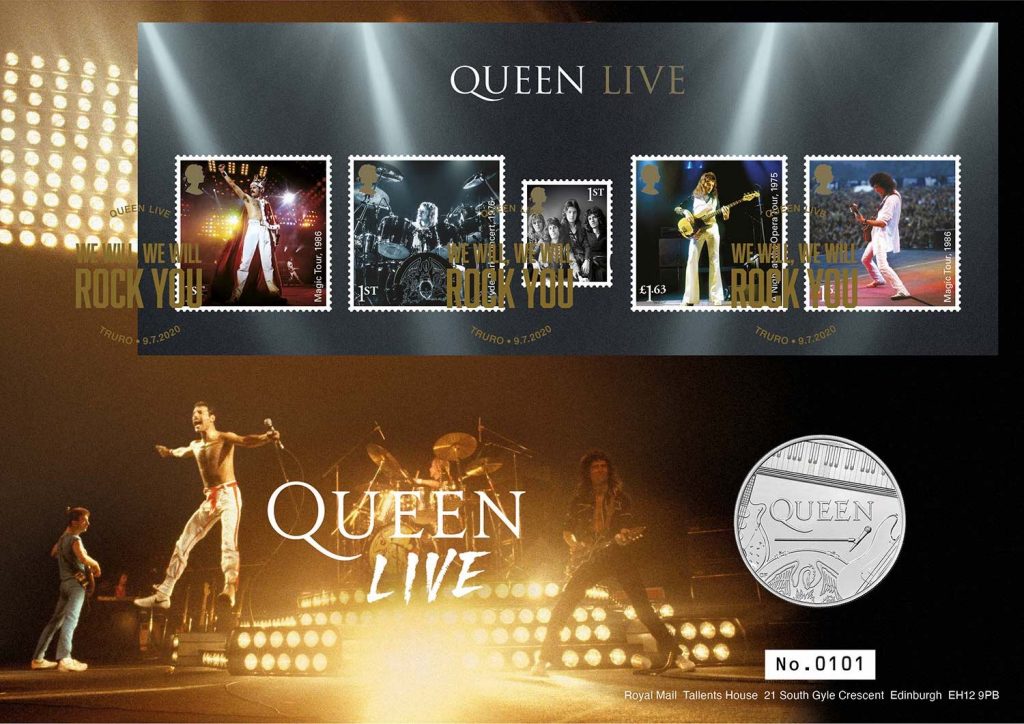
Queen Coin Cover is created in cooperation with the Royal Mint and Royal Mail (Image courtesy of the Royal Mint).
If that makes you upset, then you need to rethink your attitude on the hobby!
And now the news…
 July 2, 2020
 → Read more at deseret.com
July 6, 2020 → Read more at crozetgazette.com
July 7, 2020 → Read more at gazette-news.co.uk
July 8, 2020 → Read more at bbc.com
July 8, 2020 → Read more at juneauempire.com
July 10, 2020 → Read more at providencejournal.com
July 10, 2020 → Read more at snopes.com
→ Read more at deseret.com
July 6, 2020 → Read more at crozetgazette.com
July 7, 2020 → Read more at gazette-news.co.uk
July 8, 2020 → Read more at bbc.com
July 8, 2020 → Read more at juneauempire.com
July 10, 2020 → Read more at providencejournal.com
July 10, 2020 → Read more at snopes.com
John Albanese Sells Out Ordinary Collectors
When I wrote “eBay to ANACS and ICG: You Lose!” it was based on the release eBay provided to sellers. This was not the complete story as reported by CoinNews.
According to the release published by CoinNews, eBay worked with John Albanese to develop the standards that will be used for graded coins. Albanese is the founder of the Certified Acceptance Corporation, a third-party grading verification service, and Numismatic Consumer Alliance, which calls itself a numismatic protection corporation. Albanese is one the the original founders of Numismatic Guarantee Corporation, one of the leading third-party grading services.
On the surface it may look like a good idea to work with someone of Albanese’s alleged stature to set these standards. However, if you look at Albanese’s business interests, Albanese is not working for the ordinary collector.
The standards eBay is adopting are almost aligned with the submission policies of the CAC which Albanese is president. The difference is that modern coins (coins struck after 1964) and bullion coins graded by the acceptable third-party grading services can be listed as graded. Any other coin is considered a raw coin and cannot be listed or described as graded. While a picture of the coin in the holder is allowed, the listed cannot name the grading service or the numerical grade.
I have never met John Albanese and have been told that he is respected by those who know him. I do not know him and only know of his current efforts with the CAC. The CAC is a company owned by high end dealers who had complaints with the work of the grading companies. While a verification service is good, the CAC and its partners are working hand-in-hand to buy, sell, and trade these coins which, in essence, drives up the prices of the coins.
It is part of the CAC business model only to accept coins graded by NGC and PCGS for evaluation. It is part of the CAC business model not to accept modern coins with the exception of certain Lincoln Cent errors. And up until the last year, collectors could only submit coins through CAC affiliated dealers. The business model skews to higher-end coins with the partners creating their own trading market based on the CAC opinion.
Let’s look at the business model of the CAC using a different market. A stock broker buys a series of loan interests he wants to valuate based on a criteria held by those who are not happy with the current valuation services. Rather than look at everything, they start with a series of loan shares whose valuation are certified by certain services because they have a biased opinion against other services. They evaluate shares, put their seal of approval on it, bundle them and trade them amongst themselves create a new market that is currently not existent. Once these shares are traded in this closed market, their value is set then traded to the public. If this sounds like the derivatives market that crashed the economy in 2008, you would be correct. It also parallels the rise of the CAC and its creation of an artificial market.
If the CAC was working as an independent organization without its market-making activities, there would be nothing wrong with what it is doing. However, its market-making activities leaves open questions about its objectivity.
In the securities business, there are laws against artificially building up the price of a stock and then selling them for profit. It is called “pump-and-dump.” Those not in the securities business cannot collude to artificially fix or advance prices, as the airlines have been accused of doing. This is a potential violation of the antitrust laws of the United States. Specifically, it can be alleged that their practices are violations of the provisions of The Clayton Act. The purpose of The Clayton Act is to protect against price discrimination by using influence over markets using exclusive dealing agreements and tying arrangements. Recent cases involving antitrust applies the law to the manipulation of markets to create exclusivity.
Rather than find a better solution to cover the entire market, eBay spoke with someone who has an economic stake in the market for which eBay is trying to regulate. Thus, the new rules adopted by eBay is an attempt to influence the market and create a tying arrangement to manipulate the market to the business model and agenda supported by Albanese, the CAC, and its investors.
Coin collecting is more than the market promoted by Albanese and the CAC. Ebay, Albanese, the CAC, and those who support the CAC do not think in the context of the average collector. I am amongst the average collector. I am the one who sees ICG holders signed by the artist of the New York State Quarter and has to add it to his specialized collection of New York items. If I decide to divest this collection, I would not be able to mention anywhere in the listing the grading service or the numerical grade assigned by ICG. While I can include a picture, I would have to create a listing that would border on being fraudulent for not being able to disclose the actual details of what I was selling.
I am for sensible guidelines that would be inclusive of the ordinary collector as well as protection for those buying higher end coins. However, the route eBay has used to consult with someone who has a fiscal agenda in the market appears to be shaping the market into that agenda that will leave the rest of collecting community behind.
If you think that eBay has gone too far, I urge you to contact their customer support and express your opinion. I also call on the American Numismatic Association to step in on behalf of its member, not all are rare coin collectors, to work as an independent organization to protect the seller against an agenda-based policy. Finally, if you feel that this is the beginning of a restraint of trade violation by eBay, I urge you to file a complaint with the Federal Trade Commission and ask them to look into hampering the sale of legal collectibles.
eBay to ANACS and ICG: YOU LOSE!
This week, eBay sent a message to sellers who listed coins and currency for sale on the site to announce new listing policies for coins.
As coin collecting continues to grow and thrive on eBay, customers have told us time and again that knowing they can buy and sell with confidence is important. “We’ll be updating eBay’s Stamps, currency, and coins policy to help foster that confidence—this update may impact your coin listings,” read eBay’s note.
Starting May 30, all new listings and relistings in coin categories will need to meet the following requirements:
- First, listings for coins will be allowed to include a numeric grade in their listing title or item description only if the coin grading company meets certain objective standards.* Coins that haven’t been graded by these companies will be considered raw or ungraded. Currently, eBay has determined that only the Numismatic Guaranty Corporation (NGC) and the Professional Coin Grading Service (PCGS) meet these standards.
- Second, for US Coins only, grading by companies meeting these standards will now be required for all coins listed with a Buy It Now, reserve, or start price of $2,500 and above.
A footnote for the asterisked line says, “These standards will be posted on eBay’s website shortly.” The policy page has not been updated to explain the standards which the decision is based.
By this rule, coins certified by ANACS and ICG have now been reduced to second class status even though there may be nothing wrong with them. Nice coins still in old PCI holders with J.T. Stanton’s signature are also reduced to “irrelevancy” becuase of eBay’s undisclosed decision.
This is not the first time eBay has made arbitrary decisions about coin collecting based on questionable advice. In January, eBay banned the sale of replica coins where they said they worked in conjunction with the Professional Numismatic Guild to come up with a policy.
“We’ve heard from both buyers and sellers that they’d like to see more coins on eBay graded by companies who meet high standards,” read the eBay release. “These new requirements are an important step toward meeting these marketplace demands.”
As both a buyer and seller, I have never been asked.
By making this statement, eBay and not experts or the numismatic public is telling the marketplace that they know better. By making this statement, eBay will not allow me to search for or buy that old ANACS photo holder or the ICG graded error coin verified by CONECA because ANACS and ICG cannot be used in the title and description.
Rather than managing its market place, eBay has now turned themselves into an enforcement bureau making policies that could be considered a restraint of trade by telling independent sellers what they can or cannot sell that would be legal elsewhere.
Ebay has a right to limit the type of item sold on via its service. Ebay has extensive policies regarding prohibited and restricted items as well remedies for violating these policies. Now, eBay has branched out from prohibited and restricted items to practically banning LEGAL products because they do not meet arbitrary and capricious standard that they have yet to divulge.
Restraint of trade is a common law doctrine relating to the enforceability of contractual restrictions on freedom to conduct business. By eBay telling me and other sellers that we cannot properly list and sell any other coin but those encapsulated by PCGS or NGC is restricting my freedom to conduct business. Ebay will not let me sell or advertise the ICG graded error coins or the artist signed state quarters also slabbed by ICG. In other words, I would be restrained from appropriately advertising LEGAL inventory by contractually restricting my freedom to conduct business.
If there is an alternative to eBay for selling legal coins, I would like to know. The extra coins from the divesting of part of my collection will be listed there. Ebay is no longer a viable outlet to sell collectible coins.
PNG Defines Coin Doctoring
In a late press release on April 17, it was announced that after two years, the members of the Professional Numismatists Guild approved a three-point definition of “coin doctoring.”
“This is a complex issue, but we needed to have a concise definition to help combat the deliberative and unacceptable alteration of coins in an effort to deceive,” said PNG President Jeffrey Bernberg.
As the hobby has grown and the ability to sell coins have become easier, the problem of coin doctoring has been one of those issues simmering just below the industry’s radar. But as the prices of key and semi-key coins have risen, the temptation by some to cash in has caused coin doctoring to be a more significant issue.
“We’ve been working on this for over two years with Numismatic Guaranty Corporation and Professional Coin Grading Service as well as a committee of dealers and collectors to formulate an industry-acceptable definition,” said PNG Executive Director Robert Brueggeman.
According to PNG, coin doctoring refers to the alteration of any portion of a coin, when that process includes any of the following (emphasis added):
- Movement, addition to, or otherwise altering of metal, so that a coin appears to be in a better state of preservation, or more valuable than it otherwise would be. A few examples are plugging, whizzing, polishing, engraving, “lasering” and adding or removing mint marks.
- Addition of any substance to a coin so that it appears to be in a better state of preservation or more valuable than it otherwise would be. The use of solvents and/or commercially available dilute acids, such as Jeweluster, by qualified professionals is not considered coin doctoring.
- Intentional exposure of a coin to any chemicals, substances, or processes which impart toning, such that the coin appears to be in a better state of preservation or more valuable than it otherwise would be. Naturally occurring toning imparted during long-term storage using established/traditional methods, such as coin albums, rolls, flips, or envelopes, does not constitute coin doctoring.
While much of this makes sense in the current environment, there are some things that the collecting public must remember. First, not all doctored coins are an effort to deceive. One example are Buffalo Nickels that have been treated with a chemical to make the date readable. These “acid coins” are easy to detect since the chemical leaves a stain where used and, in the vast majority of cases, are advertised as being altered coins.
Another issue is that at one time coin doctoring was an accepted practice. People did not want ugly coins, so dealers would use various methods to polish he coins to make them look better. It was also common for some to use the same abrasive copper polish that was used to clean copper cookware to clean older copper coins to try to make the coins look mint red. Others embraced the natural oxidation of copper that turned them brown and coated them with lacquer to preserve its rich, dark color.
When blatant altering of the surface fell out of fashion, dipping the coins in chemicals to improve the surface continued, especially for copper coins. While not as easy to detect, it is possible to find better and semi-key Indian and Lincoln cents that were dipped a long time ago when the practice was acceptable. An experienced eye can tell if a coin was once dipped, but it is not easy. If you have any question, either ask that coin be graded by a third party or do not buy the coin.
One item that is objectionable is in the second definition where it says, “the use of solvents and/or commercially available dilute acids… by qualified professionals is not considered coin doctoring.” What this says is that if I have coins that have been contaminated with polyvinyl chloride (PVC) from being improperly stored, I cannot buy acetone to rid the coins of the damage. Rather, it appears that NGC has preserved the business of its sister company, Numismatic Conservation Service by saying only NCS can do the job and a vigilant collector is a coin doctor.
A collector who uses a dilute or neutral acid that does not alter surfaces like acetone to remove PVC, dirt, or other contaminants is not a coin doctor!
Toning is a controversial topic because toning is he result of the oxidation of the coin metal accelerated by environmental contaminants. Oxidation alters the irreversibly alters the surface of a coin. Usual causes of toning comes from storage using non-neutral materials. Since toning can give coins a pleasing or pretty look with many interesting colors, there are collectors who seek out toned coins.
Artificially toning a coin can be used to hide the work of doctored coins or make the coin more desirable. The problem is that there is no definitive way to tell the difference between artificial and natural toning. There are ways to tell the difference between deliberate attempts at toning, but there has been anecdotal evidence demonstrating that it is possible tone a coin that has fooled the grading services.
Now that we have he definition of coin doctoring, what do we do with it? While PNG can use this definition to police its own members, what happens to dealers who are not PNG members? Will PNG work with the American Numismatic Association to adopt similar ethics rules? If so, will ANA members be allowed in this conversation?
“It frankly took longer than some of us expected or wanted to get something substantive finally approved, but the overwhelmingly vote now by PNG members to support a specific coin doctoring definition is an important, major step for the hobby and the profession. It needed to be done,” said Brueggeman.
Maybe they should have waited longer and put out their definition for general comment before enthusiastically adapt a message with questions.
Saga of the Half-Cent
Since the Canadian government has proposed the elimination of their one-cent coin from production and putting in measures to remove them from circulation, proponents of a similar policy in the United States have been pointing northward and the past to support their position. When they point to the past, the target is the Half-Cent, established as part of the Coinage Act of 1792 and eliminated by the Coinage Act of 1857.
The common argument is that if the United States could eliminate an unpopular low-denomination coin in the 19th century, why can’t we do this in the 21st century?
In order to understand why that question is a non-sequitor, you have to look back at the history of the half-cent.
After the passage of the Constitution by the constitutional convention, Alexander Hamilton wrote extensively for both the Federalist Papers and spoke in many venues how the a strong, centrally managed currency would improve commerce between the new states and promote the nation as a whole in foreign trade. While this view was shared by others, how to implement a new currency system became controversial.
On January 28, 1791, Hamilton submitted the Secretary of the Treasury Report, “On the Establishment of a Mint” to the House of Representatives. Hamilton tied the value of the basic unit to the Spanish Milled Dollar (8 reales) and called the basic unit a “dollar.” In that report, Hamilton proposed a simple system of currency that included a ten and one dollar gold coins, one and one-tenth dollar silver coins, and one-hundredth and two-hundredth copper coins. Hamilton surmised that using smaller denominations would standardize production around a few coins that could be produced in sufficient numbers to supply commerce.
While mostly in agreement with Hamilton’s report, Thomas Jefferson had another idea. Jefferson thought it would be better to tie subsidiary coins tied to the actual usage of the 8 reales coin. At the time, rather than worry about subsidiary coinage, people would cut the coin into pieces. A milled dollar cut in half was a half-dollar. That half-dollar cut in half was a quarter-dollar and the quarter-dollar cut in half was called a bit.
The bit was the basic unit of commerce since prices were based on the bit. Of course this was not a perfect solution. It was difficult to cut the quarter-dollars in half with great consistency which created problems when the bit was too small, called a short bit. Sometimes, short bits were supplemented with English pennies that were allowed to circulate in the colonies.
As an aside, this is where the nickname “two bits” for a quarter came from.
Jefferson felt that in order to convert the people from bit economy to a decimal economy, the half-cent was necessary to have 12½ cents be used instead of a bit without causing problems during conversion from allowing foreign currency to circulate as legal tender until the new Mint can produce enough coinage for commerce.
Much against Hamilton’s wishes, congress agreed and made the half-cent along with the eagle, half-eagle, quarter eagle, silver (not gold) dollar, half-dollar, quarter-dollar, disme (later renamed dime), cent, and half-cent. After the bill was passed and signed by President George Washington on April 2, 1792, Washington decided to put the new Bureau of the Mint under the jurisdiction of Secretary of State Thomas Jefferson to ensure that the currency system would be implemented since Secretary of the Treasury Alexander Hamilton objected to these provisions of the law.
As the new Mint ramped up production, there were other issues with U.S. coinage that overshadowed any perceived controversy that the half-cent would have received. Over the next 60 years, laws were passed to change the composition of coins, ratio of gold-to-silver, and even the problem with melting that caused the suspension of producing the silver dollar in 1804.
The half-cent would come into focus in the 1850s when the cost to produce the United State’s copper coins was nearly double their face value. In 1856, the Mint produced the first of the small cents, the Flying Eagle small cent, and produced 700 samples to convince congress to change to the small cent. As part of the discussion was the elimination of foreign currency from circulation making the U.S. Mint the sole supplier of coins.
There is no record of outcry from the public on the elimination of the half-cent. Its elimination came four years after the Coinage Act of 1853 that created the one-dollar and double eagle gold coins in response to the discovery of gold in North Carolina, Georgia, and California. The gold rush caused a prosperity and inflation that not only made the half-cent irrelevant but not something on the public’s mint. In that light, the Mint and congress felt that it just outlived its usefulness and would not be necessary with the elimination of foreign currency from circulation.
More controversy was generated in 1857 over the demonetizing foreign coins in the United States than the elimination of the half-cent. While the half-cent continued to circulate, it was estimated that one-third of the coins being circulated were foreign, primarily reales from Mexico. Redemption programs did not go smoothly, but in the end foreign coins were taken out of the market and the American people adapted and it could be said we prospered.
Comparing the elimination of the half-cent in 1857 with the trying to eliminate the one-cent coin today is like saying one baseball player is better than another because he hits a lot of home runs. Just like there is more to consider than hitting home runs in baseball, there is more to the discussion than pointing to an event that happened 155 years ago without considering entire picture.
History of Women at the U.S. Mint & BEP
Originally released on March 30, 2012 and updated on April 12, the Department of the Treasury updated their video honoring the history of women working for the U.S. Mint and the Bureau of Engraving and Printing over its history. The video also honors the 220th Anniversary of the U.S. Mint and the 150th Anniversary of the BEP.
Introduced by Treasurer of the United States Rosie Rios, the video shows how both the U.S. Mint and the BEP have a history of providing opportunities for women since each agencies founding.
Considering that women were considered second class citizens in the 18th century, it is amazing to find out that within two years the U.S. Mint hired two women to be adjusters. When the BEP was founded in 1862, women were hired alongside men and held the majority of positions within four years. I do not think any other agency in the U.S. government has a similar recrod.
Support the Coin Collectors Blog
 Buy me a coffee
Thank you for your support!
Let Me Know What You Think
Are you going to the World's Fair of Money
Total Voters: 17
 Loading ...