
Buy Me A Coffee
 Some have noticed the new buttons on the Coin Collectors Blog for Buy Me A Coffee. Buy Me A Coffee is a service for content creators to earn a little money on their content. It is like Patreon but more flexible.
Rather than sell advertising that gets in the way, this is a way to crowdsourcing the funding that will help offset the rising cost of hosting the Coin Collectors Blog and new projects.
I am using Buy Me A Coffee like a tip jar. If you like what you read, hit the button and buy me a coffee. Have you been reading a while and want me to keep going? Hit the button and buy me a coffee.
Right now, I have two extras available through Buy Me A Coffee. Both are a small charge to help identify and give more information about your coin. For $5, I will help identify your U.S. coin, provide some background, and estimate its value. For $10, I will help with all other coins.
On my Contact page, there is an option to ask the questions through Buy Me A Coffee. But if you don’t want to pay, send a note anyway. I have been answering these questions for many years and will continue. After the answer, please consider Buying Me A Coffee.
Within the next week, I will make an e-book available through Buy Me A Coffee. Stay tuned for that announcement!
In the meantime:

U.S. Mint Announces New Dollar Sales Options
The U.S. Mint announced that they are creating four new numismatic product options for the Presidential $1 Coin program. For collectors, the U.S. Mint is adding a “Four Coin Set” for $9.95, a 100-coin bag for $111.95, 250-coin box for $275.95, and a 500-coin box for $550.95. The bulk options will cotton unmixed coins of each design.
All previous products will remain including the Presidential $1 Coin & First Spouse Medal Set, First Day Coin Covers, along with the proof and uncirculated sets. Also continuing are the coin rolls of the Presidential and Native American dollars.
The Presidential $1 Program continues on April 5 with the release of the coin honoring Chester A. Arthur, our 21st President.
Arthur’s wife, Ellen Lewis Herndon “Nell” Arthur, died from pneumonia in 1880. When Arthur became president after President James A. Garfield died on September 19, 1881 from the assassination attempt on July 2, 1881.
Although Arthur was a widower during his administration, the U.S. Mint will not be issuing an Arthur “Liberty” coin as part of the First Spouse Gold Coin Series. The Presidential $1 Coin Act of 2005 (Public Law 109-145 [Text] [PDF]) requires the U.S. Mint to issue a coin honoring Alice Paul, a leading suffragist who was born on January 11, 1885, during the Arthur administration.
The U.S. Mint has not announced when the Alice Paul Gold Coin will be available.
The public will not be able to order rolls of 2012 $1 coins from the banks since the Federal Reserve will not be taking delivery of new $1 coins. Orders to banks will be filled from existing storage consisting of $1 coins struck from 2007 through 2011. Since the U.S. Mint will be selling $1 coins for $1.11 as part of their bulk sales (bags and boxes), look for these coins to be priced $1.75 to $2.50 from dealers.
Appreciating Modern Coin Designs
What will they think of today’s coins
The “they” I am talking about are the collectors 50 and 100 years from now.
By that time, those of us who remember non-clad coins will be long gone or elderly. But what would our successors in this hobby say about us?
For the last few years, I have been putting together a set of Barber coinage to cover the 20th century. From the Liberty Head Nickel, to the Barber dimes, quarters, and half-dollars, these coins had an interesting sameness whose aesthetic roots appear to be from Victorian culture. Even the dollar designed by George Morgan had a similar look to those Barber coinage.
While there are fans of Charles Barber’s coin design, we tend to concentrate on Theodore Roosevelt’s “pet crime.” Roosevelt was not fond of Barber’s designs. In fact, he called the “atrociously hideous” and “conspired” with Augusts Saint-Gaudens to design coins that would be considered more artistic.
Judging the aesthetics of any coin design is subjective, but a closer and more objective look at Barber’s designs do have a lot of character for the time they were produced at the height of the Victorian era. When TR took office in October 1901, Queen Victoria had passed 9 months earlier and Roosevelt, whose was not a fan of Victorian Era designs, wanted something different.
Barber’s designs appear to be a victim of Roosevelt’s efforts rather than being a sign of its times. It has produced a general opinion that Barber was not a good artist or that his designs were lacking without considering the times in which he worked.
So how will today’s coins be thought of in the future?
The “modern era” of U.S. coinage started with the introduction of clad coins. This marked the end of silver circulating coinage with the exception of the half-dollar, which was silver-clad until 1970. Forty-eight years later, modern coinage does not have the same appeal to many collectors as its silver predecessors mainly because of the impression from older numismatist that these coins are not silver or copper. Some believe that the only excitement generated by clad-coinage in the last half of the 20th century were the bicentennial designs of 1975-1976.
Even though the 50 State Quarter program started in 1999, the 21st century has been the century of the circulating commemoratives. The introduction of the Sacagawea Dollar introduced a new dollar coin in an attempt to “fix” the problems caused by the Susan B. Anthony dollars (too much look a quarter) while new designs representing four states were issued each year. During that program, we were treated to the 2004-2006 Westwood Journey Nickel Program honoring the “Corps of Discovery Expedition” lead by Meriwether Lewis and William Clark to the far reaches of the Louisiana Purchase. There was also the Abraham Lincoln Bicentennial Cent Program honoring the 200th birthday of our 16th president. All have been seen as positive programs.
Then there are what some consider failures, such as the Presidential Dollar and Native American programs. These failures are not because of their designs but because they are based on the one dollar coin that does not circulate in the United States. In fact, most of the presidential portraits are well executed and the reverse designs of the Native American dollars are inspiring. But numismatists, collectors, and the public are more focused on the politics surrounding the use of dollar coins rather than the designs.
Similarly, the National Parks Quarters have not lived up the expectations that it would be as popular as the 50 State Quarters program. Some have even seen the program as jumping the shark on circulating commemoratives, but the designs have been very interesting and even well representative of the site which is being commemorated.
Again, how will today’s coins be thought of in the future?
As new, younger collectors enter the hobby, the stigma of clad versus silver coinage has waned since clad coinage is all these collectors know. They have seen world coins made of base metals dating back to times earlier than the United States change to clad coinage and do not wax nostalgic for “simpler times.” These are their simpler times!
While speaking with some younger collectors, many of whom started collecting state quarters, they like the new programs. State quarters have helped them learn about the states and some have said it helped them learn the history of the United States and its geography. Some like the Presidential Dollars not as circulating coins but as a collectible representing the democratic succession of peaceful leadership represented by the office. And they wish that the National Parks Quarters would see better circulation to add to the history behind the United States coins.
Looking at the short history of 21st century coinage, some might not believe it will be well thought of but the future numismatic leaders are more accepting of these coins meaning the future is bright. Older numismatists may not like what has been happening to U.S. coinage, but years down the road the future for their popularity seems bright, albeit without the values of pre-modern coinage because of the differences in metals used and their ample supply.
2012 Pocket Change
It was just an ordinary trip to run some errands. It was not a special shopping sprees except that it included essentials to get through the next week. After all, it was the weekend and I really wanted a little rest. I was not expecting to find anything remarkable.
In the first store, I was handed three very brilliant Lincoln Cents. I looked at the one on top and it was dated “2011.” Thinking that the establishment must have received a roll of 2011 cents from the bank, I dropped the coins in my pocket and went to my next stop.
After paying for my items at my second stop, I did not look at the coins as I dropped them into my pocket so I can get this trip over with.
One more stop before going to the grocery store. Grab some essentials, something nice for dinner, and then pay for my purchase so I can hurry home to put the perishables away. As I am handed the change, I noticed a very shiny Jefferson nickel. Since it was tails-up, I did not see the date.
That evening, I empty my pocket and place the coins on the top of my dresser. There they stayed until last night when I started to sift through my finds. When I looked at the three brilliant cents, I found the 2011 but the other two were dated 2012, making it the first 2012 coins found in 2012. This is the earliest I have found 2012 coins this early since the start of the current recession.
That shiny Jefferson nickel was dated 2012-D. Not only was it the first 2012 nickel of the year, but it is from Denver. Since the Washington, D.C. area receives its primary deliveries from the Philadelphia Mint, finding a D mintmark was an unexpected pleasure.
Recently, I have been finding quite a few quarters from the 1970s, but this time I found something different: an El Yunque National Forest quarter! While I have been finding quite a few 2010 quarters in change, I cannot recall finding any 2011 quarters and definitely not the latest release.
Also found in the change was a 1995 Canadian Cent, which at the current exchange rate is on par with the U.S. one cent coin.
There are still interesting finds in pocket change!
A Key Commemorative Launches at Fort McHenry
The following is the full version of the article that appeared in Numismatic News.
 Eighty-one years (and two days) after President Herbert Hoover signed he law that make “The Star-Spangled Banner” the United State’s official national anthem, the U.S. Mint and Maryland dignitaries came to Fort McHenry to launch the 2012 Star-Spangled Banner Commemorative Coin Program. The commemorative coins are designed to honor the role of the fort in the Battle of Baltimore and Francis Scott Key’s composing the poem after seeing the 15-star and 15-stripe flag still flying after an evening of bombardment by the British Royal Navy.
During the march to Baltimore after the British attack on Washington, D.C., the British took Dr. William Beanes as a prisoner for his role in capturing British stragglers and deserters. Beanes was imprisoned in Baltimore as the Royal Navy gathered forces for their attack on Fort McHenry in Baltimore Harbor.
Word of Beanes’s capture reached Francis Scott Key, an accomplished lawyer, prosecutor, poet, and friend of Dr. Beanes. Key, who was known as a skilled negotiator and a very temperate man, was asked by the Army to accompany prisoner exchange agent Colonel John Stuart Skinner to Baltimore to secure the release of Dr. Beanes. On September 7, 1814, Key and COL Skinner dined with British officers abroad the HMS Tonnant to negotiate the release of prisoners. Although Beanes was released, the British would not let the men leave the ship because they had heard about the British plans to attack Fort McHenry.
That night, Key, Skinner, and Beanes watched as the Royal Navy bombarded the fort and surrounding areas of Baltimore. As the smoke cleared on the morning of September 14, 1814, after 25-hours of bombardment, Key was able to see the U.S. flag still flying over Fort McHenry. Key was so moved by the sight that after returning home, he wrote the poem “The Defence of Fort McHenry.” The poem was published in the Baltimore Patriot on September 20, 1814.
When the poem was published, it was noted that it could be sung to the music of The Anacreontic Song, the official song of the Anacreontic Society. Shortly after publication, the music and words were published together by Thomas Carr and renamed the Star-Spangled Banner.
Tina Orcutt, Superintendent of the Fort McHenry National Memorial & Historic Shrine, led the attendees in the Pledge of Allegiance to open the launch ceremony. After her welcome message, Baltimore’s WBAL reporter Sarah Caldwell took over as master of ceremonies to introduce the dignitaries. Senator Ben Cardin spoke on how he helped push the bill through the senate with the chiding from Rep. C.A. “ Dutch” Ruppersberger who sponsored the original bill. Rep. John Sarbanes, whose district includes Fort McHenry, spoke next and Maryland Governor Martin O’Malley followed. The program concluded with a few words from U.S. Mint Chief Counsel Daniel Shaver to open the sale of the coins.
Waiting in line to purchase the silver proof coin following the ceremony was Melissa, a paramedic from Orlando who was in Baltimore for training. She was with her family visiting Fort McHenry not knowing about the launch ceremony. When asked about the ceremony, she said, “I thought it was very professional. It was awesome. It was moving very moving.” After purchasing the coin Melissa and her family toured the new Visitor Center before visiting the fort.
Richard Hughes came to the ceremony from Annapolis, the state capital for the launch. He was asked about the silver coin he was about to purchase and said, “I like it. It’s provocative. I think they did a good job.” Several people standing nearby in the line agreed.
Also attending was Shaun Butcher who came from Frederick, Maryland “to be one of the first to buy [the coin] when it was released,” noting Frederick was Francis Scott Key’s hometown. “I think the design is unique in terms of highlighting the War of 1812 and the Star Spangled Banner,” Butcher said. “We should be proud a Marylander wrote the National Anthem.”
Butcher is a member of the Frederick Arts Council and is an elected board member of the Frederick Tourism Council. He boasted how Frederick is part of the War of 1812 Bicentennial celebration organized by the state and that Frederick is planning an additional celebration to honor Key’s writing of the poem to take place in September 2014.
The 2012 Star-Spangled Banner Commemorative Coins are available as $5 gold coins and $1 silver. Both can be purchased as uncirculated or proof coins from the U.S. Mint. Surcharges collected from sales of these coins, $35 for the gold coin and $10 for the silver coin, will be paid to the Maryland War of 1812 Bicentennial Commission to support the celebration that will last through 2014.


Idaho Caucus Goers Flips Coins
While watching the Super Tuesday results, numismatists were treated to a new potential collectible: the Idaho Caucus Coin.
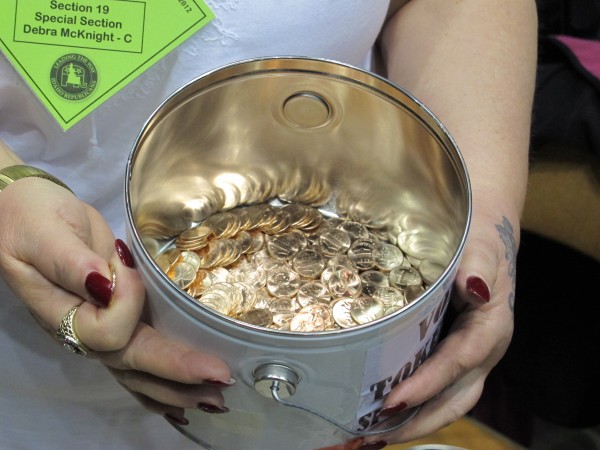 The Idaho Caucus Coin, part of a new process this year, was used during the caucus in Boise, Idaho. Caucus goers were given a specially made coin to drop it in a closed canister for the candidate of their choosing. When the voting ended, the coins were “counted” by weighing them. If the caucus judges felt that the weight was wrong, they could request the coins be counted. First they would be counted by machine and, if that was not satisfactory, the coins would be counted by hand. There have been no reports that counting was requested.
During the caucus, if no candidate received more than 50-percent of the coins, those receiving less than 10-percent were dropped from the next round or the candidate with the lowest total would be dropped. This process would continue until one candidate received more 50-percent of the coins.
During a live report on CNN, the reporter showed a specially made coin for the event that was copper in color. Although CNN did not focus on the coin, it looked similar in size to the U.S. One Cent coin. CNN did not comment on the composition or the design of the coin used.
A query has been sent to the Canyon County Republican Party asking about purchasing the coin. This post will be updated when someone provides information.
Image courtesy of Boise State Public Radio.
Support the Coin Collectors Blog
 Buy me a coffee
Thank you for your support!
Let Me Know What You Think
Are you going to the World's Fair of Money
Total Voters: 17
 Loading ...