
May 2020 Numismatic Legislation Review
 Days keep blending together as we try to survive major crises in this country. With the justified outrage over the killing of George Floyd, reports are coming out that coronavirus deaths are beginning to rise. Since the protests are largely attended by young people, it will change the narrative that the virus is particularly deadly to those older and to those with pre-existing conditions. Then again, many people do not know they have a pre-existing condition until it is triggered by something else.
Frontline health care professionals and others are fighting the disease and, in some cases, injuries that occurred during the protests. To celebrate these essential workers Rep. Jack Bergman (R-MI) introduced a commemorative coin program in their honor. Although the bill was introduced, the text has yet to be published. All we know is the title as submitted. It might be nice to honor the frontline workers, the likelihood of this type of bill passing is not good given the current political climate.
Unless the current circumstances change, it is unlikely any numismatic-related legislation will be acted on before the end-of-session cleanup votes in December.
H.R. 6923: To require the Secretary of the Treasury to mint coins in commemoration of the health care professionals, first responders, scientists, researchers, all essential workers, and individuals who provided care and services during the coronavirus pandemic.
Help Protect the Ancient Collecting Hobby
I received this in email and thought it was important enough to reprint here.
This message is being transmitted on behalf of the Ancient Coin Collectors Guild (ACCG) concerning an urgent matter that affects all collectors of ancient coins.
What is being asked of you is to take 5 minutes to write a comment to the State Department’s Cultural Property Advisory Committee via a website. Please submit your comment once by the deadline of November 2, 2011, 5pm EST.
Please consider sending this to any coin collector you know:
The US State Department is seeking public comment on a new request for import restrictions made on behalf of Bulgaria. To submit comments electronically to the State Department’s Cultural Property Advisory Committee (CPAC), go here: http://www.regulations.gov/#!submitComment;D=DOS-2011-0115-0001. For further details of the request, see http://exchanges.state.gov/heritage/whatsnew.html.
What is at issue? Despite President Obama’s efforts to foster government transparency, the State Department has not indicated whether coins are part of the request. Nonetheless, based on recent history, it is probable that import restrictions on coins will be proposed. As a practical matter, this means the State Department and US Customs may be considering restrictions on tribal coinages from Thrace, coins of Greek city states like Apollonia Pontica and Messembria, Roman provincial coins struck at Bulgarian mints, and even some Roman Imperial coins. It’s also possible that any restrictions will include later coins as well. Though details are few, the public summary the State Department has provided indicates that Bulgaria seeks import restrictions on objects from 7500 B.C. to the 19th c. AD. If restrictions are imposed on coins, many common types will likely become so difficult to import legally that they will become unavailable to most collectors.
Why bother? Large numbers of coin collectors have made their concerns known to CPAC. Recently, 70% of the comments CPAC received on an MOU with Greece were from concerned coin collectors. Even though recent extensions of import restrictions to certain Greek and Roman Republican coins from Italy and on coins from Cyprus despite the vast amount of public comment make it easy to become cynical, public comment can at least help moderate demands for import restrictions. For example, the archaeologists actively sought import restrictions on Roman coins as well during the discussions about the Italian MOU, but they remain exempted, and thus easy to obtain on the open market, likely due to the 2000 or so faxes CPAC received from concerned collectors.
What should I say? Tell the State Department and CPAC what you think about the bureaucracy’s efforts to deny you the ability to collect common ancient artifacts that are available worldwide. You might also might consider noting that coins from Bulgarian mints are common and often very inexpensive. Tens of thousands or hundreds of thousands exist in collections around the world, and because of the low price the vast majority of these coins will never have been through an auction and will have no verifiable provenance.
If you are having trouble commenting from the direct link above, go to http://www.regulations.gov and search on docket number DOS-2011-0115. Further information about regulation.gov, including instructions for accessing agency documents, submitting comments, and viewing the dockets, is available on the site under “How To Use This Site.” Kindly note that your comments will be public so avoid conveying any personal information, and, of course, be polite in commenting on the issue.
Please submit comments just once, before the cutoff of 5:00 PM EST Nov. 2, 2011.
NOTE: Click this link to see the Notice of Receipt of Cultural Property Request From the Government of the Republic of Bulgaria.
From a note sent by vauctions.com.
Learning From a Non-Numismatic Catalog
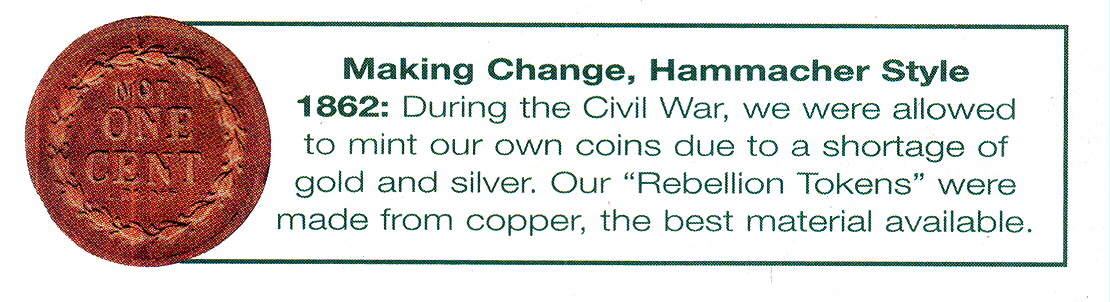
This week I received the “Gift Preview 2011” catalog from Hammacher Schlemmer. Within its pages was a note that said that during the Civil War, Hammacher Schlemmer was allowed to strike their own coins because of a shortage of circulating coinage. Their “Rebellion Tokens” was made from copper.
If you are not familiar with Hammacher Schlemmer, the company started in 1848 as a hardware store. As time went on, the company expanded into high-end merchandise that was high quality and highly innovative. For the last three decades, Hammacher Schlemmer has supported innovative inventors through its Hammacher Schlemmer Institute testing and reviewing new products to sell to their clientele. The claim that they are America’s longest running catalog with over 168 years without interruption.
Not only does the catalog have interesting items, but interesting facts about Hammacher Schlemmer.
Image taken from the Hammacher Schlemmer “Gift Preview 2011” catalog.
Predicting the Price of 25th Anniversary Silver Eagle Set
Several stories have confirmed that the American Eagle 25th Anniversary Silver Coin Set will go on sale October 27, 2011. Shipping is expected to begin in late November.
The United States Mint American Eagle 25th Anniversary Silver Coin Set will include five one-ounce American Eagle Silver Coins:
- one proof coin from the United States Mint at West Point
- one uncirculated coin from the United States Mint at West Point
- one uncirculated coin from the United States Mint at San Francisco
- one reverse proof coin from the United States Mint at Philadelphia
- one bullion coin
All five coins will be mounted in a custom-designed, highly polished, lacquered hardwood presentation case accompanied by a Certificate of Authenticity.
The U.S. Mint plans to produce 100,000 of these set with a limit of 5 sets per household. The prices has still not been set.
If we were to speculate on the potential price of this set, we can look at the cost of the 20th Anniversary American Silver Eagle Set. In August 2006, when the 20th Anniversary set when on sale, $100 purchased a 2006-W Proof, 2006-W Burnished, and 2006-P Reverse Proof coins. That year, the U.S. Mint sold the 2006-W Proof Silver Eagle for $27.95 and the 2006-W Burnished Eagle for $19.95. Using the proof price for the reverse proof, the total cost was $75.85. By pricing the set at $100, that is a 33-percent markup.
For the 25th Anniversary American Silver Eagle set, there are two proof coins currently selling for $29.95, two uncirculated coins now selling for $50.95, and the current price of silver is $42—but these calculations will use the price of the uncirculated coins currently on sale at the U.S. Mint as a basis for this speculation. With these prices, the total cost of the coins are $272.75. Given that the 20th Anniversary set was marked up about 33-percent, the total cost with the mark-up is $362.75.
Adding to the costs will be the “custom-designed, highly polished, lacquered hardwood presentation case accompanied by a Certificate of Authenticity.” This differs from the cardboard-based packaging that was used for the 20th Anniversary set. Aside from the labor, the U.S. Mint has to account for materials. Therefore, the speculative cost of the set will be $368.95.
Remember, you heard it here first!
ANA Successfully Uses Social Media
As easy as it is to criticize, it should be just as easy to complement. I want to complement the American Numismatic Association, specifically, whomever is responsible for the @ANACoins Twitter account. If you have not been following the tweets for @ANACoins, the updates have been reporting the goings on at the ANA National Money Show in Pittsburgh.
During the open Board of Governors meeting on October 14, person using @ANACoins had the following conversation:
| ANACoins ANA Under proposal, clubs would get free club tables but all tables would have to be staffed. #ANAshows 14 Oct |
|
| CoinsBlog CoinsBlog @ANACoins How about shared club tables so clubs can pool resources? 14 Oct |
|
| ANACoins ANA @CoinsBlog 2 clubs are allowed to share one club table under the proposal. Thanks for the question. 14 Oct |
|
| CoinsBlog CoinsBlog @ANACoins What about a regional org like MSNA and its member clubs? 14 Oct |
|
| ANACoins ANA @CoinsBlog That’s something we need to clarify. I’ve shared your tweet with Gov. Greg Lyon. We’ll get an answer on that. 14 Oct |
I am happy that someone is responding to their Twitter account and I hope to hear from Greg Lyon during the week.
Numismatics On Television
Those watching television in the evening had the opportunity to watch two shows were numismatics played a role in the story. On Monday night, CBS’s Hawaii Five-0 had a story that included Spanish gold escudos and the Hawaii over-print dollars.
After a child found a disembodied hand floating in the water, the fingerprints identified its former owner. When they went to search his home, the Five-0 team found Spanish gold coins soaking in a tank of water. McGarrett and Danny Williams went to a local museum to learn that a Spanish galleon carrying a cargo of gold coins sunk near the islands. Being good detectives, Five-0 traces the search for the galleon to a diving company that specializes in searching for lost treasure. As part of looking for the rest of the body, Five-0 and the Coast Guard finds an abandoned boat—or what they thought was abandoned. This leads them to go diving to see what was below the surface.
In an underwater wreckage, they find a body. When the body was examined, the wallet contained currency that was washed out. Using whatever forensic techniques they used to identify the note, they enhanced the image to find that it was a Series 1934A Federal Reserve Note issued in 1942. The forensic scientist explains how the Hawaii overprint notes were issued in case the notes were captured by the Japanese during an invasion. If that happened, the notes could be demonetized, making them useless.
The note was used to help identify the body and the gold escudos were used to trace who was responsible for the murder.
To see the full episode of “Mea Makamae,” you can watch it on CBS’s website here.
One of my favorite shows is History Detectives on PBS. For those who have not seen the show, History Detectives explores the history behind artifacts that people find or are handed down by family members to discover its history and the history behind the objects. Anyone who loves history may want to add History Detectives to your must see list.
This past week, Gwen Wright, who is also a professor of architecture at Columbia University, investigate a stock certificate issued by the Harlem Associated Heirs Title Company.
The person who initiated the investigation was a collector of stock and bond certificates, a part of numismatics called scripophily. Those who collect these certificates have interests in financial history, the signatures, or artwork on the certificates. Early certificates were hand autographed by the presidents and treasurers of the companies making them more desirable. Today, stock certificates are a thing of the past since stocks are transacted electronically.
In this investigation, Wright traces the certificate to the history of Harlem. Originally, the area we know as Harlem was a remote area of Manhattan island, far away from what we know today as downtown where most of the people lived. The area was dotted with exclusive vacation homes of the rich with a section of land that was granted to a group of people. By the end of the 19th century and into the early 20th century, New York City grew so much that Harlem was no longer a remote area and the city worked with developers to develop the land regardless of alleged ownership. The Harlem Associated Heirs Title Company was a group who tried to reclaim the property after the turn of the 20th century.
Of course I left out some details. Watch the segment from this week’s show:
Watch the full episode. See more History Detectives.
Support the Coin Collectors Blog
 Buy me a coffee
Thank you for your support!
Let Me Know What You Think
Are you going to the World's Fair of Money
Total Voters: 17
 Loading ...