
Ancient Coin Online Exhibit
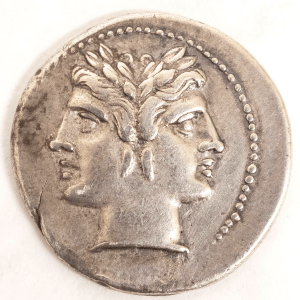
Marcus Claudius Marcellus from the D’Argenio Collection at Seton Hall University
Donated to the university by Ronald D’Argenio (MS’76/JD’79), the collection allows scholars “to trace the relationship of the earliest Roman coins of the Republican period to its immediate Greek predecessors. It includes coins with images of Julius Caesar, the first Roman leader to have his portrait represented on a piece of currency.”
The library added the collections to the Google Arts and Culture online collection. “Google Arts and Culture is a rapidly growing site that displays highlights from over 2,000 museums and private collections. Its app, which can be downloaded from Google Play or the Apple Store, allows the visitor to interact with the artwork through AI features like virtual tours and exhibits.”
The online exhibit is in two parts:
Hammered Commemoratives
Long before the invention of electricity, before steam powered everything, and even before the perfection in the forging of iron and steel to make manual machines, coins were hammered by strong men in order to impress the image on the coinage metals.
Hammered coins were struck from ancient times until the screw coin press was invented by German silversmith Max Schwab around 1550. Hammered coins were struck by frost placing a coin blank on a stationary die (anvil die) that was attached or sunk into a log or another hard surface. The anvil die produced the reverse image. Then, holding the obverse die (trussel) in one hand, the coiner swung the hammer and forced the dies into the coin blank. The pressure from the hammering pushed the metal into the crevices of the dies including the stationary lower die to create the impression. It would take multiple hammer strikes in order to impress the image into the coin.
Hammered coins were rarely perfectly round. Aside from there being no collar surrounding the blank to keep it in place, Depending on the strength and skill of the coiner, the image may not transfer perfectly, the thickness may vary, the coin could exhibit flat edges, and striking errors. Collectors of these coins, mostly pre-17th century, find beauty in the character of each strike.
Monnaie de Paris (The Paris Mint) announced that it will create coins with the theme “From Clovis to the Republic” commemorating 1500 years of the history of France. The theme and design concepts were created by famed designer Christian Lacroix, Artistic Advisor of the Monnaie de Paris. The series will celebrate 15 kings, emperors, and presidents over five years that represents French history from Clovis I through Fraçois Metterand.
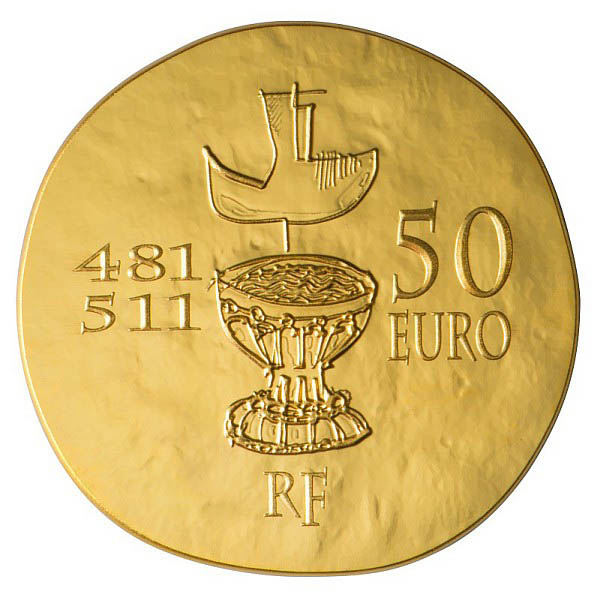
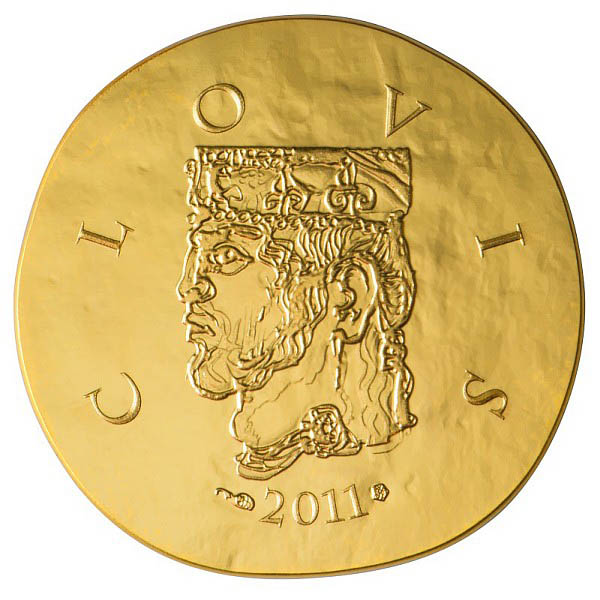 The first coin commemorate Clovis I. Clovis was the first King of the Franks. Clovis was the first Catholic king who united all of the Frankish tribes under one ruler. The second coin in the series features Charlemagne, the first Holy Roman Emperor and King of the Franks who created the first European-based empire. Both France and Germany traces their history back to Charlemagne.
To give the coin a similar character to what might have existed during the time of Clovis and Charlemagne, Monnaie de Paris developed a method to make the coin appear to be hammer struck using modern minting equipment. The obverse of both coins has a portrait as it might have appeared at the time.
The reverse of the Clovis coin has a dove flying over a baptismal font representing his Catholic heritage.
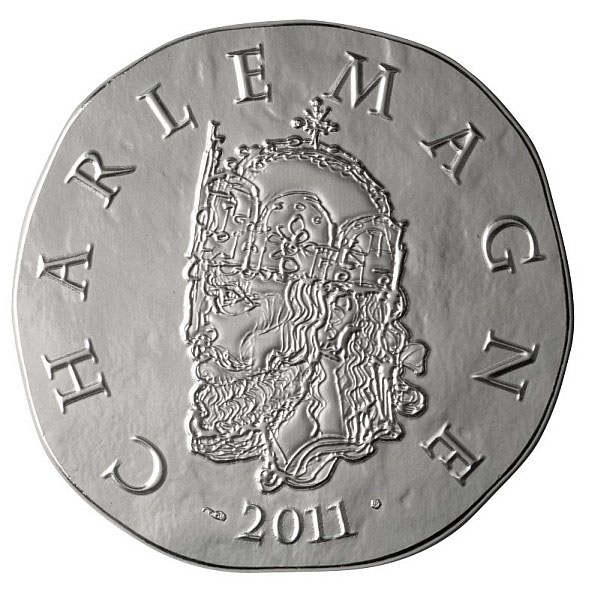
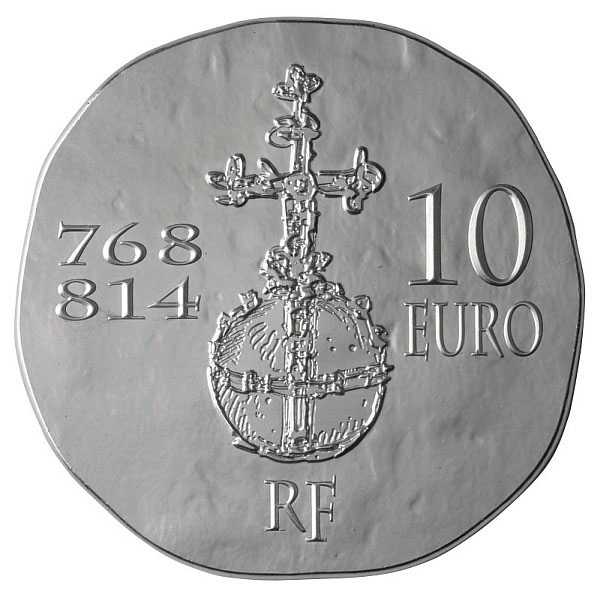 The reverse of the Charlemagne coin features a cross-bearing orb (globus cruciger in Latin), Charlemagne’s symbol of his sovereignty and power as the first emperor of the Holy Roman Empire.
To the left of the reverse image are the years of their reign. To the right is the denomination. Below the image are the letters “RF” for République Français for “The French Republic.”
For each commemorative. Monnaie de Paris will be producing two coins. The 10 Euro coin is made from 22.2 grams of .900 fine silver and has a production limit of 20,000 coins at a cost of 65 € (54.35 € without VAT for outside of Europe). The 50 Euro coin is made from 8.45 grams (quarter-ounce) of .920 fine gold (22-Karat) and has a production limit of 1,500 coins and will cost 427 €. Those of us who live outside of Europe can find regional authorized distributors using a web search.
I like the idea to make commemoratives honoring historic figures designed and struck to look close to period pieces. It will be interesting to see how the people who vote for Coin of the Year reacts to these coins.
Coin images courtesy of Monnaie de Paris.
Does the U.S. Mint Need a Politician Director?
Since the founding of the U.S. Mint in 1792, all of its 38 directors, from David Rittenhouse to Edmund Moy, have been a political appointment. Every so often there has been a gap between the service of directors, but eventually, a director is appointed.
Currently, the U.S. Mint has not had a director since the departure of Ed Moy in January 2011. Four days later, it was announced that Deputy Director Andy Brunhart also left the U.S. Mint to take a position with the Bureau of Engraving and Printing.
Treasurer Rosie Rios became acting director and served until Richard Peterson was hired as Deputy Director on January 25. Peterson is not an appointee but a member of the government’s Senior Executive Service. According to his biography at the U.S. Mint website, Mr. Peterson was an executive at General Electric and has a manufacturing and supply chain background. Prior to becoming the Deputy Director, Mr. Peterson was Associate Director for Manufacturing. He is a retired U.S. Naval officer, a graduate of the U.S. Naval Academy, and holds an MBA from Harvard.
In other words, Richard Peterson is well qualified to be the chief executive of the largest manufacturer of coins and medals in the world.
Since Peterson’s promotion, there has not been controversies from the U.S. Mint. Granted, there has not been many opportunities for problems, but it seems the U.S. Mint has weathered released of the five-ounce silver National Parks coins without too many controversy. Neither has the sales of the 2011 commemorative coins. Sales of the 2011 September 11 National Medal seems to be going well.
The U.S. Mint does not have a politically appointed director and it appears to be running without issue. In fact, it might be running better under a professional executive.
With the exception of the recent problems with the production of the new $100 notes that has delayed their release, the Bureau of Engraving and printing has run very well over the last few years. It is an efficient organization that maximizes its seigniorage and is able to supply the Federal Reserve with the currency it needs. Larry Felix, Director of the Bureau of Engraving and Printing, is a government professional and not a political appointee.
Pendleton Civil Service Reform Act (22 Stat. 403) of 1883 eliminated the patronage system within the federal government. For the first time in United States history, government employment was determined by merit and not because of who you know. It has resulted in a more professional workforce and one that did not have to curry political favor.
Although the law allows the president to convert appointed positions to be civil service jobs, the Director of the U.S. Mint has remained an appointed position.
Considering the recent history of the U.S. Mint and in the best interest of the bureau, it is time for President Obama to exercise his privilege under the law and convert the job of Director of the U.S. Mint to be a civil service position.
A Declaration
The unanimous Declaration of the thirteen united States of America
 When in the Course of human events it becomes necessary for one people to dissolve the political bands which have connected them with another and to assume among the powers of the earth, the separate and equal station to which the Laws of Nature and of Nature’s God entitle them, a decent respect to the opinions of mankind requires that they should declare the causes which impel them to the separation.
We hold these truths to be self-evident, that all men are created equal, that they are endowed by their Creator with certain unalienable Rights, that among these are Life, Liberty and the pursuit of Happiness. — That to secure these rights, Governments are instituted among Men, deriving their just powers from the consent of the governed, — 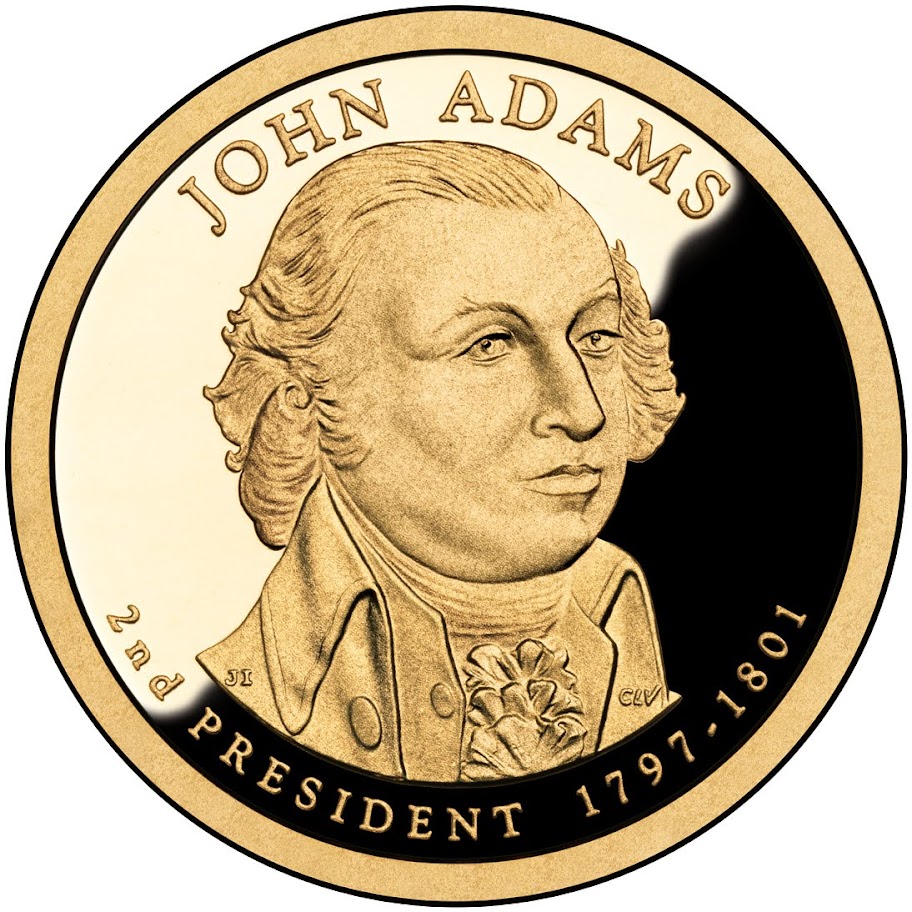 That whenever any Form of Government becomes destructive of these ends, it is the Right of the People to alter or to abolish it, and to institute new Government, laying its foundation on such principles and organizing its powers in such form, as to them shall seem most likely to effect their Safety and Happiness. Prudence, indeed, will dictate that Governments long established should not be changed for light and transient causes; and accordingly all experience hath shewn that mankind are more disposed to suffer, while evils are sufferable than to right themselves by abolishing the forms to which they are accustomed. But when a long train of abuses and usurpations, pursuing invariably the same Object evinces a design to reduce them under absolute Despotism, it is their right, it is their duty, to throw off such Government, and to provide new Guards for their future security.
 In every stage of these Oppressions We have Petitioned for Redress in the most humble terms: Our repeated Petitions have been answered only by repeated injury. A Prince whose character is thus marked by every act which may define a Tyrant, is unfit to be the ruler of a free people.
We, therefore, the Representatives of the united States of America, in General Congress, Assembled, appealing to the Supreme Judge of the world for the rectitude of our intentions, do, in the Name, and by Authority of the good People of these Colonies, solemnly publish and declare, That these United Colonies are, and of Right ought to be Free and Independent States; that they are Absolved from all Allegiance to the British Crown, and that all political connection between them and the State of Great Britain, is and ought to be totally dissolved; and that as Free and Independent States, they have full Power to levy War, conclude Peace, contract Alliances, establish Commerce, and to do all other Acts and Things which Independent States may of right do. And for the support of this Declaration, with a firm reliance on the protection of divine Providence, we mutually pledge to each other our Lives, our Fortunes and our sacred Honor.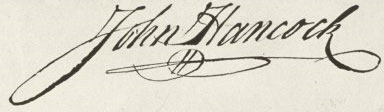
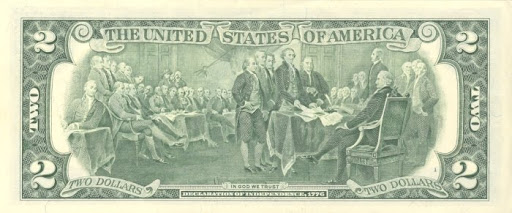
Adams Dollar image courtesy of the U.S. Mint.
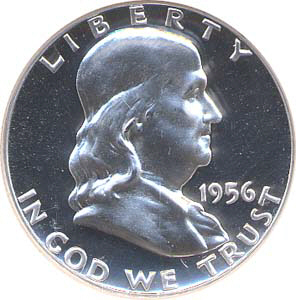
Franklin Half image courtesy of PCGS.
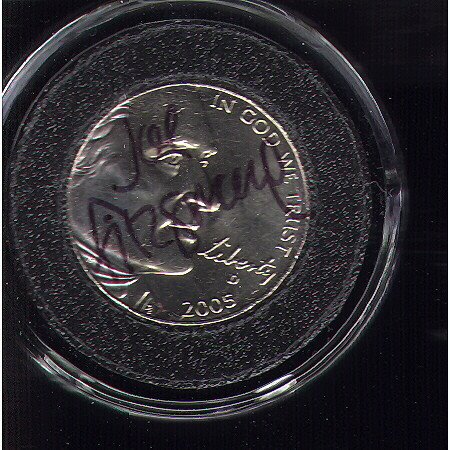
Two Dollar reverse and John Hancock signature images courtesy of WikiMedia.
NOTE: The section containing the declaration of charges against King George III was intentionally omitted.
Coin Collection at the National Museums in Berlin
As I do research for an article on great coin collections from around the world, I was looking into the coin collection at the Staatlichen Museen zu Berlin (National Museums in Berlin). The collectioncollection at the Staatliche Museen is well known as being very comprehensive and diverse covering the beginnings of coinage through the coins of today. With over 500,000, it is one of the largest collections in Europe. Staatliche Museen boasts large collections of Greek, Roman, and European coins from the Middle Ages to today. They also have an extensive collection of art medals dating from 1400.
In addition to the coins and medals, the collection also contains an extensive collection of paper currency primarily from Europe and items used as money from all over the world. The non-coin collection includes tools and dies that were used to strike coins in Berlin since the 17th century. The Staatliche Museen online English version of their online catalog can be found here.
Curators and museum staff made an introductory video about the collection. The narration is in German with English subtitles. Maybe it will entice someone to visit the collection and tell me about it!
Warman’s E-Book Sale
Since January, I have been advocating more electronic numismatic books. Up until this past year, the only e-books I have found were the books on CD/DVD and downloads from Krause Publications. After I posted those comments, I heard from Dennis Tucker at Whitman Publishing who partially corrected me and said that they do have plans to sell more e-books. Subsequently, I heard from Scott Tappa, Publisher at Krause Publications who said, “This year you will see more and more KP books available for e-reader devices like the iPad, Kindle, Nook, etc.”
Although both companies have started to publish e-books, it looks like Krause has embraced electronic as a full business model.
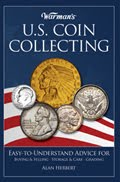 Earlier this week, sent out emails advertising their 4th of July Weekend sale by offering four of their Warman’s e-books to download for free. The Warman’s books are basic guides with the essential information in full color. For example, Warman’s Coins & Currency Field Guide is a solid price guide, but not as extensive as the U.S. Coin Digest. In fact Warman’s Coins & Currency Field Guide would be great to have on a smartphone when attending a coin show.
After receiving the notice from Krause, I was able to ask Meghan McKeon, Publicist for F+W Media, Krause’s parent corporation, about the number of e-books that were available on line. McKeon wrote, “Currently we have over 1,500 eBooks at all of our vendors (Amazon, Barnes&Noble, Sony, Google, iTunes). As of right now, we will continue to make our catalogs available in CD form with selected downloadable PDFs (from their website).”
I spot checked iTunes, Google, and Amazon.com to find quite a number of Krause books available on in e-book format. In fact, while checking iTunes, I download three of the four free e-books (I omitted Warman’s Stamps Field Guide since I am not a stamp collector).
While there, I also spot checked what was available from Whitman Publications. Comparatively, there were fewer choices than their competition. I was able to find e-books for titles like Cherrypicker’s Guide and 100 Greatest US Modern Coins, but not the Red Book or other books in their Red Books series. I like the Red Books series, but if Whitman is not delivering them electronically, I am looking for books elsewhere.
I currently own several e-books from Krause including two of the Standard Catalog of World Coins, U.S. Coin Digest, and now the Warman’s Field Guides in their recent advertisement. As long as Krause and F+W Media is publishing books in the form I want, I will continue to buy their products.
Book cover image courtesy of Krause Publications.
Support the Coin Collectors Blog
 Buy me a coffee
Thank you for your support!
Let Me Know What You Think
Are you going to the World's Fair of Money
Total Voters: 17
 Loading ...