
Quarantine Reading List: History of US Money Manufacturing
With the announcement that the coalition of northeast states will continue their stay-at-home order at least through May 15, it is time to turn off the news and think about something else.
Since the kids are doing their homework without a teacher, you can pick up a book or two and learn something about the hobby we love.
The inspiration for today’s Quarantine Reading List came from a reader asking about the history surrounding the institutions that create the numismatic products.
Although many books explain the manufacturing processes and describe the history, the goal of this list is to suggest well written and accessible books on each topic. If the publication is available online, there will be a link to read it or download a copy.
U.S. Mint
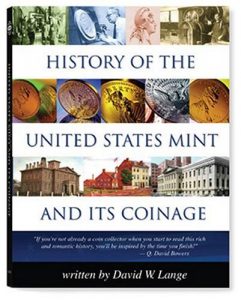 Of all the money manufacturing institutions, the U.S. Mint has the most documented history. There are so many good books about the Mint’s history it is difficult to narrow down a recommendation to one book. If you are going to read one book, read History Of The United States Mint and Its Coinage by David Lange.
Whether you read for knowledge or pleasure, it is always best when it is well written. David Lange’s reputation as a great writer is on full display in this book. Using his skill, Lange writes a broad context of the history of the U.S. Mint fitting it in 190 pages with images of coins, vignettes, and documents of the time. After you finish, give the book to your young numismatist who will also enjoy it.
History Of The United States Mint and Its Coinage is no longer in print but can be found on the secondary and used book market.
Bureau of Engraving and Printing
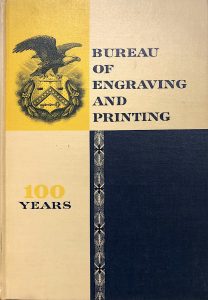 The Bureau of Engraving and Printing started in 1862 in the basement of the Treasury Building as the National Currency Bureau. Their first job was to separate currency notes produced by private banknote printing companies. The newly formed bureau started its printing operations in 1863.
The BEP grew out of the necessity to fund the Civil War. From there, the bureau became the primary security printing service for the government. To learn more about the BEP and its growth, read History of the Bureau of Engraving and Printing. Produced for the 100th Anniversary of the BEP, the book is the most comprehensive coverage of its history.
For those looking to save money, the book is available online. It does not have copyright restrictions since it was produced by the BEP and printed by the Government Printing Office. You can download the book in many electronic formats from Newman Numismatic Portal and the Internet Archives. Download the book now and start reading!
Department of the Treasury
 The Treasury Department is the only Cabinet-level department whose history mirrors the country’s history. Although there has been a lot written about Treasury, most of the book covers a specific era of history. Whether the subject is the founding of the department by Alexander Hamilton, the Gold Rush era, or the transition to working with the Federal Reserve starting in 1913, you can find a book that will expand on Treasury’s history.
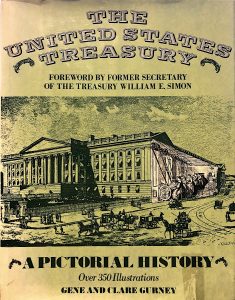
For a good overview that discusses the history of the department and reconizes the production of money through the years is The United States Treasury: A Pictorial History by Gene and Clare Gurney.
Written in 1978, it is not an academic study of the Treasury Department. The book provides a pictorial overview along with the story of Treasury with over 350 illustrations in 216 pages.
Of course, you can buy the book and have it as a perpetual reference. If you want to “borrow” an electronic book, you can do so at the Internet Archives. Once you create a free account on the Internet Archives, you can check out an electronic version for two weeks.
Commission of Fine Arts
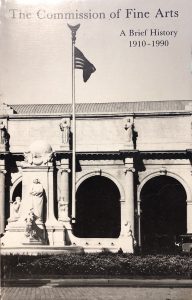 Although the Commission of Fine Arts is not part of the manufacture of money, it wields influence on the designs of the coins struck by the U.S. Mint. The first influence the CFA had on coin design was for the 1921 Peace Dollar. It was the CFA that managed and selected the competition that was won by Anthony de Francisci.
In 1976, the CFA published the initial version of the commission’s history. They produced updates every five years with the last published in 1996 that covers its history through 1995. Most of the book does not mention its ties to numismatics until the 1985-1990 additions.
It is difficult to find physical copies of the later version of the book. The most common version found on the secondary market was the one published in 1986, before their involvement with the American Eagle program. But as a government publication, it is available online at the Internet Archive. As with other electronic books downloadable from the Internet Archive, it is available in many different formats depending on your device.
SUMMARY
- History Of The United States Mint and Its Coinage by David Lange.
- History of the Bureau of Engraving and Printing can be read online from the Internet Archives,
- The United States Treasury: A Pictorial History or borrow an online ebook from the Internet Archives.
- Download a copy of The Commission of Fine Arts: A Brief History 1910—1995 from the Internet Archives.
Reading is an excellent way to pass the time.
Stay healthy! Stay safe!
Political Collectible Book and Numismatics
 It is difficult to live in the Washington, DC area without being interested in politics. Some statistics have shown that 60-65 percent of all people either work for the Federal Government, a contractor to the federal government, or working in a job that supports the people, contractors, and governments. For those of us whose daily habits includes watching cable news, the Sunday morning shows, and reads Politico on a daily basis, it should be no surprise that a coin collector would be interested in political exonumia.
So I was ordering CDs from Krause Publishing and found myself short of the $49 needed for free shipping. While looking for something interesting to fill out the order, I found Warman’s Political Collectibles: Identification and Price Guide. I did not know why this was with their numismatics books, but it looked interesting and added it to my order. Satisfied my order would ship for free, I placed my order.
When it arrived, I flipped through the color pages and glanced at a number of interesting pages, but did not think twice. It was interesting but I had other things to do. This past weekend, I picked up the book and from Chapter 1, I found why this book would be of interest to exonumia collectors: “Medals, ‘Coins,’ Badges, & Plaques.” It is an entire chapter on tokens, medals, woods, and ribbons of politics from years past.
For most of the 19th Century through the early 20th Century, it was common to see medals and ribbons on the campaign trail. Hard Times Tokens with pithy statements on the political issue of the day were as common as money was not. Many of the medals shown in the book have holes so that they can be worn as jewelry. And the book shows quite a few ribbons that are real interesting and had me looking at the archives of online auctions to see who has listed these items.
Warman’s Political Collectibles is a full-color book printed on heavy glossy paper. The images are fantastic and the information appears to be solid. While the price ranges are based on the author’s research at the time the book was published (2004), there should not be a big difference between the published prices and what you should expect to spend today.
It would be impossible to catalog every political collectible that ever existed, but this book highlights some of the more interesting items and potential prices ranges for each. The one chapter about political exonumia was a pleasant surprise and worth purchasing if you have an interest in political collectibles.
Cover image complements of Krause Publications.
Let’s Talk Collecting
Let’s do something different. Let’s talk collecting!
I am finding quite a few 2011 coins in pocket change. Most of my finds are Lincoln cents, but there have been a few 2011-P nickels mixed in. For the first time, I found 2010 dimes in change. I have yet to find any America the Beautiful Quarters® in change. Finding 2011 coins in pocket change this early is a good sign, until oil prices rise and put us back into the “Big Recession.”
In recent years, I have purchased the $2 Single Note Collection from the Bureau of Engraving and Printing. I don’t collect the notes from all of the Federal Reserve branches, I only collect the ones from the Federal Reserve Bank New York. The $2 Single Note Collection features a Series 2003A Federal Reserve note with a a serial number beginning with “2010xxxxD” in a special holder. During the pre-release period, the BEP will only sell the 2011 $2 Single Note Collection as a set. They will begin to sell the individual notes on March 15.
Last week, I purchased the 2010 Presidential $1 Coin Covers. I have been buying U.S. Mint coin covers since they were first released in 1999 for the 50 State Quarters. I find these very cool collectibles and have enjoyed showing them off. They are not popular with collectors and do not sell well in the secondary market, but I like them. To store and display them, I use a two pocket first day cover page stored in a loose leaf binder with anticorrosion pages in the front and back of the book.
I did not buy the 2010 annual sets. The proof sets contain 14 coins and the mint set has 28 coins. Because of the number of coins, the prices for these sets are high. I am not sure it is worth the price since since I collect uncirculated and proof coins in various blue albums and feel that these sets are redundant collectibles. Up until now, I was collecting mint and proof sets dating back to my birth year. But I am not sure I want to continue. I may stop collecting these sets and sell off the collection except for my birth year and the 1965-67 Special Mint Sets.
In fact, I was looking at my collection and may sell a lot of it to just concentrate on my date-mintmark collection, U.S. Mint First Day Covers, interesting world Philatelic-Numismatic Covers (PNC), and some other smaller specialized collections. The rest may end up on eBay!
Speaking of Maryland Colonial currency, I have seen buyer-friendly prices on different auction websites. I wonder if the lack of activity is because of the economy or general interest. For collectors, this is good since we can buy what we want at a good price with a potential for a good future return.
I Will Buy An iPad 2: Where’s My e-Numismatist?
While I unbury myself from “real work,” I have been fielding questions and comments over my postings on electronic publishing. The comments have run the gamut from skeptical to enthusiastic for more electronic publishing.
I bring this up now because as part of the introduction of Apple’s new iPad 2, Apple CEO Steve Jobs announced that Radom House, Inc., the largest trade book publisher in the U.S., has made its catalog of 17,000 electronic books on Apple’s iBookstore.
Apple says that the iBookstore sells ebooks from more than 2,500 publishers and all six major trade publishers. This does not include specialty applications sold in the iTunes app store.
I wonder how difficult it would be to create an ebook version of The Numismatist? While the reader that the American Numismatic Association uses to display The Numismatist on the computer screen, the program uses Adobe Flash, which is not available on the iPad. It also requires that the computer be connected to the Internet reducing its portability.
I wonder of Apple or Amazon.com wants to help pioneer working with not-for-profit organizations by supporting subscription downloads. Amazon.com would be a good partner because they offer the Kindle reader and apps that can read Kindle formatted ebooks for many devices, including the Apple iPad. Imagine waking up one morning and the current version of The Numismatist on your favorite device. Pick up your device and just go!
Since I will not buy the first release of any product, it was difficult to wait for the iPod 2. The iPad 2 is faster, lighter, has new cameras, and more for the same price as the first generation product with a cool Smart Cover, it was worth the wait. Although I will not stand on line in front of an Apple Store when it will will go on sale at 5:00 P.M. on March 11, I will buy one before the end of the month.
Once I buy my iPad 2, I want content. Dear ANA: please sell me content!
Here I am telling the ANA that I will pay my dues for the content they provide in the form of The Numismatist in a form that would be cheaper to produce. I am not asking for something for nothing. In fact, I will pay the current paper version in order to be able to download The Numismatist to my iPad 2 so that I can consume this media how I want. So why isn’t the ANA looking outside of the box to figure out how to do this?
C’mon ANA, You’re Going to Lose a Voluntary Resource!
I received the March 1, 2011 edition of Numismatic News in today’s mail. In a front page, top right article, NN reported that American Numismatic Association membership is down to 28,500 members. This is the low end of the 20 year average of 28,000 to 32,000. It was reported that Kim Kiik, ANA Senior Administration Manager, told the board that an aggressive membership campaigned will be announced shortly.
In the February 2011, ANA President Cliff Mishler wrote in The Numismatist that ANA Governor Wendell Wolka wants to make the ANA library and museum more accessible to ANA members. Wolka wants the library to wants to make it easier for members to reserve books from the library by making the process electronic. He also wants to have rare and popular books digitized so that they may be electronically accessed by members.
On May 21, 2010, when I posted a follow up to my post “ANA versus Technology: The ANA is Losing!,” I wrote that the ANA is doing very little to make the association accessible to the potential 20-something and 30-something members. Then, during my January discussion of electronic publication, I wrote:
Numismatics is dominated by many people over 50. If there is a second age group, it is younger than 18. Missing in the demographic are those from 18-50 who might have been a Young Numismatist but dropped out in college and did not return until after their children have grown. This situation is unacceptable if the hobby is to survive!
The ANA can offer better outreach to this connected demographic by the appropriate use of technology. This does not have to cost a lot of money. It takes a little imagination to figure out where these potential members congregate online and deliver new content.
Based on the reporting of NN and the reporting in the February 2011 edition of The Numismatist, the ANA Board of Governors, the majority who are older than 50, are sticking their proverbial toes in the technology waters where rest of the world has lapped them several times in the race for the attention of the ANA’s lost demographic.
Rather than try to be democratic about providing advice, I am going to be very specific in my recommendations:
- While there is still time to plan, the open sessions at the World’s Fair of Money should be live streamed on a service like uStream. The ANA can start with Board Meetings and other open meetings involving the organization. How about broadcasting some of the Numismatic Theater talks on the Internet?
- What about using something like GoToWebinar to broadcast Numismatic Theater presentations with electronic slides and audio available to anyone who wants to log in at the time of the event. The online portion can be saved so that members can view later on demand.
- Borrow, lease, or buy any number of what is called “prosumer” video products that includes sound capture and tripod setup to record video, find a member with basic editing tools to add titles and do some minor editing, and upload the video to YouTube for anyone to watch. For a lesser expensive option, I have been very impressed with the Flip Ultra HD. For $199.99 (list price), with two hours of high definition video and other amenities, it is a fine camera to mount on a tripod in a room and create a video. Find someone with a Mac that has iLife preloaded (like your blog host, an ANA member), and you have the beginnings of a basic editing studio.
- Going further into the electronic video publishing environment, uStream can be used to set up pay-per-view, on-demand video. While I would love to attend the Summer Seminar, I have found that my work schedule has not been flexible enough to take the time to attend. However, if some of the courses were available online, I would pay to watch the videos. This is the ultimate money maker that can be used to support the video production environment. Create the video from the Summer Seminar and offer it online after the World’s Fair of Money at a price for one-third of the on-site course. For the price, the watcher gets the information but does not have the ability to interact with the instructor and other students.
- If you search Google Books, you can find some of the books that are in the ANA library in the electronic catalog. There are also a few copies of The Numismatist available. These are all books and journals that have been scanned by university libraries in conjunction with Google. Has someone contacted Google to scan books whose copyrights have expired or out of print books (available through their court settlement with authors and publishers that will allow them to scan “orphaned” books) making them available for the entire numismatic community? Google provides much of the resources to do this and may welcome a different source of content for their vast online library.
In order to convince the ANA Lost Demographic to maintaining their membership, the ANA should add more electronic resources and consider price breaks for this demographic. First, create a new tier what I will call the Lost Demographic. The Lost Demographic member would be potential member who older than 23 but not older than 32, was a registered YN member at any time prior to turning 23, applied for the ANA’s Basic Membership—it would not be available for Regular Membership. Lost Demographic Basic Membership dues would be half of the difference between a Regular and YN membership. For example, the Basic one-year membership for YN is $14 and Regular members $28. For the Lost Demographic Basic Membership would be $21 per year.
Finally, I am not one to sit on the sideline and throw stones by telling others what to do. Once again, I am willing to volunteer my services as an ANA member and a computing professional. Although I have offered my voluntary services to the ANA many times in the past, I am using my personal soap box to offer my services. However, continued frustration will reduce my desire to help. Act now before it is too late!
A 2011 Find in a New Place
Yesterday, I received one of those charity solicitations in the mail with a nickel attached to the form. After opening the envelope, I found a shiny, new 2011-P Jefferson Nickel. Usually, I send back the nickel with a donation. This time, I kept the nickel as my first 2011 nickel of the year. When I write the check I will add 5-cents to my donation instead.
I thought this was an unusual place for a coin find!
Support the Coin Collectors Blog
 Buy me a coffee
Thank you for your support!
Let Me Know What You Think
Are you going to the World's Fair of Money
Total Voters: 17
 Loading ...