
Follow up: FAQ on ANA’s Online Education #Fail
 The feedback from my post, “Why the ANA does not have online education,” was interesting. About 10-percent of the readers (based on collected statistics) commented to me via email. That is a lot of feedback for one post! The comments ranged from a virtual headshake to anger for being “disrespectful” to the ANA president.
Unfortunately, nobody will go on the record with their comments. Please remember that I welcome all comments and will allow you to post any criticism you want. I accept and post all feedback, especially if you disagree with me. All I ask is that you keep it clean.
I want to answer two questions publically:
1. You’re the head of the IT Committee, why don’t you do something about the situation?
I am not longer the chairman of the IT committee, and I am no longer a member of the committee.
In late November 2019, ANA President Steve Ellsworth removed me from the committee after seven years of service.
When Ellsworth called to tell me, he did not give the exact reason. His statements as to why he made the decision were vague and ambiguous. Later that same day, I had to send him an email for clarification.
I assume that he did not want me around. After all, I came out against his candidacy before the end of the last election. But Ellsworth had a problem. How could he remove a recipient of the Glenn Smedley Award from the position that was the reason for the honor?
Unfortunately, I gave Ellsworth a way out. After he took office, Ellsworth changed a few things, including wanting status reports and a strategic plan. When he told me about the strategic plan, Ellsworth said that the ANA did not have one in many years and should come up with one.
At the same time, my business picked up. I was working 18 hour days, instead of my usual 14 hours, and had to hire more people. While my business was good, it did not provide enough time to devote to the ANA. I was hoping to catch up in late October, but that did not happen.
With the ANA not being a priority and my inability to deliver whatever Ellsworth wanted, I gave him the excuse to get rid of me.
Ellsworth’s move was a bit punitive, but it pales in comparison to what he hass done to the Exhibition Committee. That is a story for another time.
2. Can’t the ANA use something like Zoom to create classes?
YES!
They can also use software like Microsoft Teams, Google Hangouts, GoToMeeting, WebEx, and Skype. Any video conferencing software and presentation slides that can be shared can create an instant class environment.
Google Hangouts and Skype are suitable for small classes. Although both are known to have bandwidth issues, keeping the courses between 7-10 people make these an inexpensive option.
Zoom is the current darling of the industry since they have a free tier. While Zoom has some excellent features, its security issues have shown they are going through significant growing pains. It is like watching your teenage son grow six inches in two months while his voice is changing. Eventually, he will evolve, and so will Zoom.
WebEx and GoToMeeting are the old stalwarts of the industry. Both have the advantage of being mature and familiar to many in the business world. The significant difference between these services and Zoom is that Zoom makes it easier to connect to a meeting.
Another option is YouTube Live. Classes can be live streamed with any number of people tuning in. Interacting with a YouTube Live stream is via comments only, similar to Facebook Live, but it is something that the ANA can use.
Here is an idea: How about a YouTube Live class for Numismatics 101? After the live class, leave the video online with an email link to allow future viewers to send questions.
There are better ways to hold online classes. Blackboard and similar software have better options. But to start, do something!
Another Maryland Note Comes Home
I think I may adjust my 2011 collecting goals to finding representative notes of Maryland colonial currency from each emission. While searching an popular online auction website, I found a listing for a note that needed to “come home.” This note did not look like it was in as good condition as my previous purchase, but it looked good enough to represent a new emission.
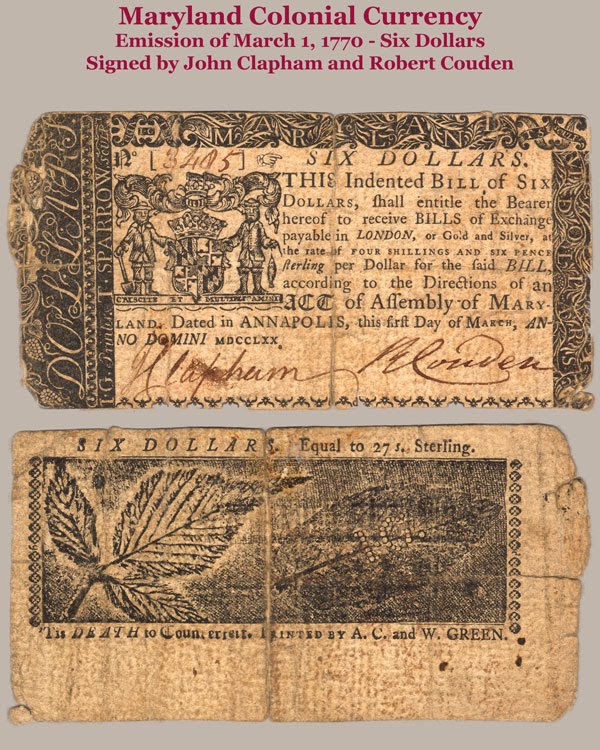 With money in demand, the Maryland Colonial Assembly authorized an emission of $318,000 in indented bills without legal tender status that would be issued as loans which came due between October 10, 1781 and April 10, 1782. The dollar was tariffed at 4/6 sterling or equivalent in gold or silver. These notes were similar to the release of 1767 except they listed the printers as A.C. and W. Green (Anne Catherine Green and her son William). Jonas Green, Anne’s husband, had died three years earlier. Each bill had two signers, who were Robert Couden, an Annapolis dry goods merchant and mayor of Annapolis from 1786–87, and John Clapham, a landowner in western Maryland who served as sheriff (tax collector) of Anne Arundel County (Annapolis) from 1770–72. These two went into private business together in 1772.
This note has a few condition issues that give it the character of surviving 241 years. Aside from the softness of the paper from handling, the center has a fold that is beginning to tear from the bottom and the bottom right corner (obverse) is torn to almost coming off. But the printing is still clear including the signatures of two Maryland patriots.
One of the interesting features of this note is the “J G” included in the right leaf on the reverse of the note for Jonas Green. Green’s influence can also be seen on the obverse of the note on the left border that says “JG Printer · T Sparrow, sculp.” These notes were sculpted by Thomas Sparrow, a Maryland artist who provided most of the border cuts for Maryland colonial currency.
Those who study the history of colonial currency are quick to note that Maryland notes declare that they “shall entitle the Bearer hereof to receive BILLS of Exchange payable in LONDON, or Gold and Silver, at the rate of FOUR SHILLINGS AND SIX PENCE sterline per Dollar for the said BILL.” Notes issued by the Maryland Colonial Council were backed by the profits of Calvert family whose head was Frederick Calvert, the Sixth Lord of Baltimore.
Frederick Calvert was somewhat of a ladies man after becoming the Sixth Lord of Baltimore and Fourth Proprietor of Maryland at the age of 20 in 1751. Aside from having several mistresses, one who published a scandalous autobiography in 1768, he was accused of abducting and raping Sarah Woodcock in London. Although Calvert was acquitted after claiming the encounter was consensual, Calvert escaped to Europe looking to escape his notoriety. Calvert eventually died in Naples in September 1771.
During this time, nobody spoke for the Calvert family and the Maryland assembly continued to freely use the family’s holdings as collateral for these indented bills. Even though Frederick Calvert’s will left the entire Calvert estate to his oldest son, Henry Harford, Harford was only 13 and did not have influence over the assembly’s working even though he was welcomed as the Fifth Proprietor of Maryland. Since Harford was the illegitimate child of Calvert and Hester Whelan of Ireland, Harford was not entitled to ascend to become Lord of Baltimore making Frederick Calvert the last Lord of Baltimore.
Eventually, Harford’s Maryland holdings were seized during the Revolutionary War and used to help fund the government and the Maryland regiments. Harfod returned to Maryland in 1883 and attempted to reclaim the land. Petitions to the Maryland General Assembly failed. His heirs fought for more than 100 years to reclaim the family property. The last case was heard by the U.S. Supreme Court in 1899. In Morris v. U.S., the court denied the family’s claim.
Isn’t it great how one note can open up a segment of history that is not included in your high school history books?!
Click on image to see a larger version.
Old Maryland Notes, New Owner
Last year, I wrote an article about the currency issued by the Maryland colony in the 18th century through the end of the Revolutionary War that was published of the Maryland Numismatist, the quarterly publication of the Maryland State Numismatic Association (MSNA). I became interested in Maryland colonial currency after stumbling over the Numismatic Collection in the Department of Special Collections at the University of Notre Dame and reading about Maryland currency on their Colonial Currency page.
Discovering this information about Maryland Colonial Currency inspired me to do more research. The result was a presentation (PDF) I gave to my coin club. I was then asked to convert the presentation to an article that was published in the Spring 2010 edition of the Maryland Numismatist. It was selected as “Article of the Year” by the MSNA.
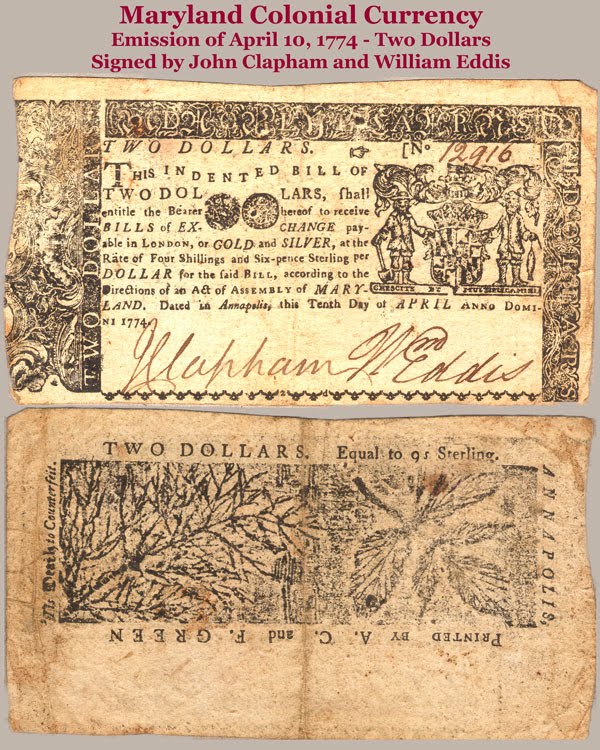 After doing this research, I realized I did not own a piece of Maryland currency. After reading that some people were finding bargains during the holiday time period at one large auction house, I decided to spend my holiday gift money buying a Maryland note. I bid on a few notes hoping to win one. At the end of the auction, I won two notes!
The notes I won are two-dollar and eight-dollar notes from the April 10, 1774 emission. These note were authorized by the Maryland Colonial Assembly. They authorized an emission of $480,000 of non-legal tender bills to be dated and issued on April 10, 1774. This emission. would be the last colonial issue before the Revolutionary War. The authorization was for $266,666 to pay loans, $80,000 for government expenses, and $133,334 to be exchanged for worn bills payable from October 10, 1785-April 10, 1786 at the rate of 4/6 sterling per dollar. An act of October 17, 1780 changed the exchange rate for all currency issued before 1776 to forty old dollars for one new dollar to be redeemed by March 20, 1781, after which all colonial notes were voided.
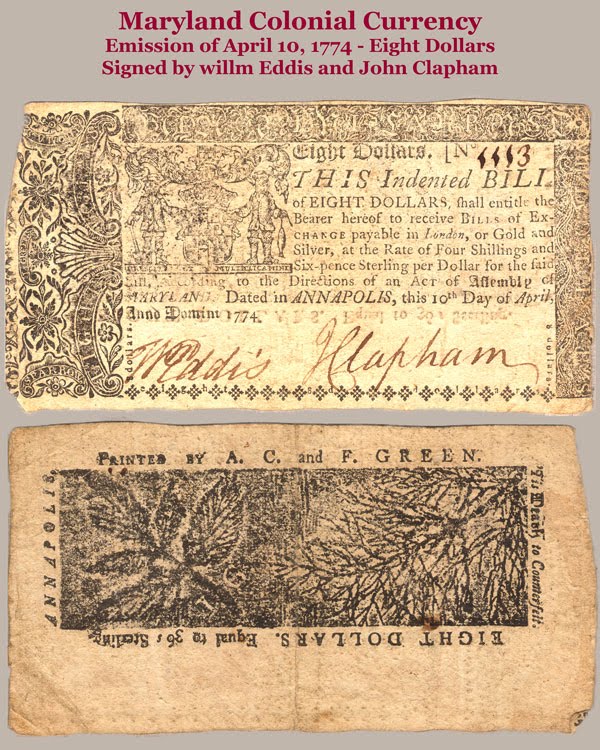 Designs and denominations were similar to the March 1, 1770 issue. Anne Catherine and William Green printed these notes. Anne Catherine Green, whose name appears at “A.C. Green” on the note, took over the business following the death of her husband Jonas Green. Anne Green had to use her initials because it was not acceptable for a woman to be working as a printer in the 18th century. William was Anne’s oldest son. The notes were originally designed by Thomas Sparrow who created the border cuts for these notes. Numismatists studying coinage attempts for the government formed under the Articles of Confederation knows that Sparrow was involved in one attempt.
In order to make these notes legal to issue they had to be signed by authorizing agents. The agents who signed these notes were John Clapham and William Eddis. Clapham was a landowner in western Maryland who served as sheriff (tax collector) of Anne Arundel County (Annapolis) from 1770–72. Eddis was a British loyalist, born in England about 1745, worked for Colonial Governor Sir Robert Eden as the office of surveyor of customs. Eddis fled to England in 1777.
For being nearly 237 years old, these notes are in fantastic condition. Considering what the reference books say the notes should cost, I can say that I did very well with this purchase. It is a great way to start the new numismatic year!
Click on any image to see a larger version.
PCGS Demonstrates Its New Technology
Last March, the Professional Coin Grading Service announced the PCGS Secure Plus service. Coins graded through Secure Plus will be scanned by an optical device that will map the surface of the coin creating a digital signature of its characteristics that can be used for later reference. The digital signature is a unique identification of the coin that can withstand potential coin doctoring and to prevent the users from removing the coin from the slab to try to have it graded higher. It can also be used to determine if the coin was doctored from its previous submission such as being artificially toned.
Recently, PCGS created a video demonstrating the scanner used to fingerprint and detect re-submitted coins. In the demonstration, PCGS shows how it detected a coin that had previously been submitted then artificially toned before being re-submitted. Here is the video:
I thought the device would be a little bigger. But that is the beauty of modern technology. In the past, I wrote, “Computers are great tools. Imaging technologies enhanced by computers can do wonderful things. To apply this technology to coin grading and analysis would be a fantastic addition to the industry. Can you imagine being able to take the technology to major shows and for a small fee, provide on sight diagnostics for coins before submitting them to the grading services?” PCGS is one step closer to that possibility!
CCAC Meets to Discuss Design Report
If you are in the Washington, DC area, the Citizens Coinage Advisory Committee is meeting today in the 8th Floor Board Room a at the U.S. Mint Headquarters located at 801 9th Street NW.
Today’s agenda includes the review and consideration of the draft report “A Blueprint for Advancing Artistic Creativity and Excellence in United States Coins and Medals.” Last June, the CCAC formed a subcommittee after being consistently frustrated with “overall disappointment with the poor quality of the alternatives presented for the 2011 commemoratives” and reminding the Director Edmund Moy that he wanted “and intend to spark a Neo-Renaissance of coin design and achieve a new level of design excellence that will be sustained long after my term expires.”
Although Moy resigned as director, the challenge remains.
Earlier today, CCAC Member Donald Scarinci tweeted, “CCAC will hopefully adopt the design excellence subcommittee report today. The info in it might be shocking to some, but all accurate.” While wondering what was so shocking, I asked Scarinci if the report will be release to the public today. He said yes. However, given the low information aspect of the CCAC’s website, I hope the report is given prominent place on the front page.
If you cannot attend the meeting you can follow along as Donald Scarinci tweets from the meeting. You can follow Donald at @scarinci on Twitter.
More E-Numismatics and Krause E-Books
I am amazed at the response I have received over the topic of digital books. For those who wrote to me directly echoing my call for more, I wish you would add them as comments to my posts. I think the numismatic publishers would like to see your comment—especially since I have been contacted by both the publishers at Whitman Books and Krause Publications, they are reading and paying attention!
Roger deWardt Lane reports that his book Encyclopedia Small Silver Coins: Brother Can You Spare A Dime about modern dime-sized silver coins of the world can be purchased in both paper form and as a download. Roger also said that he gave permission to Google Books to add it to their digital database.
Thijs Verspagen wrote to let me know that he maintains the Digital Library Numis that links to many electronic numismatic books and articles that can be freely downloaded. The site has quite a list of a variety of downloadable numismatic publications.
I also heard from Scott Tappa, Publisher at Krause Publications. Scott reports that two Krause books are now available on the Kindle. Scott writes:
This year you will see more and more KP books available for e-reader devices like the iPad, Kindle, Nook, etc. For instance, here are links to Kindle editions of two recent releases, Warman’s U.S. Coin Collecting and Canadian Coin Digest. (click on the titles to view the listings at Amazon.com)
Numismatic books face certain challenges in formatting for e-readers. In particular, our catalogs are image-heavy, which makes them very large files, which can make them difficult to download. Thus, expect to see KP create e-reader specific products that are smaller and more focused than our large catalogs.
Our parent company, F+W Media, has made e-books a top priority. In fact, we are hosting the second annual Digital Book World conference in New York City starting January 24, and are keenly focused on staying at the front of this market revolution.
Numismatic publishing is a niche business. While it is a large niche, publishers are competing for the best content, the best authors, and access to the same distribution sources. These companies have to be responsive to what their readers want. I am sure that these publishers welcome your feedback.
Support the Coin Collectors Blog
 Buy me a coffee
Thank you for your support!
Let Me Know What You Think
Are you going to the World's Fair of Money
Total Voters: 17
 Loading ...