
Weekly World Numismatic News for April 12, 2020
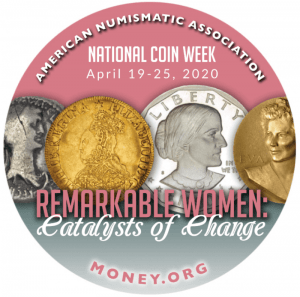 Earlier this week, Roundtable Trading announced that the Great American Coin Hunt that is part National Coin Week would go on as planned.
During the week of April 19-25, 2020, coin dealers will attempt to place collector coins into circulation. Those finding coins are encouraged to log onto social media and show off their finds using the hashtag #GreatAmericanCoinHunt.
Who is spending money and where are they spending it?
With the current COVID-19 stay-at-home orders, The number of places that are now taking cash payments has dwindled. Patrons of restaurants and encouraged to use online ordering and payments before arriving. Delivery services also want items paid for before making the trip to your front door.
In states that have laws that require retail stores to accept cash, retailers are requesting that customers limit “payment options to credit cards/debit cards… to minimize physical contact.”
The PaymentsJournal, a payments industry publications, reported that a study released by RTi Research shows an increase in people showing concern about catching coronavirus from using cash. The studies show that more people have used less cash, and more will use less cash in the future.
If consumers are using less cash in the fewer open retail outlets, then how successful will a coin drop be?
And now the news…
 April 4, 2020
 → Read more at scienceinpoland.pap.pl
April 6, 2020 → Read more at kitco.com
April 6, 2020 → Read more at breakingnews.ie
April 7, 2020 → Read more at space.com
April 10, 2020 → Read more at prweb.com
April 10, 2020 → Read more at collectspace.com
April 11, 2020 → Read more at stokesentinel.co.uk
→ Read more at scienceinpoland.pap.pl
April 6, 2020 → Read more at kitco.com
April 6, 2020 → Read more at breakingnews.ie
April 7, 2020 → Read more at space.com
April 10, 2020 → Read more at prweb.com
April 10, 2020 → Read more at collectspace.com
April 11, 2020 → Read more at stokesentinel.co.uk
Brunhart Leaves the U.S. Mint
It is not often a member of the federal government’s Senior Executive Service makes the news for changing jobs. But when that person is Andy Brunhart, it has the numismatic media noticing. CoinWorld is reporting in its January 31, 2011 edition that Brunhart left the U.S. Mint four days after Ed Moy’s last day.
Brunhart is now working for the Bureau of Engraving and Printing and will oversee quality and strategic integrated production issues. His arrival at the BEP comes after the mainstream media picked up on the production problems plaguing the printing of the new $100 federal reserve note.
CoinWorld reports that the Treasurer of the United States Rosie Rios will carry out the duties of the Director until a new director is appointed by President Obama.
Whitman on E-Books
Earlier this month I posted the question, “Where are the Electronic Numismatic Books?” That post garnered the most responses I have seen in quite some time—although many were in the form of personal notes rather than blog comments. Most of the comments were overwhelmingly positive agreeing with my assertion that there should be more electronic numismatic books.
Some of the comments, including Dennis Tucker, Publisher at Whitman Publishing, corrected me in saying that the Whitman Encyclopedia of U.S. Paper Money by Q. David Bowers is available on DVD. Tucker also said that the the Guide Book of United States Coins, Professional Edition was also available on DVD but I did not see it listed on Whitman’s website.
After receiving the note from Tucker, I asked him about Whitman’s e-book plans. He responded as follows:
Whitman Publishing does plan to distribute more books in electronic format. PDFs have certain strengths that our readers find appealing: they can be distributed on DVDs; they’re searchable; they have internal links; they’re PC and Mac compatible. Paper-money collectors love Q. David Bowers’s Whitman Encyclopedia of U.S. Paper Money — a massive 900-page reference book — and they also love having an electronic version available on a conveniently portable DVD.
Retail pricing, distribution models, and other details of future electronic projects aren’t ready to go public yet. But I can say that nothing is off the table as we explore the best ways to bring numismatic content to our readers — PDFs, downloads, apps, online content are all possibilities. Currently we have two web sites, WhitmanReview.com and WhitmanCoinCollecting.com, that aren’t “books” or “magazines” as such, but that broadcast show reports, book reviews, numismatic interviews and commentary, auction news, and other hobby information.
Remember in the early and mid-1990s, when “CONTENT IS KING” became the mantra of every Internet consultant and Web design agency from coast to coast? It’s still a very important concept in numismatic publishing. Whitman is strongly devoted to supporting fresh, ongoing, original numismatic research and authorship. This of course includes updated retail and wholesale pricing (as found in the Red Book and the Blue Book), updated auction records, updated certified coin populations, and the like. Those kinds of market data are very important to collectors, dealers, and investors. But Whitman Publishing has a commitment to the hobby community that goes beyond just reporting on market trends. We’ve nurtured a booming renaissance in numismatic publishing over the past ten years or so in particular. That investment, that energy, that explosion of talent has created the CONTENT; without good content, distribution models (whether ink-on-paper or electronic) are irrelevant to the hobbyist. If the content is factually wrong, or if it’s incomplete or misleading, or if it’s just a stale rehashing of old previously published information, it won’t matter if it’s published in books or online — collectors won’t find it valuable. Neither the publisher nor the consumer will find true, lasting value in that formula.
Whitman Publishing has the best numismatic authors and researchers working today. Kenneth Bressett, Q. David Bowers, Jeff Garrett, Dick Doty, Roger W. Burdette, David W. Lange, Rick Snow, Mike Moran, Bill Fivaz, J.T. Stanton, Katherine Jaeger, Rick Tomaska, Nicholas Brown, David Camire, Fred Weinberg, David Sundman, Harlan J. Berk, Clifford Mishler, Jim Haxby, Art Friedberg, Ron Guth, John Dannreuther, Hugh Shull, George Tremmel, Robert Azpiazu, Ira and Larry Goldberg, Eric P. Newman, Paul Rynearson, David MacDonald, Don Bailey, Scott Schechter, Saul Teichman, Fred Reed, Adam Crum, Selby Ungar, Jeff Oxman, Frank Colletti, Bob Leonard, Len Augsburger, Joel Orosz — that constellation of numismatic stars shows Whitman’s commitment to content. How we deliver that fresh, original content will continue to evolve. And it won’t end with the current generation of numismatic superstars. Last year Whitman teamed up with the American Numismatic Association to revamp and endow three new literary awards for Young Numismatists. They’ll be the ones digging in Treasury archives, unearthing primary documents, analyzing data, making brilliant connections, and writing about their findings after we all retire.
Is the traditional paper book obsolete? No. Are distribution models changing? Yes. Will Whitman Publishing continue to bring its best to collectors and serve their needs? Yes indeed!
Interestingly, I never questioned the quality of the content of Whitman Books. On the contrary, it is because that their content is so worthwhile that I am interested in e-books that Whitman would publish. However, I believe that the those of us who are interested in technology and those who grew up in the 1990s will be more interested in e-books than dead-tree editions. In other words, I think Whitman, Krause, Zyrus Press, and any other numismatic publisher should be entrenched in electronic publishing within the next five years.
Good Video Showing History of the BEP
When I returned to coin collecting a few years ago from my hiatus that began before I went to college I discovered there was more to collecting than buying shiny objects of copper and silver. I found that there was a confluence of history and politics that was also an interest. My return to numismatics coincided with my returning to school to get a masters degree that included public policy as part of the curriculum. It was perfect for a political junkie. So when something is written or broadcast that adds to my quest to learn about history that includes numismatics, my interest piques.
At the end of November, I was channel surfing and found a documentary on one of the C-SPAN channels about the History of U.S. Currency. The show featured an interview with Franklin Noll, Consultant in the Bureau of Engraving and Printing Historical Resource Center. It was a different look at the BEP since it did not go into the process of printing money but the final result and the evolution of the BEP.
Using pieces of the BEP’s archive, Noll traces the history of the bureau from its founding in 1861 to the modern small currency. Noll begins by showing some of the pre-BEP printed notes and how the government needed to control its currency in order to help fund the Civil War. He showed the first notes that were printed by a “New York Printer” under the authority of the new bureau. Noll does not mention that the New York printer was the American Banknote Company.
One think I learned was that Franklin Delano Roosevelt was the only president who had a direct influence on any aspect of currency design. When presented with the proof for the small one dollar Federal Reserve Note, FDR requested that the BEP switch the Great Seal and the Heraldic Eagle so that the eagle is on the right side of the note. FDR felt that this would be better since the eagle’s head would face the center of the note. Otherwise, the eagle’s head would be facing off the note. Noll showed the actual proof sheet that FDR wrote his request.
The video of the History of U.S. Currency can be viewed online in the C-SPAN Video Library. Not only can your watch the video, but there is an option to purchase a DVD. Just click here to see the video. Enjoy!
Rethinking Safety and Security
With the news coming from Arizona this past weekend, I was thinking about personal security and the security of our collections. It may seem like a gruesome topic to discuss in the aftermath of the shooting, but as long as our attention is on the situation, we need to take a look at our own security.
Last June, I discussed the Safety and Security Traveling with Coins after the robberies of dealers traveling to and from shows. One the key points I made is the beware of your surrounding, what we call “situation awareness.” It is not typical to think like this, but if you have numismatics that seem to be desirable, you need to consider your environment. Does the area “feel right?” Do you feel comfortable in the area? Are you worried about the strangers around you? What is your gut feeling? If you are not comfortable and just have that feeling that the area is not safe, go with that feeling and take appropriate actions.
We would like to think we live in a safe neighborhood, but at least once per week I see a news report with someone saying, “Nothing like this has happened here. This is such a safe neighborhood.” Unfortunately, there is always a first time, why be the first victim. How secure is your property? Are you coins on display in your home? If they are, do you have a security system?
Whatever you have for security may not be enough. You have to think like a thief and figure out how strengthen your defenses. Sure, strengthening your defenses may stop 95-percent of the thefts, but what about the other five percent? What about the amateur thief who gets lucky?
One of the best resources you have is your home insurance company. After many years of protecting property all over the country, they know what works and where to find the best people to help. Most insurance companies will help you with the risk assessment and share with you what their company knows about the risks in your area. They can also tell you about savings that you could see if you added additional security to your home.
Aside from the security of your personal property, you also need to considered what to do with your collection when you are no longer able to enjoy it. In my post, What Will Your Heirs Do With Your Collection, I discussed the necessity of estate planning with your collection. Remember, “It may be difficult to admit that the niece or grandson that appears to love to see your coins when they visit or is excited to receive a special numismatic gift may be more happy because of their interaction with you rather than your collection.”
Be honest with yourself, does your family really want the coins or what the coins are worth. If you are not going to mind that they will sell your coins, then leave it to them. However, if they are not going to keep the collection and their disposition really matter to you, then you should figure out how to deal with them while you still can make the decision.
While we pray that Rep. Gabrielle Giffords and the others who were injured a complete recovery; and we join with the families of Judge John Roll, 9-year old Christiana Green, Dorothy Morris, Phyllis Schneck, Dorwan Stoddard, and Gabriel Zimmerman in grieving their losses, we should take this opportunity to heighten our own security awareness to protect ourselves, our loved ones, and our collections.
Where Are the Electronic Numismatic Books
Ever since I first put my fingers to the keyboard of a PolyMorphic Systems Polly 88 microcomputer and learned to program it in BASIC, I have been very interested in technology and integrating technology in my life. I have owned computers since the early 1980s and spent a career first as a programmer, architecting systems and networks, and for the last 18 years in information security. Over my 30 year career I have seen the industry grow from million dollar mainframes to being able to put a computer in your pocket that can make telephone calls without wires and play music.
My trip down memory lane comes as the the Consumer Electronics Show (CES) opens in Las Vegas. It is the largest show that features nearly every electronic gadget and gizmo both available and not available. It is where companies announce new products, new features, and show off what they are thinking about the future—which those of us in the industry call vaporware. It is where all of the neat toys are shown off.
Even for those of us in the industry, it is difficult to predict the future, even after seeing this year’s “next big thing.” We can look back at the last CES and see what made it past the announcement and has became hotter a year later. Watching the new product introductions, the hot products are smarter phones and tablets.
Tablets are smallish computers with the functionality to consume media and content and only powered enough to be a limited content creator. Applications run locally to enhance the tablet’s functionality while giving the user access to an entire Internet of resources. This year it is clear that those introducing new products are looking to be the next iPad killer. Weather you like Apple or not, the iPad has set the tone for the tablet market the same way the iPhone has set the tone for the smart phone market.
So why am I talking about CES on a coin collector’s blog? Because this big thing will have an impact on how you consume numismatic information.
The future of content consumption is electronic. E-book readers will support the reading of books, magazines, newspaper, and some online content on a small handheld device conveniently sized for reading. They are designed to do one thing very well: provide you a way to read published content in a more convenient manner and without killing trees. While tablet and smart phones are more general devices, both have the ability for you to read published works when you are not playing the current hot game or social networking. All of these devices have programs that can tap into online bookstores so that you can buy books at a reduced price and have it loaded directly onto your device to read.
E-book readers can read many different format files, but the type used for the best reading experience is based on the concept of “electronic paper.” Electronic paper allows the reader to resize, bookmark, type notes, highlight, and do anything to an electronic page except fold it while maintaining the integrity of the book. As the read changes size or add their own notes, electronic paper allows the book to reflow, or repaginate, within the device. When a book or document is repaginated, tables of contexts and indices are also adjusted to make the text easy to search.
Currently, the only numismatic book publisher selling electronic versions of their books is Krause Publications. If you visit their online store you can search the Coin CDs/DVDs section to find a number of their publications, including the Standard Catalog series can be purchased on CD. Once you load the CD on your computer and copy the Portable Document Format (PDF) file to your hard disk, you can open the file in a PDF reader (Adobe Acrobat Reader on any system or Preview on a Mac). Once the file is open you can search for any text, zoom in to view any image up to 400 percent, add notes, bookmark pages, and highlight areas. Again, anything you can do with a real book except fold page corners.
Krause also sell sections of the Standard Catalogs and other publications as downloads. For example, if all you are interested in are Obsolete Bank Notes of the District of Columbia, you can just download that section of the Standard Catalog of United States Obsolete Bank Notes for significantly less than the entire four CD set.
Since I purchase the Standard Catalog of World Coins for the 20th century, it has been a wonderful resource to have while sitting at my computer. Searching for country coinage information and making highlights has really enhanced my appreciation for the work without having to lug around that huge volume. I also consider how many trees were saved by buying bits and not pulp.
Using a PDF document on an e-reader does not take advantage of the e-reader’s strength. Since I do not have an e-reader, I downloaded Krause’s U.S. Coin Digest onto my iPhone to use as a portable reference. It is a wonderful portable reference to have without having to carry the book. However, the use of a PDF document shows its limitation on smaller screens. A test on a friend’s Kindle demonstrated the limitation of a PDF file when it was proven difficult to navigate a zoomed PDF document because of screen size limitations. It would help those of us with e-readers if they would publish books in ePub and E Ink formats.
At least Krause has taken the first step into electronic publishing. Whitman Publishing, the other major publisher of numismatic books, only offers “dead tree editions.” I know that some people like the physical book, but they should start embracing the 21st century and offer e-books for those of us who want to read their books in a more portable format that does not kill trees. I am sure Whitman can figure out the economic benefits of replicating bits over importing physical copies from China.
Until Whitman and other numismatic publishers catch up with the e-reader, you can find classic electronic books to download to any device. The best source if Google Books. While Google Books does sell current editions in electronic format, they also have a number of scanned books they have permission to make available or whose copyrights have expired. The best way to find numismatic books is search for “coins” on the Google Books website. Books can be read online or you can download free books through the Google Bookstore. You can file early copies of The Numismatist through Google.
Publishers who have not embraced the e-reader will lose out on the business of younger numismatists and technology-oriented people like myself. CES made it clear that the future is in portable electronic devices and the publishers who cannot or will not provide the appropriate product will be losing out on new business. I hope the numismatic publishers consider this for their current and future publications
Support the Coin Collectors Blog
 Buy me a coffee
Thank you for your support!
Let Me Know What You Think
Are you going to the World's Fair of Money
Total Voters: 17
 Loading ...