
REVIEW: The Coin World Podcast
(yes, I borrowed their logo!)
Currently, there are three numismatic-related podcasts. Today’s review will only look at the newest entry, the Coin World Podcast.
The Coin World Podcast is one-year old. It started on March 28, 2019, and features hosts Jeff Starck and Chris Bulfinch, both writers for Coin World. After one-year, Jeff and Chris have hit on a rhythm that makes it worth listening.
If you binge listen from the beginning, you will find that it takes Jeff and Chris a while to fix a number of their technical issues. As a listener of those early shows, I can tell you that the sound quality was not right and sometimes was grating. It took almost two months for them to work out those issues.
Even with the lousy sound quality, it is worth going back and listening, especially for the interviews. After the banter at the beginning, each episode features a conversation with someone in the numismatic industry.
Doing a “live” interview, as opposed to an interview for print, is that a broadcast interview has to flow in a way that makes sense. Aside from being able to flow, the interviewer has to anticipate what the listener wants to hear. They ask compelling questions and add logical followup. It makes for a great listen.
As with a lot of podcasts, Jeff and Chris open with the news. While they do report the news, they do let some of their opinions show through. The way they add their opinion is not overt but enough to get their point across in a way that does not alienate a listener who might disagree.
A recent feature is a discussion of this period in numismatic history. Jeff and Chris would reference something that happened and read a contemporary account. They will also read letters that appeared in Coin World from years ago to prove the axiom, “the more things change, the more they stay the same.”
Combining history with contemporary accounts gives the feature a more exciting feel than just reciting facts. They should do this more with other discussions, especially with the library they have access to at Coin World.
After a year together, Jeff and Chris have developed a pleasant on-air rapport and a rhythm that makes the podcast worth the time to listen. However, whenever listening to the podcast, it feels as if something is missing before the interview. I know the P.T. Barnum once said, “Always leave them wanting more.” But there should be something else to add that one extra punch.
Having been a listener since Episode 1, the improvements have made a difference, and the interviews are enough to keep listeners coming back for more. I grade the podcast and MS-65, noting that there is a little room to add that one thing that can give it a grade boost.
Congratulations to Jeff Stark and Chris Bullfinch for making it to the first anniversary of the Coin World Podcast!
Palladium Eagle May Be Coming
In a rare swift move by the House of Representatives, H.R. 6166, American Eagle Palladium Bullion Coin Act of 2010, was introduced, discharged from the House Committee on Financial Services, considered on the floor, and passed without objection. With its passage in the House, the bill was Engrossed and sent to the Senate for consideration.
In the Senate, the bill was read twice and referred to the Committee on Banking, Housing, and Urban Affairs. Congress has adjourned for the election season.
H.R. 6166 was introduced by Rep. Denny Rehberg (R-MT), the representative at-large from Montana. Montana is home of the Stillwater Mining Company, (NYSE: SWC) the only producer of palladium in the United States. Stillwater also owns platinum mines that supplies the U.S. Mint with platinum for American Eagle Bullion coins. With this bill, Rehberg adds his name to a long line of congressmen who have introduced bills to protect their state’s mining interests by using the U.S. Mint as a primary purchaser.
In the world of metal investing, palladium is behind gold, silver, and platinum in demand. Palladium is not as popular in the United States as it is in other countries. Palladium sells better than silver in Canada and Europe. It is rarer than gold, but a little more abundant than platinum but has the silky look of platinum while being almost as ductile as silver. Artists in Europe and Asia are beginning to use palladium instead of platinum for their higher-end designs.
Since the price of palladium is less than the price of gold and platinum, it is possible that investors could consider palladium as part of a diverse portfolio. Those who believe in “end of the world” scenarios will not be interested because the secondary market is not as strong as it is for gold.
![[Most Recent Quotes from www.kitco.com]](http://www.kitconet.com/images/sp_en_6.gif)

 The bill requires that “the obverse shall bear a high-relief likeness of the ‘Winged Liberty’ design used on the obverse of the so-called ‘Mercury dime’” making it yet another bullion coins using a design from the early 20th century. For the reverse, the law says that it “shall bear a high-relief version of the reverse design of the 1907 American Institute of Architects medal.” Both the Mercury Dime and 1907 AIA medal were design by Adolph A. Weinman, whose Walking Liberty design is used on the American Silver Eagle coin.
In other words, congress saying that it does not trust the U.S. Mint to create a design suitable for this coin. While some might have an issue with the design of recent coins, it would be nice to unleash the creativity of the U.S. Mint’s artists and allow them to make a design to represent Liberty. Maybe if the artists were less constrained, they can use their talents.
Another provision of the bill is that aside from using palladium from U.S. sources, it allows the U.S. Mint to purchase palladium from other sources. The bill also makes a distinction between proof and bullion coins allowing the U.S. Mint consider minting proofs to meet collector demand… or not depending on whether there is a demand and a supply to meet the demand. In other words, it will be up to the government lawyers to figure out what is meant by the wording in the bill!
If the bill passes the Senate and signed by the President, palladium bullion coins will not be issued until 2012 because it is too late in the year for the U.S. Mint to plan to issue this coin.
1938 Mercury Dime image is owned by the author.
Image of the 1907 AIA Medal copied from Architecture: celebrating the past, designing the future by Nancy B. Solomon.
New $100 Note Release Delayed
On October 1, the Federal Reserve announced that they will delay the release of the redesigned $100 Federal Reserve Note because of production issues. The release was planned for February 10, 2011.
The announcement said that the BEP has identified a problem with sporadic creasing of the paper during printing of the new $100 note that did not appear during pre-production testing. While the BEP is working to resolve the issue, the Federal Reserve will not have enough notes to begin worldwide distribution causing the delay. No date was announced.
Grand Canyon Quarter Launched
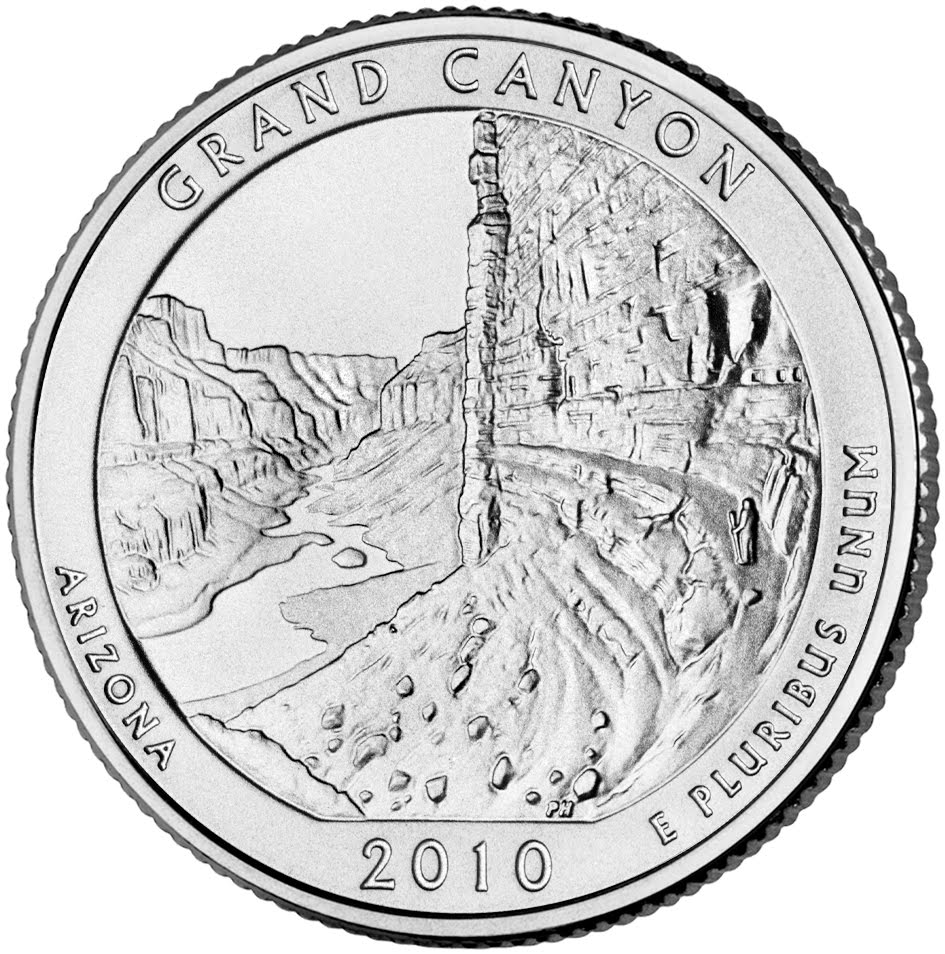 On September 21, the U.S. Mint had its launch of the Grand Canyon National Park quarter. The event was held near the Verkamp’s Visitor Center at the Grand Canyon National Park. The reverse image features a view of the granaries above the Nankoweap Delta in Marble Canyon near the Colorado River. Marble Canyon is the northernmost section of the Grand Canyon. Granaries were used for storing food and seeds. It was designed and sculpted by United States Mint Sculptor-Engraver Phebe Hemphill.
As with previous releases, the U.S. Mint released an edited B-roll video of the launch with highlights, scenery, production footage.
The Grand Canyon is the first of the quarters that represents a national park I have visited. Looking at the background over his shoulder, I understand why U.S. Mint Director Ed Moy looks happy. Although I have only been to the South Rim, the Grand Canyon is still one of the most awesome sites in the United States and worth visiting.
Quarter image and video complements of the U.S. Mint.
BEP Releases Video on New $100 Note
As a follow up to their previous video, the Bureau of Engraving and Printing has released Part II of their educational series about the new $100 Federal Reserve Note.
This month’s video is “How to Detect A Counterfeit, Part II.” The 12-minute video shows consumers how to recognize the watermark, security thread, color-shifting ink, raised printing, and microprinting security features on the new note. The video includes a demonstration by Kelley Harris of the United States Secret Service, head of the Washington, DC counterfeit lab. Harris also shows examples of counterfeit attempts. Interestingly, she talks about the small letters and numbers located on the notes that show the plate and position codes of the notes.
Here is the BEP’s video:
UPDATE:
Yesterday’s release announcement was for the third video podcast of the BEP’s $100 Note Podcast series. Rather than read the release, I used the information from other sources. Sorry! The new video is “The Art of the Banknote Design.” The video features Larry Felix, Director of the Bureau of Engraving and Printing, and Michael Lambert, Assistant Director of the Board of Governors of the Federal Reserve System. Felix and Lambert discusses the thoughts behind the creating of the new $100 Federal Reserve Note.
Here’s video three:
Grand Canyon Quarter Launch Live Webcast
The U.S. Mint will hold its launch event for the Grand Canyon National Park on Tuesday, September 21, at 1:30 p.m. (MST). You can watch the event live starting at 1:25 p.m. (MST)—4:25 p.m (EDT) at americathebeautifulquarters.gov. I will have the highlights and B-roll video posted here when it becomes available.
Support the Coin Collectors Blog
 Buy me a coffee
Thank you for your support!
Let Me Know What You Think
Are you going to the World's Fair of Money
Total Voters: 17
 Loading ...