
Weekly World Numismatic News for March 1, 2020
Show of hands: how many of you have found an old coin only to think it was a reproduction?
As an avid junk box diver at flea markets, antique shows, and other venues, I regularly come across reproductions of old coins made of various materials. The most common are brass and pewter.
In 2018, someone found a pewter coin that resembles a Continental Currency dollar in the same design as the Fugio Cent. After consulting a dealer, the coin was sent to Professional Coin Grading Service for authentication.
PCGS determined that it was a period created coin. They graded it MS-62.
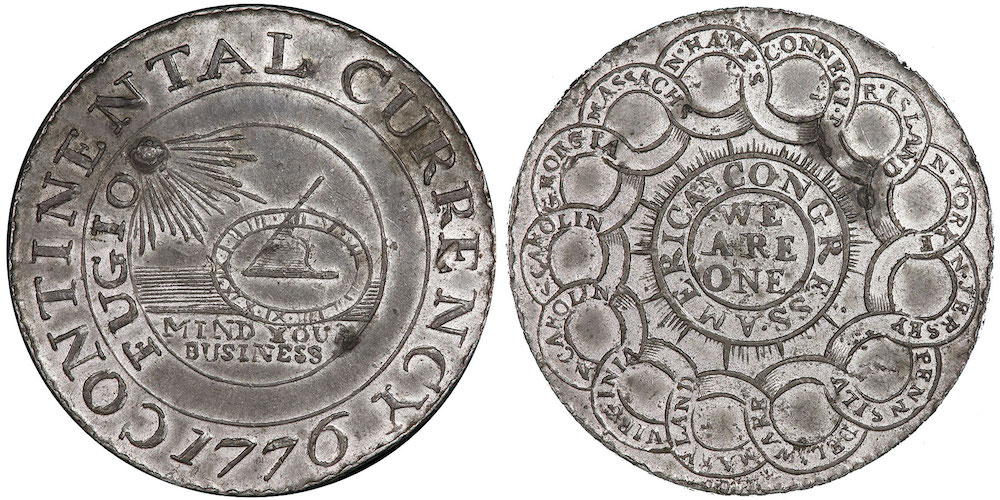
1776 Pewter Continental Dollar, PCGS MS-62
(Image courtesy of PCGS)
It is not clear where the coin was made. Some experts say that it was a pattern made in Philadelphia. Others speculate that it was made in England as a satire piece to mock the newly formed country.
The problem is that PCGS does not describe the criteria that they used to determine the coin is authentic. Neither their public news article or the PCGS Coin Fact entry does not provide details of what makes this a genuine coin. With all due respect to PCGS, I have learned the hardway: trust but verify!
https://www.pcgs.com/news/pcgs-paris-office-certifies-1776-continental-dollar?gid=47
https://www.pcgs.com/coinfacts/coin/1776-1-curency-pewter/794
Someday, I hope to find something similar in one of my junk box dives. But I hope PCGS would help the community by publishing what to look for when junk box diving. I would not mind sending a proper find for authentication, but I do not want to pay for a service if it is not necessary.
And now the news…
 February 24, 2020
 → Read more at mesquitelocalnews.com
February 25, 2020 → Read more at masslive.com
February 25, 2020 → Read more at pennlive.com
February 27, 2020 → Read more at wmar2news.com
February 29, 2020 → Read more at mysuncoast.com
February 29, 2020 → Read more at thesun.co.uk
February 29, 2020 → Read more at thenewsminute.com
February 29, 2020 → Read more at tcpalm.com
→ Read more at mesquitelocalnews.com
February 25, 2020 → Read more at masslive.com
February 25, 2020 → Read more at pennlive.com
February 27, 2020 → Read more at wmar2news.com
February 29, 2020 → Read more at mysuncoast.com
February 29, 2020 → Read more at thesun.co.uk
February 29, 2020 → Read more at thenewsminute.com
February 29, 2020 → Read more at tcpalm.com
Tweeting the May CCAC Meeting
Yesterday, the Citizens Coinage Advisory Committee met at the US Mint Headquarters in Washington DC. During the meeting, CCAC member Donald Scarinci set up his laptop and tweeted from the meeting.
Based on Scarinci’s tweets, it was not a comfortable meeting. While reading the tweets, it seemed that there were some contention between the U.S. Mint and the members who blindly support whatever the Mint wants. Scarinci has indicated to me and in his commentary that appeared in Coin World that he was interested in performing the job intended by the law authorizing the CCAC.
Following the meeting, comments from other members indicated that Scarinci’s statements that appeared in Coin World editorial was the catalyst for the contentious feelings experienced at the meeting. One member indicated that there were more tactful ways to make comments about other members.
It is not apparent from the Coin World editorial what was objectionable in what Scarinci did or said. However, past experiences with CCAC Chairman Gary Marks may indicate that he takes commentary personally rather use it as a constructive lesson. If Marks and the U.S. Mint can realize that those who criticize are not against them but care enough to want to make things better there would be less of a strained relationship between the CCAC members and the public.
UPDATE: I am not condemning or condoning Scarinci’s comments. I am saying that on the surface it does not appear that what he said rises to the level of scorn that is being raised. Regardless of how you feel about his situation, I encourage Scarinci to continue to work in a manner that he feels is in the best interest of the CCAC, even if it means trampling on a few egos.
If you missed the meeting, the following are the compilation of the tweets from @Scarinci:
Follow the CCAC Tweets on Tuesday
As a reminder, the Citizens Coinage Advisory Committee will meet on Tuesday, May 25 at the US Mint Headquarters in Washington, DC. On the agenda is the review for the 2011 US Army and Medal of Honor Commemoratives. Coin World is reporting that the designs are less than inspiring.
If you cannot attend the meeting, you can follow the tweets of CCAC member Donald Scarinci to read real-time updates from the meeting. Just follow @Scarinci on Twitter. Scarinci has already begun tweeting about the designs the CCAC are reviewing also noting the Coin World article on the designs. Stay tuned!
Record Sale for Rare Dollar
Last week, a 1794 Flowing Hair Silver Dollar that may be the oldest known silver dollar was sold for a record $7.85 million! Steven L. Contursi of Rare Coin Wholesalers of Irvine, California sold the coin to Cardinal Collection Educational Foundation of Sunnyvale, California in a private sale.
The coin was graded by Professional Coin Grading Service as Specimen 66 (SP66).
The sale surpasses the $7.59 million paid (including buyer’s premium) in 2002 for the legendary Farouk-Fenton 1933 Double Eagle.
As an interesting aside, the Farouk-Fenton would be worth $9,197,822 accounting for inflation between 2002 and 2010. Of course the coin could sell for more if it should come up for sale again. However, the existance of the ten Langbord-Switt 1933 Double Eagles could change the perception of value for all of the 1933 Double Eagles.
Could EU Countries Reissue Their Original Currency
You might have noticed that a European debt crisis has caused the markets to panic where some have been saying there is no relief in sight. It started wit the economy of Greece needing its own bailout while it is questioned as to whether they can pay the money back. The the news that Portugal, Spain, and possibly Ireland may follow. As a result, the Euro is at a 4-year low against the dollar and dropping.
Aside from the economic impact, there has been questions about the viability of the European Union as an economic entity and its ability to act as a central bank in the best interests of the sovereign members of the Euro zone. Countries can no longer manipulated their currencies or manufactured more money to maintain solvency. They now have to follow the rules of the European Central Bank in order to maintain “fairness” within the Euro zone.
What would happen if these countries did not want to be beholden to the European Central Bank? Countries would have to break from the bank and issue its own currency. There has even been speculation as to the current value of the former EU currencies if they were still in circulation.
For numismatists it would add new collectibles to the market. Countries that would re-issue its own currencies would likely demonetize the Euro and force locals to trade in their Euro coins and notes for the re-issued currency. This would make the reverse designs that are country specific instantly collectible as well as the new Drachma, Escudo, Pesta, Franc, Lira, or Deutsche Mark that would be issued in its place.
Maybe Great Britain was right for not converting to the Euro. But for now, their newly issued circulating coinage is arguably the most interesting in the Euro zone. Maybe another country will join them an open new areas of collectibles.
Follow Up: ANA versus Technology
First, I want to thank everyone who responded directly to me regarding my post ANA versus Technology: The ANA is Losing! There have been so many notes that it is impossible to respond individually.
An overwhelming number of responses were from people who identified themselves as 20-something or 30-something collectors who said they read my blog and others to hear from other collectors. It seems as if they read the blogs to share with other collectors as they would do if they were to attend a coin club meeting. It may be anecdotal, but it adds to my assumptions as to where to find what I am calling “the gap generation” between the young numismatists and the member who comes back to collecting after they are settled into their life.
To answer the predominant question generated by the post: yes, I heard from members of the ANA Board of Governors and ANA President Cliff Mishler. Since I have not had a chance to answer their notes I will not comment on the contents of the correspondence at this time. There are areas for me to follow up and will do so shortly.
I will say that I learned a few things from the Board members that is not readily apparent from materials published by the ANA. That information gap is worrisome and something that has to be addressed.
Support the Coin Collectors Blog
 Buy me a coffee
Thank you for your support!
Let Me Know What You Think
Are you going to the World's Fair of Money
Total Voters: 17
 Loading ...