
Weekly World Numismatic News for January 5, 2020
News opened for the new year with ancient coins returning to Mexico after previously been legal for trade.
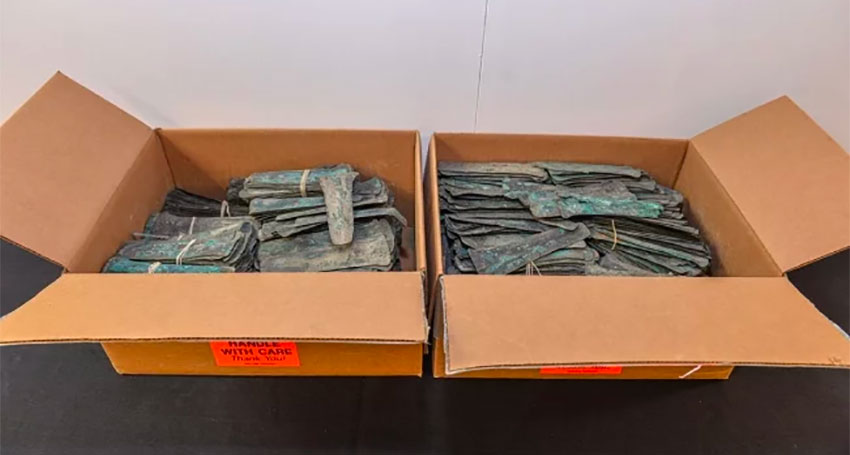
Pre-Hispanic Mexican coins that were recently “returned” to Mexico (Image courtesy of Mexico News Daily)
After the coins were taken to Spain for auction, the Mexican government contacted the FBI asking for their help. Allegedly, the collector voluntarily turned them over.
Even though the coins were obtained legally and subsequently legislated into chattel, foreign governments continue to attack United States collectors because they can.
Under the UNESCO convention, numismatic items are the most problematic. When so many examples exist, every coin should not be considered cultural property. Countries can be reasonable and hold back a few examples that would help tell their story, but what is wrong with sharing that story with the world? Does 3,500 coins, most that will never see the light of day again, have to be hidden from the public in Mexico? Would it be against Mexico’s interest to share about 85-percent of that hoard with the world?
Watchers of how countries selectively enforce the provisions UNESCO convention will note that the majority of claims on the alleged numismatic cultural property occurs in the United States or against Americans abroad. Why does the Italian government not claim property rights for all the Roman hoards found in the United Kingdom? Why has there not been claims made against hoards found along the path of the Silk Road during the last few decades?
The only time the UNESCO convention is invoked for numismatics is when someone tries to smuggle coins out their countries, which is reasonable, or in the United States. Why?
And now the news…
 December 31, 2019
 → Read more at mexiconewsdaily.com
December 31, 2019 → Read more at breakingisraelnews.com
January 1, 2020 → Read more at haaretz.com
January 5, 2020 → Read more at bnn-news.com
January 5, 2020 → Read more at whig.com
→ Read more at mexiconewsdaily.com
December 31, 2019 → Read more at breakingisraelnews.com
January 1, 2020 → Read more at haaretz.com
January 5, 2020 → Read more at bnn-news.com
January 5, 2020 → Read more at whig.com
Numismatic Website Updates
Progress and experience is a good thing. It helps us learn about ourselves and how other perceive us. In the world of competing for business in numismatics, progress and experience helps those who sell coins and offer services improve how they communicate to us, their customers and constituents. Today, we are going to look at the websites that those of us who live part of our lives online visit for our numismatic fix.
Earlier this year, the Royal Canadian Mint updated their website. Prior to their current update, their site was written using Adobe Flash in a way that felt limiting to someone who visited the site to browse. The updated site has a more exciting look, fresher colors, and is better for those of us who like to browse. And speaking of browsers, this version does not use Flash in the same way as the old site. Your experience will be faster and more responsive than the previous RCM design. It is clear that experience has allowed the RCM to progress to a new design.
Not long ago, The Royal Mint updated their website. Although The Royal Mint did not need an update, they chose to change the basic theme and go with a simple design with a black background. It give the site a regal look, which is in tune with The Royal Mint’s vision of itself as one of the world’s oldest mint. However, navigation of this site is a bit quirky. There appears to be extra clicks required to find products and while the look is nice, every page has an image on top that distracts from the presentation by pushing to coins down. This image may only be a minor annoyance, but an annoyance nonetheless.
Here in the United States, there have been changes in the website for the Bureau of Engraving and Printing. The bureau with one of the best domain names (www.moneyfactory.gov) appears to have hired website designers that have graduated from Web Design 101. The site is is clean and professional looking with easier navigation making it easier to find information about the BEP. From the front page, the site is about the bureau and its functions. Sure, the last major even of the BEP is the redesign of the $5 Federal Reserve Note in 2007, but it allows the BEP to highlight its limited accomplishments.
With the new design, the BEP has created a new store front with its own domain name: www.moneyfactorystore.gov. The new store is easier to navigate and find products. The categories have been cleaned up, the unavailable products have been removed, and the premium series can be purchased by series or individual Federal Reserve banks. Buying individual premium products by Federal Reserve Bank was not possible with the old website.
Moving away from the government, the Professional Coin Grading Service has redesigned its website again. This time, rather than rely on the black and gold theme of their logo, PCGS is using a lighter blue theme to highlight their service. While this design is better than their previous designs, it is not without issue. For example, there is something about the front page layout that bothers me. The banner is too large, there is too much space between the banner and the page contents, and menus at below the main content are too low. If the PCGS web designers can lower the height of the banner, close up that extra space, the lower menus will move up on the page and not feel as if they are an after thought. Making these fixes could change the A- design into a solid Grade A design.
Of course the one website that is in dire need of updating continues to have the same design since 2000. The US Mint should update their web presence, especially their online catalog.
Happy Thanksgiving
 Thanksgiving was first celebrated in 1621 by the settlers at Plymouth, Massachusetts to celebrate a successful harvest. It was a tradition that the Pilgrims brought with them from England. After the birth of the United States, President George Washington issued a proclamation honoring the Thanksgiving harvest during his presidency. The only other president to issue a Thanksgiving proclamation was President James Madison. As part of his attempt to maintain the union, President Abraham Lincoln issued a proclamation that made Thanksgiving Day a national annual event.
Be thankful for your family.
Be thankful for our hobby.
Be thankful for everything.
Image of The First Thanksgiving at Plymouth by Jennie A. Brownscombe courtesy of the Pilgrim Hall Museum.
Numismatic Follow Friday on Twitter
Do you tweet? Tweeting is what you do when you post a message on Twitter, the popular social networking website where messages are limited to 140 characters. Twitter hosts many very active communities discussing everything from politics to sports to news to technical support and everything in between. Interestingly, breaking news spreads faster on Twitter than on many news organization’s websites!
Rather than reading every tweet on the single timeline, you would read your timeline which includes your tweets and the tweets of the people you follow. This way, you can create your own community and just watch the tweets of the people you are interesting in reading.
Those who run Twitter has let it evolve into its own culture with conventions that users adhere to communicate community of interests. The primary convention is one built into the Twitter software is using the “at symbol” (@) to identify a user name. By using the at-symbol in front of the user name, it allows the software to recognize the tweet as a message to or about that user. Direct replies to a user begins with the user name. For example, I use the username coinsblog for numismatic tweets. I would see references made as “@coinsblog” as part of my timeline.
Another convention using the user name is the re-tweet. A re-tweet is a message from another user that I am replaying for those users that follow me. If I tweet something you like and want your followers to read, you would send a message that begins with “RT” followed by the at-symbol prefixed user name followed by the message. This way you give credit to the original tweeter.
One useful way to use Twitter is to point to something on the web that further explains your tweet. For me, I will post something to the blog and tweet about it. However, URLs of the post may be too long to fit with the message in 140 characters. In order to fit the URL into the message, I would use a URL shortening service. A URL shortening service is a website that takes the long URL and shortens it to a few parameters. Two popular URL shortening services are tinyurl.com and bit.ly. Both will take a long URL and provide a shorter one that will be expanded when you click on the link. For example, the URL to my last post was shortened to http://bit.ly/2Nqyaw.
The final convention that I will talk about is the use of hashtags. Hashtags are keywords that begin with the pound or number symbol (#) to indicate that those interested in the keyword can use to search for similar tweets. Hashtags are created by the community. There is no organization managing these hashtags, which can cause interesting conflicts. So far, there has not been a problem with hashtag “squatting.” Currently, I am not aware of the use of hashtags for numismatic tweets but I am thinking of defining a few.
Today, I will be using the hashtag #followfriday, which is used on Fridays to announce who you follow that other people who share your interests should also follow. Users named on the #followfriday tweet will be prefixed with an at-symbol so that the software will recognize the user names.
Today’s #followfriday includes:
| @ANSCoins | The American Numismatic Society. |
| @beautifulcoins | Is the user from beautifulcoins.com. I like reading the blog which features very interesting non-circulating legal tender (NCLT) coins from around the world. |
| @KPNumismatics | Krause Publications, the publishers of Numismatic News, Coins, Coin Prices, Bank Note Reporter, and many numismatic books. |
| @WhitmanCoin | The folks from Whitman Coin Expos who run a number of shows including the Baltimore Expo that I missed last weekend. |
Twitter is another tool to help us communicate as a community. If you have not joined, join now and start following these people.
Introduction of the Final Lincoln Cents
 With “Real Life” delaying the completion of my proposal to Reform US Currency, I wanted to take a brief moment to talk about the November 12th launch of the last of the 2009 Lincoln Bicentennial One Cent coins honoring Abraham Lincoln’s presidency.
The reverse design is an image of the US Capitol as it appeared on March 3, 1861 when Lincoln was inaugurated for the first time. With the Civil War imminent, Lincoln was asked whether the government should stop the construction so that the money would be used for the war effort. Lincoln was ever mindful of trying to keep the promise of the union said that the dome’s completion would enforce that view—making it an appropriate design for the last of this series. The reverse was designed by Susan Gamble and sculpted Joseph Menna.
 In addition to the launch of the final 2009 reverse design, the design for the 2010 Lincoln Cent was introduced. The reverse of next year’s coin features a Union shield. In the context of symbolism, the union shield is an emblem symbolizing a national union fitting of the theme calling for the reverse to be “emblematic of President Lincoln’s preservation of the United States of America as a single and united country” as required by Public Law 109-145. Although this is not the first time a union shield has been depicted on US coinage, this is an interesting choice that I will discuss in the future. However, given the history of the Lincoln Cent, this will be the design for the next 50 years!
If you missed the launch, you can see some of the ceremony, the crowd, the designs, and part of the exchange in the following B-Roll video from the US Mint:
Coin images courtesy of the US Mint
B-Roll video from NewsInfusion
Reforming America’s Currency: Part 5-Bullion
My motivation for recommending the restructuring of the US Mint was when they announced that proof silver and gold American Eagle coins will not be produced in 2009. The logic of the decision in the context of what we know of the US Mint’s operations was unpalatable.
Restructuring the bullion program is to first acknowledge that it is a profit center for the US Mint. Its sole purpose is the buy precious metals and create bullion coins for sale at a significant profit. In the 2008 Annual Report, the profit on bullion issues was 22-percent over all costs, more than circulating currency or commemorative coins.
The anchor of the bullion program are the American Eagles, which has been the most successful bullion program since its inception in 1986. The program started with silver and gold American Eagles. Platinum bullion Eagles were first struck in 1997. American Silver Eagle coins are one troy ounce of 99.9-percent pure silver. American Gold Eagles contain 22-karat (91.67-percet) of gold balanced with silver and copper struck in 1/10 ($5), ¼ ($10), ½ ($25), and one ($50) troy ounces. American Platinum Eagles are struck using 99.95-percent platinum in 1/10 ($10), ¼ ($25), ½ ($50), and one ($100) troy ounces. This program will not change and the US Mint will continue striking coins to meet the demand.
Under the current law, it is not required that the US Mint strike proof versions of these bullion coins. This restructuring will change this to require a minimum mintage of these coins. For the future, the US Mint will strike proof coins to meet the demand with a maximum number in ounces of metals used. For this policy, it is proposed that 1 million troy ounces of silver be used for proof coins meaning the production will be limited to 1 million coins. Gold will be limited to 500,000 troy ounces of gold across all sizes. Finally, platinum will be limited to 100,000 troy ounces in proof coins.
I am not proposing changes to the 24-karat (.999 fine) Gold Buffalo program.
To complete the transformation, the First Spouse program will be transfered to bullion issues and continue using the same rules as it does today.
This year, the US Mint introduced the 2009 Ultra High Relief Coin. This coin brings to life the Augustus Saint-Gaudens proposed high relief design for his $20 Double Eagle design that 1909 technology could not create. The coin has been praised for its beauty and should be a future Coin of the Year candidate.
The concept of creating special bullion coins like the Ultra High Relief coin is something that a new bullion program can do. The US Mint, with direction from the CCAC acting as the US Mint’s Board of Directors can authorize new bullion coins that will allow the US Mint to create new collectibles that could be marketed to a wider audience. In addition to special strikes, the new bullion program can include coins with privy marks, special reverses, enameled coins, even coins made from multiple materials.
Examples of what could be accomplished can be seen in the 2007 Coin of the Year and 2008 Coin of the Year candidates. Although there are wonderful single metal coins, there are some wonderful coins using other design elements. In fact, the the 2009 Coin of the Year award was given to the 2007 Mongolia Wolverine coin with diamonds for eyes that is very intriguing when seen in hand!
It is not my intent to tun the US Mint into the non-circulating legal tender (NCLT) producer like the Royal Canadian Mint who is known to produce a large number of bullion-related issues. The CCAC should limit the introduction of bullion issues to a few a year and limit the number of coins that could be produced for each type. But if the US Mint can find influence in more areas than classic US coinage to produce beautiful collectibles using bullion metals.
Before I forget, these coins are bullion collectibles sold as a profit for the US Mint. They are not commemorative coins and not subject to the fundraising considerations proposed for commemorative coins.
Although the US Mint has been the focus of this series, we cannot reform America’s currency without considering paper money. Next, I will look at the Bureau of Engraving and Printing and what to do with Federal Reserve Notes.
Support the Coin Collectors Blog
 Buy me a coffee
Thank you for your support!
Let Me Know What You Think
Are you going to the World's Fair of Money
Total Voters: 17
 Loading ...