Feb 6, 2022 | coins, commemorative, Royal Mint, US Mint
There was a lot of numismatic-related news this week that collectors should note.
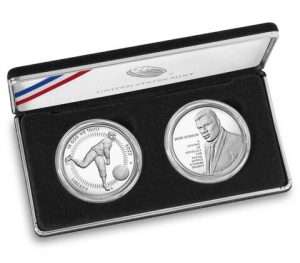
Negro Leagues Baseball Proof Silver Dollar Coin and Jackie Robinson Silver Medal Set \
(Image courtesy of the U.S. Mint)
At the same time, the U.S. Mint announced the pre-sale for the Negro Leagues Baseball 2022 Proof Silver Dollar Coin and Jackie Robinson Silver Medal Set. The Jackie Robinson 1 ounce silver medal is currently only available as part of this set.
In a separate announcement, the U.S. Mint also declared that they reached the limit on the number of pre-sale coins for the proof and uncirculated American Silver Eagle collector coins. The announcement shows that the American Silver Eagle continues to be the U.S. Mint’s most popular collector coin.
On February 6, Queen Elizabeth II celebrates the 70th anniversary of her ascension to the throne of the United Kingdom and the Commonwealth Relm. While the country celebrates the Platinum Jubilee, it is a solemn day for the Queen because it marks the 70th anniversary of the death of her father, King George VI.
While Queen Elizabeth took private time to remember her father, the Royal Mint released a good deal of coins to celebrate the Platinum Jubilee. The current lineup includes gold and silver coins ranging from one-ounce to 10-kilo gold coins.
The Royal Mint and Royal Canadian Mint announced a two-coin silver set with coins designed to celebrate the Queen’s Platinum Jubilee earlier today. The Royal Canadian Mint will sell the set.
At some point, the U.S. Mint will release the 2022 National Purple Heart Hall of Honor that will include a colorized silver dollar. That will be exciting.
And now the news…

January 28, 2022
What happened to money if a European country went broke in the 17th century? And how did a bizarre coin lead to the introduction of paper bills, as well as central banking systems?

→ Read more at
scandinavianarchaeology.com
January 31, 2022
The Underground Railroad, the famous network of safe houses and secret routes that helped enslaved people of African descent escape to freedom in Canada, is the subject of the Royal Canadian Mint's latest issue in its ongoing Commemorating Black History coin series.
→ Read more at
prnewswire.com
February 1, 2022
The year 1776 was obviously a big year for the United States. But before the Declaration of Independence was signed, another sign of freedom was created by Continental Congress.
→ Read more at
wearethemighty.com
February 4, 2022
THE Fugio cent minted in 1787 has long been enjoyed by coin collectors. We explain what you need to know about the rare coin, which is also called the Franklin cent.
→ Read more at
the-sun.com
Sep 16, 2021 | coins, Royal Mint
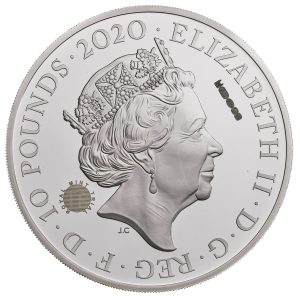
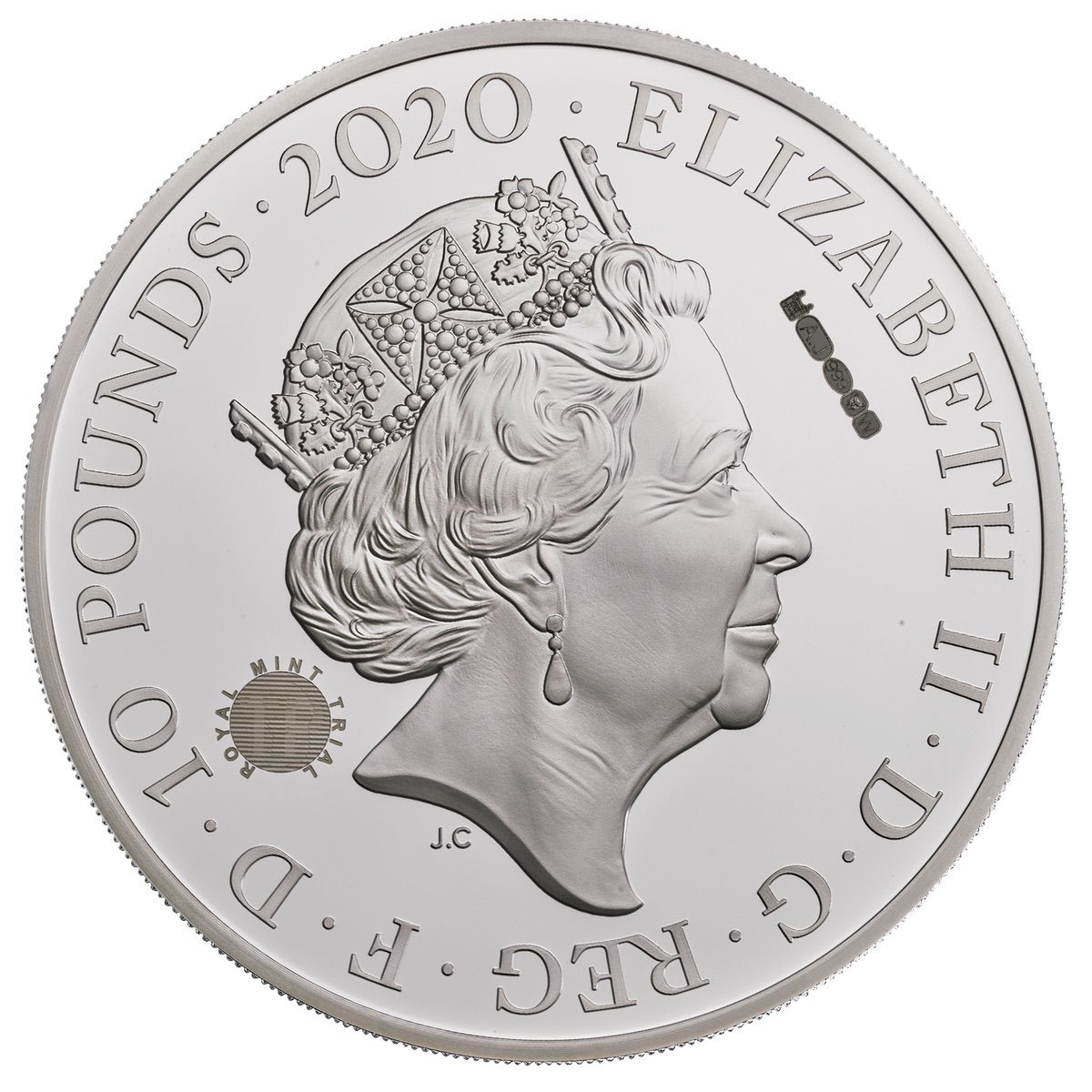
Three Graces UK Five-Ounce Silver Proof obverse (trial piece) – TR213GS5
One of the more fascinating events of Collect Week is the auction for Die Trial Pieces. Die Trial pieces are coins struck before the production run as a test. The Royal Mint has a good description of Die Trials on its website.
The list of die Trial Pieces includes gold and silver strikes from 2019 and 2020. Each coin has a hallmark attesting to the quality of the strike as defined by the Royal Mint. The Royal Mint published a list of 60 Die Trial Pieces that will be in the auction.
There are also webinars held during the week. You may have to adjust your sleep pattern to attend if you are interested, but it might be worth your time. The list of webinars advertised are:
If I get up in the middle of the night to attend a webinar, I will attend “The Importance of Die Trial Pieces.” The description makes it sound like they will discuss the minting process from the Royal Mint’s perspective.
“Making the Grade” may be worth an extra pot of coffee to see how the UK views grading.
Learning more about collecting is fun, and it is good to hear from different voices.
May 5, 2017 | Britain, coins, news, Royal Mint
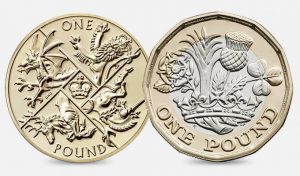
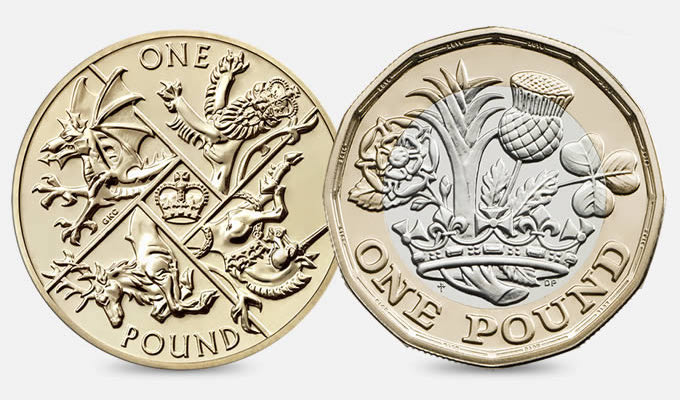
The old Round Pound and the new 12-sided £1 coin
After three years of design and production plans, the Royal Mint has produced what they are calling the most secure coin ever. The 12-sided, bimetallic coin includes micro-lettering, a latent image that is like a hologram, and something embedded in the metal to change its electromagnetic signature so that coin operated machines can detect counterfeits. These changes were made necessary by an effort criminals made to flood the market with counterfeit the previous £1 coin.
Initially, there have been complaints about coin-op systems not being able to accept the coin. Everyone from parking lots with metered and machined payment to the London Underground has been seen as not ready for the change even though the Royal Mint produced test coins in 2016 to help businesses convert. In England, where supermarkets charge to use the shopping cart in a manner that U.S. airports charge to use luggage carts, some major chains have unlocked their carts because they cannot accept the new £1 coins.
Acceptance is not the only problem they have run into. The new pound coins appear to have errors.
The first error to show up caused people to think that the coin was being counterfeited when the thistle on the reverse did not strike properly. The Royal Mint confirmed that these were not counterfeits. They were errors in the minting process. Although it was reported that the Royal Mint did not examine the coins, after seeing the images they said:
As you would expect, we have tight quality controls in place, however variances will always occur in a small number of coins, particularly in the striking process, due to the high volumes and speed of production.
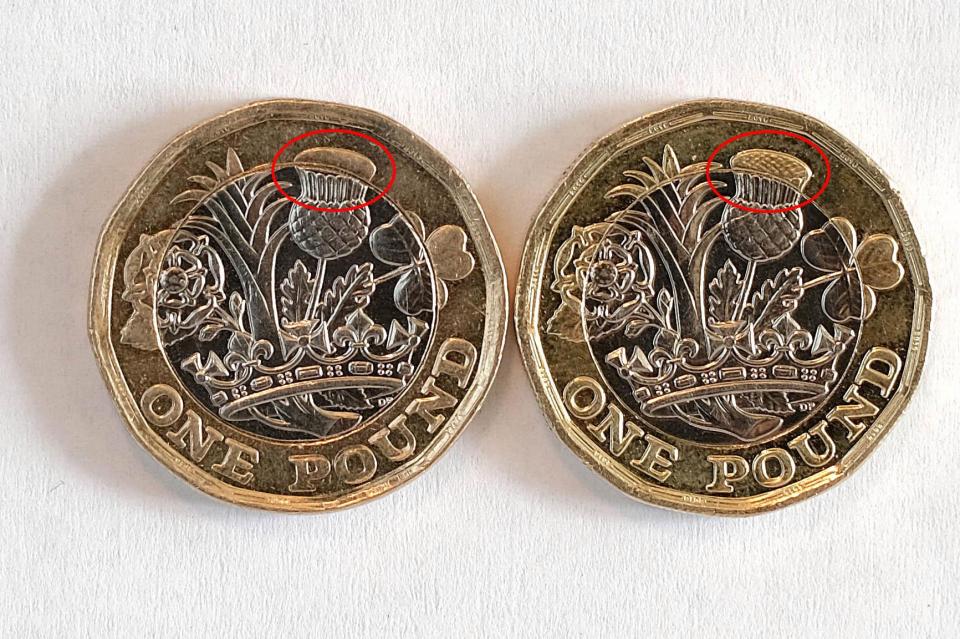
First new £1 coin error found with missing detail on the thistle
Next came the center-melt error. A woman in Birmingham found a coin that looks like the copper-nickel center melted across the coin. When minting bimetallic coins, the centers are supposed to expand in order to fuse it to the outer layers. The design crossed over the edges of the two metals to help with the anti-counterfeiting and to make sure the metals are locked into place. Since the coin is struck evenly, it is likely that either the alloy making up the center contains more of the softer nickel than specified, or that the coin was struck as second time causing the already fused centers to melt because of the friction.

Too hard of a strike is likely to have caused the copper-nickel center to melt across the coin.
A European coin expert familiar with the bimetallic minting process suggested that the pressure on the presses were set too high. This caused the coin to not eject properly from the collar leaving it in the machine for a second strike. The second strike on the higher pressure caused the center to melt and position the coin in a way to force it to eject. He is looking for an example to make a closer examination.
A final error find was the separation of the center from the outer ring. Even though the Royal Mint has said that this is impossible and all but accused the person who found the error of a crime (destroying coins is a crime in the United Kingdom), it is possible for the parts to separate if the strike pressure is not hard enough to fuse the centers to the rings. If the melting centers are caused by too heavy of the strike, the removable centers are caused by too light of a strike.
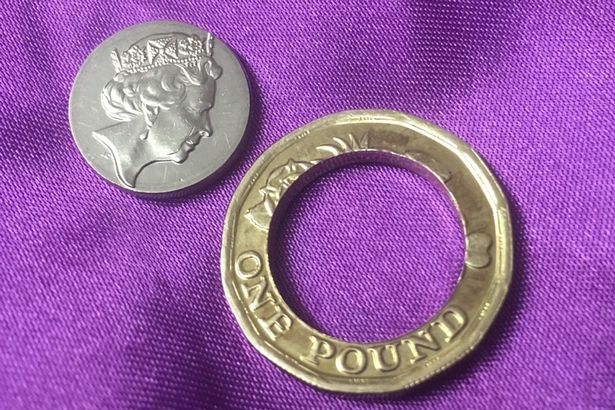
A weak strike can prevent the two metals from fusing properly allowing them to separate
It is theorized that the Royal Mint has two possible issues: quality control when resetting the coining presses when changing the dies and a design that cannot handle the tolerances.
Even when dies are changed for coins struck on a planchet with a single metal, the press has to be adjusted to ensure the coins are struck with the proper force. Even if the dies are made by the same person and machines, they can be mounted millimeters off. Operators are supposed to run a few coins and check the striking tolerances. If the strike is too hard, it will cause the dies to wear quicker (the first error) and possible cause multiple strikes (the second error) when the coins get stuck in the collars. Set too soft and the friction does not generate enough heat to fuse the metals (third error).
Looking for errors on eBay’s UK site, errors include coins without Queen Elizabeth’s portrait and 2016 trial strikes given to merchants to test coin-op machines that ended up in circulation.
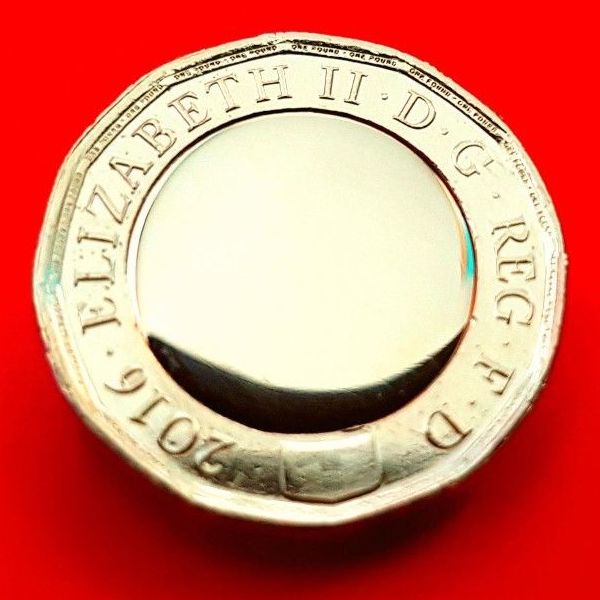
Trial strikes found without the effigy of Queen Elizabeth, II
While the Brits are having fun with the Royal Mint’s error, it is nothing like the “Godless Dollar” outrage by the easily offended when the edge lettering with “In God We Trust” was accidentally left off of the Presidential dollars. Maybe the United States cannot handle change to their change!
Credits
- Thistle error image courtesy of The Sun.
- Melted pound image courtesy of The Sun.
- Separated pound image courtesy of gtgadget.
Mar 28, 2017 | Britain, coins, news, Royal Mint, video
The old Round Pound and the new 12-sided £1 coin
- 12–sided — its distinctive shape makes it instantly recognisable, even by touch.
- Bimetallic — it is made of two metals. The outer ring is gold coloured (nickel-brass) and the inner ring is silver coloured (nickel-plated alloy).
- Latent image — it has an image like a hologram that changes from a £ symbol to the number ‘1’ when the coin is seen from different angles.
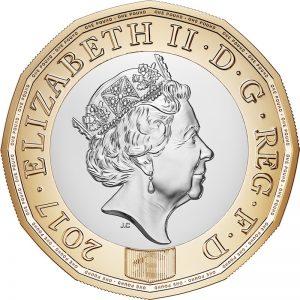
- Micro-lettering — it has very small lettering on the lower inside rim on both sides of the coin. One pound on the obverse heads side and the year of production on the reverse “tails” side, for example 2016 or 2017.
- Milled edges — it has grooves on alternate sides.
- Hidden High Security Feature — with a patented High Security Feature to protect it from counterfeiting into the future.
Of course, the Royal Mint is offering collectibles for the new pound that includes a “farewell” to the one being replaced nicknamed the “Round Pound.”
-
-
Obverse of the new 2017 12-sided £1 coin
-
-
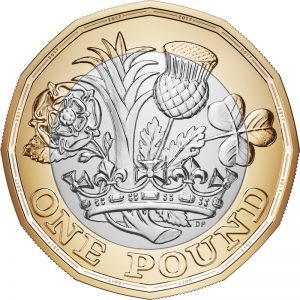
Reverse of the new 2017 12-sided £1 coin
Design and production of the new pound coin have been nearly three years in the making following the discovery of a large number of counterfeit £1 coins. Sources estimated that about 3-percent of the £1 coins in circulation are fake amounting to more than 45 million counterfeit coins. These fakes are so convincing and very well constructed that they can be successfully used in vending machines for payment including in London’s Underground.
The coin-operated businesses in Britain began complaining three years about the changes with reports that only a small fraction of all vending machines will be able to accept the new coin. Each coin-operated machine will have to be reprogramed and recalibrated to detect a coin that will have a different weight, specific gravity, and the electromagnetic signature.
Amongst those systems not ready include the London Underground and several major supermarkets.
While watching the news, I found that British supermarkets charge for people to use their trollies, which are called shopping carts on this side of the pond. I do not know if it is a deposit similar to the carts available at the airports, but could you imagine having to pay to use a shopping cart at your local supermarket? I do not think that would go over well in the United States!
Back in October 2016, the Royal Mint published education material and test coins that the coin-operating machine companies could use to test their equipment. Some of these test coins have appeared for sale on websites like eBay. Since then, there have been weekly stories about the new coin and stories have appeared daily in the British media.
Now that the new £1 coin has been released, it will co-circulate with the round pound through October 15, 2017. Banks will only distribute the new £1 coins while stores and other businesses will be allowed to accept either. During that time, it is expected for coin-operated equipment to be converted as soon as possible.
On October 16, 2017, the round pound will be demonetized and lose all legal tender status. Once the round pound loses legal tender status, they may be exchanged at some banks and the Post Office. The plan is to end the exchange of the round pound by March 27, 2018.
For collectors, this is an opportunity to collect something that was once a real circulating coin. The current round pound came into existence in 1971 when the UK transition from the pounds, shillings, and pence (£sd) system based on the power of 12 to a decimal system, called decimalization. Of course, when this happened in 1971 the web did not exist and real paper newspapers were the primary means of spreading the information about the new currency. Based on reports, there were some issues during the one-year transition but there were no stories of tragedies once the new money was issued.
Somewhat like the end of the Canadian cent, this is the end for a significant circulating coin. Except the Canadians did not replace the cent while the British are exchanging coins.
The Trade Dollar
Before you write to me to explain about the Trade Dollar, I know it was demonetized in 1876. However, it gained legal tender status again as part of the Coinage Act of 1965.
For those concerned over proposals that the United States change composition of various coins, including the one-cent coin that costs 1.5-cents to produce, watching how the UK handles the change will provide an insight as to how it might be handled here. Except for one problem: The United States does not demonetize coins (see the note in the box to the right). Every coin produced by the U.S. Mint can be used as legal tender at their face value, although it would be foolish to spend a Saint-Gaudens Double Eagle for its $20 face value since its gold content would be worth more!
It will be interesting to see how stiff those proverbial stiff upper lips hold up during this transition.
All images, videos, and British-style English text courtesy of the
Royal Mint.
Feb 26, 2016 | Canada, fun, pocket change, Royal Mint
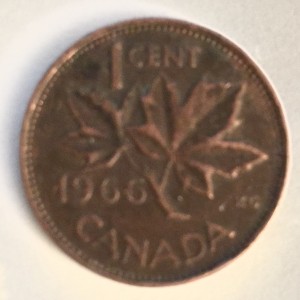
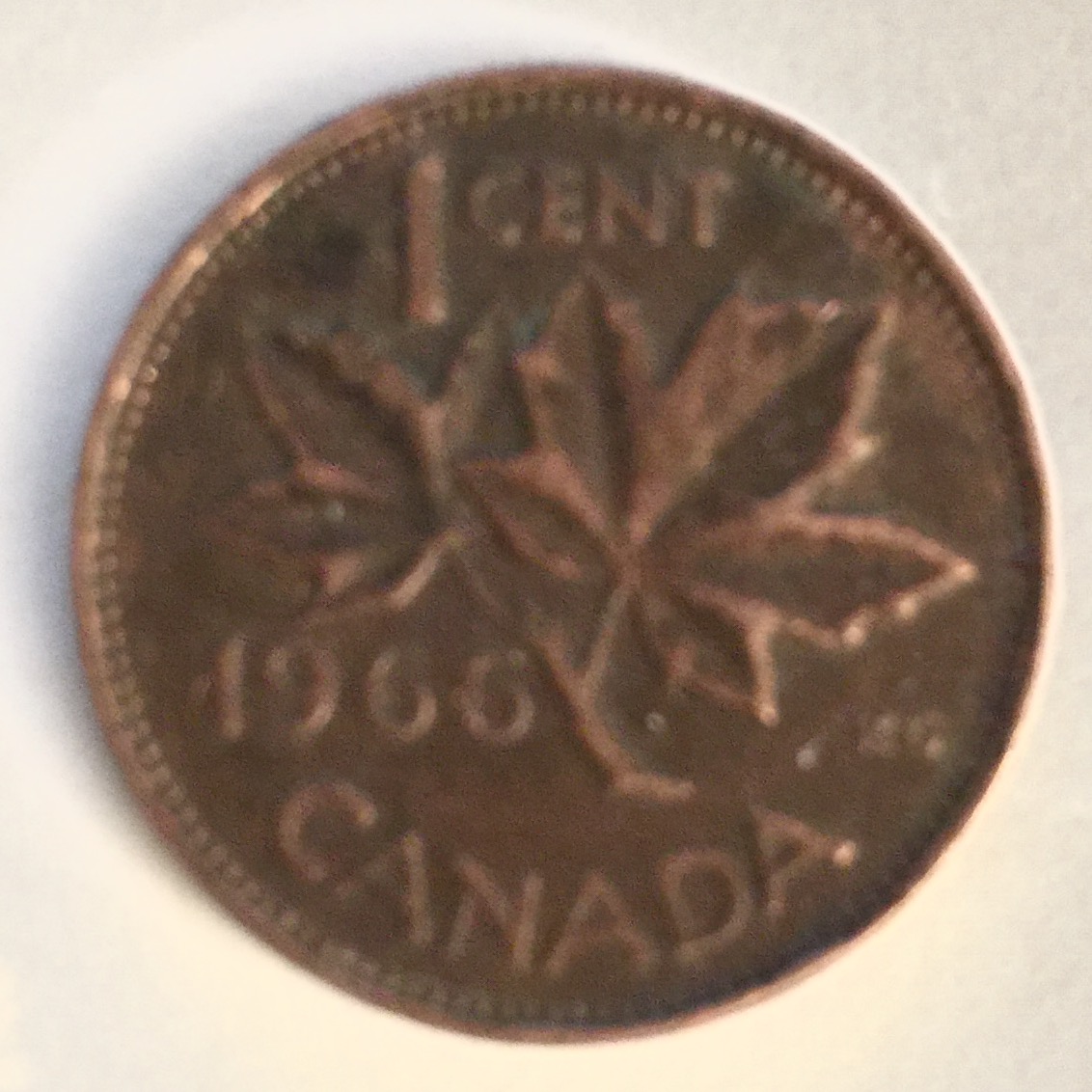
1966 Canadian one-cent found in pocket change
We need to build a wall!
We know that the Royal Canadian Mint struck their last 1-cent coin in 2012. During the six-month transition, Canadian banks were helping recall 1-cent coins while cash sales began to be rounded up or down to the nearest 5-cents.
But when I made a purchase at a local convenience store, my change included a 1966 Canadian 1-cent coin. Even though the coin is still legal tender it is not usable. I can visit an agent for the Bank of Canada or the Royal Canadian Mint to turn it in for updated coins. I was told that the minimum they will take for exchange is 100 coins. If I can scrape together 99 more coins I can trade it for a Loonie.
At the current exchange rate, the coin is worth only 0.0074 U.S. cents. Someone owes me 0.0026 cents!
Maybe I should go back to that store and see if they would give me a Canadian 5-cents coin and I would give them four U.S. cents. That would make it even.
It’s Friday. Why not have a little fun after finding a Canadian cent in my change!
Feb 12, 2016 | coins, education, history, Royal Mint
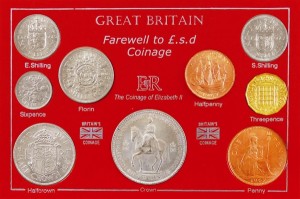
Collection of old pre-decimal coins from during the reign of Queen Elizabeth II.
A very short, simplistic, and incomplete history begins with the Norman conquest of England by William the Conqueror. His invasion of England from Normandy on the northern shores of what is France today in September of 1066 and coronation on December 25, 1066, marks the birth of what would become England.
During the next nearly 50 years, William I (1066-87), William II (1087-1100), and Henry I (1100-35), most of the emphasis has been to finish the conquest and consolidate the ruling under the single crown. The Treaty of Alton (1102) and the subsequent conquest of Normandy (1106) was capable of consolidating power and allowed Henry to attempt to create a sustainable government. Insurgencies from Whales, Rebellion of 1115-20 and the crisis of succession, where is his wife Matilda had not conceived a child, did not allow Henry to finish his work by his death in 1135.
£sd Symbolism
The pound symbol is a fancied “L” based on the Latin librae for weight or balance. It was intended that the 240 pence could be placed on a balance to weigh one pound sterling. The shilling, adapted from the Latin solidus, for solid, was the primary coin of commerce represented with an “s.” For the pence, it used the “d” from the Latin denarius, the smallest Roman coin. Multiple denominations are separated with a slash. For example, 1 shilling can be written as “1/-” while 2 shilling and 3 pence might be written as “2/3d.”
Henry I was succeeded by Stephen, the grandson of William I, with much contention. The problem was that Stephen’s younger brother, Henry of Blois, was embraced by Henry I and subsequently by the Normans. The subsequent civil war lead to a period called “The Anarchy” (1135-1154). During that time Stephen tried to continue with Henry’s reforms but was not able to hold on to the control of the government. Toward the end of his reign, Stephen recognized Henry as the heir to the throne.
With a peace treaty negotiated by Stephen, there was a new peace during the coronation of Henry II in 1154. During the peace, Henry II continued to consolidate power of Norman and Anjou (today this is northern France) and reconstructed the English government.
As part of his reconstruction, Henry II decided to base the currency on the troy pound. The troy pound was based on the Roman libra, which was the basis of weight that England accustomed with. In order to make the money more acceptable, it was divided into 20 units which were originally called testoons. Later, it was renamed as the shilling. As an attempt to make the testoon (shilling) the major unit of currency which corresponded to the Roman solidus. As the solidus was divided into 12 denarii, the testoon was divided further into 12 units with one called a penny and multiples called pence. This was to keep current with the current standard that a pound sterling weight 240 pennyweights.
Early on, it was clear that pence was not small enough of a denomination and was further divided into four parts, two halfpennies or four farthings (quarter pennies). This division was used because the one pennyweight coin representing a penny could not be cut further to represent smaller denominations. Farthings were further divided into smaller denominations using tokes until coins were first used in the 17th century.
To understand this system, I came up with the following table.
| Denomination |
Years struck |
Equivalents |
Relative to a Pound |
Nicknames |
| Quarter farthing |
1839-1853, 1868 |
1/16 d (16 = 1 penny) |
1/3840 pound |
|
| Third farthing |
1827-1913 |
1/12 d (12 = 1 penny) |
1/2880 pound |
|
| Half farthing a |
1828-1856 |
1/8 d (8 = 1 penny) |
1/1920 pound |
|
| Farthing |
1860-1956 |
1/4 d (4 = 1 penny) |
1/960 pound |
|
| Halfpenny |
1672-1860 |
1/2 d (2 = 1 penny) |
1/480 pound |
ha’penny |
| Penny |
1707-1970 |
1d |
240 pence = 1 pound |
|
| Three halfpence |
1834-43, 1860-62 |
11/2 d |
1/160 pound |
|
| Twopence |
1797 |
2d |
1/120 pound |
|
| Threepence b |
1547-1970 |
3d |
1/80 pound |
|
| Groat |
1836-1855, 1888 |
4d |
1/60 pound |
joey, sixpenny bit |
| Sixpence |
1551-1970 |
6d |
1/40 pound |
tanner |
| Shilling |
1503-1970 |
1/- (12 pence) |
1/20 pound |
bob |
| Florin |
1849-1970 |
2/- (24 pence) |
1/10 pound |
two bob bit |
| Half crown |
1707-1970 |
2/6p (26 pence) |
1/8 pound |
|
| Double florin |
1887-1890 |
4/- (52 pence) |
1/5 pound |
|
| Crown |
1707-1965 |
5/- (60 pence) |
1/4 pound |
|
| Sovereign (pound) c |
1817-1917, 1925, 1957- |
240 pence |
10 Shillings |
|
| Half guinea |
1699-1816 |
10/6d |
1/8 ounce of gold |
|
| Guinea d |
1663-1814 |
21/- |
1/4 ounce of gold |
|
Notes:
- Half farthing was originally made for Ceylon
- Three halfpence produced for circulation in the British colonies, mainly in Ceylon and the West Indies
- A one pound coin made of gold was called a Sovereign
- The guinea came into English after the Guinea region of West Africa was discovered by the British and mined its gold
- Not listed is “quid,” the nickname of a one-pound paper note
This was the system until Decimalization Day on February 15, 1971.
Today, British coins are divided into 100 pence to one pound. The coins struck for circulation by the Royal Mint are 1 Penny, 2 Pence, 5 Pence, 10 Pence, 20 Pence, 50 Pence or Half-Pound, £1 (pound), and £2. Paper currency is issued for denominations of £5 and greater.
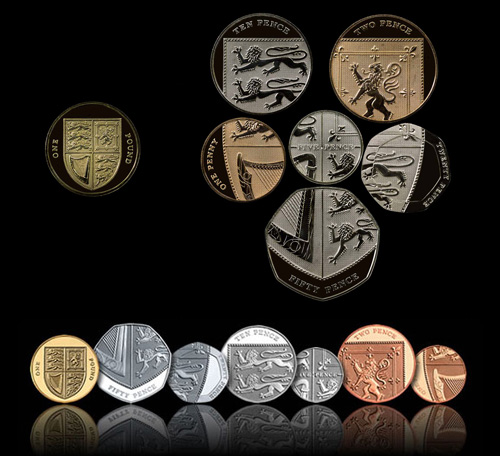
United Kingdom modern decimalization redesign of 2014 resembles a shield.
Credits
- Image of pre-decimalization coins courtesy of Coincraft
- Image of 2014 United Kingdom shield set courtesy of the Royal Mint
May 12, 2014 | base metals, cents, coins, nickels, RCM, Royal Mint, US Mint
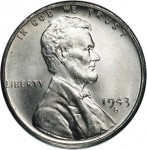
U.S. cents have been made of copper, steel, and copper plated zinc. What’s next?
Although the U.S. Mint does not define who they consider stakeholders but does mention the “coin industry” in one paragraph, the guideline questions are clearly targeted to the coin-operated machine industry. Coin-op machines are more than the soda and candy machines that may be in the break room where you work. These machines include toll booth machines, machines that produce bus and/or train fare cards, parking meters, game machines, and even the few pay telephones that are still in use. Everything that accepts coins will have to be replaced, repaired, adjusted, or scrapped should there be a change in coinage metals.
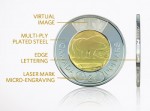
The new technology used by the Royal Canadian Mint to protect the Toonie (C$2)
In the United Kingdom, the Bank of England and law enforcement is engaged in a difficult fight against counterfeit £1 coins. Sources estimate that between 3-percent of the £1 coins in circulation are fake amounting to more than 45 million counterfeit coins. These fakes are so convincing and very well constructed that they can be successfully used in vending machines for payment including in London’s Underground. In an attempt to stem the problem, the Royal Mint has designed a new £1 coin to be circulated by 2017 in hopes to cut the counterfeiting rate.
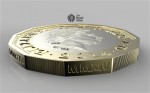
New edge view of the coin the Royal Mint hopes will be able to thwart counterfeiters.
The coin-operated businesses in Britain are beginning to complain about the changes even though they are being given nearly three years to adjust. For their systems, the new coins will have a different weight, specific gravity, and the electromagnetic signature will differ from the current coin. Every system from the Underground to parking systems to food and beverage vending machines will have to be upgraded to accept the new coins. One report estimates that it will cost up to £50 million (approximately $82.3 million) just to update parking systems.
The Automatic Vending Association, the U.K.’s vending industry trade group, estimates that the new coin will costs its members over £100 million ($168.5 million) to convert their machines.
Expect the costs in the United States to be much higher mainly because of scale. The National Automatic Merchandising Association (NAMA), the $45 billion per year vending industry trade association in the United States, has already issued a report saying that it will cost from $100 to $500 per machine to convert them to accept new coinage.
The American Amusement Machine Association (AAMA) has come out against any change in U.S. coinage. It was reported that AAMA president John Schultz said to leave the coinage alone “because it works, rather than risk the costly consequences.” AAMA has not provided an estimate for those costly consequences.
The last significant change in coinage composition was in 2000 on the introduction of the Sacagawea “Golden” dollar coin. Following the debacle of the Susan B. Anthony small dollar coin that was mistaken for a quarter, the coin was redesigned without a reeded edge and given a golden color by adding manganese to the metals mix. Although this change primarily impacted the gaming industry that relied on the dollar coin, the vending machine industry did respond by converting old machines and manufacturing new ones that accepted the new coin.
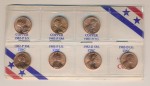
The change to copper-coated zinc cents created a seven coin set for 1982
Any discussion of coin composition changes has to include the change from silver to clad coinage. When President Lyndon B. Johnson signed the Coinage Act of 1965 (Pub. L. 89-81) into law on July 23, 1965, the composition of the dime and quarter dollar was change from 90-percent silver and 10-copper to 75-percent copper and 25-percent nickel bonded to a core of pure copper. This mix of metals was selected so that the coins would have an electromagnetic signature that was very similar to their silver counterparts. The half-dollar was reduced to 40-percent silver surrounding a pure copper core.
This change in coinage was done for the same reason that congress has asked the U.S. Mint to study alternative metals: the cost of materials and labor to make the coins is higher than the face value of the coin. As of the Fiscal Year 2013 (October 2012-September 2013) Annual Report, it costs the U.S. Mint 1.83 cents in labor and materials to manufacture the one cent coin and 9.41 cents for the five cents coin.
As a comparison, the cost for the dime including labor and materials is 4.56 cents per coin while the quarter dollar costs 10.5 cents to make.
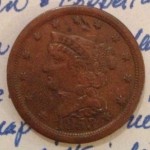
1853 Braided Hair Half Cent Obverse – The last lowest denomination coin eliminated by the congress.
- Does the U.S. eliminate the one cent coin?
- Does the U.S. eliminate the one dollar note in favor of a coin?
- If a transition to new metals is approved, does the government provide economic assistance to small businesses and sectors that will feel a bigger impact from this change?
- Will the federal government provide assistance to communities to help convert municipal services to be able to take the new coins?
- Should the U.S. Mint, a government agency, be allowed and/or required to earn a profit from its operations?
- How will the people be educated on the new coinage?
- What role will the Federal Reserve play?
Since the U.S. Mint did not define who their stakeholders are, it is fair to say that the stakeholders are all citizens of the United States. If you would like to comment, the U.S. Mint is looking for input on the following factors:
Costs to convert to circulating coins composed of alternative metals given the following possible changes to coins:
- Weight
- Electromagnetic signature
- Visual changes, such as color and relief
Transition time needed to introduce a circulating coin composed of an alternative metal.
Comments on how best to inform and educate both affected industries and the public on changes to circulating coins.
Environmental impact from the use of circulating coins composed of alternative metals.
Other issues of importance not identified above.
When commenting, note that the U.S. Mint said it is not considering aluminum alloy metals.
Responses are due to the U.S. Mint 60-days following its printing in the Federal Register (April 10, 2014 making the due date June 9, 2014). Electronic comments can be sent to Coin.StakeholdersResponse@usmint.treas.gov. If you prefer to send your comments the traditional way, mail them to Coin Stakeholders Response, Office of Coin Studies, United States Mint, 801 9th Street NW., Washington, DC 20220.
If you do comment and would like to share what you said with the rest of the community, either send it to me via email or post it as a comment below.
Photo credits: All photographs are the author’s except the image of the Toonie from the Royal Canadian Mint and the One-pound coin prototype from the Royal Mint.
Jul 21, 2012 | Britain, medals, Royal Mint, video
With the 2012 Summer Olympics starting next week in London, the folks at CNN Money did a report about the making of the medals by the Royal Mint.
Medals made for the XXX Olympiad in London are the largest medals ever made for a summer Olympics. Their specifications are as:
- Diameter: 85mm (approx. 3.346 inches)
- Thickness: 7mm
- Weight: 412g (approx. 14.5 ounces)
- Designer: David Watkins
- Obverse Design: Nike with Panathinaiko Stadium in the background
- Reverse Design: The River Thames and the London Games logo with angled lines in the background
- Composition of Gold Medal: 92.5% silver, 6.16% copper, 1.34% gold
- Composition of Silver Medal: 92.5% silver, 7.5% copper
- Composition of Bronze Medal: 97% copper, 0.5% tin, 2.5% zinc
The metals used to make the medals were supplied by Rio Tinto and was mined at their Kennecott Utah Copper Mine and Oyu Tolgol project in Mongolia.
Here is the CNN Money report about the making of the medals by the Royal Mint:
Image of the London 2012 Olympic Medals courtesy of London Organising Committee of the Olympic and Paralympic Games
Video courtesy of CNN Money
Dec 5, 2009 | RCM, Royal Mint, US Mint, web
Progress and experience is a good thing. It helps us learn about ourselves and how other perceive us. In the world of competing for business in numismatics, progress and experience helps those who sell coins and offer services improve how they communicate to us, their customers and constituents. Today, we are going to look at the websites that those of us who live part of our lives online visit for our numismatic fix.
Earlier this year, the Royal Canadian Mint updated their website. Prior to their current update, their site was written using Adobe Flash in a way that felt limiting to someone who visited the site to browse. The updated site has a more exciting look, fresher colors, and is better for those of us who like to browse. And speaking of browsers, this version does not use Flash in the same way as the old site. Your experience will be faster and more responsive than the previous RCM design. It is clear that experience has allowed the RCM to progress to a new design.
Not long ago, The Royal Mint updated their website. Although The Royal Mint did not need an update, they chose to change the basic theme and go with a simple design with a black background. It give the site a regal look, which is in tune with The Royal Mint’s vision of itself as one of the world’s oldest mint. However, navigation of this site is a bit quirky. There appears to be extra clicks required to find products and while the look is nice, every page has an image on top that distracts from the presentation by pushing to coins down. This image may only be a minor annoyance, but an annoyance nonetheless.
Here in the United States, there have been changes in the website for the Bureau of Engraving and Printing. The bureau with one of the best domain names (www.moneyfactory.gov) appears to have hired website designers that have graduated from Web Design 101. The site is is clean and professional looking with easier navigation making it easier to find information about the BEP. From the front page, the site is about the bureau and its functions. Sure, the last major even of the BEP is the redesign of the $5 Federal Reserve Note in 2007, but it allows the BEP to highlight its limited accomplishments.
With the new design, the BEP has created a new store front with its own domain name: www.moneyfactorystore.gov. The new store is easier to navigate and find products. The categories have been cleaned up, the unavailable products have been removed, and the premium series can be purchased by series or individual Federal Reserve banks. Buying individual premium products by Federal Reserve Bank was not possible with the old website.
Moving away from the government, the Professional Coin Grading Service has redesigned its website again. This time, rather than rely on the black and gold theme of their logo, PCGS is using a lighter blue theme to highlight their service. While this design is better than their previous designs, it is not without issue. For example, there is something about the front page layout that bothers me. The banner is too large, there is too much space between the banner and the page contents, and menus at below the main content are too low. If the PCGS web designers can lower the height of the banner, close up that extra space, the lower menus will move up on the page and not feel as if they are an after thought. Making these fixes could change the A- design into a solid Grade A design.
Of course the one website that is in dire need of updating continues to have the same design since 2000. The US Mint should update their web presence, especially their online catalog.
Jan 18, 2009 | coin design, coins, Royal Mint
It is interesting to watch what other mints do with circulating and commemorative coinage. Each mint is governed by its own laws and regulations that are very different than the coin design process required of the US Mint. While the US Mint is very regulated, other mints have the flexibility to create interesting coins and do it in a way that involves the public. One mint that is using its flexibility is Great Britain’s Royal Mint.
The Royal Mint is a crown corporation answerable to the Queen. While the Queen has the final authority of all Royal Mint activities, the Mint is required to consult with the Chancellor of the Exchequer (a position equivalent to the US’s Secretary of the Treasury) and the Prime Minister. Although this gives the Royal Mint a lot of flexibility, the Royal Mint uses their power judiciously—as they showed last year by redesigning British circulating coinage for the first time in 40 years, after decimalization.
With the London 2012 Olympic and Paralympic games a few years away, the Royal Mint is preparing by starting the design process. To commemorate the games, the Royal Mint is planning issue 50 pence coins with 27 different reverse designs representing the different sports that are part of the games. The obverse will continue to use the portrait of Queen Elizabeth II designed by Ian Rank-Broadley. But rather than go through a traditional design competition by having a competition amongst artists, the Royal Mint is opening the design competition up to the entire nation.
The competition is open to residents of the United Kingdom. Those interested should go to the Royal Mint’s special website for entry information. Design winners will receive a gold version of their coin, get to see their coin being produced at the Royal Mint, and receive a £1,000 prize (currently about $1,473). The following video was produced by the Royal Mint and features Chief Engraver Matt Bonaccorsi:
Along with the regular competition, the Royal Mint is holding two other competition for students. There will be a design competition for children aged 6 to 12 years and a design competition for children aged 13 to 19 years old. The younger competition winner will not receive cash and the school where the winner of the older competition attends will receive £10,000.
Deadline for the competition is the end of April. It will be interesting to see how the process progresses. It looks like the Royal Mint has an interesting idea to get the country involved. I will be watching to see how successful they are with this program. Maybe the US coin bureaucracy can learn something from this venture.


 Loading ...