
Weekly World Numismatic News for December 15, 2019 +2
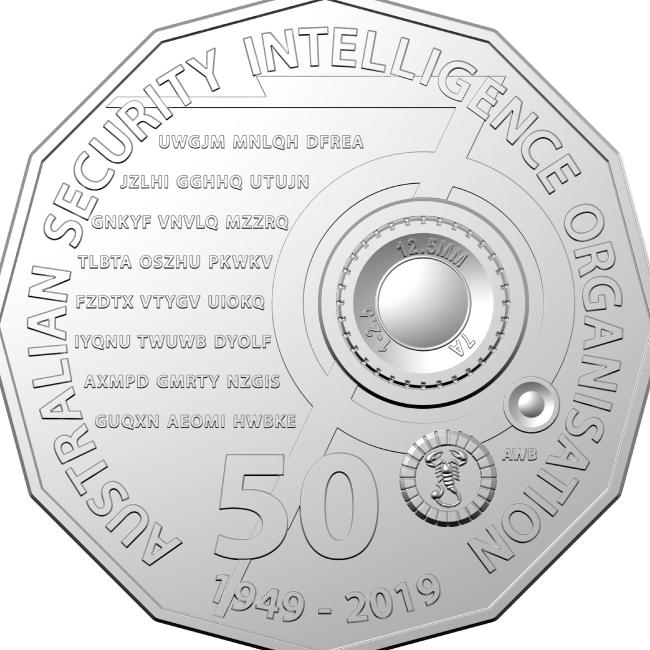
“Coincryption” from the Royal Australian Mint (Image via news.com.au)
The coin, called “Coincryption,” was issued in honor of the 70th anniversary of the Australian Security Intelligence Organisation (ASIO). The ASIO is equivalent to the Federal Bureau of Investigation in the United States.
As part of the contest, the person who cracked the code was eligible to receive a one-of-a-kind coin designed to celebrate the anniversary of the ASIO.
To crack the code, you need to use the one-time pad as a key. A one-time pad (OTP) is randomly generated text that, when you apply a specific formula, will reveal each letter. OTPs can be very secure if used only once, and the equation to decode the message is frequently changed.
For this contest, the Royal Australian Mint published the OTP in the literature sold with the coin (for AU$10) or online. Since the contest is over, the Royal Australian Mint removed the OTP from their website.
UPDATE: I found the OTP on the Royal Mint’s website → here.
According to the press report, the decoded message says:
If you want an encryption challenge, you can try your skills at Kryptos, the copper sculpture that is outside of the Central Intelligence Agency’s headquarters in Langley, Virginia.
Kryptos contains four messages in the 865 characters carved into the sculpture. Since its installation in 1990, world-wide experts have solved three of the four messages. The last 97 characters, known as K4, remain unsolved.
Since Kryptos is on the CIA grounds, it is off-limits to the public. However, the CIA has made it available on their website. More information about Kryptos, including the messages hidden in the first three panels, is available in this article.
Kryptos might be a good idea for a commemorative coin. Create a clad coin with K4, attach it to a card with information about the sculpture that includes the cipher, and offer a special gold coin to whoever solved the puzzle. Add a $5 surcharge and donate the money to STEM education.
And now the news…
 December 3, 2019
 → Read more at scotsman.com
December 9, 2019 → Read more at 9news.com.au
December 10, 2019 → Read more at themayor.eu
December 14, 2019 → Read more at news.sky.com
December 14, 2019 → Read more at news.com.au
December 14, 2019 → Read more at bbc.co.uk
December 14, 2019 → Read more at economictimes.com
→ Read more at scotsman.com
December 9, 2019 → Read more at 9news.com.au
December 10, 2019 → Read more at themayor.eu
December 14, 2019 → Read more at news.sky.com
December 14, 2019 → Read more at news.com.au
December 14, 2019 → Read more at bbc.co.uk
December 14, 2019 → Read more at economictimes.com
America The Beautiful Quarter Candidates
Over the weekend, Mike Zielinski of the Mint News Blog posted a slide show of the candidates for the America the Beautiful Quarters program. Starting in 2010, the US Mint will release five quarters per year until 2020 and one quarter in 2021 honoring one National Park or National Historic Site in the 50 states, District of Columbia, and five insular territories.
The first five quarters for 2010 will be as follows:
- Hot Springs National Park in Arkansas
- Yellowstone National Park in Wyoming
- Yosemite National Park in California
- Grand Canyon National Park in Arizona
- Mount Hood National Forest in Oregon
Mike put together a slide show of the design candidates.
The first thing I notices is that the image of the proposed obverse of the new quarters show a better executed design. George Washington’s hair looks less spaghetti-like and the features are stronger. While I would have preferred to see Teddy Roosevelt on the obverse of this quarter, a better image of our first president is a good consolation.
In looking at the designs, there seems to be an effort by the Mint to come up with meaningful designs than the State Quarters. I am sure that they will not be coming up with dead skulls and cuds for designs.
Regardless of the designs, I continue to not be excited about these quarters.
Positions Open with the CCAC
Yesterday, the US Mint has announced that they are seeking applicants for two openings to the Citizens Coinage Advisory Committee (CCAC). The CCAC advises the Secretary of the Treasury and the Director of the US Mint as to the design of numismatic products produced by the US Mint. CCAC’s recommendations are submitted to the US Commission of Fine Arts (CFA) for final decision.
“The CCAC is composed of 11 members: one specially qualified in numismatic collection curation; one specially qualified in the medallic arts or sculpture; one specially qualified in American history; one specially qualified in numismatics; three individuals representing the interests of the general public; and four individuals recommended by the Leadership of both the House of Representatives and Senate. CCAC members serve terms of four years and are Special Government Employees; therefore, they are subject to various applicable conflict of interest laws and ethics regulations.”
In this announcement, four year appointments are for the representative specially qualified in American history and one who is a specialist in medallic art. Interested parties should send a cover letter, a resumé or curriculum vitae outlining relevant experience, and an indication of which position is being applied for to the US Mint by fax to 202-756-6525, or by mail to the United States Mint, 801 9th Street NW, Washington, DC 20220, Attn: Greg Weinman. Applications must be postmarked no later than November 13, 2009.
A Commemoration to Enrico Fermi
 Today, we wish a Happy Birthday to Enrico Fermi. If he was still alive, Fermi would be 108 years old.
Fermi was a Nobel Laureate physicist who is commonly credited with harnessing the nuclear power. Fermi won the Nobel Prize in Physics in 1938 “for his demonstrations of the existence of new radioactive elements produced by neutron irradiation, and for his related discovery of nuclear reactions brought about by slow neutrons” This work made him an important contributor to the Manhattan Project.
Fermi, who is considered one of the premier scientists of the 20th century, was granted 14 patents and was instrumental in the development of nuclear energy. He is called the father of nuclear energy.
In 1984, the Republic of San Marino,the oldest sovereign state and constitutional republic in the world, issued a 200 Lire commemorative coin (KM# 166) honoring Fermi on the 30th anniversary of his death. The coin is made of copper-nickel and is worth about $2.50 as an uncirculated coin.
Happy Birthday, Enrico, and thank you for sharing your work with the world!
Sorry, I forgot where I found the picture to give that person credit.
Movement to Redesign the Dollar
Over the last ten years, US coinage has seen many changes. Starting in 1999, the 50 State Quarters® Program and the DC and US Territories Coin Program has taught us about our country and entertained us with “interesting” designs. The Westward Journey Nickels, Presidential Dollars, and this year’s Lincoln Bicentennial One Cent Redesign have kept us examining our pocket change looking for something new.
US paper currency has also changed. But the changes are not what could be considered earth shattering. Rather than undergo a good design change, I had previously commented that the “[new] currency designs look like the Bureau of Engraving and Printing is dabbling in currency design after being mired using the same basic designs for over sixty years.” With little to no restriction on currency design, the BEP designs have gone from old to bland with no redesign planned for the one dollar bill that was designed in the 1920s!
An article that appeared in The Atlantic found a “image design consultant” who also thinks that the design of the dollar and its paper equivalents need to be upgraded.
Richard Smith, founder of the Dollar ReDe$ign Project thinks that as part of improving the US image, redesign its currency. Noting that a redesign may be looking backwards, Smith noted in an interview that “you need to go backwards to go forward.” (see video below) Without explaining this statement, Smith had to have been referring to the currency of the late 18th and early 19th century that produced phenomenal design.
Smith is approaching this issue from an image perspective. As a numismatist and a collector of Israeli paper currency, I am looking at the issue from a design perspective for making interesting collectibles.
Other countries seem to be able to handle change to their currency. In fact, the emergence of the Euro forced changes throughout Europe. Euro banknotes are printed in a variety of colors and representative designs that are accepted through out the European Union.
Also, the European Union and most other industrial countries does not issue their unit currency in paper. The United States continues to print the one-dollar note which I have written costs the government more to maintain.
Maybe if the numismatic angle is not working with the BEP, maybe the we could try the angle from the image consultant. Anything that could update the US staid currency design.
Fort Knox Visitors Day, 35 Years Ago
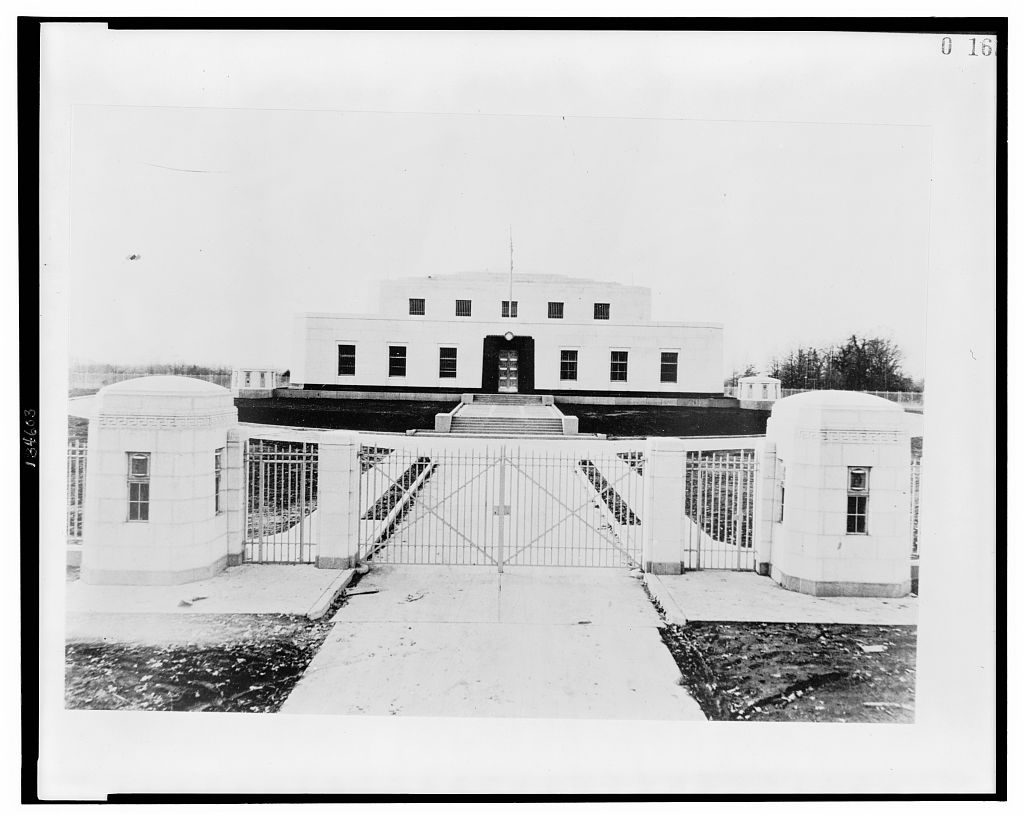
Treasury Department, Procurement Division, Public Buildings Branch, Fort Knox – United States Bullion Depository (1939)
Outside visitors are rare. Following President Franklin D. Roosevelt’s inspection trip in 1943, no outsiders have been allowed to visit the facility. Following an audit that was completed in 1953, the vaults were sealed and nobody was allowed to visit.
In 1974, noted conspiracy theorist Dr. Peter Beter wrote a book titled The Conspiracy Against the Dollar that alleged “powerful Americans have secretly permitted $20 billion worth of gold to be removed from Ft. Knox.” The claim caught on and the public clamored to prove that the nation’s gold was still in Fort Knox.
After clamoring from the public, congressed impressed on the Secretary of the Treasury William Simon and Director of the US Mint Mary Brooks to open the doors of the vault to public inspection. It was finally agreed that a select group of congress members and press would visit Fort Knox on September 23, 1974.
On September 20, 1974, the US Mint release the following press release:
FOR IMMEDIATE RELEASE
September 20, 1974INSPECTION OF GOLD AT FORT KNOXThe inspection by Members of Congress on September 23, 1974, of U.S. gold stocks stored at the Fort Knox (Ky.) Bullion Depository marks a unique departure from the long standing and rigidly enforced policy of absolutely no visitors, Mrs. Mary Brooks, Director of the Mint, announced today.
“On April 28, 1943, President Franklin D. Roosevelt inspected the Bullion Depository,” Mrs. Brooks said. “His visit was the one and only time a gold vault was opened for inspection for anyone other than authorized personnel.
“The Congressional inspection adheres to the new open door policy of the government announced by President Ford. Treasury Secretary William E. Simon issued the invitation to Congressmen to inspect the gold at Fort Knox. By also inviting the press to witness the Congressional inspection, the Mint is clearing away cobwebs and re-assuring the public that their gold is intact and safe. For the first time photographing is being permitted inside the Depository.”
After the Congressional inspection, the Bullion Depository will once again be closed to visitors.
On September 24, 1974, a special settlement (audit) is scheduled to begin and at its conclusion a report on the audit will be issued.
The audit will be performed by a committee of auditors from the U.S. General Accounting Office (GAO) and the Department of the Treasury. The auditors from the Treasury will be drawn from the Office of the Secretary, the Bureau of Government Financial Operations, the U.S. Customs Service, and the Bureau of the Mint. In addition, the committee will include technicians from the Bureau of the Mint who are trained in assaying and weighing gold bullion.
The monetary gold stock of the United States totals 276.0 million fine troy ounces valued at $11.7 billion at the official rate of $42.2222 per fine troy ounce, and is stored in various federal depositories (table attached), the largest of which is at Fort Knox, Kentucky. 147.4 million fine troy ounces, valued at $6.2 billion, is stored in 13 vault compartments at Fort Knox Bullion Depository.
MONETARY GOLD STOCK OF THE UNITED STATES
(in millions of ounces)
Account of the U.S. Treasury Fort Knox 147.4 Denver Mint 54.9 New York Assay Office 54.1 San Francisco Assay Office 10.6 FRB New York – Special Custody Acct. 4.2 Bank of England 1.3 Bank of Canada 1.4 Other .1 274.0 Exchange Stabilization Fund 2.0 Total 276.0
For more on the Fort Knox visit, you should read the article by David Ganz, who attended as a freelance writer after skipping a day at law school.
Recently, the History Channel aired a show, Fort Knox – Secrets Revealed that was produced in 2007. “Hidden deep inside the vault is an estimated $73 billion dollars in gold. Almost all information about it is classified. Through interviews with eyewitnesses, rare photos and rarely seen films, we will construct a picture of what the building might look like. Hear testimony of those journalists and congressmen who were among the select few invited inside in 1974.”
If you cannot wait for the History Channel to air the show, you can purchase a DVD copy for yourself from Amazon.com. The link to the right will bring you right to the page to purchase the DVD.
Support the Coin Collectors Blog
 Buy me a coffee
Thank you for your support!
Let Me Know What You Think
Are you going to the World's Fair of Money
Total Voters: 17
 Loading ...