
Would You Encase a Lincoln or an Almond
Two weeks ago, my crew and I emptied a 20×10 storage room. The co-owner was a picker and a dealer who had been buying and selling for many years. I met his former partner at the storage facility with a large rental truck to move everything to my warehouse.
Before leaving the storage facility, boxes filled the entire truck about two-thirds of the way high. It is our largest consignment.
In those boxes are political memorabilia, Star Trek collectibles, collectible plates, antique photos, newspapers, other memorabilia, posters, and so much more. We are creating an inventory so that they can be sold at auction.
Amongst the campaign material for many different candidates, both winners and losers, we found medals and other numismatic-related items associated with candidates.
We found a few inaugural medals, which I expected, but I also found many other numismatic-related items that I want to share.
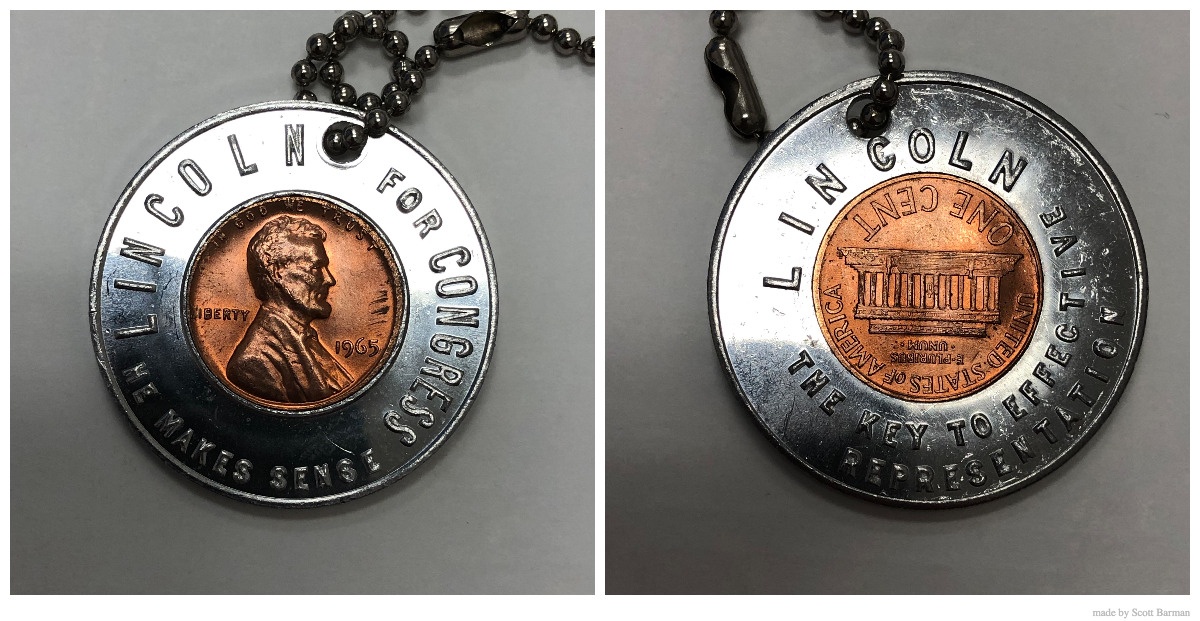
The item of today is an encased 1965 Lincoln Cent with a chain through a hole to make it into a key ring. On the obverse of the aluminum ring, it reads, “Lincoln for Congress / He Makes Sense.” On the reverse, the ring says, “Lincoln / The Key To Effective Representation.”
I found hundreds of these coins in plastic bags! All were the same, including the uncirculated 1965 Lincoln Cent.
Who was this person and did he or she win their election?
After searching records from congressional elections from 1966-1976, the only Lincoln that ran for congress is Lincoln Almond. Almond, a Republican from Rhode Island, ran for Rhode Island’s First District seat against the incumbent Fernand St. Germain in 1968. St. Germain won the election with 60.4% of the vote.
Almond later was appointed by Nixon and Ford to be the U.S. Attorney for the District of Rhode Island (1969-78) then again by Reagan and Bush (1981-1993). Almond ran for governor of Rhode Island in 1978 but lost in the primaries. He was more successful when he was elected governor in 1994.
As I type this, I began to think that basing a campaign on his first name was a good idea. Otherwise, that would be nuts! (insert rim-shot here)
US Money as Modern Marvels
Regular readers know I have an affection for television shows that are a cross between reality and history. This is why I like to watch The History Channel. On of my favorite shows on The History Channel is Modern Marvels, a show that shows the “secrets”s behind things we find in modern life. From ultimate gadgets to looking at the technology of our past, I find the show fascinating.
Thanks to a posting on the Collectors Society Forums, I found that Modern Marvels was doing a show about money. For fans of the show, The History Channel posted three of the segments on their website.
The first segment, titled “Centralization of Money” give a brief history of money in the United States from the chaos of every bank issuing currency through the basics of how the Federal Reserve interacts with the Bureau of Engraving and Printing and the US Mint.
In the second posted segment titled “Currency” traces its history from the Civil War to how the paper is made. Cameras follow the process through the creation of the cotton from blue jeans by Crane & Company. I like the animation as to how the intaglio printing works.
Finally, “Coin Production” also has a great animation that shows how master dies are used to make striking dies. Then the camera moves to the Mint’s production floor to show how the coins are made.
The History Channel does not allow us to embed their images on our websites. But if you go to the first segment, you can watch the three segments in sequence. I love this stuff!
Definitive Answer on Wisconsin Quarter Varieties
Rick Snow, noted researcher of Indian Cents and die varieties, carefully examined the high-leaf and low-leaf varieties of the Wisconsin State Quarter. Although mainstream media stories have reported this as an accident, Snow analyzes the coins under an electron microscope in order to do forensic analysis.
Snow concludes that the leaf was made with the same tool in a similar manner by a Denver Mint insider with access to the dies. Here is a video Snow produced about his analysis:
I am not sure if this is the “definitive answer,” but it is one of the better theories I have seen.
Getting Lucky on 7/11
It has been a very long week but things seem to be looking up today. Amongst some better news was receiving my first 2009 Lincoln Rail Splitter Cent in change.
I am in Charlotte this weekend because my mother has been in the hospital. On my way to visit her, where my mother was beginning to recognize us and her surroundings, I stopped for a drink at a local convenience store and received a 2009 cent in change.
It only has taken 192 days into 2009 to find my first 2009 coin in circulation. And it took me leaving the Washington, DC area to find it!
California Currency
While the study of coins can be a lesson in history, the study of paper currency can present a lesson in economics that may be relevant today. With the state of California printing and distributing IOUs to meet its financial obligations, I am reminded of how the colonies used similar arrangements to finance the fighting of the Revolutionary War.
During the colonization of the New World, charters were granted to companies to set up businesses and trade the natural resources they found back to England and the rest of the known world. We may be more familiar with the East India Company from popular movies, the first settlement at Jamestown was colonized by the Virginia Company of London. These and other companies were originally chartered by King James I to set up trading centers on the shores of the new world to make it easy to goods back to Europe.
As the companies became successful, the English government became more interested in expanding its empire. The Royal Navy was sent to the new world to protect shipping lanes. As threats from other countries and Native Americans endangered the colonists, the King began to revoke charters to make the companies Crown colonies. Governors were install with Army garrisons at their ready to expand holdings against other nation’s settlers and to fend off Indian attacks.
Following the French and Indian War, the British government was in considerable debt. When they added the cost of keeping a regular army in the colonies, the extra expense was more than King George III wanted to endure. Beginning with the Stamp Act of 1765, Parliament tried many ways to have the colonies pay the debt and for their protection. With no representation in Parliament, the colonies began the road to independence proclaiming “No Taxation Without Representation!”
In order to maintain their control over the colonies, the King and Parliament only allowed minor, non-precious metal coins to be used for commerce in the New World. Colonist adopted by accepting silver coins from other countries as legal tender. The most common coins was the Spanish 8 Reales or Pillar Dollar. But the Pillar Dollar was not enough to fight against the powerful British Army, who was attempting to keep order.
The first currency issued in the New World was issued by the Massachusetts Bay Colony in the 1690s. Later in the eighteenth century, other colonies began to issue currency, many times surreptitiously without the knowledge of the colonial governor, to raise money. When colonial assemblies issued currency, they were issued as indented bills of credit with a plan to repay the loans.
Colonial assemblies issued two types of currency. One type of issue were indented bills of credit which were not considered legal tender but could be used to pay fees or taxes. These notes contained one or more receipts or payment slips that were redeemed at specific intervals for hard currency. Legal tender currency were allowed to circulate for commerce. Both types of notes usually were printed with a denomination, value basis for the denomination, the interest rate of return, and when the note can be redeemed for hard currency. The value basis for the denomination was usually expressed as “Bill of Exchange in London for Gold and Silver” and a rate of exchange. However, that exchange rate was different from colony to colony which made inter-colony transaction difficult. Value was also based on the trustworthiness of the colony to repay these notes.
As the Revolutionary War continued, colonial assemblies found themselves without the ability to raise enough money to pay off their currency. One way around the problem was to issue enough currency to cover the last issue plus a little more to cover current expenses. Not only did this create a big debt for the colonies, but that debt made the paper worth less than is printed value which made it difficult for the colonies to purchase supplies.
After the war, both the Continental Congress and the new states were competing with each other generate revenues and to pay off their debts. This continued until the US Constitution was ratified in 1789 and the federal government took over the minting and issuing of money. Because this demonetized the currency from each state, a compromise was made to trade the currency at the rate of 100 state dollars for one dollar of the new United States currency—which at that time was being paid in Spanish Milled Dollars.
Even though the states lost the rights to print and distribute money, they continued to have the right to issue non-legal tender bills of credit in order to raise money. These bills of credit were issued in the form of bonds that were either redeemable on the date of maturity or had a periodic payment option. Bonds are usually issued to pay for capital improvement projects. They are associated with a source of revenue that would be used to reimburse the bond holders, such as a tax. This practice continues today with every states’ debt being backed by many bond issues. And with technology, most bond issues are not printed. Rather, they electronic records noting ownership of the bonds.
The paper issued by the colonies, the Continental Congress, and the United States under the Articles of Confederation are very collectible. Aside from being a lesson in history, it is a lesson in the state of the art of printing in the colonial times and a lesson in colonial economics. Finding colonial currency is not easy, a nice collection can be awe inspiring. One such collection is in the Colonial Currency Collection at the University of Notre Dame’s Department of Special Collections.
The State of California is in serious economic trouble. Their fiscal year began on July 1 without a budget and a significant deficit between the government’s income and their legal obligations to provide services to the citizens of California. Governor Arnold Schwarzenegger declared a fiscal emergency and order the printing of IOUs to pay state debt obligations. Initially, 28,750 IOUs worth $53.3 million will be issued mainly for personal income tax refunds. The IOUs will carry a 3.75-percent interest rate redeemable by October 2 or earlier if a budget agreement is reached.
The financial term for the IOUs are “registered warrants.” For the citizens receiving these IOUs, most of California’s in-state and nationally-owned banks said that they will accept the IOUs as deposits for a limited time.
California last issued IOUs in 1992 during a similar budget crisis.
Records of the how many of the IOUs were redeemed do not seem to be publicly available and I did not find an auction record for the paper issued in 1992. However, it stands to reason that the paper IOUs will be highly collectible. Opportunists have been using online classified websites to offer to purchase these warrants as souvenirs (see an ad).
Although registered warrants are not legal tender, people may elect to trade and barter these IOUs for goods, services, and even legal tender money. We can only wonder if the paper will become more valuable as a collectibles as the Zimbabwe notes after their government devalued Zimbabwean Dollar because of hyperinflation. That ball is in the court of the California legislature. But they will make interesting collectibles.
Eleven Score and Thirteen Years Ago
It was a hot day in Philadelphia when the First Continental Congress met on July 4, 1776 to finalize a resolution that would permanently separate the American colonies from the British Crown. According to the leaders of the day, it was the only way to rid themselves of the unfairness of British rule. In order to ensure that everyone was heard, the Congress adjourned and met as a Committee of the Whole to debate and adopt the resolution.
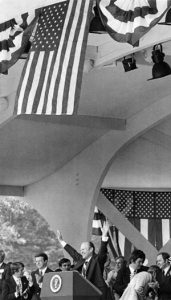
President Gerald Ford Speaking at Freedom Park in Charlotte, NC on May 20, 1975.
Thirty-three years ago, the United States celebrated its Bicentennial with a big celebration. As part of the celebration, the US Mint issued special circulating commemoratives honoring the occasion. For those of us who were born at the end of the Baby Boom generation, this was the first change in coinage we experienced. It was a great experience, especially when I shook hands with President Gerald Ford during a public appearance in Charlotte in 1975.
In honor of the United States Independence Day Celebration, here is my collection of Bicentennial Silver Proof Coins autographed by the artists whose designs were used.
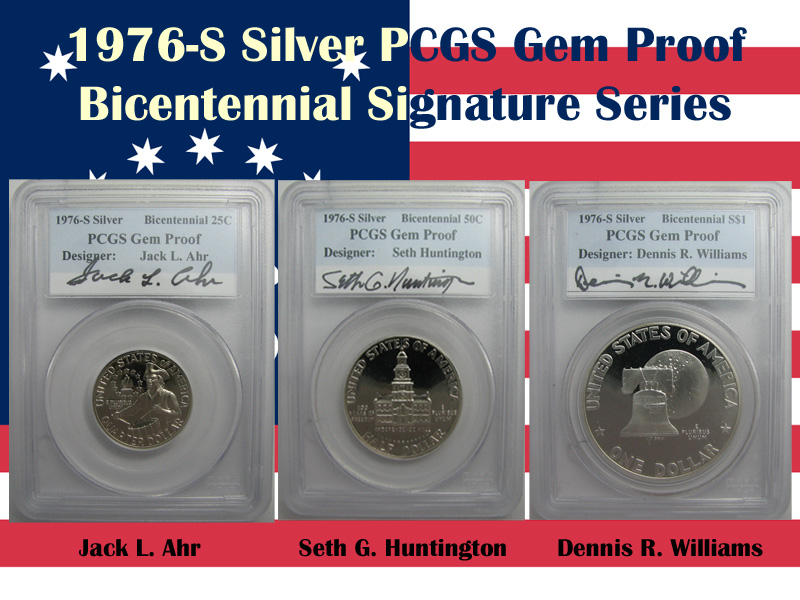
1976-S Silver Proof Bicentennial Autograph Set
Have a Happy and Safe Independence Day and please thank any active duty military service person or veteran today!
Support the Coin Collectors Blog
 Buy me a coffee
Thank you for your support!
Let Me Know What You Think
Are you going to the World's Fair of Money
Total Voters: 17
 Loading ...