
Weekly World Numismatic News for October 13, 2019
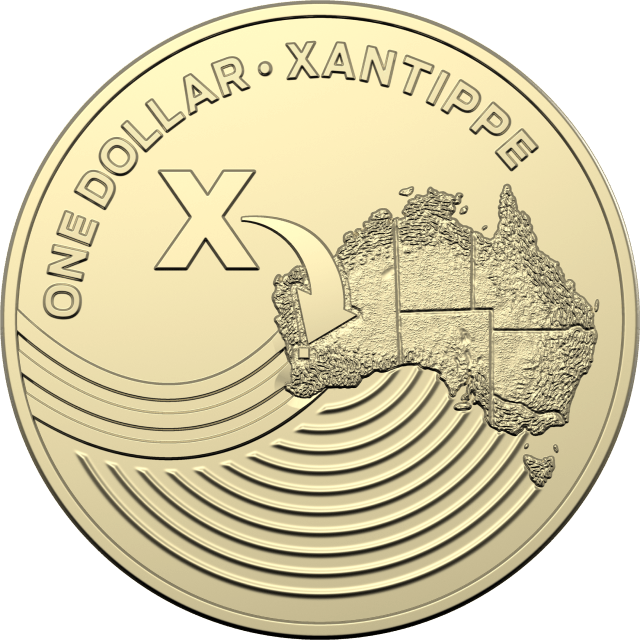
X is for Xantippe
(Image courtesy of the Royal Australian Mint)
In the chapter, Santayana was emphasizing the need to use every experience as a lesson to improve the future. The rest of the chapter discussed how to apply lessons from things that went well.
What does George Santayana have to do with numismatics? Numismaitcs has not learned from the past and making the same mistakes expecting a better outcome. In other words, the numismatic industry is fulfilling the axiom credited to Albert Einstien: “the definition of insanity is doing the same thing over and over and expecting a different result.”
What are we doing wrong? Let’s look at it in the context of this week’s news. Following the lead of the Royal Mint, the Royal Australian Mint is producing 26 limited-edition circulating one-dollar coins with the letters A to Z along with a depiction of something Australian that represents that letter. They call it the Great Aussie Coin Hunt.
Some letters are easy, like G for G’Day or V for Vegemite. Others do not have obvious names. When it came to X, the Royal Australian Mint picked Xantippe.
What is Xantippe?
Aussies were perplexed when trying to figure out who, what, or where Xantippe could be. That is when the Royal Australian Mint revealed that Xantippe is a small farming town in Western Australia.
For the Royal Australian Mint, it was the perfect way to get the message out about the new dollar coins. It caused a minor yet fun controversy that had the county talking about the series creating excitement about finding the coins.
In the UK, the Royal Mint had a similar program called The Great British Coin Hunt. In 2018, the Royal Mint issued 10 pence coins struck with British themes. Along with the other limited edition 50 pence themed coins, the Royal Mint keeps Brittons interested in coins by generating excitement about each release.
In the United States, we also saw excitement about looking for coins. We saw an increased awareness of coin collecting during the 50 States Quarters Program. Earlier this year, there was some interest shown over the release of the W mint quarters. The interest was not as strong as the 50 State Quarters, but people heard about the coin.
But that was for National Coin Week. What has happened since then?
Learn from the positive: by advertising, getting the word out, and promoting the coins, the US Mint is capable of getting people interested. By having the numismatic industry join them, people were paying attention.
Since the end of Nation Coin Week, the numismatic industry has been silent to those outside of the hobby. Most of the promotion has been like preaching to the choir. We get it. We got it. But you cannot keep an industry going that outsiders are claiming is dying.
Numismatics is not dying or near death. Like every hobby, it has problems to overcome. The first step to better health is to expand the base. The only way that could happen is if the numismatic industry does something radical: reach out consistently to everyone.
It is time to learn what worked in the past and stop doing the same things over again.
We can learn lessons from other industries. What about the collector car industry? Nearly 20 years ago, the collector car industry existed but was not that strong. The thought was that getting into cars was expensive, time-consuming, and confusing. Then Discovery Networks fell over the answer.
For Discovery, it started as HDNet, a television channel where they experimented with high definition content. They would create something in high definition and air it on HDNet to test the public’s reaction. Interestingly, the shows about cars were their most highly rated content. Then they contracted with Mecum Auctions to broadcast their events, and the ratings for a niche cable channel were higher than expected.
HDNet was renamed to Velocity. Now it is owned by Motor Trend, who rebranded the channel in its name.
Although the car hobby business was doing well, the trade publications point to the rise of HDNet and Velocity as a reason that the hobby is doing better than ever.
What can we learn from putting cars on television? First, there is an interested market out there that may not know where to turn for information. The shows provide both knowledge and entertainment. While there are shows that have a doctrine-like attitude, most are inclusive of all styles and interests.
Just like in numismatics, there is no single way to collect and enjoy cars. And like cars, there is a lot that can be used to teach everyone about history.
There was a multi-part series about the growth of the auto industry that followed many of the early titans, including Henry Ford, William Durant, and Walter Chrysler. One of the segments was their reactions to World War II, while the story was about how the automotive industry also showed how the country participated in the war effort.
What stories can be told about the 1943 steel cent? What about the “Shotgun Shell” cents struck in 1944 by recycling spent shells picked up from the training field?
How about some fun shows? Numismatic Jeopardy, where the questions are based on answers derived from something numismatic-related. For example, “It’s called the Old Line State.” The answer is on the reverse of the 2000 Maryland State Quarter!
Revive the old PBS show History Detectives and do it with numismatics. After all, they did investigate a coin said to be associated with Annie Oakley and a $6 Continental Currency note found in Omaha.
These are a few ideas. I am sure that others can come up with better ones.
Then again, that may mean that the industry will have to break out of its niche comfort zone and embrace something different.
And now the news…
 October 4, 2019
Metal detectorists have made many amazing discoveries down the years in Britain, with a great hoard of 2,600 coins just revealed last month. But there are strict rules regarding archaeological finds made by detectorists.  → Read more at ancient-origins.net
October 6, 2019The Royal Australian Mint is producing 26 limited-edition legal tender coins that will be given out as change at post offices over the coming weeks. The A to Z of Australiana could see you pocketing a Neighbours , Weet-Bix or didgeridoo $1 coin in your small change. → Read more at news.com.au
October 8, 2019The UK’s Treasury plans to commemorate Brexit by minting millions of 50 pence ($0.61) coins. But like many of the Conservative government’s recent moves, there is a major flaw: the imprint date will be the Oct. → Read more at qz.com
What Was Her Line in 1958
On July 20, 1958, Mrs. Rae V. Biester, Superintendent of the US Mint in Philadelphia was a contestant on the the CBS game show, What’s My Line. Watch as Mrs. Biester stumps the pannel:
While looking for biographical information about Rae Biester, I was surprised to learn that she was instrumental in the promotion of proof coin sets in the 1950s.
According to Tom DeLorey in The Three Major Eras of Modern Proof Sets, following the passage of legislation that allowed the US Mint to produce proof sets in 1950, sales started slowly as the public was getting used to the program and paying a small premium over face value for the “special handling.” The newly appointed Biester did what she could to help increase sales of proof sets, especially during a recession, in order to prevent layoffs. DeLorey writes:
Sales increased slowly over the first few years, and finally began to climb in 1954 under the personal care and promotion of the new Philadelphia Mint Superintendent Rae Biester, who sought to avoid a threatened round of layoffs by increasing Mint output via Proofs. Biester went so far as to write personal notes thanking buyers of the 1953 Proof sets, and inviting them and their friends to buy the 1954 and subsequent sets.
Under Biester’s administration the packaging was improved by placing the coins between two sheets of plastic divided into pockets via a simple pressure bonding, which allowed the coins to be viewed and displayed without removing them from their original holders. These &ldlquo;flat packs” appeared in mid-1955, and this is the only year which is collected by holder variations (other than by product variations).
By the time Mrs. Biester appeared on What’s My Line, she had saved the proof program and protected the employment of many US Mint employees.
Top 10 Historical Quarter Designs
After I posted a review of the DC quarter, I remembered that I had not posted what I consider the 10 State Quarter designs that best represents history and teaches us something about the state and our nation. These quarters may not be the best designs, but they represent a unique story about the state that makes it unique and contributes to the nation. Every one of the designs told a story of accomplishment and a proud heritage for the state it represents. I also learned something after each of these quarters were released.
 #1 Delaware
Engraver: William Cousins
On the very first coin, I learned who Caesar Rodney was and why is he riding a horse on the back of the Delaware quarter. Rodney was one of Delaware’s representative to the Continental Congress. He was in Dover attending to other business when he learned that Thomas McKean and George Read were deadlocked on the vote of independence. Rodney rode 80 miles from Dover to Philadelphia to vote with McKean to allow Delaware join eleven other colonies voting in favor of independence. Rodney’s signature appears on the document representing Delaware and on the Declaration of Independence. Now that’s history!
 #2 New Jersey
Engraver: Alfred Maletsky
We learned in our history classes that General George Washington lead the revolutionary troops across the Delaware River in the middle of the night to surprise the English at the Battle of Trenton on December 26, 1776. In addition to George Washington, future presidents James Madison and James Monroe was part of the contingent. Rivals Alexander Hamilton and Aaron Burr along with future Chief Justice of the Supreme Court John Marshall were soldiers serving under Gen. Washington. The Battle of Trenton was a key battle that helped change the outcome of the war for independence.
 #3 Connecticut
Engraver: T. James Ferrell
Although the Charter Oak appeared on the reverse of the 1935 Connecticut Tercentenary Commemorative Half Dollar, younger collectors probably have not seen the coin. Adding it to the Connecticut state quarter had me looking up the history of this tree. It was said that the colony’s charter was hidden in a cavity within the tree when James II sent a new governor to Connecticut to reclaim the document. One of the first “battles’ against the authority of the British monarchy.
 #4 Virginia
Engraver: Edgar Z. Steever
Jamestown, Virginia was the first permanent European settlement in the New World and would celebrate its quadricentennial in 2007. The design features the three ships that brought the first settlers to the new colony: Susan Constant, Godspeed, and Discovery. We are reminded of the beginning of this nation and how they came to the new land. Having visited Jamestown, I thought the design was exciting.
 #5 North Carolina
Engraver: Don Everhart
On a cold, wind swept day on December 17, 1903, Orville and Wilbur Wright made the first powered, controlled, sustained airplane flight from the sands outside of Kitty Hawk, North Carolina—now the town of Kill Devil Hills. For three years, the Wright brothers lived in Kitty Hawk testing and perfecting their design that culminated in four successful flights on December 17. We may take flying for granted today, but this one event significantly changed history.
 #6 Missouri
Engraver: John Mercanti
The Corps of Discovery headed by Meriwether Lewis and William Clark that explored the Louisiana Purchase was an significant event that lead to the country’s western expansion across the continent. The trip ended in what is Oregon today. Amongst his party was his Indian guide Sacagawea and her baby Jean-Baptiste Charbonneau. The design shows Lewis and Clark’s return to St. Louis from their venture.
 #7 Iowa
Engraver: John Mercanti
It would have been easier for Iowa to create a quarter design based on its agricultural heritage. Instead, they chose to celebrate their education values demonstrated in their history. Basing the design on Grant Wood’s “Arbor Day,” the quarter shows a one-room school house with a teacher helping students plant a tree. When you learn that Iowa was one of the first states to organize their schools in county-based districts. Along with being amongst the first to form high schools, their experiences were adopted in other states. A subtle, yet important, historical note.
 #8 Utah
Engraver: Joseph Menna
On May 10, 1869, the Union Pacific and Central Pacific railroads officially completed the first transcontinental railroad. The completion was celebrated at Promontory Summit, Utah with the driving of the Golden Spike. Although there was one segment in California that was completed later, the transcontinental railroad provided significant economic development for the newly expanded areas of the country.
 #9 California
Engraver: Don Everhart
When Governor Arnold Schwarzenegger announced that the design for the California quarter would honor John Muir, I had to go beyond my basic education as the who Muir was. I knew Muir was a naturalist and the founder of the Sierra Club. What I did not know was that Muir was instrumental in saving Yosemite Valley and Sequoia National Park. I also learned that Muir was widely published about ecology and proposed ecological programs that began to gain favor in the 1970s, more than 60 years following his death. Although he generated a lot of controversy, his concepts show benefits today. For teaching me about Muir, California’s quarter makes this list.
 #10 Illinois
Engraver: Donna Weaver
Anyone who was educated in the United States knows the basic story of Abraham Lincoln. We know that he was the 16th president and issued the Emancipation Proclamation. We know he was the president throughout the Civil War and delivered the most remembered speech at Gettysburg, Pennsylvania. Lincoln was born in a log cabin in Kentucky and was assassinated at Ford’s Theater in Washington, DC. But I learned that Lincoln interested in the river and railroads. He holds a patent related to the buoying of vessels. I knew that he was the first Republican elected president but I did not know he was one of the party’s founders. There is so much more fascinating information that I learned about Lincoln that was never taught in school, but this is supposed to be a short paragraph. You should read some of the books about Lincoln. He is a fascinating person and what he did as president is the reason why he is considered our greatest president.
I Found Another 2009 Coin
In the same manner as I acquired my first 2009 coin, I was able to obtain four DC quarters. Although I wish DC would have picked another topic, the design is not bad looking in hand.
Last year, I found my first 2008 coin in May. I am glad it did not take that long, even if it is cheating. Too bad the coin machines in the US Mint headquarters only dispense quarters and dollars!
More Coin Legislation Introduced
Since Rep. Sheila Jackson-Lee (D-TX) introduced H.R. 255, NASA 50th Anniversary Commemorative Coin Act, there has been two more coin-related bills introduced in congress.
Rep. Joe Baca (D-CA) introduced H.R. 406, Alice Paul Women&rsqou;s Suffrage Congressional Gold Medal Act. The bill authorizes “The Speaker of the House of Representatives and the President pro tempore of the Senate shall make appropriate arrangements for the presentation, on behalf of the Congress, of a gold medal of appropriate design in commemoration of Alice Paul, in recognition of her role in the women’s suffrage movement and in advancing equal rights for women.” The US Mint would be authorized to “sell duplicates in bronze of the gold medal.”
The other bill, H.R. 621, Girl Scouts USA Centennial Commemorative Coin Act, was introduced by Rep. Jack Kingston (R-GA). It calls for the minting of $1 silver uncirculated and proof coins “in commemoration of the centennial of the Girl Scouts of the USA” in 2011.
All three bills have been referred to the House Financial Services Committee. With the current fiscal crisis, they may be be on hold in that committee for a while.
Who Is To Blame at the US Mint
After I posted the article Ultra High Price Gouging With No Relief, an anonymous commenter accused me of having a “a low opinion the of the people there and don’t give them any credit.” It was an article that was critical of the US Mint and its policies, I was not directing criticism to the people who work for the Mint but those who run the bureau.
First, let me say that unequivocally, I have tremendous respect for all government workers. I live in the Washington, DC metropolitan area and work with the government on various levels, I know how hard the career government employees work and the pressure of working with what seems like undue regulations in their job. I have seen those with commercial experience not do well in this tightly controlled atmosphere of a government job. But when I explain this to friends and relatives who do not have my insights, I am laughed at for being too close to the situation. I fully understand the environment working for the federal government and I have a lot of respect the work they do and their service to this nation.
My low opinion of the US Mint, and other areas of the federal government, is reserved for the appointees and some high-level special pay executives who set the policies the rest of the bureau has to implement. With the problems of the Mint in the last year, I have questioned Director Edmund Moy’s ethics and his policies. I have also been critical of the hiring of Andy Brunhart as Associate Director after his less than stellar job at the Washington Suburban Sanitary Commission. With the Mint failures of the past year, both men deserve a tremendous amount of criticism for the work it appears they have not done.
Until Moy is replaced by someone more competent, I will continue to criticize him and the policies of the US Mint. Remember, this criticism is being levied against Moy, Brunhart, and the other bureaucrats. I am not criticizing the hard working employees of the bureau.
To my anonymous commenter, I apologize for making it sound like I was indicting the entire bureau for the problems caused by the bureaucrats who deserve the criticism. If you would like to talk further, you can send me a private email note and I would be happy to discuss this further.
Support the Coin Collectors Blog
 Buy me a coffee
Thank you for your support!
Let Me Know What You Think
Are you going to the World's Fair of Money
Total Voters: 17
 Loading ...