
Copper: Scientific Fact and Numismatic Fiction?
Copper is the third most common element in the world.
Copper is a versatile metal that has been exploited for many purposes since the Bronze Age that started roughly in 3300 BCE. It is as practical as wire carrying electricity and for cooking. It is used for its artistic qualities such as the Statue of Liberty. Copper is also a medium of exchange.
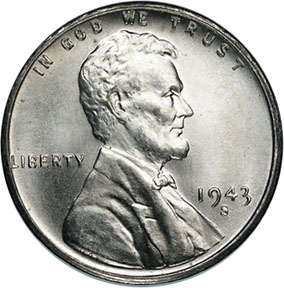
U.S. cents have been made of copper, steel, and copper plated zinc. What’s next?
When coins were struck using precious metals, more were struck using a majority of the precious metal, and the balance was copper. Although legislation required changes in the composition of the alloy, copper continued to provide the filler.
Precious metals, like gold and silver, do not oxidize. Copper will naturally oxidize. Copper oxidizes when it is exposed to the environment. Water, salts, and acids in the air will react with the copper that will cause a molecular change in copper that causes its color to change. A typical example of what happens when copper oxidizes is the Statue of Liberty. The copper statue is now a blue-green color after many years of enduring the elements. That blue-green color is known as verdigris.
In numismatics, the copper oxidation is apparent as the colors of the half-cent, one cent, and two cent coins oxidize. When a coin is the color of the initially polished planchette, it is said to have a red color. As the copper in the coin oxidizes, the color is described as red-brown, sometimes with a percentage of red to brown color. A brown coin is a coin whose red color has completely oxidized.
The oxidation process is natural and can not be stopped. It is possible to slow the process. Eventually, the copper will oxidize and turn every cent ever struck to brown.
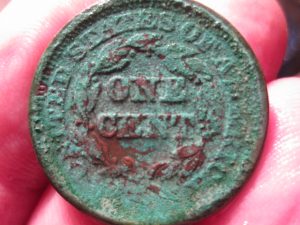
Would this metal detector find be considered “artificial toning” (Image from CTTodd.com)
As collectors, we have seen the natural oxidation of copper accelerated by artificial means. Coins stored in holders made of the synthetic polymer polyvinyl chloride (PVC) produce an acidic gas as it oxidizes accelerating the oxidation of the copper used to make coins. That acceleration can lead to the rapid breakdown of the PVC holder, causing it to appear as if it melted to coin. Numismatists call this damage. It is a natural reaction by the copper.
When copper oxidizes, it does not change its molecular structure but alters its form. If someone would test the surface of a cent with bright red color and one that has turned brown, both will test as being made of copper. The surface would have to examined on a molecular level to see how oxidation has reformatted the molecular structure.

An example of how copper tones
Although few would call the verdigris on the Statue of Liberty ugly, verdigris on a coin causes people to turn their heads away.
Another way that the oxidation of copper changes coins is when a coin becomes toned. Some collectors marvel at colors some coins become when the copper in the alloy oxidizes. Others see the coin as damaged. Both views are right.
From a scientific perspective, a toned coin shows the flaws within the alloy. If the alloy was a consistent mixture of metals, toning on every coin would be similar. Instead, the inconsistencies of how the copper is mixed with the primary metal is revealed in the pattern of the toning. This inconsistency makes toning difficult to predict and challenging to detect whether toning was through natural oxidation or by artificial means.
Experts claim they can tell the difference between natural and artificial toning. With certain exceptions, such as the toning from known contaminants like the lignin in paper and PVC, very few people can tell the difference without extensive examination. Specialized equipment such as microscopes that enhance the image using a type of radiography is the only way to determine the difference between natural and artificial toning. And that is not a perfect solution.
The third-party grading services can examine coins using specialized equipment and determine whether the coin was naturally or artificially toned. But they can only be reasonably sure. Without examining the surface to determine the type of contaminants that caused the oxidation, they can provide the best guess based on the evidence they can collect.
If you read the various numismatic forums, members share many formulas that they found to accelerate the oxidation of the copper in a coin. Some have even bragged how they were able to have the coins graded by the third-party grading services as being naturally toned. Collectors continue to chase these coins and pay additional premiums for them.
Another numismatic curiosity is the alleged conserving of coins to remove damaging oxidation. Unlike the oxidation of iron, which breaks down the molecular bonds of the alloy, the bonds of oxidized copper molecules remain strong. The green color is on the surface of the copper where it was in contact with the contaminants.
It is impossible to reverse the oxidation of copper. The only way to remove the oxidized copper that has turned to verdigris is to remove that layer of copper. When speaking with professionals that restore art and antiques, they admit that their methods of restoring copper involve removing the oxidized layers. They recognize the fact that it is the only way to restore the luster to copper.
However, numismatic conservation services make claims that they can safely remove the oxidation without damaging the surface of the coin. When asking a professional art restoration company whether this was true, they wondered how these companies could get away with making their false claims.
When shown example images of coin conservation found online, the professionals were able to explain how most of the cleaning was done using sonic tools or high pressure distilled water possibly mixed with baking soda to raise the alkaline level of the water. They did refer to this as a form of cleaning because it is designed to loosen the bonds between the contaminants and the metals.
One set of images showed the removal of verdigris on a coin. The expert said that the only way to remove the verdigris spots was the alter the surface of the coin by removing that layer of copper which changes the surface of the coin. It is an evasive procedure, yet the example images showed the coin before conservation and following the work in a third-party grading service holder not marked as having altered surfaces.
While sitting at a table where a bronze bust worth tens of thousands of dollars was in the process of conservation, this expert saw before and after images of silver and gold coins and wondered if the numismatic industry knew something the multi-billion dollar art industry did not.
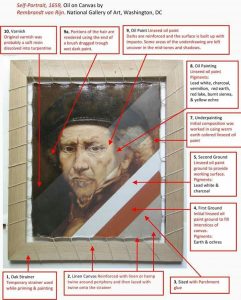
Art restoration is so understood that a graphic like this does not cause controversy.
Similar openness does not exist in the numismatic industry. Numismatic conservation companies do not document their methods by calling them trade secrets. These coins are in third-party grading service holders without any indication of their conservation, and the auction companies are happy to sell them for thousands or even hundreds of thousands of dollars.
What have we learned?
- Every coin that has been struck for circulation by the U.S. Mint contains copper except for the 1943 Steel Cent.
- Copper oxidized to the point of forming verdigris on the surface.
- Oxidation only occurs on the surface that is in contact with the environment.
- The rate of oxidation is controllable through proper handling.
- Once copper oxidizes, it is not reversible.
- It is not possible to remove oxidation without altering the copper surface.
The art world understands that conservation of copper requires altering the surface. It is accepted as part of an industry where significant works sell for tens- or hundreds-of-millions of dollars. The numismatic world hides behind alleged proprietary secrets and few questions about what they are doing.
Maybe it is time to ask the numismatic conservation companies to disclose what they are doing to understand whether they are altering the coins’ surface, or not. Maybe it is time to ask the third-party grading service why are they not disclosing that they are placing conserved coins in their holders. Maybe it is time to hold the auction companies and dealers responsible for not disclosing when a coin is conserved.
Maybe it is time the industry is honest with itself and honest with its collectors.
Now It Is 2008
After nearly six months of searching, I found a 2008-P Jefferson Nickel in pocket change. I noticed the shinier-than-usual nickel in the pile that was removed from my pocket on Thursday, June 12. Not including State Quarters, this is the latest I have seen circulating coins for any year.
The slow economy is also slowing coin production. Numismatic News is reporting that even the production of Presidential Dollars are slower than the equivalent time period after the introduction of the Sacagawea Dollar. Although the US Mint does not provide monthly production figures, the total mintage figures for 2008 through May is less than one-third of the 2007 totals.
Hopefully, I will find a penny and dime soon.
A New Roosevelt Dime
After writing about the next gimmick being offered by Rep. Mike Castle (R-DE), I was thinking about what could be the next change in our change.
At one time, we had a president who looked at our coinage and decided that it needed to change. This president wanted to place his mark on our coinage by creating a modern classic beauty that fit a great nation. Rather than trying to fight with congress to make these changes, this president looked at what could be done without congressional involvement. He picked the oldest coin and started ordering redesign. This president call it his “pet crime.”
The oldest design on our circulation coinage is the Roosevelt Dime. Shortly after the death of Franklin Delano Roosevelt, the public was clamoring for something to honor the fallen president. The dime seemed like a natural choice since Roosevelt was inflicted with polio, or infantile paralysis as it was commonly known, and the dime was the symbol of the “March of Dimes” campaign that began during Roosevelt’s first term.
The Roosevelt Dime has been used since 1946. With the exception of the placement of the mint mark and the composition, its design has not changed in 62 years. There has also not been a “special program” to alter the design during that time. After the obverse of the Lincoln Cent, it is the oldest design of any current issue. Maybe it is time for a change.
 Before someone attacks me about FDR’s association with the March of Dimes, think about when the last time you saw a “Dime Card” campaign. I remember the dime cards. They were passed out in schools or placed on counters at local stores for people to slip dimes into the slots. The cards were returned to the March of Dimes who would use the money for their good work. But they do not use this method any more—although the Penny Harvest demonstrates how using small change can go a long way. You may be able to find these cards in yard sales, antique shops, or in auctions.
Not only are these cards hard to find, I had a difficult time searching for an image to use on this page!
In the mean time, the president whose pet crime gave our coinage the greatest renaissance in its history has never been honored on a coin. Maybe it is time to retire Franklin and replace his with his fifth cousin, Theodore Roosevelt.
Theodore Roosevelt was not only the first president to earn the Nobel Peace Prize but he is the only one to earn it while still in office. The trust-busting Roosevelt worked tirelessly for the every day American. Roosevelt felt it was so important to work for the people that he invited the people to greet the president Sundays at the White House. People lined up for hours to shake Roosevelt’s hand.
It was Theodore Roosevelt’s administration that purchased the most land of any administration as public park lands to preserve their beauty for all Americans. Roosevelt created the National Wildlife Refuge System by presidential proclamation in 1903.
Theodore Roosevelt is the only president honored on Mount Rushmore not honored on our money. Maybe it is time we honor Theodore Roosevelt on the US coinage he took pride in beautifying.
Do We Need Another Quarter Series?
In a grand announcement, Rep. Mike Castle (R-DE) announced that he introduced H.R. 6184, America’s Beautiful National Parks Quarter Dollar Coin Act of 2008 that would change the reverse of the quarter dollar coins to be “emblematic of a national park or other historic site in each State, the District of Columbia, and each territory of the United States.”
Castle, who authored the 50 State Commemorative Coin Act, noted that the program will make more than $6.2 billion in revenue, which will be $3.7 billion more than non-state quarters.
Note to Rep. Castle: ENOUGH!
We know that the 50 State Quarter program was a success. Aside from the income, it helped introduce more people to collecting. The process brought good designs and bad designs. It introduced the coin making process to the public while allowing the states to create designs to allow them show off. After the states are completed, the District of Columbia and territories are get their turns next year.
During that time, we celebrated the Westward Journey by redesigning the nickel and started honoring our past presidents with a one dollar coin. Next year, we honor Abraham Lincoln with four different Lincoln Cents reverses and a special 2009-S VDB collectible. Even the reverse of the Sacagawea Dollar will undergo a change to honor Native American heritage.
Note to Rep. Castle: ENOUGH!
These programs have been nice. But maybe it is time for a break.
The Presidential Dollar program has waned, mainly because the coins are not circulating. Coins are not circulating because there is a perception that the paper Federal Reserve Note is easier to deal with. But it is known that congress will not change the law to end the one dollar note until the Bureau of Engraving and Printing can make up for the lost production. One way to do that is to print currency for other countries.
Note to Rep. Castle: what about helping BEP find foreign customers so that they are not relying on the printing of $1 FRN? Why not provide the environment so that BEP can bring in new business? Can you help the BEP do what it takes to print the polymer notes that many foreign countries are demanding?
Are you doing what is right or are you looking for a few dollars? Is there a call for this series or are you looking for a few dollars? Are you afraid that there may be some fatigue in this idea, or are you looking for a few dollars?
There seems to be a “collectors’ fatigue” with the number of offerings from the US Mint. It is time to give the collecting community a small break and allow congress to fix some of the other issues that fact the Mint.
Mother’s Day, the Infantry, and Disabled Veterans
What does Mother’s Day, the Infantry, and Disabled Veterans have in common? They all had bills passed on Tuesday for the issuing of commemorative coins in their honor.
Following the death of her mother in 1905, Anna Marie Jarvis devoted her life to establishing Mother’s Day as a national, then international holiday. Although there were some celebrations, there were no holidays to celebrate mom. With the financial help of famed clothing merchant John Wanamaker, West Virginia became the first state to recognize Mother’s Day as a holiday in 1910. On May 14, 1914, President Woodrow Wilson signed a presidential proclamation designating the second Sunday in May as Mother’s Day.
To commemorate the 100th anniversary of Mother’s Day, Rep. Shelley Capito (R-WV) introduced, H.R. 2268, Mother’s Day Centennial Commemorative Coin Act. The bill calls for thee striking of 400,000 silver dollars in 2014 where the “design of the coins minted under this Act shall be emblematic of the 100th anniversary of President Wilson’s proclamation designating the second Sunday in May as Mother’s Day.” A surcharge of $10 will be split between Susan G. Komen for the Cure Foundation and the National Osteoporosis Foundation.
H.R. 2268 was passed by a voice vote in the House of Representatives. It must be passed by the Senate before it can be sent to the president for his signature.
Another bill passed by the House and sent to the Senate is H.R. 3229, National Infantry Museum and Soldier Center Commemorative Coin Act. This bill calls for uncirculated and silver dollar commemorative coins, struck at the West Point Mint that would be “emblematic of the courage, pride, sacrifice, sense of duty, and history of the United States Infantry.” Coins will be issued in 2012 and the $10 surcharge will “be paid to the National Infantry Foundation for the purpose of establishing an endowment to support the maintenance of the National Infantry Museum and Soldier Center following its completion.”
On the other side of the Capital, H.R. 634, American Veterans Disabled for Life Commemorative Coin Act , passed the Senate by unanimous consent. Introduced by Rep. Dennis Moore (D-KS) and passed the House on May 15, 2007 by a 416-0 vote, the bill calls for the striking of 350,000 silver dollars whose design will be “emblematic of the service of our disabled veterans who, having survived the ordeal of war, made enormous personal sacrifices defending the principles of our democracy.” Coins will be issued in 2010. For this commemorative, the $10 surcharge will “be paid to the Disabled Veterans’ LIFE Memorial Foundation for the purpose of establishing an endowment to support the construction of American Veterans’ Disabled for Life Memorial in Washington, DC.” The bill passed with a minor technical change that must be approved by the House before it is sent to the President for his signature.
Interesting set of commemoratives for collectors.
Director Moy Is Not An Honest Broker
We have been in for a wild time here in the Washington, DC area. Severe thunderstorms and high winds swept through the area on Wednesday and Saturday providing the electric companies with quite a bit of work to do. During that time, I am reminded once again that computers cannot function without electricity.
While the rest of us were sweating and fixing our homes, the US Mint and Treasury policy implementers were downtown trying to figure out how to throttle the sale of silver on the open market. In fact, the Mint has been slowing the sale of American Silver Eagle bullion coins since April.
According to a letter sent to authorized bullion purchasers, the Mint has experienced “unprecedented demand” for silver bullion coins. While the demand for silver has risen, the Mint’s supply has not been able to keep up with the demand. So the Mint will be increasing production at the expense of collector American Eagles and while limiting the sales to bullion dealers.
Although sale of silver bullion has surpassed expectations, expectations by the US Mint should have been higher. With the economy waning, it should not surprise the Department of the Treasury that people would hedge their money against inflation through the purchase of precious metals. This is one of the oldest strategies in investing. Yet, the Mint all but admits to being caught short by this. Why?
Many have commented on the Mint’s shortsightedness while others argue that the Mint is acting illegally. I think it is mired in politics.
Since the seating of the 110th Congress, there has been a subtle show of acrimony between the Mint and the new congressional majority. US Mint Director Edmund Moy has made it clear that he thinks the Mint should have the power to determine the content and design of US coins. The House of Representatives responded by introducing H.R. 3956 that would give this power to the US Mint.
After H.R. 3956 was introduced, fellow members and watchdog groups question whether the bill would be constitutional since it will pass off to the executive branch the power “To coin Money, regulate the Value thereof…” (Article I, Section 8). To fix these issues, H.R. 5512. In H.R. 5512, congress would continue to determine the composition and design of coins while the Mint would become advisors.
When the bill passed the House, Moy was quick to disagree with H.R. 5512 by suggesting that the Mint should have more control over the composition and design of the coins. He also requested that the bill be changed to provide more time to implement the requirement for copper-colored steel cents. The current bill requires the change to occur in 90 days. Moy said that the conversion would require 18-24 months.
There may be more to this than just one bill. Following the passage of the Native American $1 Coin Act, the Mint thought they had a loophole that would prevent them from minting Sacagawea Dollars in 2008. Letters were exchanged between Congress and the Department of the Treasury explained the law that was passed and said that the Mint should strike Sacagawea Dollars immediately. Sources report that contentious discussions suggested that the Director would be in violation of the law if the Mint did not strike Sacagawea Dollars. Allegedly, this conversation occurred two weeks before the availability of 2008 Sacagawea Dollars.
Moy again by proposing the Mint strike 2009 Double Eagle Gold $20 ultra-high relief coin based on 1907-1908 design by Augustus Saint-Gaudens. When introduced to the Citizens Coinage Advisory Committee, Moy stated that 31 U.S.C. § 5112(i)(4)(C), the authorization of the American Eagle program, gave the Mint the authorization to strike these coins. Congress disagrees because everything about the coin, from composition to design, is not codified in the law. Rather than argue with the Director, both the House and Senate introduced appropriate legislation to authorize this coin.
Now, when the Mint was questioned on the distribution problems with silver, the Mint responded with a brief statement that said in part, “By law, the United States Mint’s American Eagle silver bullion coins must meet exacting specifications and must be composed of newly mined silver acquired from domestic sources.” (emphasis added) The problem is 31 U.S.C. § 5112(e) and 31 U.S.C. § 5112(f), the laws that authorizes the bullion program does not say that the coins must be made of newly mined silver. In fact, the law does not require that the silver be purchased from US-based mines. All it requires is that the silver used be purchased at market value and the bullion sold at a value based on the silver market.
It appears that Director Moy is using a pedantic reading of the law to make his point. Rather than working with congress to resolve these issue, Moy would rather use politics to make his point hoping citizens would complain to congress. Sources say that Rep. Luis Gutierrez (D-IL) has emphatically told both Moy and Treasury Secretary Henry Paulson to resolve the situation. Rep. Gutierrez is Chairman of the Domestic and International Monetary Policy, Trade and Technology Subcommittee which has oversight responsibility over the Mint.
Individually, these policy moves by Director Edmund Moy do not seem significant. Together, they represent a pattern that shows the Director is looking to increase his power over the Mint. Moy needs to remember that he is the boss of the manufacturing operation charged with the responsibility to strike coins as prescribed by the 535 member Board of Directors (congress) and approved by the Chief Executive Officer (president). Moy’s actions are insolent and should be the subject of disciplinary actions by the Board of Directors.
Support the Coin Collectors Blog
 Buy me a coffee
Thank you for your support!
Let Me Know What You Think
Are you going to the World's Fair of Money
Total Voters: 17
 Loading ...