A few weeks ago, I wrote about a one page collection starting with the one cent coin. The set also included an example of a half-cent to cover the lowest denomination of coins produced by the U.S. Mint.
The concept of the one-page collection is to create a meaningful collection using a single 20 pocket page that holds 2×2 holders. Using this format, I can create any type of collection without being bound to the albums and folders that are published by the numismatic press. I can also personalize the collection with information I find and other stories, some that I write.
When creating a one page collection, I am looking at ungraded coins that could be graded Fine or better and costs under $100 each. While I try to keep purchases under $50, having the ability to go over for certain coins gives me a little flexibility while staying closer to affordable.
I was asked what I used as a price guide to determine affordability. For full disclosure, I had been consulting the NumisMediaOnline Fair Market Value Price Guide of collector coin. The site is free, updated monthly, and is the same information printed in their monthly publication. The NumisMedia Online Dealer Price Guide as well as their printed version requires a subscription.
Since my first one-pager was of the lowest denominations, I will move up a bit and put together a collection of 2, 3, and 5-cent coins.
The first coin struck by the newly created Mint was the half disme in 1794. As one of the original coins designated by the Coinage Act of 1792, legend has it that the coins were struck using silver donated by Martha Washington. Although there is no proof that our first First Lady donated her silver, it makes for a good story.
The first half-dismes were really not struck for circulation but over 86,000 coins of the 20.8 grains (1.35 grams) of .8924 fine silver were delivered to Secretary of State Thomas Jefferson (under the First Coinage Act, the Mint was placed under the Department of State). Originally designed by Robert Scot, the early Flowing Hair and Draped Bust half-dimes (the “s” was dropped in 1796 since it was silent anyway). Production ceased in 1805 with the shortage of silver.
Production picked up again in 1829 with the Capped Bust design by William Kneass and continued until 1837. After the passage of the Act of January 18, 1837, the weight of the coin was reduced to 20 5/8 grains (1.34 grams) and the fineness raised to .900 silver. For this change, Christian Gobrecht’s Seated Liberty design was used for the new coin.
This is where the series gets interesting. First, there was a change in design in 1838 to add stars to the obverse. In 1853, to show that the size and weight was change, arrows were added to the date from 1853 through 1855 before being removed in 1856 when the weight was returned to the old standard. In 1860, the legend was move to the obverse replacing the stars and the reverse laurel leaves were made larger.
The silver half-dime was made through 1874 after the successful release of the copper-nickel coin we call the Shield nickel. Nobody is sure when the coin started to be called a nickel, especially since it is made of only 25-percent nickel. It has been speculated that it was called a “nickel” because of the composition while it circulated along side the silver half-dime.
The U.S. nickel is unique in that it is the only coin that has been made of the same .750 copper and .250 nickel composition since its introduction in 1866 except for the silver alloy used during World War II from 1942-1945.
Starting this collection with an easy to find 1865 3¢ Nickel
Two and three cent coins were conceived out of the coin shortages during the mid-19th century. The three-cent coin, nicknamed the trime, was conceived in 1851 for better handling by the post office for buying postage. The silver three-cent coin was struck between 1851 and 1873. However, when silver became expensive and people were hoarding the coins for their silver content, congress authorized the striking of copper-nickel three-cent coins where were called to as three-cent nickels. Mint engraver James B. Longacre designed both coins that used a Roman numeral “III” on the reverse.
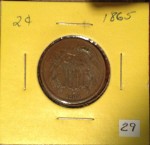
Bought this 1865 2¢ coin from my coin club’s auction
During the Civil War, the silver shortage caused hoarding of coins. The only circulating coins were the copper large cents. In order to produce more coins that would circulate, congress passed the Coinage Act of 1864 that eliminated the silver half-dime, the silver three-cent piece (trime), and authorized the production of the bronze two-cent coin. The Longacre-designed coin featured a shield on the front and the denomination “2 CENTS” on the reverse between two wheat stalks.
Beginning with the Liberty Head “V” nickel, most of the coins should be easy to find and not cost a lot of money. In fact, it may be easier to find an 1883 Liberty Head nickel without the “CENTS” on the reverse, also called the Racketeer Nickel, than an 1883 nickel with the “CENTS” in Fine to Very Fine grades. It may be easier to find a 20th century version that would fit this collection nicely.
For the rest of the series, you can find nice coins at all grades without problems. Just be aware of the major varieties, such as the two types of Buffalo nickels, and the modern changes in the Jefferson nickel. It should be fun to complete this set:
✓ 1964-1873 Two Cent piece: When I started to look for a an example of a two-cent coin, I was surprised as to how many I could find that were nicely preserved and affordable. Most VF-XF coins in this series can be purchased for $40-60 or even less if you find a dealer having a good day.
✓ 1851-1873 Silver Three Cent piece (trime): It will be difficult to find silver three-cent coins from 1863 through 1872 because most were melted in 1873. One of the best examples I have seen were the 1852 coins. Not only are they affordable but the mintage of over 18 million make them the most available coins of the set.
✓ 1865-1889 Nickel Three Cent piece: After the two-cent coin, this was the other coin minted in reaction to the hoarding during the Civil War. Early dates are easily found because of their mintage figures in the millions and for affordable prices. It should not be difficult to find a nice Extra Fine coin for around $40.
✓ 1829-1837 Capped Bust half-dimes: If you want a real challenge, put together a typeset of all half-dime types. Part of the problem with that is the Flowing Hair half-dimes will cost thousands of dollars, if you can find them. For the average collector, I suggest a Capped Bust half-dime to start the five cent part of this set. Based on the price guides and what I have seen at dealer tables, you should be able to buy a nice one graded around Fine for $60-65. This should be a good representative start of the five cent series.
✓ 1837-1873 Seated Liberty half-dimes Types 3 & 4: No collection is complete without a representation of Christian Gobrect’s Seated Liberty design. Inspired by the similar image of Britannia, Gobrect posed Miss Liberty in the same manner except holding a union shield and a phrygian cap on a pole that signifies liberty and the pursuit of freedom. For this set, I recommend the 1853-1855 “Arrows at Date” (Type 3) variety. Aside being affordable at $60-70 in XF, the arrows tell the story of how the composition was changed while the coin was being used. The “Legend on the Obverse” (Type 4) variety is an interesting change and would be even more affordable. For the “Arrows at Date” variety, you may want to consider finding one with the “O” mint mark from the New Orleans mint to keep it interesting. “Legend on the Obverse” varieties from San Francisco are affordable and would make for an interesting addition to this collection.
✓ 1866-1833 Shield nickel: Rather than worry about the “Rays” versus “No Rays” types, I decided on the “No Rays” to keep this coin around $40. However, it is your collection and if you what to spend about $100 for a VF-XF Shield Nickel with Rays, go ahead since it will give your collection a little more depth.
✓ 1883 Liberty Head nickel “Without Cents” When Charles Barber designed the coin, his idea was to use a Roman numeral “V” on the reverse and not include the word “CENTS.” Since the three-cent coins used the Roman number “III” it was a logical progression. However, since the coin was about the same size of the $5 gold-half eagle, the Liberty Head nickel was gold plated in an attempt to pass them off as the $5 gold coin. These coins were then nicknamed Racketeer Nickels. It was then decided to add “CENTS” to the bottom of the reverse. After this decision was made, people thought that the coins would be recalled and started to save them, thus making it easier to find the 1883 without CENTS nickel than it is to find an 1883 with CENTS coin.
✓ 1883-1912 Liberty Head “V” nickel: Most XF coins in this series will be around $40 each, if you can find them. It is easy to find very worn coins and very expensive to find the higher grades. In fact, if you can find a nice XF 20th century issue, that would make a nice entry in this collection and only cost around $30.
✓ 1913 Type 1 Buffalo nickel: This iconic American design by James Earle Frasier ranks as one of my favorite. While it is a great design, the coin did not wear well and it is possible to find a lot of coins where the dates have been worn flat. On the reverse, Fraser designed the coin where the buffalo (actually, an American Bison) is standing on a grassy mound. On the mound was the denomination and mint mark. This high surface wore easily in circulation. It was later changed to remove most of the mound for a line. You can find nicely preserved Type 1 Buffalo nickels from Philadelphia for around $25. Spend as little as $10-15 more for an example from Denver. San Francisco coins will be $40 more.
✓ 1913-1938 Type 2 Buffalo nickel: Basically, the mound was hollowed out leaving the buffalo standing on what looks like a line. While not as aesthetically pleasing, it did preserve the denomination and mint mark on the reverse from wear. Best bet for this collection is to find a late 1930s example for $10-15. If you spend a little more, you can own an uncirculated 1935 or 1936 with a mint mark for $35-40. These make stare-worthy coin in any collection.
✓ 1938-1942,1946-2003 Jefferson nickel: Jefferson nickels come in four types with the left-facing portrait being the dominant coin of the series. With the exception of the 1939-D, you can find an uncirculated example for under $10. If you want an example with the mintmark on the reverse, select a coin from 1964 and earlier since the mint marks were move to the obverse starting in 1968 and no coins had mint marks from 1965 through 1967. Maybe you would want to add a 1970-S coin which was the last year the nickel was produced in San Francisco and had an obverse mint mark.
✓ 1942-1945 Wartime Silver Nickels: to reduce the amount of copper and eliminate the nickel that were need for the war, the Mint produced nickels using an alloy of .560 copper, .350 silver, and .090 manganese. To distinguish these coins from regular nickels, the Mint added a large mint mark over Monticello on the reverse. It was the first time the Mint used a “P” mint mark on any coin. Since the mint mark makes them unique, one from each mint would make a nice example. Maybe one from each year with each on representing one Mint. You can find nice uncirculated examples for an average of $5 each without looking too hard.
✓ 2004-2005 Westward Journey Nickel Series: After the success with the start of the 50 State Quarters series, to honor the 200th anniversary of the exidition by Meriwether Lewis and William Clark in the newly purchase Louisiana Territory and westward, congress authorized this two-year four coin series to commemorate the journey. These modern circulating commemoratives are readily available and the four should not cost a lot of money, even as uncirculated coins. Make sure you find all four coins: 2004 coins with the left-facing portrait with the Peace Medal and Keelboat designs on the reverse. The 2005 coins had a wonderful obverse portrait designed by Joe Fitzgerald that included the word “Liberty” reproduced from Jefferson’s writing. The reverse included the American Bison and “Ocean in View.”
✓ 2006-Present Front Facing Portrait: With the return of Monticello on the reverse, a new front-facing portrait by Jamie Franki based on the 1800 portrait painted by Rembrant Peale and includes the “hand written” version of “Liberty” on the obverse.
An interesting aspect of this collection is that the coins are of all the basic metals used in non-gold coins. The 2-cent pieces were made from copper while the 3-cent coins had one type made in silver and anther in nickel. While most of the 5-cent coins were made of copper-nickel, the wartime composition removed the nickel and lowered the copper content by adding silver and manganese. It is a good representation of coinage metals circulating in the United States.
This is one set where it was difficult to think about how to keep it to 20 coins. Depending on where you shop, your patience, and your budget, this is a collection that can easily be expanded.
If you decide to use this guideline for your set, do not limit yourself to my suggestions. Consider other options. Consider adding another page. Make it personal. Make it yours.
Bibiana Boerio nomination to be the Director of the U.S. Mint was returned by the Senate.
The U.S. Mint continues to be without a permanent director and the prospects for a director being appointed any time soon does not look promising. During the opening session of the Senate on January 3, 2013, the Senate moved under unanimous consent to return the nomination of Bibiana Boerio to the President under the provisions of Senate Rule XXXI, paragraph 6 of the Standing Rules of the Senate. This rule states that nominations not acted upon during the session are returned to the President. Since Boerio’s nomination was not acted upon during the 112th congress, the Senate is required to return the nomination.
President Obama has the option of resubmitting any nominations. Thus far, the president has not re-sent Boerio or any other nomination for Director of the U.S. Mint to the Senate for confirmation during the 113th congress.
The U.S. Mint has been without a permanent director since the resignation of Edmund Moy in January 2011. Since his resignation, the U.S. Mint has been lead by the Treasurer of the United States Rosie Rios with day-to-day operations being lead by Deputy Director Richard A. Peterson as Acting Director.
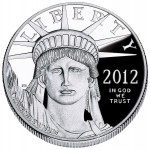
It was reported in the numismatic press but not formally announced by the U.S. Mint that they filed a notice that appeared in the Federal Register (78 FR 11954) raising precious metal prices. The new prices, which are as much as 30-percent higher than the previous became effective as of noon (ET) on Wednesday, February 27, 2013.
It was noted in the U.S. Mint’s annual report that seigniorage on precious metal products were lower in 2012 than in years past. This move appears that the U.S. Mint is trying to make up for that lost revenue.
This month’s list includes one late entry that was missed from January.
S. 203: Pro Football Hall of Fame Commemorative Coin Act
A bill to require the Secretary of the Treasury to mint coins in recognition and celebration of the Pro Football Hall of Fame.
Sponsor: Sen. Robert “Rob” Portman (R-OH)
• Introduced on January 31, 2013
• Senate Banking, Housing, and Urban Affairs Committee on January 31, 2013
Track this bill at http://www.govtrack.us/congress/bills/113/s203
H.R. 627: National Park Service 100th Anniversary Commemorative Coin Act
Sponsor: Rep. Erik Paulsen (R-MN) To provide for the issuance of coins to commemorate the 100th anniversary of the establishment of the National Park Service, and for other purposes.
• Introduced: February 13, 2013
• Referred to the House Financial Services Committee on February 13, 2013
Track this bill at
This week’s poll I want to know what kind of collector do you consider yourself to be?
I am not asking what you collect but how. I want to know if you buy raw coins and save them in an album or does your collection have to be only graded coins or coins that will be grade.
Do you pick from pocket change or do you go to the bank and buy rolls to search for something interesting?
For this poll, I thought of ten different categories of collectors. If you have a different strategy that is not in the list, add it to the comments below. Since there is no “right way” to collect, I would like to hear what other people do. Let me know what suits you best!
What kind of collector are you?
I buy raw coins and put them in albums. (41%, 9 Votes)
I am a change picker. (18%, 4 Votes)
I only buy graded coins or coins to be graded. (14%, 3 Votes)
I am a currency collector (graded and ungraded) (14%, 3 Votes)
I go to shows and search dealers' junk boxes. (9%, 2 Votes)
I am a roll hunter. (5%, 1 Votes)
I collect tokens and medals. (0%, 0 Votes)
I collect other items like Hobo Nickels, Love Tokens, etc. (0%, 0 Votes)
I hunt for old coins using a metal detector. (0%, 0 Votes)
I am a hoarder, saving every old coin I find. (0%, 0 Votes)
Total Voters: 22
Loading ...
Yes, that is my set of Somalia Motorcycle coins. I bought them from a dealer at a Baltimore show.
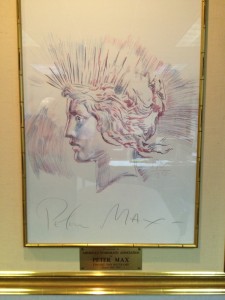
Drawing of Peace Dollar Liberty by Peter Max (1983)
Those of us that are a certain age remember growing up to with the artwork of Peter Max. His paintings and neo-expressionism posters are iconic representations of the pop culture of the 1960s. His vibrant colors made complex designs look simple as they some seemed to pop off the page. While times have changed and Max has worked on contemporary scenes, his style remains unique with an appeal that still brings a smile to my face.
Did you know that the American Numismatic Association owns a Peter Max original? While I was in Colorado Springs the week of February 19, I met briefly with Executive Director Jeff Shevlin in his office. Hanging on the wall across from his desk is a drawing of Liberty based on the design from Anthony de Francisci’s Peace dollar.
The picture looks like it was done in charcoal on paper. It is hand signed by Max and dated 1983. The picture is mounted on a fame that would have been contemporary to 1983 and has a plaque under the glass that reads:
Presented to American Numismatic Association by PETER MAX VINCENT VAN ROTTKAMP August 20th, 1983
As a fan of the Peace Dollar and Peter Max, this is a fantastic picture.
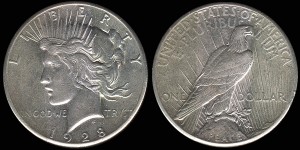
1928 Peace Dollar is a classic and under-appreciated design
Someone in the ANA offices said that this picture was the inspiration for the Peace dollar logo that used to be the official ANA logo. Remember, it was Farran Zerbe who helped push the idea of Peace dollar with his paper at the 1920 ANA convention in Chicago entitled “Commemorate the Peace with a Coin for Circulation.” In the paper, Zerbe wrote:
I do not want to be misunderstood as favoring the silver dollar for the Peace Coin, but if coinage of silver dollars is to be resumed in the immediate future, a new design is probable and desirable, bullion for the purpose is being provided, law for the coinage exists and limitation of the quantity is fixed—all factors that help pave the way for Peace Coin advocates. And then—we gave our silver dollars to help win the war, we restore them in commemoration of victory and peace.
Does anyone know why Max did this drawing? Who Vincent Van Rottkamp was and what was his association with this picture?
Maybe, we can convince Jeff to display the picture at an upcoming show for all members to enjoy.
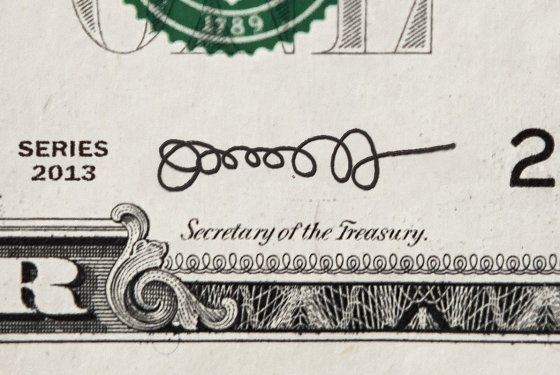
Aside from being in charge of the department that includes the U.S. Mint and the Bureau of Engraving and Printing, currency collectors now get to look forward to the addition of Lew’s “Lewpty” autograph on United States currency. When Lew was nominated to succeed Tim Geithner, it was joked that Lew’s autograph resembled a series of loops or the icing decoration on the Hostess Cupcake. There was even a petition on the White House website to “Save the Lewpty-Lew” autograph on U.S. currency (the petition ended and can no longer be found on the White House’s website).
Given the realities of the Treasury and our current economics, we wish Jack Lew well in his new position. We also hope he does not follow through on the promise he told Sen. Max Baucus (D-Montana) he made to the president “to make at least one letter legible.”
Please Mr. Secretary, Save the Lewpty Lew!
A mock-up of what Jack Lew’s signature would look like on a one-dollar note
Credits
Picture of Jack Lew courtesy of Wikipedia.
Dollar Bill mock-up with Lew’s Loops courtesy of New York Magazine.
It seems that the biggest trend in modern collectibles are colored non-circulating legal tender (NCLT) coins. You have seen these coins from various countries including Canada, Somalia, New Zealand, and Australia to name a few.
Not all colored coins are made of precious metals. My set of Somalia Motorcycle and Classic Sports Cars coins are silver-plated copper-nickel coins. In fact, most of the Somalia-shaped coins are not made from precious metals. But the shaped coins are so cool that they find buyers around the world, including with me.
In addition to making commercial collectibles, coins have had art imprinted on them, enhanced designs, and even commemorate something based on the country of issue.
So what do you think? Should congress give the U.S. Mint permission to produce colored coins? Rather than pay for a third-party colored coins, what if the U.S. Mint produced a colorized American Silver Eagle coin? Or maybe a bi-metalic coin where the coin is silver and Adolph A. Weinman’s Walking Liberty design is struck in gold on specially made planchets?
Vote in the current poll and let me know what you think below.
Should the U.S. Mint be allowed to make colored coins?
No, the coins are just fine the way they are. (41%, 11 Votes)
No, but maybe they can do something cool with different metals. (30%, 8 Votes)
Yes, colored coins are cool. (15%, 4 Votes)
Yes, and while we are at it, how about special shapes. (15%, 4 Votes)
I am in Colorado Springs attending meetings at the American Numismatic Association Headquarters about updating the technology that is being used to support the education mission of the ANA. I will talk about my time in Colorado Springs over the weekend, but let me talk about being at the ANA Headquarters.
After walking into the reception area, to the right of the reception desk is the museum store that leads to the Rochette Money Museum. Even with the current exhibition about the history of the Civil War in numismatics, the first floor also has the first steam press used by the U.S. Mint, the McDermott/Bebee specimen 1913 Liberty Head nickel, and an 1804 silver dollar. There is also a balance from the Denver Mint.
On the other side of the main level is the Harry W. Bass, Jr. collection of gold coins and rare patterns. Bass put together the finest and most complete set of gold coins ever assembled. After Bass died, his foundation donated a portion of the collection to the ANA. I posted some of the pictures to Twitter and Pintrest and will post more when I return home, but pictures do this collection justice. You have to come here to see it for yourself.
If you are an ANA member, you should make a trip to Colorado Springs to see the Money Museum. Aside from being a benefit of your membership, the ANA has an impressive collection that is nicely displayed and worth spending the time seeing. Numismatically, there is not a display like this in the United States, especially since the Smithsonian’s National Numismatic Collection was taken off of exhibit. The ANA Money Museum is the only place you can see a real half-union pattern, typesets of every gold coin ever struck by the U.S. Mint, and even the oldest known surviving currency note.
Do you like Hobo Nickels? It’s here. Assortment of Confederate currency? They’re here, too. Examples of world currency? That’s in the lower level gallery. It is near examples of colonial currency including two Maryland notes I have in my collection.
But wait, there’s more. Do you want to learn more about what you’re looking at? On the other side of the lobby is the Dwight Manley Library. In the Manley Library you can find nearly every book ever printed on numismatics including government reports, price guides, specialty books, and books on nearly every topic of numismatics.
The library also has the oldest known illustrated coin book, dating back to the 16th century. It uses images of ancient coins to talk about the various rulers of the time. This book and the oldest book about numismatics, which does not have images, written in Latin.
Before you leave the library, stop at the old card catalog case and see the printing press that ANA founder, Dr. George F. Heath, used to print the first six editions of The Numismatist.
Yes, you can check out books from the library and have them mailed to you. Yes, you can see the traveling exhibits at various shows around the nations. But to get the full impact of what the ANA has to offer, you have to come to Colorado Springs and see for yourself.
Aside from figuring out when I can schedule a return trip, I want to know why I received three, new 2013 White Mountain quarters struck in Philadelphia when I am 70 miles away from the Denver mint.
Greetings from somewhere over the southeastern United States as I fly to Dallas-Fort Worth on my way to the American Numismatic Association Headquarters in Colorado Springs for a meeting with the Technical Committee. What better way to celebrate technology than pulling out the iPad and writing a blog entry. Of course this will be posted after I land and can connect to the Internet.
Being on my way to the ANA brings to mind this past weekend’s coin show by the Tidewater Coin Club at the Tidewater Convention Center in Virginia Beach. After waking early, I climbed into the X3 and headed fours hours south to check out another club’s show. Although I anticipated coffee stops I was not prepared for the Sunday construction I found along the way. Although the drive took longer than expected, I arrived with plenty of time to browse and schmooze.
When I arrived at the convention center I found it full with two other events being held along with the coin show. The Tidewater Convention Center is a modern facility that would rival that in any medium size city and is a nice representative of the Virginia Beach-Tidewater region.
The coins how was held in a large meeting room upstairs, so I passed the two shows to the escalator going up. When I arrived at the greeting table I was met by members of the Tidewater Coin Club. The three gentlemen at the table were pleasant and engaging. The handed me a door prize ticket and I purchased tickets for the gold raffle—a quarter-ounce and tenth-ounce American Eagle gold coins. I do not think I won since I did not receive a call asking how they can send me the gold coin.
Once inside I was delighted and surprised. Delighted in that all of the tables were occupied and there were a number of people browsing the various offerings. I was surprised in the number of dealers that I have seen in the various shows around the Washington, DC area. At least a third of the dealers attended the Alexandria Coin Club show three weeks ago. The is nothing wrong with seeing the same people, they are all fun people with good inventory, but it would have been nice to meet new people.
As I made the rounds I looked at their various offerings and spoke to the dealers. I did buy but I was able to get in a little campaigning in between purchases.
My purchases from this show may be considered mundane but is significant in that they were all geared to putting together the One Page Cent type collection I wrote about last week. Even aft verifying prices with online price guides, I wanted to verify that it could be done. In the process. I was able to find a nice 1858 small letter Flying Eagle cent for $30, a 1859 copper-nickel Indian Head cent, a 1902 Indian head cent in red-brow, and a 1909 VDB cent all under $20 each. I was able to add a nice 1944 shotgun shell cent, 1959 blazing red Memorial cent, and the 7-coin 1982 copper and copper-player zinc set for less than $10 for all of the coins. With the four Lincoln birth bicentennial cents I already have, I was able to progress far into this collection.
I will finish this collection by the Whitman Baltimore Show in March and start on the next typeset. I am already working on a plan for a cent to represent 2, 3, and 5 cents coins on one page. As part of this effort, I will be turning my experience into a Money Talks program for the next National Money Show this May in New Orleans.
After making two passes around the floor, I found the president of the Tidewater Coin Club, introduced myself, and complemented him on a good show. He seemed a little overwhelmed since this was his first show as the club’s new president, but he seemed to be the type that could get things done. If my experience at their show is any indication, he will have a successful term as their president.
Before leaving the show area, I stopped to look at the nearby exhibits by club members. One that really is interested me was one about nickel typesets. Rather than being an extensive collection of copper-nickel composition five-cent pieces, it was a nice representative of various type coins with an index card for each coin explaining why each are part of the set. It would not win an ANA exhibit award, but it was very interesting and was really great to see.
We are getting ready to land. I will end here about the Tidewater Coin Club Show.
For the next few days, watch the @coinsblog Twitter feed and my Pinterest site for pictures and news from the ANA headquarters in Colorado Springs.


 It was reported in the numismatic press but not formally announced by the
 ![[PDF]](http://coinsblog.ws/library/images/pdf.png) or you can find a printable version at on the
or you can find a printable version at on the 
 Loading ...