By the time this is posted, I should be on a plane headed to the American Numismatic Association headquarters in Colorado Springs. This will be my first time visiting the ANA Headquarters and Colorado Springs. I hope it is not my last!
The reason for my visit is part of my role with the ad hoc Technology Committee to speak with a potential vendor who can offer services to the ANA to improve their technology infrastructure. With my background in building complex systems and information security, I hope to help the ANA create an environment that will use technology to better serve the members and the clubs. I admit there are some that will not embrace technology, but it will give the ANA an entree into a untapped population of collectors.
Technology is not the solution but the tool to use to bring the fun of coin collecting to more people than the 28,000 members of the ANA and hopefully make them members.
For this week’s poll, let’s imagine that the ANA has the technology to handle just about anything. What services would you like to see delivered by the ANA to help you or your club? The poll has nine suggestions plus an “other.” Pick your top three ideas. If you pick “other” then leave a comment here and let me know. In fact, I realize that the poll seems collector centric, so let me hear from dealers. I do not want to leave you out, especially since the collectors need you to help feed our collecting habits!
Comments are moderated only to prevent comment spam. All comments not deemed to be spam are approved regardless of your views—I especially like comments that disagree with me. If you do not want to give your name, then enter a handle or “anonymous.” Although the comment form asks for an email address, it will not be posted but will allow me to contact you if I have questions.
Let me hear from you and let’s work together to bring more the ANA to build a collector community.
What top 3 online services would you like to see the ANA offer?
Online courses including Summer Seminar (19%, 7 Votes)
Money Talks seminars from ANA conventions (14%, 5 Votes)
Weekly podcast with live call-in (14%, 5 Votes)
Videos from the ANA library (11%, 4 Votes)
Weekly news from around the ANA (11%, 4 Votes)
Broadcast of Board of Governors meetings (8%, 3 Votes)
Online reports from ANA shows (8%, 3 Votes)
Special museum video tours (8%, 3 Votes)
Virtual bourse from the ANA conventions (5%, 2 Votes)
Something else (3%, 1 Votes)
Total Voters: 14
Loading ...
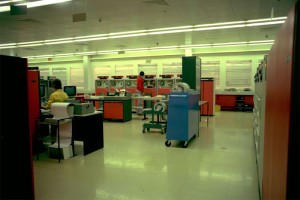
Image of an IBM System/370 Model 158 complements of Otto Rohrer on Flickr. I chose the the image of the IBM 370/158 because it was the first computer I “mastered” in college. We have come a long way since then!
Did you ever have one of those weeks where something as mundane as a viral YouTube video catches your attention for longer than it should have? If not, then spend a few moments or waste a little Saturday time to watch this video. Don’t watch the whole video because it’s over an hour long. But it is hypnotic and caught my interest for 10 minutes.
Someone who may be interested in collecting coins may look at the options and think that they are too daunting. Guide books talk about series of dates, mint marks, and varieties. Type books talk about every representative type, even ones that are not affordable to the average collector. Then the folder and album publishers give their interpretation of what a type collection should look like. What the novice to average collector is left with is confusion.
Collecting coins, specifically United States coins does not have to be daunting. You can put together sets of your own design that represents any time or any period. What is great is that once you define your goals, you can have the fun in putting the set together and showing it off to friends and relatives. It is also something that you can develop your own story and include it in your own album.
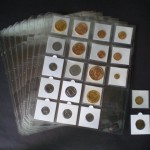
Supersafe 20 Coin Pocket Page for 2×2 holders
This is why I decided to create the One Page Collection. My one-page is a 20 pocket archival safe page to hold 2×2 holders of some type—for this, I prefer the self-adhesive cardboard holders with mylar windows. These pages can be placed in three-ring binders that can be used to build any number of collections. It is as flexible as your collecting whims can be.
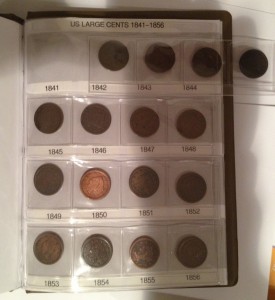
An alternative to the pocket page are Gardmaster Coin Albums. Gardmaster is made by Collector’s Supply House of Paris, Ontario in Canada. Their albums are based on a slide system where the coins are placed into pockets of a strip and the strip is slid into the page keeping the coin in place without the need for an extra holder. The albums are a smaller size with a “Snappy” binder to remove, mix, and match pages. I discovered these albums while putting together a collection of Canadian coins. I then adapted a blank 16-pocket version to create a year set for large cents. You can do an Internet search to find a dealer who sells Gardmaster albums.
For these articles, I will stick with creating a collection using the 20-coin pocket page.
As a general rule, the coins in this collection must gradable at Fine or better and cost under $100. When I create a set of half-dollars and dollars, the limit will have to be raised because of the silver values and the rarity of earlier coins.
Since these are 20-coin sets, many die varieties are ignored to a certain degree. However, design and composition changes are always significant.
The first set I will create are the copper coins. Cents and half-cents were specified in the Coinage Act of 1792 that authorized the creation of the U.S. Mint. Under the new law, the half-cent and its larger cousin the one-cent coin was struck in pure copper from 1793 through 1857.
The first half-cent struck in 1793 weighed 6.74 grams and was 22 mm in diameter. Subsequently, the half-cent weighed 5.44 grams and its diameter varied between 22 mm and 22½ mm.
The 1793 large cent had two designs, the controversial chain reverse which was then changed to a wreath weighed 13.48 grams and varied between 26-28 mm in diameter. In the 19th century, the large cent weighed 10.89 grams and its diameter varied between 27 and 27½ mm.
Consistency in the size of both coins would not be achieved until the introduction of steam-based coining equipment starting in 1836.
Large copper coins were eliminated by the Coinage Act of 1857. Signed into law by President Franklin Pierce February 21, 1857, this act repealed the legal tender status for foreign coins in the United States. It required the Treasury to exchange foreign coins at a market rate set by Treasury. This act discontinued the half-cent and reduced the size of the one-cent coin from 27mm (large cent) to the modern size of 19.05mm (small cent) that is still being used today.
First small cent was the Flying Eagle cent designed by James B. Longacre. The eagle was based on a design Christian Gobrecht used on the reverse of the Seated Liberty dollars. The Flying Eagle cent was a short lived series because of its difficulty to strike properly.
After having problems with the Flying Eagle cent, Longacre designed the Indian Head cent—which is not the image of an Indian but a representation of Libery wearing an Indian-style headdress.
Rounding out our copper collection is the Lincoln cent. Introduced as part of President Theodore Roosevelt’s “pet crime,” the Victor D. Brenner designed coin has been around over 100 years with a periodic change in reverses including the new Shield reverse that began in 2010, 101 years after the coin’s debut with the wheat stalks on the reverse.
Looking at over 230 years of copper coinage there is a lot to choose from to try to make a representative set. The following is what I came up with:
✓ 1840-1857 Braided Hair Half-Cent: A typeset of copper coins has to include a half-cent. To represent I am including a later version of the coin. Not only are these coins readily available but you can purchase a quality example for under $100. Choose one with nice features and a rich chocolate brown color to best represent this series.
✓ 1816-1863 Matron Head Large Cent: For large cents, I am picking two coins. For the early Matron Head cent, I would look at the early dates. They are readily available in better grades at reasonable prices. If you can find a version before 1836, that would represent the pre-steam press era.
✓ 1839-1857 Braided Head large cent: Walk any bourse floor and you will find later large cents that are nicely struck and at reasonable prices. If you want to spend more money you can find a red-brown example, but those with that deep brown color are well struck and wonderful. Having a large cent from this era is a good representation of the pre-small cent times.
✓ 1857-1858 Flying Eagle cent: Forget the lettering varieties. Concentrate on finding a nice coin that would grade Fine or Very Fine for your collection.
✓ 1859 Indian Head cent: This copper-nickel coin with a lauren wreath reverse is a one-coin type.
✓ 1864-1909 Indian Head cent: While there is a copper-nickel version whose reverse has an oak wreath with a shield over the wreath, the bronze version is a new composition with the same reverse. I consider the 1859 copper-nickel covers the composition and the bronze oak wreath reverse covers the change in metals. Coins from the 20th century are very available and affordable. In some cases, if you can spend more than $100 for a coin, you can purchase a nice red or red-brown example.
✓ 1909 VDB Lincoln cent: First year of issue with the “VDB” initials on the reverse is much less expensive than the San Francisco minted coins. For a few extra dollars you can even find a nice red or red-brown coin.
✓ 1909-1958 Lincoln cent: With almost 50 year of coins you can find an affordable example as a bright red coin. Spend a little more money and try for a 1909 cent without the “VDB” initials to get a first year of issue.
✓ 1943 P-D-S Lincoln steel cents: The only coin produced for circulation by the U.S. Mint that did not contain copper (the .999 silver coins contains .001 copper and the .9999 American Buffalo Gold Coin contains .0001 copper). This is worthy of adding one of each to this set.
✓ 1944-1946 Lincoln shotgun cents: Although they are Lincoln cents in every way as the 1942 and earlier cents, these coins were made from the spent shells taken from the training fields around the country. These coins might look a little darker and very available at higher grades for the average collector.
✓ 1959-1981 Lincoln cent with Memorial Reverse: These coins are made from .950 copper with the Lincoln Memorial on the reverse. These are the last copper coins struck for circulation. Adding a 1959 coin would give you the first year or add your birth year.
✓ 1982 Lincoln cent copper and copper-plated zinc coins: In 1982, the U.S. Mint transitioned from copper cents to copper-plated zinc coins. If you do not want to supplement this part with the entire seven-coin collection, then it is not a problem to ignore the lettering size and find an example of a copper and a copper-plated zinc coin. Otherwise, any coin from 1983-2008 Lincoln cent could be used for the copper-plated zinc coin.
✓ 2009 Lincoln Bicentennial cents: This four coin set should not cost more than 50-cents per coin. For a bigger challenge, find proof version that were struck on .950 copper planchets.
✓ 2010-today Lincoln cent with Union Shield reverse: The end of this set pending and further updates.
A page of Scott’s Large cent collection in a Gardmaster album
With these 20 coin you now have a set that represents the history of half- and one-cent coins ever struck by the U.S. Mint. While my concentration has been on affordable and easier to find the coins for this collection, you can extend it by looking for more expensive coins or even better grades. One challenge would be to find all of the Lincoln and Indian Head cents as red or red-brown coins. I have seen nice red-brown Flying Eagle coins but were very expensive. And for a little more money, find an 1850s Large cent that is more red-brown than brown.
Another idea is to use the Gardmaster album, buy two 16-coin pages, and expand your collection. As you look through the types, you may want to start with my “Manageable Lincoln Cent Collection” for an idea on expanding your Lincoln cent typeset. From there, you can adapt those concepts to the other cent series.
Showgard pocket pages image courtesy of Vidiforms/Showgard.
With Canada now withdrawing their one-cent coin from circulation and the Great Britain debating whether they should stop producing their penny, some are looking to the United States to figure out a direction. In fact, a line buried in an article whose link was lost in the digital surf noted that the European Union will keep its 1- and 2-eurocent coins while waiting to see what the United States and Great Britain does.
There are good arguments on both sides ranging from the coin is too expensive to make to the argument that rounding creates a regressive tax on those who pay using cash. These coins are annoying or they provide equality with those paying cash versus those paying with credit.
An alternative would be to change the composition of the coin. Various new metals can make the coin profitable again and keeping the coin in production. Even keeping the costs at par would be better than the negative seigniorage the U.S. Mint generates today.
What do you think?
Should the United State stop producing the one-cent coin?
Yes, it costs too much to produce and is not worth a penny. (63%, 57 Votes)
No, we should just keep it. (19%, 17 Votes)
No, we should keep it but change the composition (19%, 17 Votes)
Total Voters: 91
Loading ...
Image is The King of Errors: 1955 Double-Die Obverse that was graded AU-58BN by NGC proudly owned by the author.
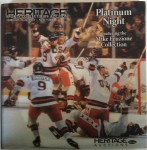
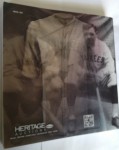
Front Cover of the Heritage Platinum Night Sports Auction
Whomever said “Don’t judge a book by its cover” did not see the recent auction catalog from Heritage Auction Galleries for their Platinum Night Sports Auction that will be held in New York on February 23-24. The catalog is a work of art worthy of the fantastic sports collectibles that are described in its pages.
Opening the Priority Mail envelope delivered in February 4 was a beautiful holographic image of iconic image of the 1980 United States Men’s Olympic Hockey Team celebrating their victory over the Soviet Red Army team. The eye-popping three-dimensional image is far more impressive than the image that appeared on the front cover of Sports Illustrated because of the visual texture it delivers.
The “Miracle on Ice” 1980 U.S. Olympic Hockey Team may have been a bunch of guys trying to play hockey, but to the rest of us, they were a proxy in the Cold War. With the games being played in Lake Placid, New York, the nation gathered around television sets across the nation to hope and watch our boys beat the Soviets—just because they were the Soviets, long suspected of cheating by twisting the rules to pay players at a time when the Olympics were an all-amateur competition. I remember a group of us transplanted New Yorkers watching hockey in the dorms at the University of Georgia trying to teach the southerners about hockey was almost as entertaining as the games.
After staring at the cover you tilt it and the image of Mike Eruzione’s jersey can be seen. Eruzione’s “Miracle on Ice”, game worn gold medal game jersey, and other memorabilia from the 1980 gold medal winning hockey team is what Heritage picked as the highlight of the auction. Current bid for “The Miracle on Ice” jersey is $325,000.
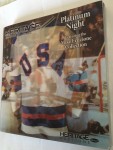
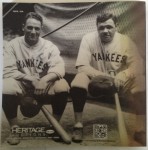
Turn the cover over and there is a three-dimensional holographic image of Lou Gehrig and Babe Ruth sitting on a bench, hats in hand holding a baseball bat. The image is from the 1927 Murders Row team. Tilt the cover to see the 1927-1928 game worn Gehrig uniform jersey that is part of the auction.
Inside the catalog are some of the most phenomenal sports collectibles that could ever be imagined from nearly every sport. One of the more unusual items if “The Bloody Sock” worn by Curt Schilling during the second game of the 2004 World Series. Schilling’s performance on bad tendons have been compared with the fictional Roy Hobbs in the 1984 movie The Natural. It also represents the end of the 84-year Curse of the Bambino. Starting bid is $25,000.
Since this is not specifically a numismatic item, I am grading it as a specimen release. I am grading this SP69 deducting a point for the typos that should have been caught in the editing process—one being in an item title that could not be ignored. It is a fantastic item and should be on the shelf of anyone who has an interest in sports and sports collectibles.
Happy bidding!
Front Cover of the Heritage Platinum Night Sports Auction
Front Cover of the Heritage Platinum Night Sports Auction tilted to show Eruzione jersey
Back Cover of the Heritage Platinum Night Sports Auction
Back Cover of the Heritage Platinum Night Sports Auction tilted to show Gehrig jersey
Catalog image is from the author whose catalog is not for sale!
The 113th congress was gaveled into session at noon on January 3, 2013 as required by the U.S. Constitution. First meeting of the new congress are largely procedural that includes giving the oath of office to anyone that was elected (the entire House of Representatives and one-third of the Senate) and electing leaders. Congress began their legislative calendar on January 4.
H.R. 77: Free Competition in Currency Act of 2013
To repeal the legal tender laws, to prohibit taxation on certain coins and bullion, and to repeal superfluous sections related to coinage.
Sponsor: Rep. Paul Broun Jr. (R-GA)
• Introduced on January 3, 2013
• Referred to the Financial Services, Ways and Means, and the Judiciary Committees on January 3, 2013
Track this bill at http://www.govtrack.us/congress/bills/113/hr77
H.R. 220: Stop the Coin Act
To limit the face value of coins that the Secretary of the Treasury may issue.
Sponsor: Rep. Greg Walden (R-OR)
• Introduced on January 14, 2013
• Referred to the House Committee on Financial Services on January 14, 2013
Track this bill at http://www.govtrack.us/congress/bills/113/hr220
S. 94: To terminate the $1 presidential coin program
Sponsor: Sen. David Vitter (R-LA)
• Introduced on January 23, 2013
• Referred to the Senate Committee on Banking, Housing, and Urban Affairs on January 23, 2013
Track this bill at http://www.govtrack.us/congress/bills/113/s94
This week’s poll is going to help me support you, the collecting community and the dealers who serve them should I be privileged to be elected to the American Numismatic Association Board of Governors. I have not made it a secret that I am against the show being fixed in Chicago. So one of my platform items is rotate the World’s Fair of Money to different areas of the country and different cities within those regions.
Thinking about this, I was curious about where would you, my readers, like to see the World’s Fair of Money. While looking at a map, I thought about several places across the country where it might be interesting to hold the show. Read the list and think about your top three preferences. Mark your choice in the poll and let me know. If you have another suggestion, let me know in the comments, below.
By the way: you will notice there is one entry that I am interested in… not that it should influence your choice!
Where would you like to see the ANA World's Fair of Money held? (select 3)
Growing up in the metropolitan New York area, you can find people who live around all of these famous landmarks but had never visited them. Whether it is visiting the observation deck Empire State Building or the Statue of Liberty, sometimes jaded New Yorkers just never get around to it.
My mother was different. She grew up in Coney Island and was adept at navigating the subway, so she wanted her children to be as wise about our hometown. During breaks from school, especially the winter break, we would take the Long Island Railroad into Penn Station and do something or see something that a tourist would do.
One of the treats about taking this trip was seeing my father in his office in Manhattan. As a youngster, it was cool to see the people who you might have spoken with on the telephone when trying to call my father or someone he had spoken to my mother about. It was also my first look into my future of working in an office, something I tried to resist to no avail.
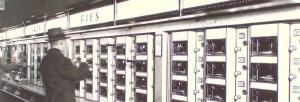
Lunch at the Automat (ca. 1940s)
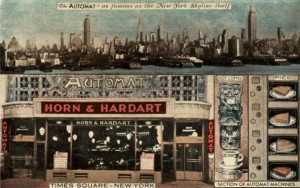
Part of that visit was lunch at Horn & Hardart’s Automat. The Automat was first opened in Philadelphia in 1902 and New York in 1911 before becoming a real institution in the areas between the cities. First opened in 1902, it was a fast food restaurant that sold meals, beverages, and deserts through coin-operated vending machines. Diners would choose what they wanted to eat, insert the correct change, and lift the window to get your food. The food was wrapped in plastic wrap when I went with my mother but in a era long before I was able to go the food was wrapped using waxed paper.
Behind the machines was a kitchen that refilled the machines and a cashier was in the center of the dining hall to give change. When the Automat first opened, the machines only accepted nickels. Things were a little more expensive in the 1960s, an era before vending machines were able to accept currency, Horn & Hardart used tokens. Remember, this was a time there were almost no dollar coins in circulation, a reported shortage of coins, and when half-dollars stopped circulating because the silver was worth more than their face value.
Tables were set up all around the room like a cafeteria and the decor was what I would later understand to be art deco.
Automat in Times Square Postcard ca. 1939
I have a distinct memory of visiting an Automat with my mother the winter break of 1968. That year was the first time my brother went with us and my youngest brother was just a baby, so he stayed with my grandmother. We went to Rockefeller Center and tried to skate on the famous skating rink. There was a man teaching the kids how to skate and I took great joy in watching my brother fall on his butt even though my skating style would not win points at any competition.
A dash to see my father and then we went to the Automat. I remember I had a sandwich and soda. Then, as my mother ran to a quick shopping excursion, I argued with my father about getting a piece of pie. He finally gave in and bought the pie that the three of us shared as we waited for my mother to return. When she did return, packages in hand, my father went back to work and we took the subway downtown to see Macy’s front window. From Macy’s it is a short walk down 34th Street to Penn Station. We went downstairs under Madison Square Garden to board the Long Island Railroad to go home.
This trip down memory lane is courtesy of the Alexandria Coin Club whose annual show was held on February 2. It was a show filled with a nice mix of dealers with varying types of collectibles, I made the trip in the snow flurries to see what I could find. While searching through an exonumia dealer’s box, I found a token that was as irresistible as a youngster picking a sandwich from an Automat vending machine. A wide smile ran across my face as the memories of the food in the machines ran through my memories. There was no way I was leaving the show without an Automat token!
I am not sure what the token is made from, but it is heavier than aluminum. It is 20 mm in diameter, larger than the cent (19.05 mm) and smaller than the nickel (21.21 mm). The front has the distinct Automat logo and the reverse has a child at one of the set of vending machines reaching up for his treat. Around the edge, it says the token commemorates the 70th anniversary of the Automat, which dates the token to 1981. What a great addition to my New York collection. Not only is it different but the memories are priceless.
Along with the Automat token I also found a commemorative medal someone issued for the Statue of Liberty centennial in 1986 and an aluminum souvenir from the Democratic National Convention held July 12-16, 1976 in New York City. When I picked it up I thought it had the look of a Mardi Gras token. When I turned it over, it says it is from Louisiana. The reverse image is that of a pelican since Louisiana’s official nickname is “The Pelican State.” Since the convention was in New York, it is added to my New York collection. Now I need to find something numismatic related from the 2008 Republican National Convention that was held in Madison Square Garden to balance the collection.
By the time I was old enough to become interested in the Automat it was in its decline. In the 1960s saw a decline in their clientele as people started to leave the city to live in the suburbs. Then companies began to open their own cafeterias and buildings reconfigured their lobbies to bring in retail customers including eating establishments. Finally, the city closed a loophole that allowed cafeteria patrons to avoid paying sales taxes and it forced the Automat to raise prices to cover the new tax burden. High labor and food costs drove its regular customers away as quality declined and the restaurants grew seedy. H&H closed half of their locations by 1971. By 1991, the last Automat in New York closed its doors for the last time.
Additional Reading
Read more about the Automat by Steve Stollman who restores old Automat equipment.
Koch’s exuberance and love of New York propelled himself and the city from the what was seen as the bottom to a trajectory that you could not think of New York without Ed Koch or Ed Koch without New York. Koch’s perpetual question, “How am I doing?” will forever be his trademark throughout the streets, cabs, subways, highways, and byways of New York City.
A more happier note, it was on February 1, 1913 that Grand Central Station (really named “Grand Central Terminal” but that’s not what we called it growing up in New York) opened. It was not the first terminal on the site to bear the Grand Central name. The previous version opened in 1903 and comprised of three separate buildings. Over the next ten years the structure that stands there today was built in phases that including the underground rail tunnels that are still in use today.
Grand Central underwent a rehabilitation that started in 1994 through 2000 that cleaned up the famous ceiling in the grand concourse and reconfigured the above ground areas to include more shops. But it still represents the major transportation hub of New York.
Collecting transportation tokens are the ultimate numismatic collection that represents local history. Transportation has been at the heart of every city and can be used as a personal tie to your collectible. Tokens and medals representing local transportation can be more beautiful and significant than coins from the same era. Not long ago, I was able to find a pewter medal from the dedication of the East River Bridge. The bridge was rename in 1915 and is known today as the Brooklyn Bridge.
Having a collection of subway tokens reminds me of all those subway trips I had taken over the course of my life and the sesquicentennial medal of the Long Island Railroad represents my daily commutes from Long Island to my job at 30 Rock.
As I think about my hometown today, remember where you are from and consider starting a collection of tokens and medals that helps to tell your story. It can be as rewarding as your memories.
And to Hizzoner, you did just fine! Rest in peace.
Montgomery County, Maryland—Newly installed Montgomery County Coin Club (MCCC) President Scott Barman announced that he would be running for a seat on the American Numismatic Association (ANA) Board of Governors.
“I would like to bring new ideas to the ANA that will increase its membership beyond the steady 25,000-28,000 of the last decade,” Scott said in his announcement. “Not only does the ANA need to embrace the future, but find ways of keeping young numismatists engaged after they reach 18 years old instead of waiting for them to find their way back after 40.”
Like many young numismatists, Scott’s collecting pursuits waned when he entered college. Although he carried his old blue folders and albums through adulthood, there was never time to engage in the hobby while growing a career and family. Like many, that changed in his 40s after becoming a widower.
Scott believes that if the technology was as available as it is today, he could have integrated collecting into his young adult activities into his life and continued with his collecting interests.
“Technology has changed a lot since I wrote my first program on punch cards,” Scott noted. “We use technology for everything from our work to talking with our neighbors. Schools teach classes online. Seminars are held online. Virtual organizations meet online. The ANA should embrace technology to keep those between 18 and 40 engaged.”
In keeping up with the technology industry, Scott knows that social media and computer-based learning are part of the fabric of life for those under 40. There is a lot that can be done with modest investments to keep young numismatists engaged as they advance to adulthood and help others interested to engage.
“A number of reports said that more than 3 million people were collecting State Quarters since the program started in 1999,” Scott said. “Why hasn’t that interest translated into more ANA members?”
Aside from making the services and resources of the ANA more available to its members, Scott is worried that the Association does not feel more accessible to the average collector. While the support from the commercial community is important, the ANA would benefit by engaging more collectors.
Building a service platform that the ANA can deliver its content to a wider audience will go a long way to engage current and new collectors. This will help make the ANA a leader in educating the public and possibly a model for similar organizations to emulate.
Another area that has to be addressed is the stability of the ANA Headquarters. For the second time, a dismissed executive director has chosen to pursue a claim against the ANA in court. This gives the appearance of a dysfunctional situation in Colorado Springs. Scott believes that the professionals working for the ANA are competent and qualified, but the Board of Governors must look into what it will take to create an atmosphere to support them and prevent the problems of the past.
“With support for the professionals in Colorado Springs and expanding the use of technology to engage more collectors, the future of the ANA will be very bright,” Scott added.
When Scott returned to collecting in 2002, he joined the Montgomery County Coin Club. Finding a club with an active membership, Scott embraced the challenge to become more active and looked to make an immediate impact. Shortly after joining, Scott became Webmaster of the MCCC website (montgomerycoinclub.org) and began to contribute to meetings with presentations. Eventually, Scott was elected to the MCCC Board of Directors before being first elected club president in 2008.
Scott served two terms as MCCC president including 2009, the club’s 50th anniversary. Club rules prohibited seeking a third consecutive term, so he became a board member and then vice president. Scott was elected president for 2013 and will continue to serve the club as its president and Webmaster.
After becoming hooked on numismatics again, Scott joined the ANA in 2003 and read everything he could find about his collecting interests. This has lead to Scott joining the American Israel Numismatic Association while collecting Israel currency and exploring his Jewish heritage, and the Royal Canadian Numismatic Association to learn more about Canadian coinage since his second wife’s family is from Canada.
Following his time as a club representative to the Maryland State Numismatic Association (MSNA), Scott became a member and the organization’s webmaster (mdstatenumisassn.org), board member, then was elected vice president for 2012. MSNA Vice President Scott Barman is serving his second term in 2013.
In 2005, Scott started the Coin Collectors Blog (coinsblog.ws) that he continues to write today. The Coin Collectors Blog is where Scott has spoken directly to other collectors writing about news, history, instructions, opinions, and whatever else has come to mind. This has lead to articles that have appeared in on-line and printed numismatic publications.
For the last year, Scott has worked with the ad-hoc ANA Technology Committee providing assistance to the ANA Board of Governors to repair and grow the ANA’s technology platforms. His work will continue with this committee and support it being made a permanent advisory committee to the ANA Board of Governors.
Recently, Scott has been working with the Gold & Silver Political Action Committee as political coordinator keeping the membership informed of the numismatic and precious metal news in his locale, Washington, DC.
When not involved in numismatics, Scott is an information security and systems architecture analyst for a not-for-profit corporation that works with the Federal Government. His job is to help the government build systems to serve the public and protect personal information. Scott holds a Bachelor of Science with a major in Computer Science from the University of Georgia and a Master of Information Systems Management with a concentration in information security and public policy management from Carnegie Mellon University.
Scott is currently finishing a book about collecting titled Enjoying Numismatics, A Conversation in Collecting. This will be published as an electronic book to reach the same audience he wants to interest in becoming ANA members.
Scott’s next project is tentatively titled The Policy and Politics of Money Manufacturing in the United States. The plan is to use his interest in public policy and numismatics and study what is behind the minting and printing of money in the United States. It will also help answer the perpetual question, “Why did the Mint do that?”
Scott’s collecting passion includes the coins of the 20th Century, numismatics representing his hometown of New York City and Inwood, Long Island; Maryland Colonial Currency; and Israel banknotes. He is also a fan of Philatelic Numismatic Covers also called coin covers with interesting themes.
Scott is passionate about collecting and the organizations that support the collector and dealer communities. He would like to use his unique background to bring a new perspective to the Board of Governors and to ensure the ANA’s future.

 By the time this is posted, I should be on a plane headed to the American Numismatic Association headquarters in Colorado Springs. This will be my first time visiting the ANA Headquarters and Colorado Springs. I hope it is not my last!
 Loading ...