As with many announcements, there was little news other that what was published in the past. The U.S. Mint did bring out a plaster model of a curved coin to show the media what it could potentially look like.
The following video shows the plaster model of the coin and the introduction by Treasurer of the United States Rosie Rios:
This is the animation that the U.S. Mint published showing the shape of the coin:
But the real news of the day is the comedy routine by Brooks Robinson. Robinson takes his sense of humor to a deprecating sense of self. It is worth watching!
Remember, this week’s poll asks if you are going to participate in this contest. Are you?
Will you try to submit a design for the National Baseball Hall of Fame commemorative?
No, I am not artistic enough. (54%, 7 Votes)
No, it's a dumb idea. (38%, 5 Votes)
Yes I am! (8%, 1 Votes)
I would like to, but I do not have the time. (0%, 0 Votes)
Maybe, I am thinking about it. (0%, 0 Votes)
Total Voters: 13
Loading ...
Videos from the launch ceremony courtesy of Gannett by Brian Tumulty. Animation video courtesy of the U.S. Mint.
In a test lawsuit filed by the Ancient Coin Collectors Guild (ACCG), the group sued the federal government over the granting of import restrictions and confiscation of coins that foreign government have declared cultural property. The suit filed by ACCG challenges recent Memorandum of Understanding (MOU) between the State Department and the cultural regulators of Cypress and China under the Convention on Cultural Property. On March 25, 2013, the case that ACCG appealed to the Supreme Court was denied a hearing (petition for certiorari).
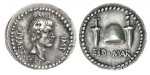
EID·MAR silver coin commemorating the death of Cæsar on March 15
Although this may sound reasonable, Article 1 paragraph (e) of the treaty defines a category of cultural property as “antiquities more than one hundred years old, such as inscriptions, coins and engraved seals.” This means that any coin minted before 1913 can be considered cultural property and not only be subject to restrictions but confiscated.
Under the Convention on Cultural Property Implementation Act (CPIA; 19 U.S.C. §§ 2601 et seq.), the law passed by congress upon the Senate’s ratification of the treaty in 1983, requests are reviewed by the Cultural Property Advisory Committee (CPAC) in the State Department’s Bureau of Educational and Cultural Affairs. The CPAC authors the MOU based on the input from the requesting country and publishes the results for public comment. By law, the public has 30 days to provide comments on the proposed MOU. However, it appears that it is very rare that the CPAC makes any changes after the end of the comment period.
The MOU undergoes whatever department review is required and then is signed by the Secretary of State on behalf of the president and made part of the policy and rule provisions granted to the Executive Branch by congress (as part of the CPIA).
The original case was filed in a Fourth Circuit Federal Court in Baltimore. In its suit, ACCG claims that the rules agreed to the by CPAC are arbitrary and made by a panel that does not understand how their decisions affect coin collectors. Even though the intent has not to work against ancient coin collectors, governments have used the law to restrict the export of newly discovered ancient to the United States. The court ruled that it did not have standing to change the law since there is no constitutional question. The appellate division of the Fourth Circuit in Richmond confirmed this ruling in October 2012.
ACCG appealed the ruling to the Supreme Court. On March 25, the court denied the ACCG’s petition for hearing. The Supreme Court’s action means that the result of the test case is only binding in the Fourth Circuit (Maryland, North Carolina, South Carolina, Virginia, and West Virginia). In other words, someone has to have been harmed by the results of the law before the courts will agree to hear a case.
Last month, Patrick Heller wrote in Numismatic News that he spoke with a dealer “who had been visited by representatives of a foreign government seeking to confiscate the valuable ancient coins issued by that nation if the dealer could not provide a chain of custody proving that the coins were legally owned before that nation banned the export of ‘national treasures.’” Heller said that the representative were only interested in the more expensive coins and not the common coins from the same country but whose value was much less.
While these issues have mostly affected ancient coin dealers and collectors, some countries have attempted to petition the United States government to make the cut-off date of what is considered cultural property for coins later. In one case, China has suggested that coins from as late as the Qing Dynasty (1644-1912) should be considered cultural property but has not petitioned the CPAC for an update to their MOU with the United States. The problem is that these countries have been trying to exercise their “authority” under the 1970 convention putting U.S. dealers and collectors at disadvantage with the rest of world for political reasons.
If the State Department’s CPAC will not work on behalf of the American people, then collectors must stand up and tell the Obama administration it is time to stop. In fact, I created a petition at the White House website. This petition reads as follows:
we petition the obama administration to: Protect coin collectors from countries using cultural property to prevent the fair trade of ancient rare coins
Using the Convention on Cultural Property Implementation Act, foreign countries have been asking the State Department’s Cultural Property Advisory Committee to update Memoranda of Understand in such a way that could harm the ancient coin collecting in the United States by declaring coins “Cultural Property” under the 1970 UNESCO convention. The problem is that these countries are only asking the US for restrictions.
In a recent case, a dealer was confronted at a coin show by foreign officials seeking to confiscate expensive ancient coins under a loose interpretation of the law. This is going to harm the small business coin dealers involved.
We the undersigned ask the administration to end the restrictions on the buying and selling of foreign coins mistakenly included in these acts.
Please take action!
I ask all of my readers to go to http://wh.gov/MD2O and sign the petition. And share it on social media. Petitions require 100,000 signatures in order to be answered by the White House. So far there is one signature (mine). Let’s see if we can motivate the coin collecting community to add more before you will not be able to own any foreign coin older than 100 years old!
Logo courtesy of the Ancient Coin Collectors Guild.
Image of the Eid Mar silver coin courtesy of dig4coins.com.
As a result of the the president signed the National Baseball Hall of Fame Commemorative Coin Act (Public Law No. 112-152 [TXT][PDF]), the U.S. Mint is required to hold a competition for the design of the obverse (heads) side of the three coins that will be issued as part of the set. The law states:
IN GENERAL- The Secretary shall hold a competition to determine the design of the common obverse of the coins minted under this Act, with such design being emblematic of the game of baseball.
SELECTION AND APPROVAL- Proposals for the design of coins minted under this Act may be submitted in accordance with the design selection and approval process developed by the Secretary in the sole discretion of the Secretary. The Secretary shall encourage 3-dimensional models to be submitted as part of the design proposals.
PROPOSALS- As part of the competition described in this subsection, the Secretary may accept proposals from artists, engravers of the United States Mint, and members of the general public.
COMPENSATION- The Secretary shall determine compensation for the winning design under this subsection, which shall be not less than $5,000. The Secretary shall take into account this compensation amount when determining the sale price described in section 6(a).
Here is your chance to design a coin that will be sold to collectors everywhere and if you create the winning design, you will win $5,000!
The obverse design must represent baseball and include the inscriptions “Liberty,” “In God We Trust,” and “2014.”
Your design must be able to look good on a coin about the size of a nickel, which is close to the size of the $5 gold coin.
You must be a 14 years old and older, a U.S. citizen or permanent resident to enter. Employees in any area of the Department of the Treasury, current and former members of the Artistic Infusion Program, and contractor to the Department of the Treasury are ineligible.
Your design must not depict any real person, name, logo, stadium, field, etc. from now or in the past. It must be original artwork.
When you are ready to submit your entries, you must submit your line art in black and while (no color) to http://www.batterup.challenge.gov/. This site is not up but will be there, ready to accept your submissions on April 11 starting at noon EDT. Deadline is May 11, 2013 at noon EDT. You can also submit a plaster or plastic model approximately 8-inches in diameter.
Do not procrastinate because the U.S. Mint has said that if 10,000 entries are received prior the May 11 deadline, they will suspend the contest early with 48 hours notice. They also said that the contest will not end before noon EDT of April 26.
If you have an idea give it a try! You do not have to be that artistic because the engravers at the U.S. Mint can translate your design into something that can be struck into coins. They are good, so give it a try!
While we are talking about the design of these coin, will you try to submit a design for this commemorative? Let me know in this week’s poll:
To understand the post’s true condition, you have to consider the following:
The Chairman of the Federal Reserve is Ben S. Bernanke. His first name is really Ben, not Benjamin.
The law requires the Federal Reserve to distribute the one-dollar note. Only congress can vote to stop producing the note.
The Acting Director of the U.S. Mint is Richard A. Peterson, not Pederson.
Seignorage is deposited in the Public Enterprise Fund. No, the leaving out of the “d” in the original post was not a typo because I was having fun!
The Director of the Bureau of Engraving and Printing is Larry Felix. I do not know a Larry Felinks. Maybe he is a long lost cousin of the director?
The company that supplies currency paper to the BEP is “Crane and Company.” The Sandhill Crane Company does not exist, but there is a bird called the sandhill crane. There is also a blue crane, but I am reasonably sure that there is no such person as Violet “Blue” Crane; or at least there is not one associated with Crane and Company. Maybe there is a Blue Crane working for Sandhill Crane? There is a joke in there that can use “Whooping Crane” which I will leave as an exercise to the reader!
Finally, when was the last time you heard the Fed Chairman concerned with coin collectors? The last line was added to emphasize the date.
In other words:
Besides, who is giving a blogger an exclusive story that does not appear elsewhere? Like the Orson Well’s broadcast of The War of the Worlds, all you had to do is change the channel (or check another source).
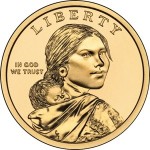
Obverse of the 2009-present Native American Dollar
In a move that will shake the markets for time to come, Federal Reserve Chairman Benjamin S. Bernanke announced that the Federal Reserve and its member banks will no longer order one dollar Federal Reserve Notes from the Bureau of Engraving and Printing. To replace the paper, the Fed will start to distribute the over one billion one-dollar coins currently being stored in the money storage facilities around the country.
“We have so many dollar coins, it makes sense to find a way to get them into circulation,” Bernanke said. “It will also help reduce the storage requirements to hold these coins.”
Bernanke, who has been both complemented and reviled over the Fed’s handling of the Great Recession, said that now that the economy was more solid, he would turn his attention to doing what he can for the federal government. Citing the GAO report that estimated the federal government could save at least $4.4 billion by using coins rather than money, Bernanke will use his power as Chairman of the Fed to determine the independent bank’s policy over circulating money.
“Not only will this keep our facilities busy but it will help the U.S. Mint maintain and increase its profitability,” said Richard A. Pederson, Acting Director of the U.S. Mint. “The reduction of dollar coins previous ordered by [then Treasury Secretary Tim] Geithner really hurt our bottom line. It significantly lowered our seigniorage and the size of our deposit into our Public Enterprise Fun.”
Pederson assured Bernanke that the U.S. Mint will be able to meet the new demand for circulating dollar coins.
Director of the Bureau of Engraving and Printing Larry Felinks said that this change will help increase productivity in other areas of their operation. “Printing of the one dollar note is over 50-percent of our production. This reduction will allow us to concentrate on other projects including trying to figure out why we have not been able to produce $100 notes.”
“Obviously, we are not happy about this,” said Violet “Blue” Crane, family spokesperson for the Sandhill Crane Company who manufactures the paper for the Bureau of Engraving and Printing. “Manufacturing paper for the one dollar bill was half of our business and gave us the most profit since that paper did not have to include anti-counterfeiting features.”
The U.S. Secret Service declined to comment for this story and any other story they were asked about.
Bernanke, sitting in his office obviously pleased with his new policy, also understood the impact of his decision on the numismatic industry. Leaning back in his chair, Bernanke closed with, “Collectors of United States coins will remember April 1, 2013 as the day I gave their dollar coin collection more meaning.”
Native American Dollar image courtesy of the U.S. Mint.
H.R. 1071: To specify the size of the precious-metal blanks that will be used in the production of the National Baseball Hall of Fame commemorative coins.
Sponsor: Richard Hanna (R-NY)
• Introduced: March 12, 2013
• Referred to the House Financial Services Committee on March 12, 2013
Track this bill at http://www.govtrack.us/congress/bills/113/hr1071
H.R. 1218: Commemorative Coins Reform Act of 2013
Sponsor: Rep. Justin Amash (R-MI)
• To prohibit the payment of surcharges for commemorative coin programs to private organizations or entities
• Introduced: March 15, 2013
• Referred to the House Financial Services Committee on March 15, 2013
Track this bill at http://www.govtrack.us/congress/bills/113/hr1218
The American Numismatic Association has posted the list of candidates for the 2013 Board of Governor elections. Although the nomination process officially concludes on March 31, all of the qualified nominated candidates have accepted their nomination. The 2013 candidates are as follows:
President
Walter Ostromecki (unopposed)
Vice President
Jeff Garrett (unopposed)
Governors (7 seats)
Gary Adkins
Scott Barman
Steve D’Ippolito
Mike Ellis
William D. Hyder
Richard Jozefiak
Greg Lyon
Tom Mulvaney
Oded Paz
Ralph Ross
Scott Rottinghaus
Laura Sperber
Jeff Swindling
Jeff Wuller
After the official close of the nomination period, the ANA will post the candidates biographies and statement on the website. They will also be printed in The Numismatist.
A candidates forum will be held on May 11, noon through 2:00 PM at the National Money Show in New Orleans. ANA members attending the show should make time to attend and make sure the candidates hear your concerns about the organization. If you are not sure whether you want to go to the National Money Show, I would recommend that you go. Aside from going to an ANA show, which is a great experience in and of itself, it is in New Orleans. New Orleans is a fun town with great sites and excellent food! I am still looking forward to a nice café au lait at Café Du Monde in the French Market!
Elections will be held during the month of June with ballots due by July 1. If you would like to vote electronically, you can go here to register for online voting.
NOTE: As I type this the ANA website is not able to process logins because of a software issue as a result of bad decisions made many years ago that does not involve the current ANA staff. I want to work to ensure that the ANA staff has better tools to support the ANA’s mission.
ALSO NOTE: Electronic balloting will be conducted by a vetted third-party with experience as an independent election auditor who has also performed online elections for other organizations. Issues and concerns with regard to the ANA website are not a factor with the online election process.
The ANA will announce election results at least 10 days prior to the World’s Fair of Money that will be held in Chicago, August 13-17, 2013. The new Board of Governors will be installed on August 16, 2013 at the show.
Your support for me and the ANA are greatly appreciated!
When I returned to the hobby, the first show I attended was the Baltimore Coin Show. Back then, it was privately run by an area dealer who grew the show to something that required a facility the size of the Baltimore Convention Center to hold for a twice per year show. I remember walking into the hall at the time and being overwhelmed with the rows of tables and starting my adventure. Even when the show occupied only Halls A and B was really a sight to see.
Then Whitman bought the show and propelled it to levels greater than its previous owner, which did not seem possible. Not only has Whitman done a great job, but they expanded the show to three times per year and expanded the number of dealers to include Hall C. Hall C also includes Whitman’s own booth along with providing space for a Kids Corner, exhibits, services, and some numismatic organizations. In many ways the size and scope exceeds last summer’s World’s Fair of Money in Philadelphia.
New Campaign Button
I arrived at the Baltimore Convention Center mid-afternoon on the Ides of March to take in the show and meet with my fellow board members of the Maryland State Numismatic Association for a scheduled meeting. Before the meeting I was able to get through about a quarter of the bourse talking with people and handing out my new buttons for my campaign.
Since the MSNA president could not get away from work, I presided as the organization’s vice president. I kept the meeting under 45 minutes while still getting a few things done. We set a new meeting, adjourned, then went to the elevator for the two floor descent to the main level and the bourse.
I did not buy much at this show since I did not take my usual inventory before going. I did look for New York-related tokens and medals and for Maryland colonial currency. But I did not find anything that intrigued me.
Later in the day, I did go by the table of Butternut Coins and COL Steve Ellsworth. This is not the first time I have spoken the Steve but every time I do I find him a very intriguing and engaging person. Ellsworth is a specialist in Early American Copper Coin along and the Civil War. It was his expertise in Early American Coppers that I was interested in.
As I was looking through his cases, I told Steve about my One Page Collection idea where I would fill a single 20 coin pocket page with nice coins for around $50-100. Since I posted it, I wanted to put the collection together and plan to talk about it at the upcoming National Money Show in New Orleans. He gave me suggestions as to what to look for based on my price and condition guidelines and found two coins that will be added to the collection.
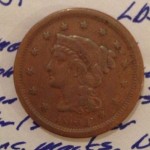
1851 Braided Hair Large Cent obverse
The first coin I found was an 1851 Braided Head large cent that his holder has marked as VF30. It is not a rare coin but a nicely preserve coin with a smooth brown color, nice details still remaining, very clear “Liberty” in the headband, and the signs of slightly weak strike on the reverse that does not detract from the look of the coin.
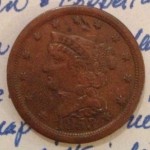
1853 Braided Hair Half Cent Obverse
The other coin is a 1853 Braided Hair half cent that his holder has marked VF35. Again, this is not a rare coin but one that is really beautiful. The coin shows some streaks of red and I asked whether it might have been cleaned at one time. Remember, it was a common and acceptable practice to clean coins to bring out their shine and color. But Steve did not think so and that the streaks of color may be original toning. Even if the coin is naturally recolored from a previous cleaning, the coloring does not detract from the beauty of the coin.
Both coins were well within budget and will be included in my one page collection. I appreciate the help that Steve provided in my search.
Now that I decided to present these ideas at a Money Talks program in New Orleans, you will have to come to the show to hear about different ideas I have.
In the mean time, if you are in, near, or can get to Baltimore on June 20-23, it is a good way to spend a day or even the weekend. And let me know, we can sit down for coffee at the stand on the third level.
Merriam-Webster’s online dictionary defines almanac as “a usually annual publication containing statistical, tabular, and general information.” Almanacs have been around for a while in various forms from the earliest times of writing to today. Early almanacs were simply calendars of coming events and records of past events. They included holidays, phases of the moon, and significant dates that related to the weather for the farming community.
Although there have been many almanacs that bridged into the modern era, none had been as famous as Poor Richard’s Almanack written by Benjamin Franklin writing under the pseudonym Richard Saunders. Franklin published Poor Richard’s Alamanck from 1733-1758. Amongst the surviving almanacs include The Old Farmer’s Almanac that has been published continuously since 1792, the Farmer’s Almanac that has been published continuously since 1818, and The World Almanac and Book of Facts published since 1868. These are the almanacs that all others are judged against.
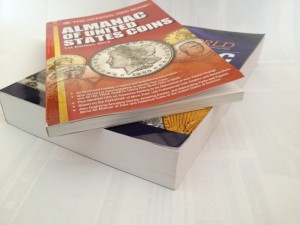
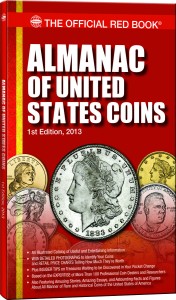
Although I read the description, I did not read it carefully because when I opened the package sent to me by Whitman, I found a skinny trade paperback-sized book. I reread the Whitman press release and it said the book was 192 pages. Initially, I felt disappointed in my hopes that there would be a competitor on the market to the Coin World Almanac since competition makes everyone better. So I can get over my initial reaction, I put the book down for a while to overcome my initial reaction to give the book a fair review.
After two weeks, I find I cannot hide my disappointment especially when I place the book next to the Coin World Almanac. Now in its eighth edition, the Coin World Almanac is 688 pages of numismatic reference that is a worthy comparison to any almanac in any industry. The problem with the Coin World Almanac is that it is updated every ten years. Having purchased the last two, the seventh edition seemed stale by 2004. I suspect the eighth edition will begin to feel stale by the end of this year if not by mid-2014. Maybe Coin World should consider shortening their update cycle.
Coin World does not have to worry about competition from Whitman. For as much as Whitman has invested in creating content across their “Official Red Book Series” from the many great authors, their Almanac of United States Coins is so lacking in content that it is many years away from being able to compete.
The only complement I can offer Whitman for this book is that many of the coin images are superb. I do like the images showing the relative grading of the individual series but wish it was expanded to include a few more grades. One example that would help collectors is that the difference between a VF-20 and MS-65 Walking Liberty half dollar is so vast, that having at least two intermediate grades (e.g., EF-40 and AU-50) would be helpful.
Whitman’s Almanac v. Coin World’s Almanac: In this case, size matters!
If had had to compare the Almanac of United States Coins, I would call it a light version of A Guide Book of United States Type Coins. The problem is that the Type Coins guide book, now in its second edition, is a better book even though it is not an almanac.
Whitman is going to have to learn that every numismatic reference book does not have to be a price guide. If they want to include type set-like guides, then do not make it look like a major component of the book. Otherwise, I would recommend people read A Guide Book of United States Type Coins instead. Thus the first improvement I would make is either eliminate the price guide information or find a way to minimize it as a central focus of each section. After all, an almanac is supposed to be about the content and the fact. Price guides are opinions that change with market forces that changes from the end of the editorial cycle until the book is published.
I know Whitman wants to sell books and has to find a way to make this book unique over their other offerings so they do not cannibalize sales, but they have to consider that they may never sell some of these books to certain people anyway. And if Whitman drops the pricing information, that still leaves their other books as an option for the reader. After all, Whitman can include a line at the end of each coin’s section that if they want in-depth information, the read can “consult” Whitman’s other book on the coin.
It is interesting how Whitman included a list of the authors for all of their books as credits but did not print the name of the editor of this book. However, Whitman’s press release named publisher Dennis Tucker as the editor.
Now that Whitman has disappointed me, they need to look at the content they have already invested in with their current books. They can start by taking whatever information is in the Red Book (A Guide Book of United States Coins), the Red Book Professional Edition, and the Blue Book (Handbook of United States Coins) and bring the content together to improve the current almanac. Just doing this would greatly improve this book. Then, it is a matter of an editor either convincing Whitman’s other authors to build on the chapters or distill the information in their other books to something suitable for an almanac.
I really wanted to like this book to the point that I put it aside in order to see if I could get over my first impression. Instead, I started to read another Whitman book that deserves the good review I will write in the near future. But I could not get over the disappointment. The text has no depth, facts that should be in an almanac are missing, and it seems like a glorified coin type price guide. Maybe they should market this as something for the very beginner, even for someone under the age of 12. Therefore I give this book a grade of F-12. The only factor that prevents this book from grading lower are the images. It is not a book I can recommend.
DISCLOSURE: Whitman Publishing provided the copy of the book I reviewed. I will not add this book to the library. It will be donated to my coin club’s annual charity auction in December with the proceeds going to the local Boys and Girls Club.
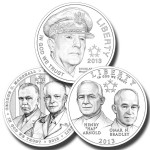
On March 21, the U.S. Mint is scheduled to start selling the 2013 5-Star Generals Commemorative Coins. The program commemorates the United States Army Command and General Staff College (CGSC) by commemorating the 5-star generals who attended or taught at the college. The generals that will be depicted on the coins are Douglas MacArthur, George C. Marshall, Henry “Hap” Arnold, Dwight D. Eisenhower, and Omar N. Bradley. General Bradley was the last to hold the rank General of the Army.
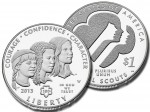
The 5-Star Generals Commemorative Program includes a $5 gold coin, silver dollar, and clad half-dollar that will be offered in proof and uncirculated options. The U.S. Mint will also offer a three-coin proof set. Surcharges of $35 for each gold coin, $10 for each silver coin and $5 for each clad coin sold will to go the CGSC Foundation to support the college. With mintage limits of the 100,000 for the gold coin, 500,000 silver dollars, and 750,000 clad half-dollars, the program can raise a maximum of $16 million for the CGSC Foundation.
Do you plan to buy any of these commemorative coins? This week’s poll asks which, if any, of these commemoratives you will buy.
Do you plan to buy any of the 2013 commemorative coins?
I don't plan to buy any of these commemorative coins (38%, 13 Votes)
2013 Girl Scouts of the USA Centennial Proof Silver Dollar (12%, 4 Votes)

 The U.S. Mint launched the Baseball Coin Design Competition today at the Russell Senate Office Building on Capital Hill. Attending the event arranged by New York Senator Kirsten Gillibrand was Rep. Richard Hanna (R-NY) whose district includes Cooperstown and introduced the National Baseball Hall of Fame Commemorative Coin Act in the 112th congress, Treasurer of the United States Rosie Rios, Member of the Baseball Hall of Fame and former third baseman for the Baltimore Orioles Brooks Robinson, President of the National Baseball Hall of Fame Jeff Idelson, and Acting Director of the U.S. Mint Richard Peterson.
 Loading ...

 Having grown up with