Mar 13, 2009 | coins, gold, US Mint
At our coin club meeting, our speaker brought in a 2009 Ultra High Relief gold coin. In hand, the coin is more impressive than pictures can show.
I tried to take pictures with the camera on my iPhone, but the room light was too low for a good picture.
The coin is presented in a capsul that should have been made better. Capsuls from the US Mint have “seams” on the top and bottom of the rim. Since the rim of this coin is an important design element, I would have thought that the Mint would have looked to use a cleaner design. But the edge lettering is readable through the capsul and a nice element to the coin.
Augustus Saint-Gauden’s Liberty design seems to almost come to life on the coin. It is almost as if Miss Liberty is walking off the coin. The brightness of the coin leaves a great impression.
The eagle on the revese appears as if it is flying swiftly over the coin with a rising Sun in the background. The yellow of the gold is so appropriate for the image that I could not imagine this image being struck in any other metal. Whomever engraved the coin did a good job preventing the motto from detracting from the coin’s look.
The coin is presented in a felt-lined wood box that screems there is something special inside. That box was placed inside a protective box. Both the protective box and Certificate of Authenticity was placed in an outer box. It gives the coin a regal treatment that is well deserved.
Regardless of what you think of the Mint’s recent performance issues, they did a wonderful job with this coin and packaging!
Recently, it has been reported that several of these coins were graded MS-70 by the top two grading services. This does not surprise me given the information as part of the exhibit that was at last year’s Worlds Fair of Money in Baltimore. One thing that was said was the presses were run manually and struck twice with 65 metric tons of force. It was also said that they were going to limit the number of coins struck per die set. Thus, unless the dies are worn, this coin should never grade below MS-69.
I find it interesting that people are removing the coin from the wonderful presentation to have it placed in a cold-looking slab. Compared with the design of the packaging, the slab cannot do this coin justice, regardless of its grade. I think it will detract from the coin’s beauty and the impact the packaging is designed to provide. If I can afford one of these coins (and I am going to try), it will stay in its orginal US Mint packaging.
Mar 3, 2009 | cents, coins, dollar, US Mint
I went to the US Mint’s online catalog to see when the Puerto Rico quarters and District of Columbia Quarter first day covers would be released. While scanning down the list of Scheduled Product releases I noticed that the Mint will be releasing a roll set for the Lincoln Cent Birthplace coins. These rolls are scheduled to be released on March 13.
Also in the list are roll sets for the Formative Years, Life in Illinois, and Presidency coins.
With the backlog of cents in the Federal Reserve System preventing these coins from circulating, this is a good idea. It will allow collectors easier access to the coins.
But what of the costs? Rolls of other coins wrapped in US Mint paper are sold with a premium. Rolls of dollar coins in the Mint wrapper with a $25 face value are sold for $35.95. Kennedy Half dollar and State Quarter rolls contain $20 worth of coins (2 rolls) sells for $32.95. How much of a premium will the Mint add to rolls worth 50-cents each?
Would it be possible that the Mint will also sell these coin as part of their Direct Ship program? Under the direct shipment program, the Mint sells 10 rolls of Presidential Dollar coins at face value ($250) in commercially wrapped paper with free shipping. It may not be cost effective for the Mint to do with with $5 worth of Lincoln Cents, but it is an option for them to think about even if they do charge for the shipping.
I may order these rolls, depending on the pricing. It may be easier than waiting for the banks to get these coins.
Feb 20, 2009 | coins, COTY
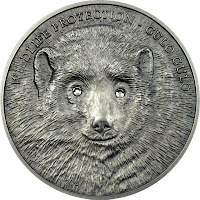 There was a lot written on other sites about the of the Coin of the Year award going to Mongolia. The award was presented at the World Money Fair this month in Berlin.
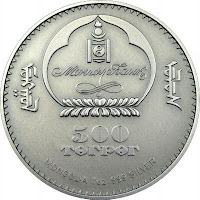 I was curious about the coin and searched for an image. The coin is a 2007 silver 500-tugrik (33-cents US) coin depicting a wolverine. A unique feature is that the eyes are made of diamonds. Even with the limits of the online images, I can understand why David Harper, editor of World Coin News, said, “The judges had to be drawn to the eyes of the wolverine. They are quite compelling.”
This coin was also the winner of the best silver coin in this year’s competition.
While the US Mint produces some nice coins, I wish they were given the opportunity to do something different with non-circulating collectible coins. There was only one bi-metalic commemorative coin and no coins that used elements other than engraving to enhance the coins. I am not suggesting that the US Mint produces colorized coins like the Royal Canadian Mint, but the use of diamonds for eyes on the Mongolian coin was a brilliant idea. I hope the Mint learns from this for the future.
Image courtesy of the Wolverine Foundation.
Feb 18, 2009 | CCAC, coins, history, quarter
It is being reported that the Citizens Coinage Advisory Committee is considering changing the obverse of the America’s Beautiful National Parks Quarter Dollar Coins (Public Law Number 110-456 [GPO: Text or PDF]). My source pointed that that the law does not specify what is to be on the obverse of the coin only that the 1998 George Washington design. Rather than recommend a design with Washington on the reverse, the CCAC is considering honoring Theodore Roosevelt on the obverse.
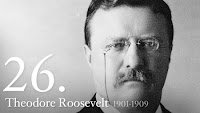 Theodore Roosevelt is credited with starting a modern renaissance of US coinage. When Roosevelt became president in 1901, he expressed his disdain for the sameness of the coinage designed by then chief engraver Charles E. Barber. Roosevelt want our coinage to reflect the greatness of the nation. He wanted a more modern classical design. Roosevelt enlisted the help of the greatest sculpture of the time, Augustus Saint Gaudens, to execute what Roosevelt called his “pet crime.”
Duriung Roosevelt’s presidency, he was directly involved with the redesign of the gold coinage using the designs of Saint Gaudens on the eagle ($10) and double eagle ($20), Bela Lyon Pratt’s incuse design for the half-eagle ($5) and quarter eagle ($2.50) coins, and Victor David Brenner’s Lincoln Cent. The other Barber designs coin were retired by 1916.
In addition to Roosevelt’s influence on coinage, he was instrumental in growing the number of national parks and protected areas in the United States. Roosevelt, who spent a lot of time in the Badlands in the Dakota Territory influenced his view by setting aside 42 million acres of national forests, 53 national wildlife refuges, and other areas including the Grand Canyon.
Roosevelt started the program that lead to the National Wildlife Refuge system and established the US Forest Service to help maintain these natural resources.
To honor Theodore Roosevelt’s conservation work and preservation of many national parks and refuges and his “pet crime” for his redesign of US coinage, it would be fitting to honor him on the National Park Quarters. As a fan of our 28th president and his work, I have advocated that Theodore Roosevelt be honored on US coinage. If the CCAC follows through with this recommendation, it would make the National Parks Quaters more palatable.
Image of Theodore Roosevelt is from the White House website.
Feb 17, 2009 | coins, dollar, history
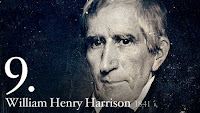 William Henry Harrison was elected the 9th President of the United States in 1840. A retired Major General of the United States Army, Harrison was famous for the Battle of Tippecanoe where he defeated the Shawnee Indians and lead by the brothers of Chief Tecumseh and Tenskwatawa The Prophet preserving the Indiana territory from further attack.
When Harrison won the Whig Party nomination for president, Harrison and his running mate, John Tyler adopted the campaign slogan, Tippecanoe and Tyler too to promote Harrison’s military record and reputation as a battle hero.
Harrison was inaugurated on very cold and wet day in Washington on March 4, 1841, without wearing an overcoat or hat in order to continue to show his toughness. His inaugural speech was the longest in American history, lasting nearly two hours. And this was the short version of the speech after it was edited by Daniel Webster for length.
President Harrison became ill with a cold on March 26 presumably as a result from the inauguration. The illness progressed to pneumonia, pleurisy and other symptoms not understood by the doctors of the period. Harrison died on April 4, 1841, after 32 days in office.
Harrison’s presidency and death was as historic as it was a test of the Constitution. Harrison was the oldest elected president at 68 until the election of Ronald Reagan in 1980. As the first president elected from the Whig Party, his two hour inaugural speech is the longest of any president and his term of 32 days is the shortest in United States history. Harrison was the only president to never appoint a federal judge.
Harrison was the first president to die in office. While we understand the rules of succession today, Harrison’s death caused a constitutional crisis in the young nation. The debate surrounded the interpretation of Article II of the Constitution:
In Case of the Removal of the President from Office, or of his Death, Resignation, or Inability to discharge the Powers and Duties of the said Office, the Same shall devolve on the Vice President, and the Congress may by Law provide for the Case of Removal, Death, Resignation or Inability, both of the President and Vice President, declaring what Officer shall then act as President, and such Officer shall act accordingly, until the Disability be removed, or a President shall be elected.
The vague wording caused a debate as to wether Vice President Tyler would take the oath of office as President or would he become an “acting president.” After debate in congress and by the cabinet, Chief Justice Roger Taney was consulted. Chief Justice Taney said that he thought the constitution meant for Tyler to take the oath of office as president. Based on Taney’s opinion, Tyler was given the oath on April 6, 1841.
As a historical note, Chief Justice Taney was presiding when the Supreme Court ruled on the infamous Dred Scott v. Sanford case in 1857.
This precedence was used in the transitions following the death of seven presidents. The 20th Amendment to the Constitution, ratified on January 23, 1933, codified the line of succession as well as change the inauguration date to noon on January 20th. Rules of succession was strengthened with the 25th Amendment that was ratified on February 10, 1967.
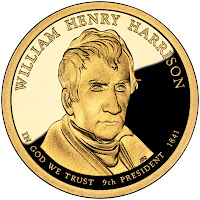 On February 16, the US Mint used 2009 President’s Day to pre-release the Harrison Dollar Coin to an audience in Charles City, Virginia. The coin officially goes into circulation on February 19. The reverse was designed and engraved by Mint Sculptor-Engraver Joseph Menna.
As Harrison was the cause of a number of firsts, the coin honoring his short presidency is the first of the Presidential Dollars to feature the motto In G-D We Trust on the obverse rather than the rim as mandated by law.
Image of William Henry Harrison from the White House website.
Image of the Harrison Dollar obverse courtesy of the US Mint.
Feb 12, 2009 | cents, coin design, coins, Federal Reserve, US Mint
The US Mint will introduce the first in a series of redesigned Lincoln Cents honoring our 16th President’s 200th birthday at the Abraham Lincoln Brithplace in Hodgenville, Kentucky. Unveiling will occur at 10:00 AM during The Kentucky Abraham Lincoln Bicentennial Celebration to be held at LaRue County High School in Hodgenville, Kentucky.
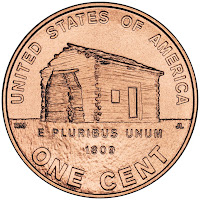 Billed as the first redesign of the Lincoln Cent in over 50 years, the first coin issued will honor his birth and early childhood in what is now known as Hodgenville, Kentucky. Lincoln was born on February 12, 1809, in a log cabin to Thomas and Nancy Hank Lincoln. While the log cabin where Lincoln lived has been lost to history, a replica of common design for the era was used as a model for the coin. The reverse was design by Artistic Infusion Program (AIP) Master Designer Richard Masters and sculpted by Sculptor-Engraver Jim Licaretz
However, it may be a while before the new coin will be seen in change. Susan Headley points out that the way coins are distributed through the Federal Reserve system, there may be a backlog of coins in stock that will prevent the new cents from reaching the public. Susan explains that the bad economy has caused more coins being returned to the Fed than being distributed. Since the Fed buys only what it needs from the US Mint, it may be a while before the inventory is depleted enough for the Fed to order coins.
Susan reported that when she visited the Philadelphia Mint last week, she found that three of the lines striking cents were not running. When I visited the Philadelphia Mint in the summer of 2007, we were told that the machines that strike cents run 24 hours a day, seven days a week. To hear that the Mint has reduced production of cents is very worrisome for the economy and those who work at the Mint. I hope their superintendent has the chutzpa that Mae Biester showed in the 1950s.
Image courtesy of the US Mint.
Feb 12, 2009 | coins, commemorative, dollar, US Mint
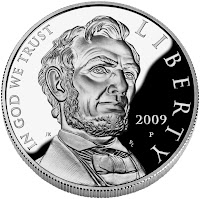 Starting at 12:00 Noon Eastern Time, the US Mint will begin to sell the 2009 Abraham Lincoln Commemorative Silver Dollar. The commemorative is limited to a production of 500,000 coins by law and will be available in proof and uncirculated versions. Coins will be struck in 90-percent silver and will have a face value of one dollar.
The obverse of the coin was created by United States Mint Artistic Infusion Program Master Designer Justin Kunz and sculpted by Sculptor-Engraver Don Everhart. The image was inspired by Daniel Chester French’s famous sculpture of the President that sits inside the Lincoln Memorial in Washington, DC.
 The reverse was designed and sculpted by Sculptor-Engraver Phebe Hemphill. The design features the an inscription of the last 43 words of the Gettysburg Address:
WE HERE HIGHLY RESOLVE THAT THESE DEAD SHALL NOT HAVE DIED IN VAIN–THAT THIS NATION, UNDER GOD, SHALL HAVE A NEW BIRTH OF FREEDOM—AND THAT GOVERNMENT OF THE PEOPLE, BY THE PEOPLE, FOR THE PEOPLE, SHALL NOT PERISH FROM THE EARTH.
These words are encircled by a laurel wreath with Lincoln’s signature incuse into a banner at the bottom of the design.
From the first availability until 5:00 PM on March 16, 2009, the Mint will sell these coins at a reduced price. According to the Mint’s press release pricing has been set as follows:
| Product Code |
Description |
Introductory Price |
Regular Price |
| LN7 |
Proof Silver Dollar |
$37.95 |
$41.95 |
| LN8 |
Uncirculated Silver Dollar |
$31.95 |
$33.95 |
| LN6 |
Special Set |
— |
— |
The special set will contain a proof silver dollar and proof versions of the four 2009 Lincoln Cents. The set will be available in the spring and will be limited to 50,000 units. The special set sounds interesting and worth waiting to see how the Mint will price this option.
Images courtesy of the US Mint.
Feb 7, 2009 | coins, gold, video
As an avid collector and purveyor of the “neat” things in numismatics, I find it difficult to pass up a “how it’s done” video. A friend who knows this, saw the video I posted about Rae Biester, Superintendent of the Philadelphia Mint, appearing on the game show What’s My Line, and sent along a link to another interesting video.
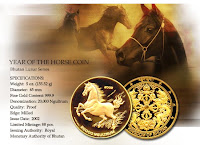 This video is from the Mayer Mint, a private mint in Germany, and sponsored by the Gold Refining Forum. It shows the making of a 2002 non-circulating legal tender gold coin honoring the Year of the Horse. It is part of the Bhutan Lunar Series. The coins struck in the video are 5 ounces of 999.9 gold proofs with the denomination of 20,000 Ngultrum issued by the Royal Monetary Authority of Bhutan.
I love videos like this!
Coin specification image courtesy of the Mayer Mint GmbH
Feb 2, 2009 | coins, history, state quarters
After I posted a review of the DC quarter, I remembered that I had not posted what I consider the 10 State Quarter designs that best represents history and teaches us something about the state and our nation. These quarters may not be the best designs, but they represent a unique story about the state that makes it unique and contributes to the nation. Every one of the designs told a story of accomplishment and a proud heritage for the state it represents. I also learned something after each of these quarters were released.
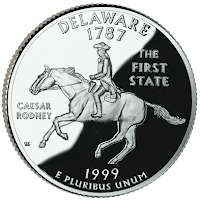 #1 Delaware
Engraver: William Cousins
On the very first coin, I learned who Caesar Rodney was and why is he riding a horse on the back of the Delaware quarter. Rodney was one of Delaware’s representative to the Continental Congress. He was in Dover attending to other business when he learned that Thomas McKean and George Read were deadlocked on the vote of independence. Rodney rode 80 miles from Dover to Philadelphia to vote with McKean to allow Delaware join eleven other colonies voting in favor of independence. Rodney’s signature appears on the document representing Delaware and on the Declaration of Independence. Now that’s history!
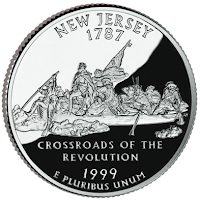 #2 New Jersey
Engraver: Alfred Maletsky
We learned in our history classes that General George Washington lead the revolutionary troops across the Delaware River in the middle of the night to surprise the English at the Battle of Trenton on December 26, 1776. In addition to George Washington, future presidents James Madison and James Monroe was part of the contingent. Rivals Alexander Hamilton and Aaron Burr along with future Chief Justice of the Supreme Court John Marshall were soldiers serving under Gen. Washington. The Battle of Trenton was a key battle that helped change the outcome of the war for independence.
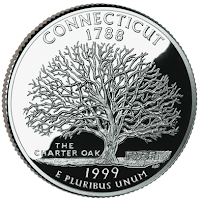 #3 Connecticut
Engraver: T. James Ferrell
Although the Charter Oak appeared on the reverse of the 1935 Connecticut Tercentenary Commemorative Half Dollar, younger collectors probably have not seen the coin. Adding it to the Connecticut state quarter had me looking up the history of this tree. It was said that the colony’s charter was hidden in a cavity within the tree when James II sent a new governor to Connecticut to reclaim the document. One of the first “battles’ against the authority of the British monarchy.
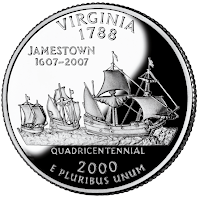 #4 Virginia
Engraver: Edgar Z. Steever
Jamestown, Virginia was the first permanent European settlement in the New World and would celebrate its quadricentennial in 2007. The design features the three ships that brought the first settlers to the new colony: Susan Constant, Godspeed, and Discovery. We are reminded of the beginning of this nation and how they came to the new land. Having visited Jamestown, I thought the design was exciting.
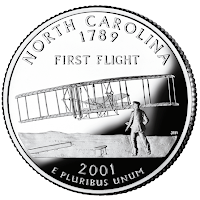 #5 North Carolina
Engraver: Don Everhart
On a cold, wind swept day on December 17, 1903, Orville and Wilbur Wright made the first powered, controlled, sustained airplane flight from the sands outside of Kitty Hawk, North Carolina—now the town of Kill Devil Hills. For three years, the Wright brothers lived in Kitty Hawk testing and perfecting their design that culminated in four successful flights on December 17. We may take flying for granted today, but this one event significantly changed history.
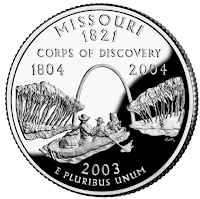 #6 Missouri
Engraver: John Mercanti
The Corps of Discovery headed by Meriwether Lewis and William Clark that explored the Louisiana Purchase was an significant event that lead to the country’s western expansion across the continent. The trip ended in what is Oregon today. Amongst his party was his Indian guide Sacagawea and her baby Jean-Baptiste Charbonneau. The design shows Lewis and Clark’s return to St. Louis from their venture.
 #7 Iowa
Engraver: John Mercanti
It would have been easier for Iowa to create a quarter design based on its agricultural heritage. Instead, they chose to celebrate their education values demonstrated in their history. Basing the design on Grant Wood’s “Arbor Day,” the quarter shows a one-room school house with a teacher helping students plant a tree. When you learn that Iowa was one of the first states to organize their schools in county-based districts. Along with being amongst the first to form high schools, their experiences were adopted in other states. A subtle, yet important, historical note.
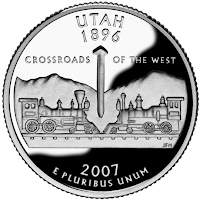 #8 Utah
Engraver: Joseph Menna
On May 10, 1869, the Union Pacific and Central Pacific railroads officially completed the first transcontinental railroad. The completion was celebrated at Promontory Summit, Utah with the driving of the Golden Spike. Although there was one segment in California that was completed later, the transcontinental railroad provided significant economic development for the newly expanded areas of the country.
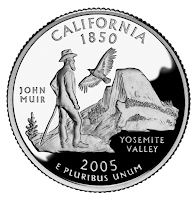 #9 California
Engraver: Don Everhart
When Governor Arnold Schwarzenegger announced that the design for the California quarter would honor John Muir, I had to go beyond my basic education as the who Muir was. I knew Muir was a naturalist and the founder of the Sierra Club. What I did not know was that Muir was instrumental in saving Yosemite Valley and Sequoia National Park. I also learned that Muir was widely published about ecology and proposed ecological programs that began to gain favor in the 1970s, more than 60 years following his death. Although he generated a lot of controversy, his concepts show benefits today. For teaching me about Muir, California’s quarter makes this list.
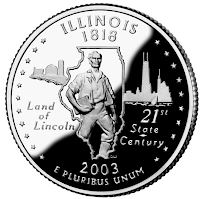 #10 Illinois
Engraver: Donna Weaver
Anyone who was educated in the United States knows the basic story of Abraham Lincoln. We know that he was the 16th president and issued the Emancipation Proclamation. We know he was the president throughout the Civil War and delivered the most remembered speech at Gettysburg, Pennsylvania. Lincoln was born in a log cabin in Kentucky and was assassinated at Ford’s Theater in Washington, DC. But I learned that Lincoln interested in the river and railroads. He holds a patent related to the buoying of vessels. I knew that he was the first Republican elected president but I did not know he was one of the party’s founders. There is so much more fascinating information that I learned about Lincoln that was never taught in school, but this is supposed to be a short paragraph. You should read some of the books about Lincoln. He is a fascinating person and what he did as president is the reason why he is considered our greatest president.
Feb 1, 2009 | coins, quarter
In the same manner as I acquired my first 2009 coin, I was able to obtain four DC quarters. Although I wish DC would have picked another topic, the design is not bad looking in hand.
Last year, I found my first 2008 coin in May. I am glad it did not take that long, even if it is cheating. Too bad the coin machines in the US Mint headquarters only dispense quarters and dollars!



 Loading ...