Apr 2, 2010 | US Mint
Be it enacted by the Senate and House of Representatives of the United States of America in Congress assembled, and it is hereby enacted and declared, That for the purpose of a national coinage be, and the same is established; to be situate and carried on at the seat of the government of the United States, for the time being: And that for the well conducting of the business of the said mint, there shall be a Chief Coiner, and Engraver, a Treasurer.
—Coinage Act of 1792 (1 Stat. 246)
The second Congress of the United States meeting in Philadelphia passed the Coinage Act of 1792 to establish the dollar as the unit of currency, created a decimal currency system, authorized the production of coins, and established the United States Mint. It was signed into law by President George Washington at the President’s House in Philadelphia, the first executive mansion of the United States.
President Washington appointed noted astronomer David Rittenhouse as the Mint’s first director on April 14, 1792. Rittenhouse was paid a yearly salary of $2,000 and charged with obtaining the land and establishing the first Mint. This was a yoeman’s effort for the 60 year old Rittenhouse who was in bad health at the time.
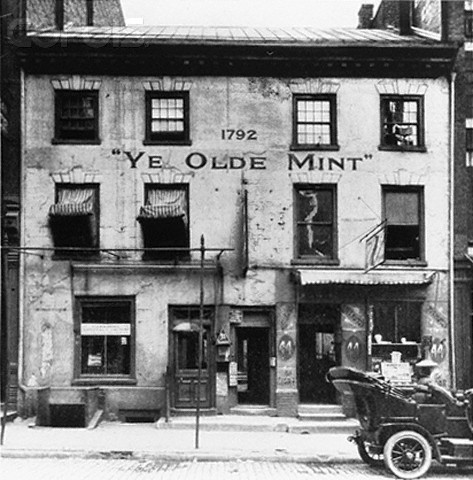
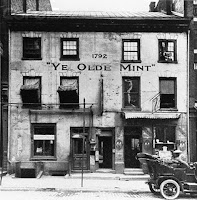 Pressing forward, Rittenhouse purchased and L-shaped lot with three buildings on Market Street in Philadelphia to establish the Mint in May 1792. Henry Voigt was appointed as Chief Coiner and Joseph Wright as Chief Engraver. Before Wright was able to prepare dies, he died of yellow fever in September 1792. He was replaced by Robert Scot who is considered the Mint’s first Chief Engraver.
Rittenhouse resigned on June 30, 1795 with the Mint in operation. He died on June 26, 1796 at the age of 64.
From those humble beginnings in 1792, the US Mint is the largest manufacturer of coins in the world. The US Mint operates mints in Philadelphia, Denver, San Francisco, and West Point. The Mint also operates the United States Bullion Depository in Fort Knox, Kentucky and the Silver Depository in West Point. During fiscal year 2009, the US Mint produced $777 million in circulating coins with a total seigniorage (profit) of over $904 million from all sales including bullion.
Although there have been issues with the recent operations of the Mint, its 218 year history makes it a uniquely successful bureau in the United States government.
Mar 25, 2010 | national park quarters, US Mint, video
First Coin in Series to Be Released into Circulation on April 19
WASHINGTON (adapted from the US Mint press release)—The US Mint unveiled the designs for the first five quarters in the America the Beautiful Quarters Program in a special ceremony today at the Newseum in Washington, D.C. US Mint Director Ed Moy treated special guests and the media to a first look at the new designs, which celebrate the spectacular natural wonders that are found in the United States’ national parks, forests, shores and other national sites. Other speakers included Congressman Mike Castle, one of the lead co-sponsors of the legislation; United States Treasurer Rosie Rios; Harris Sherman, Under Secretary of Agriculture for Natural Resources and the Environment; and Secretary of the Interior Ken Salazar.
The first quarter in the series, which honors Hot Springs National Park in Arkansas, will be released into circulation on April 19, with an official launch ceremony in Hot Springs on April 20. It will be followed by quarters honoring Yellowstone National Park in Wyoming (to be released in June), Yosemite National Park in California (July), Grand Canyon National Park in Arizona (September), and Mount Hood National Forest in Oregon (November).
The following is the video from the introduction of the designs at the Newseum along with interviews and B-Roll footage.
America the Beautiful Quarters Designs
- The image on the reverse of the Hot Springs National Park quarter depicts the façade of the Hot Springs National Park headquarters building with a fountain in the foreground. The headquarters was built in the Spanish colonial revival style and completed in 1936. The National Park Service emblem is featured to the right of the door.
- The image on the reverse of the Yellowstone National Park quarter features the Old Faithful geyser with a mature bull bison in the foreground.
- The image on the reverse of the Yosemite National Park quarter depicts the iconic El Capitan, which rises more than 3,000 feet above the valley floor and is the largest monolith of granite in the world.
- The image on the reverse of the Grand Canyon National Park quarter features a view of the granaries above the Nankoweap Delta in Marble Canyon near the Colorado River. Marble Canyon is the northernmost section of the Grand Canyon. Granaries were used for storing food and seeds (A.D. 500).
- The image on the reverse of the Mount Hood National Forest quarter depicts a view of Mount Hood with Lost Lake in the foreground.
Each coin in the series features a common obverse (heads side) with the 1932 portrait of George Washington by John Flanagan, which has been restored to bring out subtle details and the beauty of the original model. Inscriptions are UNITED STATES OF AMERICA, LIBERTY, IN GOD WE TRUST and QUARTER DOLLAR.
For more information on the America the Beautiful Quarters Program, please visit www.americathebeautifulquarters.gov.
Learning through the America the Beautiful Quarters Program
The America the Beautiful Quarters Program will also introduce a brand new lesson plan format with a series of interactive educational tools for students from kindergarten through high school. Students will be able to take a virtual visit to the national sites highlighted each year and have the opportunity to learn about forest communities and the plants and animals that live in our national parks and sites. For more information about America the Beautiful Quarters Program educational resources, please visit www.usmint.gov/?action=educators.
Mar 18, 2010 | national park quarters, US Mint
A public relations firm sent out a media alert announcing that the US Mint will unveil the designs for the first five quarters in the America the Beautiful Quarters Program. The program that begins this year is a new multi-year initiative honoring 56 national parks and national sites in each state, the District of Columbia and the five US territories and will run through 2021.
The media event will be held Wednesday, March 24, 12:00 noon at the Newseum in Washington, DC (map). The event will feature US Mint Director Ed Moy unveiling the new designs of the first five quarters in the program and a video of the featured national sites showcasing the natural and historic significance of the first five quarters.
Hot Springs National Park in Arkansas will be first quarter and will be released on April 19 to be followed by Yellowstone National Park in Wyoming (to be released in June), Yosemite National Park in California (July), Grand Canyon National Park in Arizona (September), and Mount Hood National Forest in Oregon (November).
Additional featured speakers scheduled include US Treasurer Rosie Rios, Secretary of the Interior Ken Salazar, and Dayton Duncan the writer and co-producer of the Ken Burns documentary The National Parks: America’s Best Idea.
This may be a media-only event and not open to the public. If you are going to be near the Newseum on March 24, it might be worth trying to attend. Besides, the Newseum is one of the great museums in Washington and worth the time to visit.
Feb 28, 2010 | CCAC, US Mint
The US Mint announced on Friday that they are accepting applications for the Citizens Coinage Advisory Committee to represent the interests of the general public. Application deadline is March 31, 2010.
Looking over the list of CCAC members it appears that the term of Dr. Mitchell Sanders is expiring in 2010. Dr. Sanders has been the Chairman of the CCAC from 2005 through 2009.
According to the US Mint:
The CCAC was created to advise the Secretary of the Treasury on the selection of themes and design proposals for circulating coinage, commemorative coins, bullion coinage, Congressional Gold Medals and other medals. The CCAC also advises the Secretary with regard to the events, persons, or places to be commemorated by the issuance of commemorative coins, as well as the mintage levels and proposed designs of commemorative coins.
Sometimes, it does not seem that the CCAC is maintaining this advisory role or they are not communicating it properly. Recently, I have been critical of the CCAC and even had a public “discussion” with a member of the CCAC that highlighted the problems with communications.
What would happen if the CCAC had a different point of view? What would happen if the CCAC had a citizen member who was interested in bringing the voice of the general public into the committee who would also be interested in ensuring that the working of the CCAC would be published in full to the general public? Could it be possible that the CCAC be seen as more of a representative of the general public?
I would like to see the CCAC take the next step and make the CCAC’s proceedings more open to the citizens. I would also like to see that whatever comes in front of the CCAC is available to the general public to read, analyze, and comment on either through the media or on their own. I would like to see the CCAC general public representative be more of a representative to the input of the general public being represented.
That being said, what if your intrepid were to apply for this opening?
The problem is that in this town, politics is the rule and not the exception. I am sure that my criticism on this blog and other venues will work against me even though I had called for the expansion of the CCAC’s role in how it relates to the US Mint. Another issue is that I work for the same company as a current member of the CCAC. Although my company does not do business with the US Mint, there is no telling how this situation would be viewed by those making the decision.
However, I have demonstrated significant and thoughtful of opinions on the US Mint and CCAC that includes suggestion for improvement. It would be great if I could work with the CCAC to try to improve what they do for the US Mint and make suggestions that would benefit the Mint’s coinage programs. I know I would be in the forefront to expand their communications capabilities to get the public more involved and better support the collecting community.
So what do you think? Should I apply? Leave a comment here and I will consider your suggestions.
Feb 15, 2010 | cents, coins, US Mint, video
While the Washington, DC area continued to dig out of Snowmageddon II, US Mint held a ceremony on Friday, February 11, 2010 at the Abraham Lincoln Presidential Library and Museum to introduce the 2010 Lincoln Cent. The new coin features the new shield reverse as being emblematic of the “Preservation of the Union.” The shield is featured in many of the frescos painted by Constantino Brumidi throughout the US capitol. Brumidi was the Artist of the capitol during Abraham Lincoln’s presidency.
The obverse is a slightly modified bust of Lincoln designed by Victor David Brenner that has been used since the first Lincoln cent was released in 1909.
Although the launch of the 2010 Lincoln Cent went on as schedule, the sales and distribution in the Washington, DC area was postponed because of the weather conditions. No announcement was made as to if or when the sale will be rescheduled.
The following video has scenes from the launch in Springfield, Illinois and some B-Roll footage:
Here is the video from the State Journal-Register from Springfield, Illinois:
Feb 10, 2010 | bullion, cents, coins, economy, Federal Reserve, US Mint
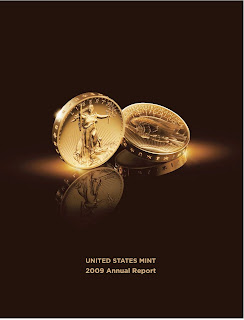 After reading a few stories on how the president’s 2011 federal budget was proposing changes to coin composition. Many of these articles point out how the budget projects that changes could save the US Mint about $150 million per year after making over $777 million in circulating coins (business strikes) in fiscal year 2009. The US Mint’s Fiscal Year 2009 Annual Report says that the US Mint earned over $904 million in seigniorage from all sources.
While everyone is concentrating on the costs of changing coinage metals, there is a missing point: even if the US Mint was able obtain the copper covered zinc planchets for the cent at no cost, the US Mint will lose 0.62-cents per cent struck just for the labor and administrative costs.
In 2009, the US Mint shipped $777 million in circulating coins after shipping over $1.2 billion in 2008. The 40-percent reduction in production also was matched by a 40-percent reduction in the amount the US Mint spent on the metals. In other words, the increase in the costs of metals between 2008 and 2009 was minimal. However, the cost to produce the 40-percent fewer coins cost the US Mint 1.1-percent more in 2009! With presses sitting idle for long periods of time for the first time in many years, the US Mint paid $98.1 million in 2009 for striking few coins and costing $97 million in 2008.
The US Mint documents the costs in the Annual Report as Sales, General & Administrative (SGA). In the Annual Report the reported SGA from 2006 through 2009 has remained stable. Increases have roughly followed the rate of inflation. When looking at the SGA for individual coins, the US Mint spent $65.3 million to sell $459 million one-dollar coins to the Federal Reserve in 2009. In 2008, it cost $52.2 million to sell $475 million one-dollar coins.
The US Mint’s core responsibility is to manufacture the coins required by the Federal Reserve for commerce. In 2009, the seigniorage for business strikes was $427.8 million while making $32.7 million for bullion sales.
The problem is not the cost of the metals. The problem is the inefficiency of operations at the US Mint. “In FY 2009,” the US Mint’s FY2009 Annual Report reads, “the worsening economic environment challenged our ability to maintain efficient manufacturing operations but also presented opportunities for long-term efficiency gains.” Then where are the efficiencies? If the US Mint has an efficient manufacturing process, then why did it cost the US Mint 1.1-percent more in 2009 to producing 40-percent fewer coins than they did in 2008?
If the Obama Administration wants the US Mint to produce more in seigniorage, then the place to start is to immediately replace the political hack that is the current director. A replacement should be someone that has had a manufacturing background working in a regulated environment to lead the US Mint forward.
Feb 4, 2010 | CCAC, policy, US Mint
Last week I had a public discussion with Gary Marks, a member of the Citizens Coinage Advisory Committee about my comments about the CCAC on CoinNews.net. My initial comments were based on an article that Mr. Marks says misrepresents the work of the CCAC. After following up with asking for more information, Mr. Marks produced a quote buried in a document on the CCAC website that was lacking context. It is evident that Mr. Marks does not fully understand the issue.
The Citizens Coinage Advisory Committee is supposed be a conduit for the public to have input to the coin design process. The CCAC is supposed to work with the US Mint to create coin designs that represents the best of the best. It is a committee that is to do what President Theodore Roosevelt did as part of his “pet crime.”
New York Yankees limited partner John McMullen once said, “Nothing is more limited than being a limited partner of [George Steinbrenner].” McMullen has not tried to pry information from the CCAC and the US Mint!
Openness of the federal government was first codified in the Freedom of Information Act signed by President Lyndon B. Johnson on July 4, 1966. At the time, it was referred to as the “Sunshine Laws.” Before the growth of the computer age, the purpose was to make documents that were not sensitive or classified available to the public. Presidents Bill Clinton, George W. Bush, and now Barack Obama have mandated their administrations to expand the availability of government information as electronic capabilities have improved.
On January 20, 2009, the first day of the Obama Administration, President Obama signed the Memorandum for the Heads of Executive Departments and Agencies which said that “agencies should adopt a presumption in favor of disclosure, in order to renew their commitment to the principles embodied in FOIA, and to usher in a new era of open Government.” By August, the White House issued the Transparency and Open Government memo telling agencies that they have 120 days to report to the Office of Management and Budget how they would make the processes more open.
Rather than making the process more open as the President requested, the CCAC and the US Mint appears to be stuck in the mindset of the electronic world before the invention of the World Wide Web.
Although the meetings are open to the public, knowing when the meetings are being held is almost a state secret. Although announcements are made via a press release by the US Mint—of course everyone follows the US Mint’s press releases—the CCAC website has no information as to when meetings are held. Rather, the front page says to call a Washington, DC telephone number to listen to a recorded message about the meeting. Meeting announcements are not posted on the web site. Neither are the agendas in advance of the meeting. Instead of following the President’s executive order to be more open, the CCAC makes meeting announcements are technically legal but violates the spirit of open government.
Even using the 20th century forms of communications, the CCAC is not updating their website. At this time, minutes have not been posted for the last four meetings. Not that it matters because the information is sparse and really does not explain what the CCAC is doing.
There is also nothing worth reading on their Press Room page.
Anyone attending the CCAC meetings are handed a package of papers with an agenda, support letters, and even images of the proposed designs being discussed. These packages contain a phenomenal amount of information that when combined with the sparse minutes provides a better insight into what the CCAC has discussed. But these packages are not available to the public. If you know someone attending the meeting, you can ask them to obtain an extra copy. When I called the US Mint to ask to receive a package, I was told that it could not be done but I could receive copies of the coin images if I signed a copyright release. More than a year ago, I submitted a request for the release. After my application was rejected because I could not provide a company name, I was told I would have to sign a form for each request.
Most of the meetings are held at the US Mint’s Headquarters in Washington, DC. On occasion, meetings have been held during the American Numismatic Association’s Summer Seminar, Worlds Fair of Money, and recently the Florida United Numismatics show. While I would like to attend these events, I have a full time job, not in numismatics, that keeps me close to home. However, if I had access to the meeting package and a way of listening to the conversation, I would be able to make educated judgements on their work without having to rely on a second hand source like a non-numismatic newspaper.
Even if the CCAC continues to use 20th century communications, the Department of the Treasury does have the capability of creating a teleconference bridge that can be outbound only and recorded. This teleconference bridge will allow people who are not local to the meetings to listen to the meeting. In my “Real Life”™ job, I have used this service. It requires the bureau to request the service in advance.
After the meeting, the audio can be posted on the website so that anyone who could not participate during the time of the meeting could download the audio and listen at another time.
If the CCAC and US Mint wants to step into the 21st century, there are Internet-based audio services that can be used with greater capacity than the Treasury’s teleconferencing service.
Would it be too much to ask for the CCAC to have a Really Simple Syndication (RSS) feed? RSS feeds allows for better communication by my RSS reader letting me know when the site has created updates by watching the RSS feed. RSS is really simple. There are a number of programs to help create feeds and services that help publish feeds. As the webmaster for my local coin club, I provide an RSS feed when the website changes. I also use it to remind members of upcoming meetings.
Also, it is possible to integrate Google search into the CCAC website to provide search capabilities to visitors. There is no cost for this service.
If the CCAC participated in the Open Government initiative ordered by the President and made its deliberations more open to the citizens, maybe there would be a better understanding between the committee and the citizens they are supposed to represent.
Feb 2, 2010 | coins, pocket change, US Mint
I finally found a DC quarter in the DC area. I am working on a new project in Alexandria, Virginia and stopped by a local grocery store after work. Before shopping, I stopped by the in-store coffee stand for a warm beverage where I was handed a DC quarter in change. Although I was able to purchase these quarters at the US Mint headquarters building, this is the first one I found in change.
Almost a year after their issue, I am beginning to see 2009 quarters and the Lincoln Bicentennial Cents in circulation. I have yet to find 2009 nickels and dimes in change. With a production of 84.64 million nickels and 146 million dimes are the lowest mintage totals since the 1950s.
The US Mint’s Annual Report says that production of circulating coinage was down 70-percent and it is not anticipated that their primary customer, the Federal Reserve, would increase their purchasing of new coins. It might be more difficult to find 2009 and 2010 coins in pocket change.
Dec 26, 2009 | cents, coins, commemorative, dollar, quarter, US Mint
Around this time last year, I wrote that 2009 would be quite a year. As 2009 comes to an end, I know why I am not a prognosticator. With the down economy, the convergence of so many coin programs, and the performance questions of the US Mint it is difficult to call 2009 a successful year; yet it was not a failure.
Some of the success of this year included the 2009 Ultra High Relief Gold Coin, the District of Columbia and US Territories Quarters, and the Lincoln Bicentennial One Cent program. Although finding the cents and quarters have been difficult to find in change, these new coins had nice designs and was a chance for people to learn about Lincoln’s life and the history of our territories.

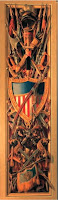 As the Lincoln Cent enters its 101st year of production, it will be given a new reverse. The Union Shield was selected as the symbol of a united country. The shield is featured in many of the frescos painted by Constantino Brumidi throughout the US capitol. Brumidi was the Artist of the capitol during Abraham Lincoln’s presidency. The fresco shown here is one of the eight trophy panel from room S-128 (from the Senate side) of the capitol. It was design by Brumidi and painted by English artist James Leslie.
Starting in 2010, the US Mint will begin the American the Beautiful Quarters Program. It will be a program with 56 quarter-dollar coins featuring designs depicting national parks and other national sites. Although this program might be overkill, the designs show that the program has the promise to show new and interesting designs. The first five quarters for 2010 will honor Hot Springs National Park in Arkansas, Yellowstone National Park in Wyoming, Yosemite National Park in California, Grand Canyon National Park in Arizona, and Mount Hood National Forest in Oregon. It will be interesting to see if this program will catch on.
 In the second year of the Native American $1 Coin program, the theme for the 2010 reverse is “Government–The Great Tree of Peace.” The reverse design features five bound arrows and the Hiawatha Belt. Hiawatha was the helper to the Great Peacemaker who negotiated peace amongst the Seneca, Cayuga, Onondaga, Oneida, and Mohawk tribes in the area now known as New York state. The alliance was known as Haudenosaunee, the Iroquois Confederacy, and is featured on the reverse. The words “Great Law of Peace” is also on the reverse to honor the constitution that created the confederacy. It is a wonderful design that follows up the great design of 2009.
Continuing the Presidential $1 Coins, 2010 will include coins for Presidents Millard Fillmore, Franklin Pierce, James Buchanan, and Abraham Lincoln. We may see an increase of interest in these coins with the introduction of the dollar honoring Lincoln as we pass the (ho-hum) early 19th century presidents.
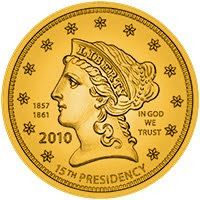 Along with the Presidential dollars will be the First Spouse Gold Coins. Along with the presidents will be gold coins to honor Abigail Fillmore, Jane Pierce, Buchanan’s Liberty, and Mary Todd Lincoln. President James Buchanan was not married. His first spouse coin will be a reproduction of the Liberty Head Quarter Eagle designed by Christian Gobrecht minted and issued from 1840 through 1907. The reverse design depicts the future President as a boy working as a bookkeeper in his family’s small country store design by Artistic Infusion Program Associate Designer David Westwood.
To round out circulating coinage, no changes are in store for the nickel, dime, and half-dollar.
Commemorative coins for 2010 will include the 2010 Boy Scouts of America Centennial Commemorative Coin and the American Veterans Disabled for Life Commemorative Coin. The Boy Scout commemorative celebrates the 100th anniversary of the Boy Scouts of America. The program will produce 350,000 silver dollar coins with the $10 surcharge will be paid to National Boy Scouts of America Foundation who issues grants to local council for the extension of scouting in hard-to-serve areas.
The American Veterans Disabled for Life will also produce 350,000 silver dollars in proof and uncirculated version to honor disabled veterans. The $10 surcharge will be paid to the Disabled Veterans’ LIFE Memorial Foundation to support the construction of the American Veterans Disabled for Life Memorial in Washington, DC.
Considering what happened this year, it will be difficult to predict what will happen to the American Eagle Bullion and American Buffalo 24-Karat Gold coins. Because of how the law is written, American Eagle bullion will be produced but we are not sure whether American Eagle proof coins will join them. I hope the proof coins will be produced in 2010, but with the current Mint administration, we will not know until they announce a commitment to their production.
I hope 2010 sizzles as much as 2009 fizzled!
Fresco image from Constantino Brumidi: Artist of the Capitol.
Coin images courtesy of the US Mint.
Dec 26, 2009 | history, state quarters, US Mint
It was a desperate act during a desperate time. It was the winter of 1776 and the Colonial Army was looking for something to give it hope that they could beat the British who occupied Boston, New York, and Philadelphia, the most important cities of the time. Something had to be done.
To restore faith in the Continental Army, General George Washington devised a plan to attack the Hessian forces in southern New Jersey that were helping protect an advance onto Philadelphia. General Washington know that the Hessians, German soldiers employed by Great Britain, were hearty partiers and would be doing so on Christmas. He devised a plan to cross the Delaware River at night to surprise the Hessians.
On Christmas night, Washington lead 2,000 troops across the icy Delaware River undetected by the British. They regrouped on the New Jersey side of the river and marched to Trenton where the Hessians were camped.
Two thousand hungry and cold colonial troops attacked the Hessian camp. After 45 minutes of fighting, the colonial forces has taken over 900 Hessians prisoner and controlled the camp. The soldiers found food, supplies, and much needed ammunition. A week later, the Colonial Army marched to Princeton and defeated the British army lead by Lt. Col. Charles Mawhood.
Word of the success in New Jersey spread throughout the colonies and provided incentive for them to press on with the fight for independence.
 We may not know what it is like, but German-born artist Emanuel Leutze’s oil painting of Washington Crossing the Delaware is the image we most associate with the crossing. The iconic painting depicts General Washington on the lead boat with his foot on the bow as soldiers rowed across the frozen river. A flag bearer is standing behind General Washington who is being held up by another soldier. The darkened overhead sky to represent the night crossing with the sun rising in the east signifying the dawn of a new day in the revolution.
 On May 17, 1999, the US Mint introduced the New Jersey State Quarter, the third quarter of the 50 State Quarters program. The reverse of this quarter is engraver Alfred Maletsky’s wonderful interpretation of Leutze’s painting.
Numismatics meets history as we remember the struggle for independence on December 25, 1776.

 Pressing forward, Rittenhouse purchased and L-shaped lot with three buildings on Market Street in Philadelphia to establish the Mint in May 1792. Henry Voigt was appointed as Chief Coiner and Joseph Wright as Chief Engraver. Before Wright was able to prepare dies, he died of yellow fever in September 1792. He was replaced by Robert Scot who is considered the Mint’s first Chief Engraver.


 Loading ...