Sep 18, 2008 | Eagles, gold, silver, US Mint
When I started writing this blog in 2005, gold was around $470 per ounce and silver was around $7.75 per ounce. The economy was going strong and the numismatic market starting to really move lead by the strong housing market. For collectors, we wondered how high gold and silver would climb and how much more our collections would be worth.
As the economy is collapsing under the pressures caused by the failures of large financial institutions, gold opened the year at $846.75 per ounce, climbed to a high of $1,006.75 on March 18, and closed at $813.00 as I write this on September 18. After the some predictions of gold closing the year over $1,000.00, gold is now down for the year by over $30.
Additional pressure on the market will be the sale of $40 billion in 35-day bonds that will help the Federal Reserve fund the AIG bailout. While some see this as good for the government, there are others who think investors will run away from the market and look to gold as a safe haven.
Overnight, it is being reported that Morgan Stanley is talking with China about cash investments and mergers.
This has made all markets a bit skittish and looking for “safer” investments. Those looking to buy American Eagle bullion coins has been having a difficult time finding coins since the Mint admitted that they have a shortage of gold and silver.
While researching a future post, I visited the Kitco website and found the following note on their front page:
In order to reflect the current strong demand for Silver Maples and Silver Eagles, Kitco is temporarily increasing its current bid (buyback) price for these particular products. Please visit our Selling to Kitco page for more details.
The good news for those buying bullion, the prices are probably the best in a year. For example, the current price for American Eagles at Kitco are selling with a 6½-percent premium for gold and 11.2-percent premium for silver. These are better prices than purchasing from the US Mint.
Given the current environment, it is difficult to say where the financial markets are going and how it will affect the market for coins. We do know that generic gold and silver (common date) coins and bullion will rise and fall with the market. But it makes it difficult to consider what will happen in the collectible market. I will have some thoughts in a few days.
Sep 15, 2008 | Eagles, gold, platinum, silver, US Mint
When I woke up this morning, I found that Lehman Brothers filed for Chapter 11 Bankruptcy protection on Sunday. Merrill Lynch, another venerable Wall Street institution, is being purchased by Bank of America. Insurance giant AIG is asking the Federal Reserve for a bridge loan to weather its own fiscal issues. As the Dow Jones Industrial Average index drops 300 points after the markets open, it is not surprising that there are worries about the fundamentals of the economy.
Those of us in numismatics, we watch the prices of precious metals for indication as to how our market is going. In recent weeks, gold, silver, and platinum have been falling to levels not seen since early 2007. As I write this, gold is up $11.80 to $775.50 per ounce (1.5-percent) while silver is up only 20-cents and platinum is down $38.00.
The general rule of thumb is that when there are problem in the capital markets, investors try to convert their cash to precious metals. While gold is the most popular investment, the relatively stable prices and average trading volumes suggest that investors are not running away.
For the collector, this means that collectibles tied to the prices of precious metals should not move much. Even though the U.S. Mint has not changed its prices during this declining market, those using American Eagle and 24-karat Gold Buffaloes as investments can find coins from previous years at lower prices.
If you are collecting rare coins, the PCGS3000 Index (a market basket price of 3,000 rare coins) shows that prices are up $4.65 for the day (0.01-percent). The PCGS3000 index has trended upward since November 2007.
As a collector and not an investor, I will take the advice of Dave Harper and wait to see what happens to the market. The currents are much to rough for a collector to jump in head first!
Sep 9, 2008 | dollar, US Mint
September begins a shopping season that guides us through a series of holidays that will have retailers looking for ways to separate you from your money. When you do spend your money, our friends at the US Mint want you to spend the Presidential $1 Coins instead of paper currency.
September also begins the new advertising program proclaiming that using Presidential Dollars is the “green” thing to do. But it is not catching on.
Creative Loafing, a leisure-based newspaper with an interesting twist based in Charlotte, did an investigative report on the success of the Mint’s promotion.
Essentially, the reporter found that some people are spending the dollars while others will not take them as changed. Although the story is based on empirical evidence, his observations are predictable.
But the US Mint is required by law to promote the use of the dollar coin. But as I previously wrote, the dollar coin will not be widely accepted until the Bureau of Engraving and Printing stops printing one dollar notes—and we know that will not happen because of politics.
I cannot wait for the Government Accountability Office (GAO) to do their investigation on this advertising program. The report will be very entertaining!
Sep 7, 2008 | ANA, gold, US Mint
While the beginning of a new school year wreaks havoc with some schedules, as a contractor to the federal government, my schedule is affected by the end of the government’s fiscal year. Agencies have work to do and a budget that has to be accounted for. As the year comes to a close, they look to ensure that the money is spent on worth while work—or at least their systems are securely built. I do more “emergency” information security assessment in August and September than I do during the rest of the year.
With my head assessing security risks, I continue to watch the numismatic market. There are a few things I want to comment on.
I has previously questioned the US Mint’s pricing of precious metals. Although the Mint has adjusted prices when the price of gold has gone up, they have not lowered the price when gold prices go down.
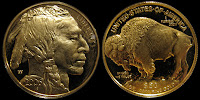 When I discussed the price and premium of the American Gold Buffalo coins released in July, I noted that the Mint was charging a premium averaging over 20-percent the price of gold for these coins. But that was on July 15, when gold was $975.10 per ounce. The gold market closed at $802.90 on September 5, a $172.20 drop in price. Yet the Mint continues to sell Gold Buffaloes at their original issue price.
Updating that table with the current price of gold, we can see the increase in premiums:
| Option |
Mint Price |
Metal Value on 7/15 |
Premium on 7/15 |
Metal Value on 9/5 |
Premium on 9/5 |
Premium Pct |
| Proof 1 oz |
$1,199.95 |
$975.10 |
$224.85 |
$802.90 |
$397.05 |
33.08% |
| Proof ½ oz |
$619.95 |
$487.55 |
$132.40 |
$401.45 |
$218.50 |
35.24% |
| Proof ¼ oz |
$329.95 |
$243.78 |
$86.18 |
$200.73 |
$129.23 |
39.17% |
| Proof 1/10 oz |
$159.95 |
$97.51 |
$62.44 |
$80.29 |
$79.66 |
49.80% |
| Proof 4-Coin Set |
$2,219.95 |
$1,803.94 |
$416.02 |
$1,485.37 |
$734.58 |
33.08% |
| Uncirculated 1 oz |
$1,059.95 |
$975.10 |
$84.85 |
$802.90 |
$257.05 |
24.25% |
| Uncirculated ½ oz |
$539.95 |
$487.55 |
$52.40 |
$401.45 |
$138.50 |
25.65% |
| Uncirculated ¼ oz |
$289.95 |
$243.78 |
$46.18 |
$200.73 |
$89.22 |
30.77% |
| Uncirculated 1/10 oz |
$129.95 |
$97.51 |
$32.44 |
$80.29 |
$49.66 |
38.21% |
| Uncirculated 4-Coin Set |
$1,959.95 |
$1,803.94 |
$156.02 |
$1,485.37 |
$474.58 |
24.21% |
About.com’s Susan Headley posted an article about the Mint’s pricing policies with a proposal to tie the price of the coin to market conditions.
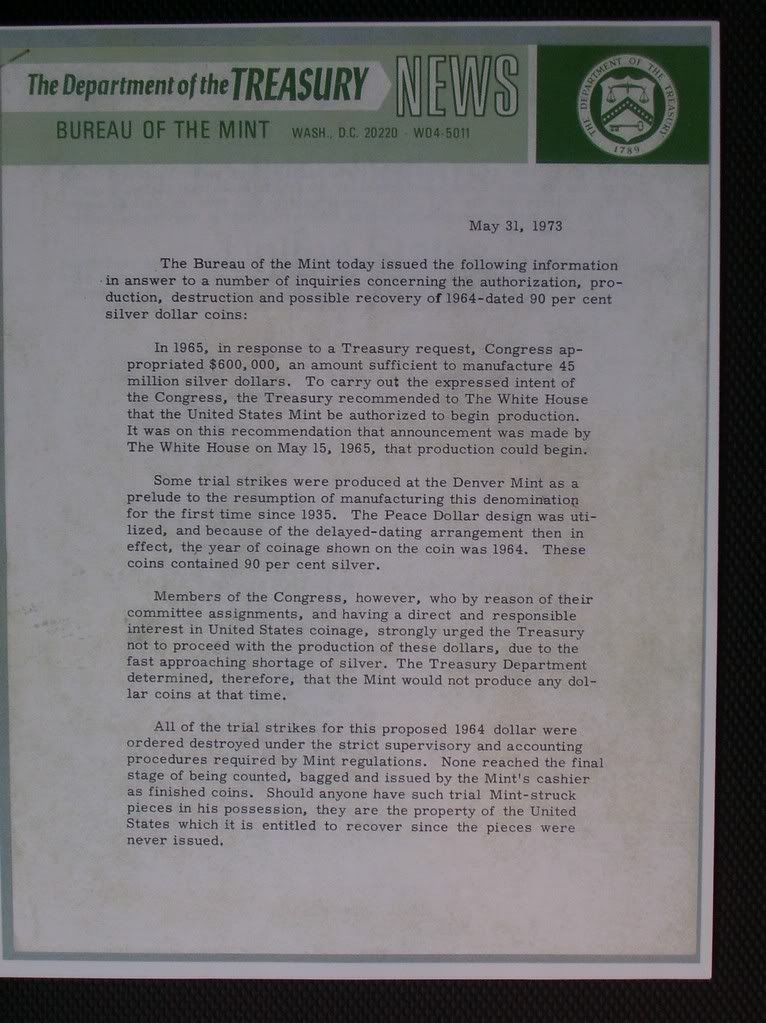 If you follow me on Twitter, you will notice that the image I use is a digitally altered image of a 1964-D Peace Dollar. Trial Peace Dollars were struck very briefly at the Denver Mint in 1965 to use to gain approval for their issuance. Because of the silver shortage in 1964, the Mint was urged to cease production and melt these coins. Collectors’ Universe forum user “savoyspecial” posted an image of a May 31, 1973 letter from the Mint explaining the fate of the 1964-D Peace Dollar. Although the letter says all coins were destroyed, I have a feeling that a few examples missed the smelting pot and not in the government’s possession.
 Let me close by offering my condolences to family, friends, and associates of Radford Sterns. Dr. Sterns was a prolific exhibitor at the American Numismatic Association conventions and former governor. His specialty was Georgia colonial currency. I met Dr. Sterns at an ANA convention and asked questions about colonial currency and aspects of Georgia history. He was very gracious and engaging. The hobby was better for his participation and will miss his contributions.
Image of US Mint letter courtesy of CU Forum user savoyspecial
Image of Radford Sterns courtesy of Numismatic News
Aug 31, 2008 | fun, state quarters, US Mint
Monday, August 25, 2008, had a lot of news for the political watchers. After Sen. Ted Kennedy appeared at the Democratic National Convention, Arizona Senator and Republican presidential candidate John McCain appeared on the Tonight Show. Even First Lady wannabe, Cindy McCain, was in the news by making a humanitarian trip to the war-torn nation of Georgia.
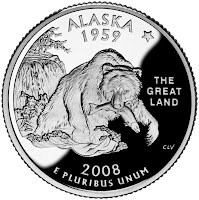 Meanwhile, quietly, without fanfare, the US Mint release the Alaska State Quarter into circulation.
Arizona was the previous State Quarter in the series.
For the previous 48 states, the US Mint has either had a first issuance ceremony on the first day of circulation. This time, the Mint waited until Friday, August 29 to issue its press release and hold its first issuance ceremony.
On Friday, August 29, John McCain announced that he selected Alaska Governor Sarah Palin as his choice for Vice President.
Conspiracy theorists could say that the Mint was made aware of the pick by the McCain campaign and asked to delay their announcement until Friday. The Mint could say that they did not want to overshadow the Democratic National Convention with the announcement of the quarter’s release while accommodating the schedule of the Alaska State Fair, even though the Fair started on August 21. What do you think?
Image courtesy of the US Mint
Aug 21, 2008 | coins, dollar, US Mint
It is not new that the various dollar coins have not been circulating as the US Mint and congress would like. It is also not new that congress refuses to eliminate the one-dollar note even though there are more incentives to eliminate the paper note. What is new is the new attempt at marketing ploy to try to convince people to use the one dollar coins.
According to Golin Harris, Campbell-Ewald, and Momentum Worldwide, the partnership that will market the dollar coin for the Mint, the campaign will highlight the “green” aspect of the dollar coin. No, not green the color, but green as in recyclable and environmental friendly.
According to Ellen Ryan Mardiks, GolinHarris chief client officer:
With the $1 Presidential Coin, every man, woman and child will make a personal statement about the money they spend. The coin is 100 percent recyclable and lasts for decades, offering consumers—and Mother Earth—tangible benefits that are especially relevant today. In addition, the U.S. Government Accountability Office (GAO) estimates that increased usage of the coin can save our country as much as $5 billion over the next ten years. The time is right for consumers to embrace the $1 coin, and we intend to show them these benefits through a creative and dynamic integrated marketing campaign.
For some reason when I read this, I thought about the movie Thank You for Smoking. What do you think?
Aug 18, 2008 | Eagles, silver, US Mint
This morning, I was checking the prices of the various commodities market and noticed that metal prices rose a little in foreign markets. Gold is hovering just below $800 per ounce and silver is under $13. Both are significantly lower than their recent six-month highs. It made me curious as to whether the US Mint is still selling gold and silver at a significant premium.
As I looked through their online catalog, I noticed that Proof American Silver Eagles are no longer for sale!
Legally, there are no limits on the number of proof American Silver Eagles that may be sold. But the Mint has placed limits on the sale of these coins. In 2003, there was a published limit of 750,000 coins. However, since 2005, the Mint does not report there being any limit on the sales of American Silver Eagle proof coins.
Last week, the Mint halted gold bullion sales to dealers. A move that has been speculated to be tied to the downward trend in the price of gold. But American Eagle gold collectible coins remain for sale at their previous prices.
Are the American Silver Eagle proofs sold out or is there a production issue that the Mint has yet to announce? Inquiries to the Mint have not been unanswer at this time. Stay tuned.
Aug 15, 2008 | Eagles, gold, silver, US Mint
Several sources are reporting that the US Mint has suspended sales of American Gold Eagle bullion coins to dealers. There has been no announcement but the Mint has refused to take orders.
American Eagle Gold Proof and collector uncirculated coins are still for sale at the Mint’s online catalog. All coins appear to be available with no backorder messages.
Gold has fallen below $800 during today’s trading. In this week’s trading, gold dropped 8.4-percent for the week. Silver also fell 16.4-percent. The fall is attributed to the strengthening of the US dollar.
Since gold reached $1,004.30 on March 17, the price has dropped more than 20-percent over the five months.
Silver has not been immune to the a change in value. From the high of $21.24 and a close of $20.64 on March 17, the current price of silver is $12.75, a 38-percent drop in value.
Currently, the US Mint has not indicated that they would revalue collectibles in the light of the market downturn. One reason could be that the Mint bought the metals at the higher prices and need to recoup their investment in these metals as part of their real cost of doing business. However, if the price of metals drop and sales of Eagles decline, then the Mint will have to adjust its prices.
Last year, we speculated about what it would take for the Mint to raise prices. What will it take for the Mint to lower prices?
Jul 22, 2008 | BEP, coins, currency, dollar, policy, US Mint
Since the introduction of the Presidential $1 Coin, many numismatic venues have discussed how to make the program more successful. Reports are being made that Gallup has been calling people asking questions that lead to the impression they are researching the circulation of dollar coins.
When asked about how to increase the circulation of the dollar coin, the dominant suggestion has been to remove the one dollar federal reserve note from circulation. It is thought that the move would force people to use the coin when the paper currency is no longer available.
There are many emotional arguments on both sides of the issue. Whether one is for or against the printing of the one-dollar note, the US may be the only nation to print its unit currency in paper. Looking beyond the emotional arguments, each side has dominant arguments to support their positions.
Those who want to eliminate the one-dollar note use at the cost of is production as the dominant reason. The Bureau of Engraving and Printing reports that 95-percent of all notes printed are used to replace notes that are taken out of circulation. Using BEP’s 2007 production numbers, 4,147,200,000 one-dollar notes were printed. With 95-percent being replacement notes, 3,939,840,000 notes were printed just to maintain circulation levels. With it costing 4½ cents to produce one note of any denomination, the cost to just replace notes removed from circulation was $177,292,800 in 2007.
Rather than printing paper dollars, if the US Mint strikes coins the cost to replace those 3.9 billion notes would cost 15.9-cents (according to the Mint’s 2007 Annual Report [PDF]) per coin. The total production cost would be $626,434,560.
But do not let the 353-percent increase fool you. The BEP predicts the life of a one-dollar paper note is three years while the US Mint predicts the life of any coin is 30 years. To help with the calculation, let’s assume the price of printing notes will stay constant. In order to keep the $3.9 billion of one dollar notes in circulation for 30 years, it will cost the BEP $1.77 billion dollars. Since the Mint will be striking new coins for circulation and (theoretically) not replacement coins, the US government would save about $1.15 billion over 30 years. The following table illustrates these costs:
| Denomination |
Production Total |
Number of Replacement Notes |
Cost of Production for Replacements |
Cost of Replacements over 30 years |
| Paper Dollar |
4,147,200,000 |
3,939,840,000 |
$177,292,800 |
$1,772,928,000 |
| Coin Dollar |
N/A |
3,939,840,000 |
$626,434,560 |
$626,434,560 |
While this might be a compelling argument to stop printing one dollar notes, such a move has political ramifications for some powerful members of congress. With over 1500 people working in the Eastern Currency Facility in downtown Washington, DC, they are represented by several leaders of both parties. Amongst the protectors of the employees in the facility include House Majority Leader Stenny Hoyer (D-MD), House Campaign Finance Leader Christopher VanHollen (D-MD), Former Chairman of the Government Reform Subcommittee Tom Davis (R-VA), Del. Eleanore Holmes Norton (D-DC), and the well respected Senator John Warner (R-VA). These powerful members of congress will not allow anything that will reduce the production capacity of the Bureau of Engraving and Printing and where constituents could lose jobs.
This does not take into consideration that the President of the United States is from Texas, location of the Western Currency Facility.
Before congress changes the law to stop the printing of the one-dollar note (31 U.S.C. §5115(a)(2)), the BEP will have to supplement production in order to protect jobs. The way this could be done would be to print foreign currency. However, it seems that the BEP is having problems selling their services to foreign governments.
While there are no official statements from the US or foreign governments, the dominant request is for the printing of polymer notes. According to unconfirmed reports, BEP is experimenting with different types of polymer substrate without notable success. If the BEP can adjust their equipment to print on polymer paper, they can solicit business from other countries to produce their currency. Once the BEP builds its portfolio, they are prepared to go to congress to recommend discontinuing production of the one-dollar note. Until then, the BEP will continue to produce one-dollar notes in order to keep workers employed in key congressional districts.
If BEP starts to use polymer notes, it would raise the eyre of Senator Edward M. (Ted) Kennedy, the powerful senior Democrat from Massachusetts. Amongst Sen. Kennedy’s constituents are the employees of Crane & Company from Dalton, Massachusetts. Crane & Comapny has been the exclusive supplier of currency paper to BEP since 1879. Although BEP tried to open the competition for purchasing currency paper used in printing currency (see GAO Report GAO-05-368 [PDF]), the cost of entry into the market has prevented other manufacturers from competing for the business. If BEP would stop printing over 4 million one dollar notes without replacing it with similar paper production, the Massachusetts-based company could lose significant business.
Regardless of the measures taken by the US Mint to increase the circulation of the one-dollar coin, public perception is that the one-dollar paper note is easier to use than the coin. Unless key congressional leaders agree that ending the printing of the one-dollar note is in the best interests of everyone, including their political careers, the political reality is that printing of the one-dollar note is here to stay until a significant event causes a change in policy.
Jul 16, 2008 | gold, US Mint
While I was in surgery, the US Mint announced that they will be accepting orders for the new American Buffalo 24-karat Gold Coins starting on July 22, 2008. In addition to the one ounce coin that has been issued since 2006, the Mint will add half ounce ($25), quarter ounce ($10), and one-tenth ounce ($5) fractional issues. They will also sell a four-coin sets that contain one coin in each size.
I was curious as to what premium the Mint was putting on these coins. Using the spot price of $975.10 (as of market close, 4:00 PM on July 15), I took the Mint’s announced price of these coins to create the following table:
| Option |
Price |
Metal Value |
Premium |
Premium Pct |
| Proof One Ounce |
$1,199.95 |
$975.10 |
$224.85 |
23.06% |
| Proof Half Ounce |
$619.95 |
$487.55 |
$132.40 |
27.16% |
| Proof Quarter Ounce |
$329.95 |
$243.78 |
$86.18 |
35.35% |
| Proof Tenth-Ounce |
$159.95 |
$97.51 |
$62.44 |
64.03% |
| Proof Four-Coin Set |
$2,219.95 |
$1,803.94 |
$416.02 |
23.06% |
| Uncirculated One Ounce |
$1,059.95 |
$975.10 |
$84.85 |
8.70% |
| Uncirculated Half-Ounce |
$539.95 |
$487.55 |
$52.40 |
10.75% |
| Uncirculated Quarter-Ounce |
$289.95 |
$243.78 |
$46.18 |
18.94% |
| Uncirculated Tenth-Ounce |
$129.95 |
$97.51 |
$32.44 |
33.27% |
| Uncirculated Four-Coin Set |
$1,959.95 |
$1,803.94 |
$156.02 |
8.65% |
If you are into buying gold coins for investment purposes, it looks like the uncirculated one-ounce and multi-coin sets are the best bargains. Since I am not an investor, I will be purchasing the proof one-ounce coin to go with my 2006 and 2007 coins.



 Loading ...