Nov 20, 2008 | commemorative, US Mint
Seven score and five years ago, Abraham Lincoln brought forth a message, conceived in war, read in peace, and remembered more fondly than the initial reaction.
The country was engaged in a great civil war that tested the foundation of the 87 year old nation. They stood on the bloodiest battlefield of that war. He read that speech dedicating the final resting place of citizens and brothers who fought for principle and died for a cause. Lincoln said that “it is altogether fitting and proper that we should do this.”
 In a larger sense, Lincoln did not understand the impact of his address on the battlefield in Gettysburg, Pennsylvania. He paid tribute to those who lived and survived from that battle. But Lincoln said, “The world will little note, nor long remember what we say here, but it can never forget what they did here. It is for us the living, rather, to be dedicated here to the unfinished work which they who fought here have thus far so nobly advanced.” The world notes and remembers what happened as we celebrate our freedom.
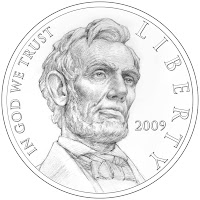
On November 19, during the annual Dedication Day Ceremony at Soldiers’ National Cemetery in Gettysburg, Pennsylvania, the US Mint attended to unveil the design for the 2009 Abraham Lincoln Commemorative Silver Dollar Coin.
The obverse of the coin was created by United States Mint Artistic Infusion Program Master Designer Justin Kunz and sculpted by Sculptor-Engraver Don Everhart. The image was inspired by Daniel Chester French’s famous sculpture of the President that sits inside the Lincoln Memorial in Washington, DC.
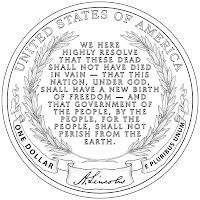 The reverse was designed and sculpted by Sculptor-Engraver Phebe Hemphill. The design features the an inscription of the last 43 words of the Gettysburg Address:
WE HERE HIGHLY RESOLVE THAT THESE DEAD SHALL NOT HAVE DIED IN VAIN–THAT THIS NATION, UNDER GOD, SHALL HAVE A NEW BIRTH OF FREEDOM–AND THAT GOVERNMENT OF THE PEOPLE, BY THE PEOPLE, FOR THE PEOPLE, SHALL NOT PERISH FROM THE EARTH.
These words are encircled by a laurel wreath with Lincoln’s signature incuse into a banner at the bottom of the design.
The US Mint is authorized to strike 500,000 coins at the Philadelphia Mint. Proceeds from the sale of the coins will be paid to the Abraham Lincoln Bicentennial Commission.
I like the design. If it is executed as good as these line drawings, it will be a fantastic coin!
Images courtesy of the US Mint.
Nov 14, 2008 | gold, US Mint
Somewhere along the line, I stopped paying attention to the price of gold from the US Mint. Their prices have been very out of line from the market and represented a significant premium over spot. It was not worth buying these coins.
With the US Mint Clearance Sale coming tomorrow, I decided to see if there have been any price adjustments. I found that the Mint has already lowered the price for the one-ounce American Gold Buffalo Proof coin by $150. Prices for other Gold Buffalo coins have been reduced as well.
According to Mint News Blog, most precious metal products were taken off sale on Wednesday only to reappear on Thursday with their prices lowered.
Gold was $802.90 per ounce on September 7, 2008. The spot price of gold is $764.30 as I type this. When the 2008 American Buffalo proof coins were introduced in July, the spot price of gold was $975 per ounce.
Remember, the Mint’s clearance sale starts at 12:01 AM on Saturday. You can pick up some nice holiday gifts!
Nov 12, 2008 | dollar, history, US Mint
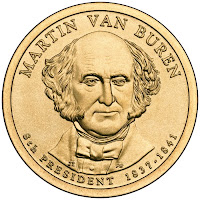 On November 13, the US Mint will release the Martin Van Buren Dollar to honor our eighth president. Van Buren was one of the founders of the modern day Democratic Party. He succeeded Andrew Jackson after serving as Jackson’s vice president.
Van Buren’s presidency was not considered a success after the Panic of 1837 that was caused by Jackson’s refusing to renew the charter of the Second Bank of the United States and withdrew federal funds from then bank. The result was a credit crisis when banks could not access funds and purchase securities to back their deposits.
Van Buren spent the rest of his presidency trying to fix the economy while trying to stay true to Jacksonian Democratic policies, which was not well received. Van Buren refused to expand the treasury, renew the charter for the Bank of the United States. And with slavery being an issue, Van Buren blocked statehood for Texas to prevent the expansion of slave owning states.
Van Buren served one term when he was defeated by the Whig Party candidate William Henry Harrison in 1840.
Image courtesy of the US Mint.
Nov 10, 2008 | state quarters, US Mint
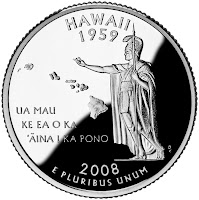 The final coin of the 50 State Quarters® program will be unveiled during a ceremony Honolulu, Hawaii. Hawaii’s coin features the image of King Kamehameha with his outstretched arm over the united islands of Hawaii with the state motto Ua Mau ke Ea o ka ’Āina i ka Pono (The Life of the Land is Perpetuated in Righteousness).
Kamehameha rose to power in the late 18th century deposing rulers in his way. By 1790, Kamehameha was King of what we know today as the big island of Hawaii. Using arms bought from British and American traders, Kamehameha launched attacks on neighboring islands. After many battles and enduring illness, Kamehameha united the islands in 1810.
In 1893, as Queen Liliuokalani ascended to the throne on the death of her brother, King Kalakaua, she received petitions calling for reforms. Rather, Liliuokalani tried to strengthen her power which made many American and European businessmen nervous. A coup d’état was arranged leaving Queen Liliuokalani imprisoned at Iolani Palace under house arrest.
For the next few years, Hawaii was an independent republic managed by various business interests, including the United States. A counter rebellion was attempted by loyalists to Queen Liliuokalani but was suppressed. However, official policy under President Grover Cleveland was not to support the new government until the government was returned to Liliuokalani. This policy changed when William McKinley succeeded Cleveland. Two years into his administration McKinley singed the Newlands Resolution in 1900 annexing Hawaii a territory of the United States.
On August 21, 1959, Hawaii became the 50th state of the United States.
Image courtesy of the US Mint.
Nov 4, 2008 | BEP, coins, legislative, US Mint
Citizens of the United States wake up this morning to what some has called the most exciting and exhausting election season since Dewy did not beat Truman. It also has to be the longest campaign after having started the day after the 2006 midterm election by our over-active press.
Numismatically, there should be few changes if any. Although there is a lot of passion for the presidential candidates, the only influence the president may have is the appointment of the directors of the US Mint and the Bureau of Engraving and Printing. Otherwise, congress must past the laws to command the US Mint to do its job. The president can veto any law, but is rarely done with numismatic bills.
Although most of the action is in congress, there is not much to watch from a numismatic perspective. Polls show that the Democrats will maintain control of Congress and possibly increase their lead. It is likely that the leadership will probably remain in place for the 111th Congress including Barney Frank (D-MA), Chairman of the House Financial Services Committee, the committee responsible for numismatic laws.
Analysts suggest that Frank will win his 15th election and return to the House as chairman of the House Financial Services Committee. Numismatically, this means that the run the committee adopted that any commemorative coin bill must have 250 co-sponsors before it would be considered.
In other races, Virgil Goode (R-VA) is in a very tight race. Goode was eventually credited with inserting a measure in an omnibus budget act to move the motto “IN G-D WE TRUST” from the edge to the front of both dollar coins.
For those hoping that the new congress will eliminate the paper dollar, the 111th congress may not be your answer. With the exception of the retiring Rep. Tom Davis (R-VA), most of the Washington, DC area representatives in Maryland and Virginia will be returning to their seats the House meaning that there will continue to be local political incentives force the BEP to continue with printing $1 Federal Reserve Note.
Since this election does not matter numismatically, you may want to consider such “minor” issues such as the economy, healthcare, or international policy. But whomever you chose, VOTE!
Vote Early and Often!
Oct 15, 2008 | policy, US Mint
A weeks ago, an article appeared on the numismaster.com site, and subsequently in the October 6, 2008 edition of Numismatic News. The article, Get Government Out of Coin Manufacture said:
Coin dealers and collectors are still reeling from the U.S. Mint’s announcement that it had run out of American Eagle gold coins. But what ought to surprise every American isn’t that a government agency came up short. It’s that the U.S. government should be making little metal discs at all.
Today, a counterpoint was posted. In Hamilton was Right in Creating U.S. Mint, the author concludes:
The U.S. Mint is the world’s largest manufacturer of coinage. They are subject to market conditions that have to be managed, as would any manufacturer. Maybe the manufacturer’s board of directors (Congress) and it shareholders (the taxpayers) should question how the managers are doing their jobs. Making them accountable will fix more issues than ignoring 216 years of history.
I may be biased, but the author of the second article has it right. We should hold the management of the US Mint responsible for the problems they have experienced. If you have a difference of opinion from either of the authors, feel free to leave a comment here.
Oct 8, 2008 | gold, platinum, RCM, silver, US Mint
Showing that the management of the US Mint does not understand how to manage a specialized manufacturing facility, it was reported that the Mint is not going to try to maintain the supply to meet the demand for precious metals. In a letter to authorized dealers, the Mint blames the fluctuating market and high demand for this decision.
For the rest of the year, the Mint will continue to strike gold and platinum coins until supplies of blanks are depleted. The supply of 24-karat Gold Buffaloes have been depleted. Silver and one-ounce gold American Eagles will continue to be available as they can be struck.
Those wanting to purchase gold may want to consider previous years or Canada Gold Maple Leafs. It is being reported that the Royal Canadian Mint continues to strike gold but has been having problems keeping up with the demand. Alex Reeves, a spokesperson with the Royal Canadian Mint, said, “[Distributors] would like more gold than we can produce but we’re supplying the best we can. Look at that as good news. We’re able to keep producing gold while the U.S. Mint has to throw up their hands and say, ‘we’re out.’ ”
Fasten your seat belts, it’s going to be a bumpy ride!
Sep 28, 2008 | Federal Reserve, pocket change, policy, US Mint
During the year, there have been a few articles written speculating why the number of circulating coins have decreased. On article said that the “bank hates your coins” and looks to deter you from cashing them in. Another article presented the case for credit cards and other means of electronic transactions that is cutting into coin production.
Both articles present a case for the lower demand for coins as being the reason for these acts. While the demand for coins may be down and the Mint’s production is also down, both articles do not take into consideration the inventory and movement of coin inventory by the Federal Reserve.
How the Federal Reserve manages inventory has been the subject of investigation by the Government Accountability Office (GAO). In the report published in March 2008, the GAO found that while the various Federal Reserve branches have been able to meet the demand for coins to enter commerce, the GAO questions whether the Federal Reserve properly manages its inventory.
One suggestion that the GAO acknowledges that the decline in coin production may be a result of the mismanagement of inventory by the Federal Reserve when they wrote that the “data from one major coin recycling company, the value of coins returned to circulation through recycling grew from approximately $1 billion in 2000 to $2.6 billion in 2006.” With more coins in circulation, the need for new coins to meet demand may be lowered.
Further, as part of inventory management, it was acknowledge that the Federal Reserve banks “look for opportunities to transfer coins within their district to meet projected demand. For example, one Reserve Bank office may want additional coins, while another office may have more coins than it wants to hold to meet short-term demand. The Reserve Bank office works with the coin terminal operators to move the coins as needed.” This will reduce the need to order new coins from the US Mint.
The reports finds that the Federal Reserve does not grasp the concept of an optimal inventory with some coin terminals having lower supply than others. Even with inventory goals, the Federal Reserve does not properly manage to those goals leaving inventories in a state of flux. The report even suggests that the spike in coin production in 2001 was not a result of better economic times, but a mismanagement in ordering for circulated coins and overstating the demand for the 50 State Quarter program. This was alluded to in industry publications.
There have been anecdotal reports saying that bright early date 50 State Quarters are being found in circulation. This could be from people who bought rolls and put them back into circulation with the down economy and the Federal Reserve clearing out the back of the coin storage rooms. Additionally, companies like Coinstar has announced higher earnings based on increased usage of their machines, which places more coins back into circulation.
And none of this considers the effect on the production of currency.
With more money in circulation and the mismanagement of inventory by the Federal Reserve, concluding that the reduction in production by the US Mint because of the increased use of credit cards is questionable. It may be one factor, but not the single reason.
Sep 25, 2008 | coins, gold, US Mint
The US Mint sent a letter to authorized dealer announcing sales of the American Buffalo Gold Coins have been suspended.
“Demand has exceeded supply for American Buffalo 24-karat gold one-ounce bullion coins, and our inventories have been depleted. We are, therefore, temporarily suspending sales of these coins,” the Mint said in a memorandum to authorized American Buffalo dealers.
The Mint had resumed sales of American Eagle Gold Coins and said that they had a sufficient supply for dealers.
This announcement does not include collectible coins, which can be purchased via the US Mint’s online catalog.
Sep 23, 2008 | cents, coin design, US Mint
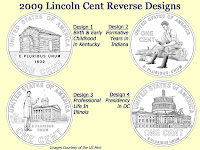 The US Mint held a ceremony at the Lincoln Memorial Reflecting Pool to unveil the four new reverse designs for the 2009 Lincoln Cent.
The four reverse designs were part of the Presidential $1 Coin Act of 2005 (Public Law 109-145 [GPO: TEXT, PDF]) to celebrate the Abraham Lincoln Bicentennial. The law calls for four reverse designs to honor Lincoln’s birth and early childhood in Kentucky, his formative years in Indiana, his professional life in Illinois, and his presidency in Washington, DC.
The obverse of the coin will continue to have the portrait of Abraham Lincoln that was designed by Victor David Brenner and first released in 1909.
New coin designs will be release quarterly with the Early Childhood reverse being released on February 12, 2009.
These new coins will circulate with the District of Columbia and United States Territorial Quarters. Additionally, do not forget the 2009 scheduled Presidential $1 Coins honoring William Henry Harrison (our 9th president), John Tyler (10th), James K. Polk (11th), and Zachary Taylor (12th).
Click image to enlarge.

 In a larger sense, Lincoln did not understand the impact of his address on the battlefield in Gettysburg, Pennsylvania. He paid tribute to those who lived and survived from that battle. But Lincoln said, “The world will little note, nor long remember what we say here, but it can never forget what they did here. It is for us the living, rather, to be dedicated here to the unfinished work which they who fought here have thus far so nobly advanced.” The world notes and remembers what happened as we celebrate our freedom.
 The reverse was designed and sculpted by Sculptor-Engraver Phebe Hemphill. The design features the an inscription of the last 43 words of the Gettysburg Address:


 Loading ...