
Weekly World Numismatic News for October 4, 2020
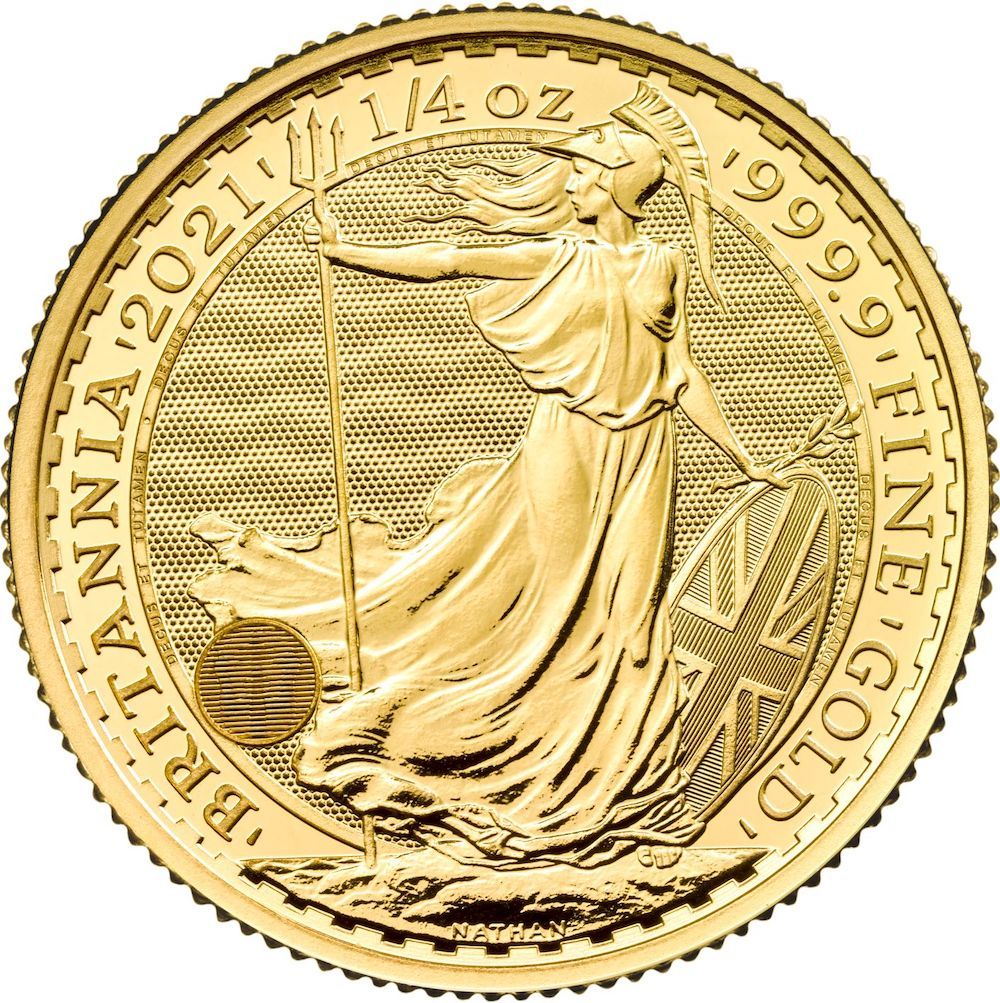
The Royal Mint adds new security features for the 2021 Britannia
As much as I have written, tried to manipulate the search engine optimization (SEO) to get the word out, and dropped messages on social media, people continue to purchase counterfeit coins from China.
You cannot even trust the slabs sent by Chinese companies. A dealer who saw my post about purchasing coins that I suspected were counterfeit saw the picture of the slabs that were shipped. On closer examination, the slabs are the same as they use to counterfeit NGC slabs.
Last week PCGS announced they are adding a tag to their slabs that can help identify them electronically. The technology is called Near Field Communications (NFC). The technology creates contactless communications between a passive and an active device. In this case, the tag in the slab or currency holder is passive. There is no power in the passive tag but will respond to a special signal to transmit its data.
The active device sends the signal that causes the passive tag to respond. In this case, your smartphone can send the signal to and process what the passive tag sends. It is called Near Field Communications because the passive tag does not generate a strong signal, and the active device has to be close enough to hear what the tag has to say.
Using NFC is an interesting idea and, if implemented correctly, can add to the security of a slab. In the future, I will contact PCGS to discuss the security of the system they developed. Maybe I will dust off my old hacker’s hat and reverse engineer one of these tags. Very few electronic devices are unhackable. The idea is to make it as difficult as possible.
In the future, the technology that will help collectors protect themselves must be made publicly available. The current state of image processing and artificial intelligence can be used to examine a coin’s surface. Aside from its ability to grade the coin, it could tell the difference between a legitimate coin and a counterfeit that uses an aluminum alloy.
In addition to adding technology, the U.S. Mint should follow the leads of the Royal Canadian Mint and the Royal Mint to add security features to bullion coins. After all, David Ryder spoke about security during his confirmation hearing. Where is the progress on that?
And now the news…
 September 28, 2020
 → Read more at brusselstimes.com
September 28, 2020 → Read more at thepeninsulaqatar.com
September 29, 2020 → Read more at belfasttelegraph.co.uk
October 1, 2020 → Read more at edp24.co.uk
October 2, 2020 → Read more at thecostaricanews.com
→ Read more at brusselstimes.com
September 28, 2020 → Read more at thepeninsulaqatar.com
September 29, 2020 → Read more at belfasttelegraph.co.uk
October 1, 2020 → Read more at edp24.co.uk
October 2, 2020 → Read more at thecostaricanews.com

EXCLUSIVE BREAKING NEWS: Fed to eliminate Dollar Bill
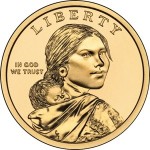
Obverse of the 2009-present Native American Dollar
“We have so many dollar coins, it makes sense to find a way to get them into circulation,” Bernanke said. “It will also help reduce the storage requirements to hold these coins.”
Bernanke, who has been both complemented and reviled over the Fed’s handling of the Great Recession, said that now that the economy was more solid, he would turn his attention to doing what he can for the federal government. Citing the GAO report that estimated the federal government could save at least $4.4 billion by using coins rather than money, Bernanke will use his power as Chairman of the Fed to determine the independent bank’s policy over circulating money.
“Not only will this keep our facilities busy but it will help the U.S. Mint maintain and increase its profitability,” said Richard A. Pederson, Acting Director of the U.S. Mint. “The reduction of dollar coins previous ordered by [then Treasury Secretary Tim] Geithner really hurt our bottom line. It significantly lowered our seigniorage and the size of our deposit into our Public Enterprise Fun.”
Pederson assured Bernanke that the U.S. Mint will be able to meet the new demand for circulating dollar coins.
Director of the Bureau of Engraving and Printing Larry Felinks said that this change will help increase productivity in other areas of their operation. “Printing of the one dollar note is over 50-percent of our production. This reduction will allow us to concentrate on other projects including trying to figure out why we have not been able to produce $100 notes.”
“Obviously, we are not happy about this,” said Violet “Blue” Crane, family spokesperson for the Sandhill Crane Company who manufactures the paper for the Bureau of Engraving and Printing. “Manufacturing paper for the one dollar bill was half of our business and gave us the most profit since that paper did not have to include anti-counterfeiting features.”
The U.S. Secret Service declined to comment for this story and any other story they were asked about.
Bernanke, sitting in his office obviously pleased with his new policy, also understood the impact of his decision on the numismatic industry. Leaning back in his chair, Bernanke closed with, “Collectors of United States coins will remember April 1, 2013 as the day I gave their dollar coin collection more meaning.”
Native American Dollar image courtesy of the U.S. Mint.
Summary of March 2013 Coin-Related Legislation
H.R. 1071: To specify the size of the precious-metal blanks that will be used in the production of the National Baseball Hall of Fame commemorative coins.
Sponsor: Richard Hanna (R-NY)
• Introduced: March 12, 2013
• Referred to the House Financial Services Committee on March 12, 2013
Track this bill at http://www.govtrack.us/congress/bills/113/hr1071
H.R. 1218: Commemorative Coins Reform Act of 2013
Sponsor: Rep. Justin Amash (R-MI)
• To prohibit the payment of surcharges for commemorative coin programs to private organizations or entities
• Introduced: March 15, 2013
• Referred to the House Financial Services Committee on March 15, 2013
Track this bill at http://www.govtrack.us/congress/bills/113/hr1218
ANA Elections Are Almost Set
 The American Numismatic Association has posted the list of candidates for the 2013 Board of Governor elections. Although the nomination process officially concludes on March 31, all of the qualified nominated candidates have accepted their nomination. The 2013 candidates are as follows:
After the official close of the nomination period, the ANA will post the candidates biographies and statement on the website. They will also be printed in The Numismatist.
A candidates forum will be held on May 11, noon through 2:00 PM at the National Money Show in New Orleans. ANA members attending the show should make time to attend and make sure the candidates hear your concerns about the organization. If you are not sure whether you want to go to the National Money Show, I would recommend that you go. Aside from going to an ANA show, which is a great experience in and of itself, it is in New Orleans. New Orleans is a fun town with great sites and excellent food! I am still looking forward to a nice café au lait at Café Du Monde in the French Market!
Elections will be held during the month of June with ballots due by July 1. If you would like to vote electronically, you can go here to register for online voting.
The ANA will announce election results at least 10 days prior to the World’s Fair of Money that will be held in Chicago, August 13-17, 2013. The new Board of Governors will be installed on August 16, 2013 at the show.
Your support for me and the ANA are greatly appreciated!
Whitman Show in Baltimore is always fun
When I returned to the hobby, the first show I attended was the Baltimore Coin Show. Back then, it was privately run by an area dealer who grew the show to something that required a facility the size of the Baltimore Convention Center to hold for a twice per year show. I remember walking into the hall at the time and being overwhelmed with the rows of tables and starting my adventure. Even when the show occupied only Halls A and B was really a sight to see.
Then Whitman bought the show and propelled it to levels greater than its previous owner, which did not seem possible. Not only has Whitman done a great job, but they expanded the show to three times per year and expanded the number of dealers to include Hall C. Hall C also includes Whitman’s own booth along with providing space for a Kids Corner, exhibits, services, and some numismatic organizations. In many ways the size and scope exceeds last summer’s World’s Fair of Money in Philadelphia.
New Campaign Button
Since the MSNA president could not get away from work, I presided as the organization’s vice president. I kept the meeting under 45 minutes while still getting a few things done. We set a new meeting, adjourned, then went to the elevator for the two floor descent to the main level and the bourse.
I did not buy much at this show since I did not take my usual inventory before going. I did look for New York-related tokens and medals and for Maryland colonial currency. But I did not find anything that intrigued me.
Later in the day, I did go by the table of Butternut Coins and COL Steve Ellsworth. This is not the first time I have spoken the Steve but every time I do I find him a very intriguing and engaging person. Ellsworth is a specialist in Early American Copper Coin along and the Civil War. It was his expertise in Early American Coppers that I was interested in.
As I was looking through his cases, I told Steve about my One Page Collection idea where I would fill a single 20 coin pocket page with nice coins for around $50-100. Since I posted it, I wanted to put the collection together and plan to talk about it at the upcoming National Money Show in New Orleans. He gave me suggestions as to what to look for based on my price and condition guidelines and found two coins that will be added to the collection.
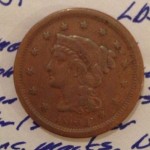
1851 Braided Hair Large Cent obverse
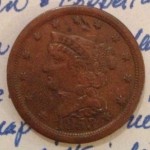
1853 Braided Hair Half Cent Obverse
Both coins were well within budget and will be included in my one page collection. I appreciate the help that Steve provided in my search.
I have to start working on the 2, 3, and 5 cent coins one-pager.
Now that I decided to present these ideas at a Money Talks program in New Orleans, you will have to come to the show to hear about different ideas I have.
In the mean time, if you are in, near, or can get to Baltimore on June 20-23, it is a good way to spend a day or even the weekend. And let me know, we can sit down for coffee at the stand on the third level.
An almanac that isn’t
Merriam-Webster’s online dictionary defines almanac as “a usually annual publication containing statistical, tabular, and general information.” Almanacs have been around for a while in various forms from the earliest times of writing to today. Early almanacs were simply calendars of coming events and records of past events. They included holidays, phases of the moon, and significant dates that related to the weather for the farming community.
Although there have been many almanacs that bridged into the modern era, none had been as famous as Poor Richard’s Almanack written by Benjamin Franklin writing under the pseudonym Richard Saunders. Franklin published Poor Richard’s Alamanck from 1733-1758. Amongst the surviving almanacs include The Old Farmer’s Almanac that has been published continuously since 1792, the Farmer’s Almanac that has been published continuously since 1818, and The World Almanac and Book of Facts published since 1868. These are the almanacs that all others are judged against.
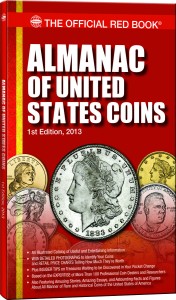 Having grown up with The World Almanac, reading the Central Intelligence Agency’s The World Fact Book, and being a begrudging fan of the Coin World Almanac, I was interested when Whitman Publishing sent out a notice that they just released the First Edition of the Almanac of United States Coins.
Although I read the description, I did not read it carefully because when I opened the package sent to me by Whitman, I found a skinny trade paperback-sized book. I reread the Whitman press release and it said the book was 192 pages. Initially, I felt disappointed in my hopes that there would be a competitor on the market to the Coin World Almanac since competition makes everyone better. So I can get over my initial reaction, I put the book down for a while to overcome my initial reaction to give the book a fair review.
After two weeks, I find I cannot hide my disappointment especially when I place the book next to the Coin World Almanac. Now in its eighth edition, the Coin World Almanac is 688 pages of numismatic reference that is a worthy comparison to any almanac in any industry. The problem with the Coin World Almanac is that it is updated every ten years. Having purchased the last two, the seventh edition seemed stale by 2004. I suspect the eighth edition will begin to feel stale by the end of this year if not by mid-2014. Maybe Coin World should consider shortening their update cycle.
Coin World does not have to worry about competition from Whitman. For as much as Whitman has invested in creating content across their “Official Red Book Series” from the many great authors, their Almanac of United States Coins is so lacking in content that it is many years away from being able to compete.
The only complement I can offer Whitman for this book is that many of the coin images are superb. I do like the images showing the relative grading of the individual series but wish it was expanded to include a few more grades. One example that would help collectors is that the difference between a VF-20 and MS-65 Walking Liberty half dollar is so vast, that having at least two intermediate grades (e.g., EF-40 and AU-50) would be helpful.
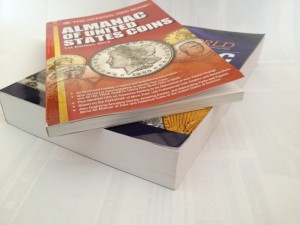
Whitman’s Almanac v. Coin World’s Almanac: In this case, size matters!
Whitman is going to have to learn that every numismatic reference book does not have to be a price guide. If they want to include type set-like guides, then do not make it look like a major component of the book. Otherwise, I would recommend people read A Guide Book of United States Type Coins instead. Thus the first improvement I would make is either eliminate the price guide information or find a way to minimize it as a central focus of each section. After all, an almanac is supposed to be about the content and the fact. Price guides are opinions that change with market forces that changes from the end of the editorial cycle until the book is published.
I know Whitman wants to sell books and has to find a way to make this book unique over their other offerings so they do not cannibalize sales, but they have to consider that they may never sell some of these books to certain people anyway. And if Whitman drops the pricing information, that still leaves their other books as an option for the reader. After all, Whitman can include a line at the end of each coin’s section that if they want in-depth information, the read can “consult” Whitman’s other book on the coin.
It is interesting how Whitman included a list of the authors for all of their books as credits but did not print the name of the editor of this book. However, Whitman’s press release named publisher Dennis Tucker as the editor.
Now that Whitman has disappointed me, they need to look at the content they have already invested in with their current books. They can start by taking whatever information is in the Red Book (A Guide Book of United States Coins), the Red Book Professional Edition, and the Blue Book (Handbook of United States Coins) and bring the content together to improve the current almanac. Just doing this would greatly improve this book. Then, it is a matter of an editor either convincing Whitman’s other authors to build on the chapters or distill the information in their other books to something suitable for an almanac.
I really wanted to like this book to the point that I put it aside in order to see if I could get over my first impression. Instead, I started to read another Whitman book that deserves the good review I will write in the near future. But I could not get over the disappointment. The text has no depth, facts that should be in an almanac are missing, and it seems like a glorified coin type price guide. Maybe they should market this as something for the very beginner, even for someone under the age of 12. Therefore I give this book a grade of F-12. The only factor that prevents this book from grading lower are the images. It is not a book I can recommend.
DISCLOSURE: Whitman Publishing provided the copy of the book I reviewed. I will not add this book to the library. It will be donated to my coin club’s annual charity auction in December with the proceeds going to the local Boys and Girls Club.
Cover image courtesy of Whitman Publishing.
Support the Coin Collectors Blog
 Buy me a coffee
Thank you for your support!
Let Me Know What You Think
Are you going to the World's Fair of Money
Total Voters: 17
 Loading ...