
The Failures of the U.S. Mint’s Website Continues
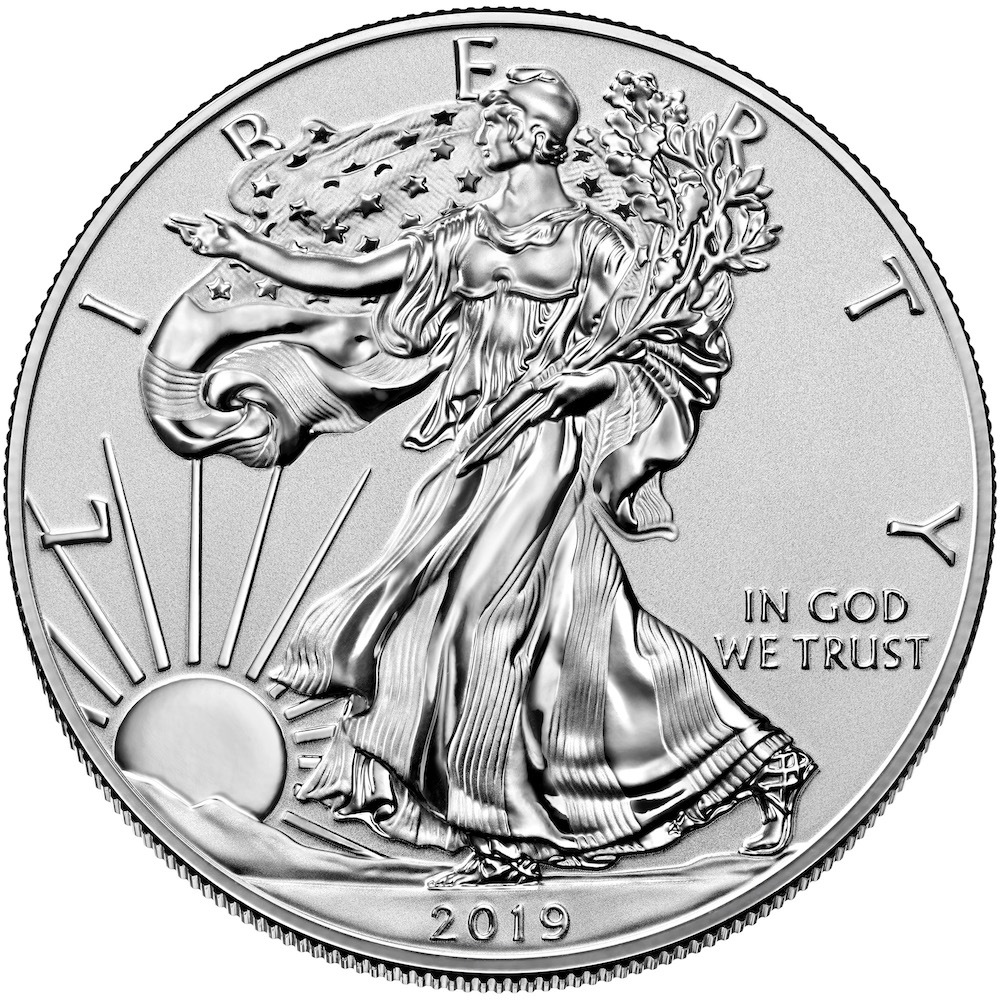 The subject line of the email contained the entire note. My correspondent asked, “Did you try to buy the 2019 Reverse Proof?”
Reports said that the remainder of the products sold out in 10 seconds. That was probably the same 10 seconds the U.S. Mint’s website seemed to freeze.
I admit that I tried cheating. As a retired programmer, I tried to script the purchase. The script watched the clock, and right at noon, the script tried to place the coin in my bag then transfer the payment page to the browser. But for the seconds after high-noon, the site did not respond. Frozen!
The best solution offered for these situations is a lottery system. Reports suggested that the suggestion was made to Director David Ryder. Ryder, like the last appointed director, is tone-deaf to the collectors. Some day, the U.S. Mint will have a competent director.
South African Miner Strikes Will Affect Metals Prices

Location of the Gold Field’s Kloof-Driefontein Complex (KDC)
According to Gold Fields, KDC East produces 1,660 ounces of gold per day.
The Association of Mineworkers and Construction Union (AMCU) has said that they are not involved with the strike and claims the strike was caused by a dispute between National Union of Mineworkers (NUM) branches. AMCU is working with the South African government over the shooting deaths of 34 and wounding 78 striking minders by police at the Lonmin Platinum mine on August 16. The South African National Prosecuting Authority charged 270 miners with murder and attempted murder.

Striking platinum mineworkers gather for a report back on negotiations at Lonmin’s Marikana mine in South Africa’s North West Province, August 29, 2012.
NUM workers have been on strike since August 10, primarily in a dispute with their own union claiming that the union leaders are more interested in politics than the needs of the miners.
Lonmin reports that a 6.6 average attendance in all shafts of the mine following the shootings. The mine is located in the city of Rustenburg, northwest of Johannesburg.
London Gold Fixing closed at $1,648.50, down $9.25 from the morning price. Platinum closed at $1,517.00 up $9.00 from the morning price. Prices were posted prior to the statement issued by Gold Fields. London markets are open on September 3 while the United States markets will be closed for Labor Day.
Map of KDC courtesy of Gold Fields, Ltd.
Image of striking workers courtesy of Reuters/Mike Hutchings
Should the U.S. Mint Be Like the Royal Canadian Mint
2012 American Silver Eagle Proof (courtesy of the U.S. Mint)
First, the U.S. Mint’s product offerings do not make sense, specifically in the area of coins minted at the San Francisco Mint. First, in an attempt to resolve the issues surrounding the release of the 25th Anniversary Silver Eagle Set, the U.S. Mint changes their approach by making the ordering period for the 75th Anniversary of the San Francisco Mint Silver Eagle Set a month long and announcing they will mint enough coins to the demand.
Of course some people believed that would be the extent of the run of Silver Eagles with the “S” mintmark. However, many missed the fine print that said the U.S. Mint may continue to strike and sell S mint Silver Eagles following the sale—which they did. Buried in the news was the announcement of the Making American History Coin and Currency Set, a combined set to celebrate the U.S. Mint’s 220th anniversary and the Bureau of Engraving and Printing’s 150th anniversary. The set contains an S Mint Silver Eagle and a $5 Federal Reserve Note from the Federal Reserve Bank of San Francisco with the serial number beginning with “150.”
Even though that set has limits (100,000 based on the number of $5 FRN available), there have been some complaints from the buying public about not putting limits on the number of S Mint American Silver Eagle products.
But does this matter? Is this a case of collectors trying to dabble with investment in their collection? I know we all would like our collection to be worth more than what we paid, but are we collectors or investors? As a collector, I am not concerned that my 1928 Peace Dollar is not worth that much more than I paid for it.
Legally (31 U.S.C §5112(e)), the U.S. Mint is required to supply the bullion market with American Eagle coins to demand. Striking of coins for the collector market is up to “the Secretary’s discretion,” which we saw with the American Eagle Proof non-production fiasco of 2009.
The American Eagle bullion coins are the most popular investments coins in the world with Canada’s Maple Leaf coming in a close second because of currency exchange rates. Even as the Canadian dollar passes the U.S. dollar in value, American Eagles are still selling. The demand for the product is there and by law, the U.S. Mint is required to supply the demand. There is even demand for the collector versions of the American Eagles, as we saw in 2009. The U.S. Mint does not have to limit sales, and why should they? After all, the U.S. Mint is one of the few profit making mechanisms for the federal government—and even with the price controls placed on them by the law, why should they not be allowed to take advantage of the market? If a complaint about the government is that they do not act like a business, and it is a business decision to sell more American Eagle collector products to satisfy market demand, then why are they being criticized?
The Royal Canadian Mint produces the popular Maple Leaf bullion coins as well as other issues based on the Maple Leaf and other precious metal coins. They can do this because the RCM is not a government agency. The RCM is what is known as a “Crown Corporation,” legally owned by the Crown of the Commonwealth Realm (Queen Elizabeth II) with exclusive rights to produce coins on behalf of the Bank of Canada. Issues and designs are decided by a committee within the RCM which is then approved by the Bank of Canada so that they have legal tender status before being approved by the Governor General of Canada, the Queen’s representative in Canada.
Since the RCM can issue many different non-circulating legal tender (NCLT) coins without the onerous permission requirements that the U.S. Mint needs to go through by getting a law passed, the RCM can create many limited availability issues and use the limited availability as part of their promotion. In the mean time, the U.S. Mint has a limited number of coins they can produce because this is what congress has allowed them to do.
Golino writes, “We need more coins with different and better designs.” This one is difficult to answer because of how the U.S. Mint is regulated by congress. Even if you try to extend the American Silver Eagle coins with different design, the law (31 U.S.C §5112(e)) says the design must be “symbolic of Liberty on the obverse side” and “of an eagle on the reverse side.” Maybe the U.S. Mint could use the American Silver Eagle coins to reprise old designs like the Christian Gobrecht’s Seated Liberty design with the reverse eagle designed by Titian Peale from the Gobrecht Dollar, but to create something else requires an act of congress.
Even if the U.S. Mint was allowed to alter the designs of the American Eagle coins, these designs have to be vetted by the U.S. Commission of Fine Arts and the Citizens Coinage Advisory Committee. While a vetting process should continue, the redundant process of having to run the designs by both the CFA and CCAC is a business risk that the U.S. Mint will probably choose not to go through.
There is no incentive for the U.S. Mint to request a change in its current operating structure because it would require cooperation from congress where the current oversight subcommittee chair, Ron Paul, is not considered a friend to the the agency.
As a first step, it would be nice for the U.S. Mint to be able to leverage the American Eagle program to create a changing design for collectibles. One would be to revive some of the older one-dollar designs as a tribute to the large silver coins. Another would be to do the same for gold coins, such as a year where the Bela Lyon Pratt incuse half-eagle Indian Head design would be featured. But this would require a change in the law since the obverse design is not a representative of liberty.
Until such legislation can be created and passed through congress, the U.S. Mint can change packaging, create products with the Bureau of Engraving and Printing, and has even created products with the U.S. Postal Service (see the State Quarters and Greetings from America products). Even if some think the products are contrived, like the Making American History Coin and Currency Set, this is what the law allows the U.S. Mint to do.
If you want something different, write to your member of congress and suggest that the law be changed. Otherwise, if you do not like the offering, do not buy it. Nothing speaks louder than consumers exercising their rights not to buy a product.
Review: Electronic Standard Catalogs
There are few numismatic references as the Krause Publication’s Standard Catalog series. The multiple volume phonebook-sized references is invaluable to collectors of world coins and paper money. When it came time to update my set, I opted to buy the volumes on compact disk rather than “dead tree editions.”
Long time readers of this blog knows that I am a proponent of electronic books. E-books are the future and will dominate the publishing landscape in the next 10 years. I do not think paper will ever disappear. I believe that yearly references, such as the Standard Catalogs, will find a new, more successful home in electronic form.
I have read reviews where the Standard Catalog series has its problems with missing or inaccurate data, but it is one of the most complete references that exist. There are studies of various series that has more in depth information and a better reference for Canadian numismatics, but to have one reference for the world, there is nothing to match the Standard Catalogs. However, it would be a good idea for the staff at Krause to address the missing or erroneous information that has been communicated to them.
But this review is not necessarily on the content but the format. When you buy the CDs of the various Standard Catalogs you receive a disk with the PDF of the entire book with installation and reading instructions along with the occasional “bonus feature.” I have ignored everything on the CD except the PDF of the Standard Catalog.
Installation is easy. Insert the CD in your computer and copy the files to the hard disk. Since the files are big, the copy will take some time, but it is worth copying them to your hard drive rather than trying to use them from the slower CD. If your computer has a solid-state drive (SSD)—sometimes called a RAM or Memory Drives—I would recommend using that for storage since it is much faster than mechanical disks.
The real advantage is being able to load the file onto your mobile device and taking it with you. While you can use the files on a smartphone, the size of the file and the page formatting is best for tablets. Since I own an iPad, I was able to drag-and-drop the files into iTunes and sync the files to my iPad.
On the iPad, the Standard Catalog files were accessible using iBooks, which made navigation and searching easy. For my test in toting and using the iPad, I also sent the PDF of the Standard Catalog of World Paper Money to be opened using the Amazon Kindle app for the iPad, which requires send the file via email to a special address Amazon sets up for you once you register your Kindle app on their site. After you mail the file, then it can be downloaded to your Kindle or the app. I am not happy with the two-part process, but it does work.
There is little difference between using iBooks and the Kindle app for being able to read and search the Standard Catalog files. Searching was as easy as tapping on the screen to see the search dialog and entering what I am looking for, such as the name of a country.
While attending the World’s Fair of Money a few weeks ago, I was able to reach into my backpack to consult these references on my iPad. This was a lot easier than toting around phonebook-sized references.
The problem with using the PDF files is that the format is fixed and do not reflow to reflect the variations of the ebook formats. However, this is not Krause’s fault. Current ebook technologies, primarily the EPUB standard, does not support in-text images or the formatting of tables which is critical for the Standard Catalog references. The standards organization that is working on the next version of the EPUB specification is supposed to be addressing these issues. Until then, PDF versions are the best option.
PDF documents should be the first step on the road to ebook references. What would be better is an app that would run natively on the tablet. The app would be easier to navigate than a book possibly use imaging and pattern matching technologies to help collectors identify coins. A low cost app that may have a subset of the data with paid updates that might be available quarterly would be an option. In other words, if the costs are affordable (less than what it costs today for physical media), then it would make a worthwhile reference for all collectors.
For now, the PDF files make using the Standard Catalogs easier to use and even saves trees. I am all for saving trees especially when it is easy to use!
Counting Change
On a lighter note, after saving pocket change for nearly two years, I was able to fill a one galling container and an old beer pitcher. Using all the strength left in my aging arms, I carried the container and pitcher to the local bank that offers free coin counting for customers. Even though I am not a customer, my wife is and I deposited the results into her account to save money on the fees.
During the counting process, two of the bags in the machine filled and the teller had to replace them. But after a little more than a half-hour of feeding coins into the machine and checking the rejection bin, all the coins that were countable were counted and I came up with the following totals:
| Coin Type | Quantity | Value |
|---|---|---|
| Dollar coins | 18 | $18.00 |
| Quarters | 1405 | $351.25 |
| Dimes | 1247 | $124.70 |
| Nickels | 793 | $36.95 |
| Cents | 2108 | $21.08 |
| Total | $551.98 | |
While I am not surprised that there were more cents than any other coins, I was a bit surprised as there were less than one thousand nickels. Over the next few days I carefully looked at the amount of change and figured out that most of the time, I am receiving quarters and dimes for most transactions ending with a 5. Change of 25, 35, and 45 cents does not require a nickel to be used while change of 55-cents adds a nickel to two quarter—of course I could have received 3 dimes and a quarter, but that was not the case while I was watching carefully.
Of 5,571 coins counted, 38-percent were the lowly Lincoln Cent that represented 3.8-percent of the total value. Although I still maintain that the United State should not end the coin’s production, seeing these results can lead to an interesting discussion. And before you do respond, an informal conversation at the Royal Canadian Mint during the World’s Fair of Money that they are delaying the buy back of their one-cent coins because of social issues brought up by merchants and many citizens. It appears that while many say they were for the elimination of the one-cent coin, when it really happened there are some significant objections being heard. We can discuss this further in the spring after the RCM begins their buy-back program.
There were several rejected coins including six wheat-back Lincoln cents from the 1950s. Somehow a steel cent ended up in the pile—but that may have happened when my cleaning people picked up a stray coin I may have dropped and added it to my pitcher. I also found several foreign coins including Canadian Cents (sorry, I am keeping those), two one-cent coins from Jamaica, a penny from the United Kingdom, a Canadian 5-cent coin, a 5 Eurocent coin with a French reverse, and two 1976 Bicentennial Quarters. There were also three buttons and a $1 note buried in the pitcher.
Proceeds are being donated to three different charities as well as being used for a nice dinner out with my wife. A special donation (on top of divided donation) of the $21.08 from the proceeds of the cents will be donated to Common Cents, creators of the Penny Harvest and the “Official Charity” of the Coin Collectors Blog.
Review: Heritage Mobile Catalog for the iPad

Heritage Mobile Catalog Opening Screen
This review is for the Heritage Mobile Catalog for the iPad only. Heritage has a separate app that works for the iPhone and iPad that is a wrapper around their mobile website. Do not confuse the two. The Heritage Mobile Catalog app is an application and different from the website. The Heritage app provides nothing more than what you can experience if you opened Safari on your iDevice and went to HA.com. For Android users, you are not missing anything by not having the Heritage App. I deleted the Heritage app from my iPhone and iPad.
The Heritage Mobile Catalog app is works in portrait and landscape mode on the iPad, but I found that using it in landscape mode looks better. When you open the app, you are presented with a number of virtual “catalogs” of Heritage’s various auctions. Even though this blog is interested in numismatics, I like to look at some of Heritage’s other auctions—which is why I now own some older political memorabilia. For this review, I selected the catalog for the August 3 Currency Signature Auction in Philadelphia.
The first issue that users will experience is this is not a “real-time” application. Before being able to browse an auction, you have to download the catalog. This can take some time depending on your connection. Even a more recent test using my home WiFi connection at full strength and no other activity I lost track of the time it was taking to download a catalog that was reported to be over 164 megabytes. All I remember was that during the wait I was able to make a bio-break and pour a beverage. If I was not trying to refresh my review, I would have given up and opened Safari to go to their website.

The Update dialog for the Heritage Mobile Catalog app.
You can avoid the dialog box if you press the “Update Bids” button. This will do the same as the dialog box, but you have to remember to press it first before pressing the “View” button to see the catalog. In either case, this is not a straight forward interface for the ordinary user. In fact, as a note to the project manager at Heritage, this type of interface reminds me of the book The Inmates Are Running the Asylum. The first half of this book makes it worth reading.
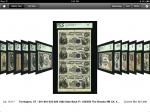
Gallery View in the Heritage Mobile Catalog app is similar to Apple’s cover flow.
List View really lets you get down to the business of browsing and bidding on the auction. While Gallery View is nice, you will probably use List View more. Both views allows you to sort the list by several criteria and the Refine button will let you search for specific items and let you narrow the display by relevant terms. While the images here are screen shots from a currency auction, the Refine Search adapts to the type of auction you are viewing.
Where the annoyance returns is the “My Heritage” button that does not offer a service but connects you to the Heritage website and uses the output from the website as the display. In order for an iOS application to open a web page, it has to bring up a separate window that overlays over the app. There’s a “clunky” feeling to this type of interface that I find annoying.
When you tap on an auction to bid on it, users of the eBay for iPad app will find familiar. There is nothing wrong with this interface because I think the Heritage version is a cleaner and a little more intuitive than the way eBay crammed everything into their version.
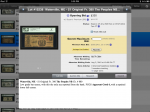
Bid screen in the Heritage Mobile Catalog app.
While I can speculate on why the Heritage Mobile Catalog app does this type of pre-loading, the bottom line is that it takes too long and does not update prices in “real-time” as their announcement claims. While other apps find ways to integrate their backend processing directly into the app, the Heritage Mobile Catalog has a “bolted-on” feeling. With the exception of the Gallery View, why should someone use this app over opening the browser and directly accessing the auction on the website?
I wanted to love this app but the interface annoyances has me using the website more than this app. It is like a mint state coin that is not well struck which is why I am grading this app MS60. Whomever is responsible for this app at Heritage should look at similar apps (eBay) and consider attending the next Apple World Wide Developers Conference to attend the course on what makes a good iOS interface.
-
- Heritage Mobile Catalog Opening Screen
-

- After the catalog is downloaded, the downloaded catalogs are sorted first in the Heritage Mobile Catalog.
-
- The Update dialog for the Heritage Mobile Catalog app.
-
- Gallery View in the Heritage Mobile Catalog app is similar to Apple’s cover flow.
-
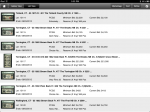
- Even though Gallery View is fun, serious bidders might use List View more often in the Heritage Mobile Catalog app.
-
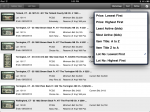
- Heritage Mobile Catalog sorting options.
-

- Heritage Mobile Catalog search and refinement options.
-

- Administrative interfaces in the Heritage Mobile Catalog app is directly to the Heritage website.
-
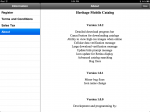
- Heritage Mobile Catalog app credits… who to blame! 🙂
-
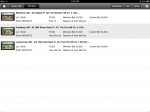
- Using the search option to look for currency from Maryland in the Heritage Mobile Catalog app.
-

- MyHeritage display is nothing more than the reformatted webpage and not native to the Heritage Mobile Catalog app.
-
- Bid screen in the Heritage Mobile Catalog app.
-
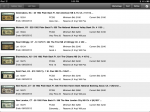
- A different sort image in the Heritage Mobile Catalog app.
-

- Heritage Mobile Catalog app can only show you the catalogs you want to see.
&nbps;
Support the Coin Collectors Blog
 Buy me a coffee
Thank you for your support!
Let Me Know What You Think
Are you going to the World's Fair of Money
Total Voters: 17
 Loading ...