
Simply put, there is an adequate amount of coins in the economy
 The U.S. Mint succinctly stated in its press release about the shortage of circulating coins is that there are enough coins in the economy. There is no shortage.
What is happening is that, like everything else during the COVID-19 crisis, the supply chain broke. Coins stopped circulating because people were not going out and spending the coins or currency. Since cash sales dropped, there was no need for stores to stock up on coins. They had the supply to conduct business.
Since the stores did not need the coins, the banks stopped ordering coins for its inventories. Larger stores that rely on logistics carriers were not ordering coins or sending coins into the supply chain. Finally, the logistics carriers saw their inventories rise and become stagnant, giving them no reason to buy more coins from the Federal Reserve.
Now that areas are opening and the demand for change has increased, the supply chain has to restart. According to Federal Reserve Chairman Jerome Powell, the cash rooms operated by each Federal Reserve District has a sufficient supply of coins. But the coins have to be circulated through the system.
The government is doing its job. The U.S. Mint is striking a sufficient volume of coins for circulation, and the Federal Reserve has the supply to support commerce. It is the private sector that manages the supply chain that has failed.
The logistics companies, the coin processors that move the money between the Federal Reserve, the banks, and the retailers, have caused the backup. Since many banks have limited access to their drive-thru operations, there is an opportunity for the supply chain to adjust. They cannot adjust fast enough.
If you want to help fix the supply chain, spend your coins. Use exact change when possible. When it is not possible, use a credit or debit card.
If you are the type that keeps coins in jars, now is the time to do your search and send the rest back into circulation. Some banks are offering bonus payments for bringing in coins. Others that were charging fees if you did not roll the coins are waiving those fees. If you regularly buy from Amazon, consider using a Coinstar machine to turn your coins into an Amazon credit. Coinstar does not charge a fee when you trade your coins for Amazon credit.
Relax! It is not a conspiracy to get coins out of circulation. The government is not replacing U.S. dollars with Bitcoin. The government is not participating in creating a global currency, especially when you see how that has worked with mixed results in Europe. And this is not how the government is going to take your money away from you. That is what the tax code does.
Take your coin jar, search for collectible circulating coins, and spend the rest. Get the coins back into circulation.

About Foreign Coin Production by the U.S. Mint
For over 80 years since its founding, the U.S. Mint worked to increase production for it to be the sole supplier of coins for the young country. During that time, foreign coins, specifically the Spanish Milled Dollar (8 Real silver coin) was legal tender and served daily commerce. Congress revoked their legal tender status with the passage of the Coinage Act of 1857 making the U.S. Mint the sole supplier of coins in the United States.
Although the U.S. Mint was supposed to be building to supply the country with coins, it was taking on contract minting since it was the only entity with the ability to strike high quality medals. The first record of producing medals for someone other than the government was in 1833 for the American Colonization Society, a group whose purpose was to transport free-born blacks and emancipated slaves back to Africa and settle what today is known as Liberia.
Congress authorized the U.S. Mint to strike circulating coinage for foreign governments with the passage of the Act of January 29, 1874, “Provided, That the manufacture of such coin shall not interfere with the required coinage of the United States.”
The first legal tender coins produced for a foreign government was struck at Philadelphia for the Venezuelan government in 1875-1876 dated 1876-1877. The last circulating foreign coins were struck for Panama in 1983 when congress revoked the authorization because it began to interfere with domestic coin production.
The last time a coin was struck for a foreign country was in 2000 when the Leif Ericson commemorative silver coins were produced for domestic sales and for Iceland. The Iceland coin was struck with a face value of 1,000 Krónur.
Between the first coins struck for Venezuela and the Leif Ericson Commemorative Coin for Iceland, the U.S. Mint produced 1,127 coin types, not including varieties, for 43 countries. Coins were produced in gold, varied fineness of silver, bronze, brass, copper-nickel, nickel, steel, aluminum, and steel. Foreign coins were produced at Philadelphia, Denver, San Francisco, New Orleans, West Point, and Manila.
After the Philippines became a colony of the United States, the U.S. Mint established a branch mint in Manila in 1920. It is the only branch mint outside of the continental United States. Coins struck in Manila used the “M” mintmark making it the first foreign coin produced with a U.S. mintmark. The first foreign coins struck with a mintmark from one of the continental U.S. branch mints was the “P” that appeared on four different foreign coins in 1941. However, these were not the first time a foreign coin was identified as being struck in Philadelphia. In 1895, the word “PHILADELPHIA” was incorporated into the design of the reverse on the Ecuadorian 2 decimos coin.
Mintmarks on United States Coins
A mintmark is part of the coin design that tells which mint the coins were produced. Using mintmarks to identify where coins were made began in ancient Greece. Coins that were released into circulation were required to have a “Magistrate Mark,” a distinct mark representing the magistrate in charge of producing the coin. If a coin was to have problems, whether by accident or on purpose, the government knows who the responsible party was.
Mintmarks were first used in ancient times as a quality control mechanism. If a coin did not fit the specifications (under or overweight, not the right metal, etc.) it was easy to identify where the coin was made.
Another type of mark made on non-United State coin is a privy mark. A privy mark is a small design added to the coin to identify the where the coin was made, the coiner responsible for the coin, or some other aspect of the coin’s production for quality control purposes. Privy marks fell out of favor in modern times and countries with multiple branches use lettered mintmarks. Some mints use privy marks to differentiate different types of non-circulating legal tender coins.
Mintmarks used on United States coins are as follows:
The U.S. Mint was formally founded with the passage of the Mint Act of 1792. David Rittenhouse, the first Mint Director, was able to find a building in Philadelphia and begin operations in 1793. The first mint building served the country until 1833. The second mint building served from 1833-1901 and was demolished in 1902. The third mint was in service from 1901-1969. The building is now part of the Community College of Philadelphia. The fourth mint, located two blocks from the location of the first mint building, was opened in 1969 and continues to be used today. Up until 2009, it was the largest mint building in the world. However, no other mint in the world produces more circulating coinage than the Philadelphia mint.
All coins struck in Philadelphia from the founding of the Mint in 1793 until 1980 did not include a mintmark. The exception was the Type 2 Jefferson Nickels minted using the wartime alloy from 1942-1945. Coins struck using the silver-copper-manganese alloy feature a large mintmark above Monticello, including a “P” for Philadelphia.
In 1979, Susan B. Anthony dollars struck in Philadelphia included the “P” mintmark.
Beginning in 1980, all coins struck in Philadelphia, except for the Lincoln Cent, includes the “P” mintmark.
Charlotte became the first branch mint outside of Philadelphia. Authorized in 1835 following the gold strike at the Reed Gold Mine, it first became operational in 1838. The Charlotte branch mint was closed when the building was seized by the Confederacy during the Civil War in 1861. It was not reopened after the war. The Charlotte Mint’s “C” mintmark only appears on gold coins.
The Dahlonega Branch Mint was authorized by congress in 1837 after the Georgia Gold Strike. It opened for production in 1838. Like the Charlotte Mint, the Dahlonega Mint was seized by the Confederacy during the Civil War in 1861 and was never reopened. Gold coins dated 1838-1861 with the “D” mintmark were struck in Dahlonega. Coins with the “D” mintmark starting in 1906 were struck in Denver.
The branch mint at New Orleans was authorized by congress in 1836 as part of a discussion to make New Orleans a central trading gateway to the Midwest. This branch mint struck all denominations with the “O” mintmark. In 1861, the building was seized by the Confederacy and used by the Confederate government to strike coins. The Union Army recaptured New Orleans and the building in 1862. Unlike Charlotte and Dahlonega, the New Orleans Mint was eventually reopened. Its second life began as an assay office in 1876. With the passage of the Bland-Allison Silver Act of 1878, the building was refurbished to bring it back to coining standard and was used to strike silver coins, mostly dollars, until 1909. It was closed for the last time in 1909 with production down and Denver taking over the production load.
The San Francisco branch mint was opened in 1854 to assay and coin gold discovered during the California Gold Rush. The first building, known as the “Granite Lady,” was one of the few buildings to survive the Great San Francisco Earthquake of 1906. During the aftermath of the earthquake, Superintendant Frank Leach helped local residents by allowing them to use the grounds as a refuge. A new building was opened in 1937 and celebrated its 75th anniversary in 2012. Today, the Granite Lady is being refurbished as the Museum of San Francisco.
San Francisco produced circulating coins with the “S” mintmark until 1955 when production was suspended and the facility was “downgraded” to an assay office. Production of proof coinage was transferred to San Francisco in 1968 and they began to strike some coinage for circulation until 1974. Since 1975, San Francisco produced only proof coins along with cents without mintmarks to supplement production from Philadelphia. It is not possible to distinguish from no mintmark cents from either mint. San Francisco also produced circulating Susan B. Anthony dollars 1979-1981 with the “S” mintmark. They were granted mint status in 1988.
After the major discovery of silver as part of the Comstock Lode in what is Virginia City today, politicians lobbied congress for the formation of a branch mint to assay and strike coins. Congress authorized a mint in 1868 for nearby Carson City and the building was opened for production in 1870. The Carson City branch mint struck silver and gold coins but in lesser amounts than the other mints, making their coins highly collectible and more expensive because of their rarity. The “CC” mintmark is the only two-character mintmark used on U.S. coins.
Production ended in 1893 with the reduced production from nearby silver mines. Starting in 1895 the building served as an Assay Office until the gold recall of 1933. The building was sold to the State of Nevada in 1939 and was turned into the Nevada State Museum.
During the Pikes Peak Gold Rush, congress authorized the opening of a Denver assay office in 1863. Congress authorized the building of a branch mint in 1896 and construction began in 1898. Operations from the assay office were transferred to the new building in 1904 and the mint started to strike circulation coins in 1906. Denver struck gold coins until 1933 when gold was recalled. All coins with the “D” mintmark struck since 1906 were minted in Denver. Earlier gold coins dated 1838-1861 were struck in Dahlonega, Georgia.
In 1937, the Treasury built a facility on the northern part of the campus of the U.S. Military Academy to store silver. Originally, it was called the West Point Bullion Repository and was nicknamed as “The Fort Knox of Silver.” From 1968-1973, West Point produced cents without a mintmark in order to supplement the production from Philadelphia. They also produced Bicentennial and Washington Quarters 1975-1979 without mintmarks.
The “W” mintmark first appeared on the 1983 Olympics Commemorative Coins. West Point produces coins for the American Eagle Bullion program without mintmarks but produces collectable versions of the American Eagle with the “W” mintmark. Other commemoratives have been struck at West Point that includes the “W” mintmark.
The same bill that returned the San Francisco branch mint back to mint status in 1983 granted mint status to the West Point branch mint.
After the Philippines became a colony of the United States, the U.S. Mint established a branch mint in Manila. It is the only branch mint outside of the continental United States. The mint opened in 1920 and produced coins in one, five, ten, twenty, and fifty centavo denominations. Coins struck by this mint bear either the “M” mintmark or no mintmark.
Rallying Congress to Fight Overseas Counterfeiting Problems
I attended the event sponsored by the Gold and Silver Political Action Committee (GSPAC) on June 27, 2012 to lobby them for passage of the Collectible Coin Protection Act (H.R. 5977) introduced last month by Rep. Fred Upton (R-MI), Chairman of the U.S. House Energy and Commerce Committee, and Lamar Smith (R-TX), Chairman of the U.S. House Judiciary Committee. This is a bill that everyone in the numismatic committee should support and ask their member of congress to support.
For now, I will let the folks at PCGS tell you their experiences at the event (their press release follows). I will follow up at some point with my own thoughts and commentary on the topic. Also, while the press release has one picture, there are three more that I posted to Pinterest that I think are more interesting, including a Morgan Dollar that was cut in half to marry a specific date with a mintmark that was placed in an altered PCGS holder and sent to PCGS for verification. It is fascinating what some people will do and what they get away with.
PCGS Gives Congressmen A Close Look At Counterfeiting Problems
(Washington, DC) – During June 27, 2012 meetings with numismatic leaders in Washington, DC, influential U.S. Congressmen and congressional staff members learned about rare coin authentication and were shown examples of counterfeit coins from the Professional Coin Grading Service (www.PCGS.com) reference collection and examples of counterfeit PCGS encapsulation holders. PCGS has detected over 5,500 counterfeit coins submitted in the last 12 months, a higher number by far than in any previous 12-month period.
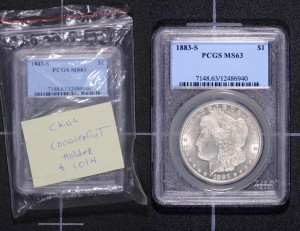
PCGS representatives showed Congressmen counterfeit U.S. coins in counterfeit PCGS holders during their recent meetings in Washington, DC. (Photo courtesy of PCGS.)
Vartian met with Rep. Fred Upton (R-Michigan), Chairman of the U.S. House Energy and Commerce Committee, Lloyd Doggett (D-Texas), a member of the House Ways and Means Committee and staff members for other Congressmen including Howard Berman (D-California), the second ranking Democrat on the House Judiciary Committee.
“It was a very successful series of meetings. The Congressmen and staff members focused on the items we brought; actual counterfeit coins and counterfeit holders, and heard about the on-going efforts by PCGS to combat dealers who sell fake coins and holders. We also talked about educating collectors and dealers. But now the numismatic community must come together and urge other members of Congress to support and approve changes to the law.”
Those proposed changes are in HR5977, the Collectible Coin Protection Act of 2012, a bill that would amend and significantly strengthen the Hobby Protection Act of 1973. The Washington meetings were aimed at educating members of Congress about the counterfeiting problems and the need for stronger laws.
“Every collector, every dealer, should personally contact their Congressional representatives now and specifically request they support HR5977,” Vartian emphasized.
“There are several very positive elements in the bill (HR5977) for PCGS and for all collectors and dealers who buy and sell PCGS-certified coins. One provision provides for triple damages for counterfeiting third-party holders such as the patented, sonically-sealed PCGS tamper-evident holders,” said Don Willis, PCGS President.
HR5977 was introduced on June 20 by Congressman Lamar Smith (R-Texas), Chairman of the U.S. House Judiciary Committee, and co-sponsored by Congressman Upton.
The Washington meetings were organized by the Gold & Silver Political Action Committee. In addition to PCGS, representatives of the Industry Council for Tangible Assets (ICTA), the Professional Numismatists Guild (PNG) and Numismatic Guaranty Corporation (NGC) also attended along with former Louisiana Congressman Jimmy Hayes, a long-time collector.
The Hobby Protection Act, first enacted in 1973 and amended in 1988, requires manufacturers and importers of imitation numismatic items to mark them plainly and permanently with the word, “COPY.” The Collectible Coin Protection Act would expand and strengthen the consumer protections to provide remedies against sellers of such items and others who substantially assist them. It also would increase penalties for fake coins fraudulently sold inside counterfeit grading service holders.
Barry Stuppler, Chairman of the Gold & Silver PAC, said if approved by Congress and signed into law by the President the new law would:
- Include not only the distribution but also the sale in commerce of prohibited items;
- Add a provision expanding the Hobby Protection Act to include “any person who provides substantial assistance or support to any manufacturer, importer, or seller” knowingly engaging in any act or practice that violates the Act;
- Expand the venue for legal action to include not just having an agent present, to include “transacts business” — or wherever venue is proper under section 1391 of Title 28, United States Code;” — and
- Add a section on Trademark violations specifically written to include the certification services and adds remedies to the Hobby Protection Act that currently exist under the Trademark Act of 1946 (U.S.C. Title 15, Sections 1116-1118) for violations of the Hobby Protection Act.
In a statement prior to the meetings, Willis stated: “Chinese counterfeiting is the most serious challenge faced not only by the collectibles markets and brand name products, but also by the United States Treasury. Entire industries have sprung up in China to manufacture virtually anything made in America including U.S. Government issued coins. These factories and industries operate in the open and with the full support of the Chinese government. By its lack of action to stop the activities, the Chinese government endorses the counterfeiting of U.S. coins.”
“Even worse, Customs and the U.S. Government do little to stop counterfeits from entering the U.S. Once in the US little effort is made to arrest and prosecute individuals selling counterfeit material. Consequently the U.S. has been flooded with counterfeit products, including coins, resulting in the loss of billions of dollars in revenue each year,&rdquo Willis explained.
Catching Up On Whitman’s Baltimore Show
Those following the weather-related events around Washington, DC have seen how a little wind can set the local electric companies into a tizzy. Most of us in the effected areas feel that the restoration experience more represents the Keystone Cops rather than a responsible utility company. The last few blog posts have been previously scheduled. Now that power is restored and the refrigerator has been cleaned and restocked, it is time to talk numismatics.
Before the storm, I attended the Whitman Baltimore Expo. While their June show may be the smallest of the three shows that are put on in Baltimore, it still remains a premier show on the east coast, only rivaling its other two shows and F.U.N. for being amongst the best of non-A.N.A. shows. This may be a biased view since the Baltimore Show was the first show I attended when I returned to numismatics following the untimely passing of my first wife. But I am still amazed how Whitman can put on a good show three-times per year!
Friday, after a morning appointment and a delay in leaving, I backed out of my garage and headed to the highway. Over the last year, there is a new highway that will bring me to I-95 a lot quicker than driving down to the Capital Beltway. The ride was a pleasure since it new highway is a toll road and people seem to be allergic to tolls. My problems began when I exited to I-95 North. An accident and two major construction projects extended the usual one-hour trip to nearly two-and-a-half hours! I should be used to this type of traffic living in the D.C.-area, known as the worst on the east coast, but Capital Hill is not the only place where one could find mindless acts.
I could not park in my usual location because it was full, so I was further delayed by trying to find parking near the convention center. Thankfully, my new hip allows me to walk further distances and I was only 35 minutes late for the talk by Don Kagin. While I did arrive in time to take some pictures (a very small sample are on Pinterest), I wish I could have been there for his entire talk.
Before walking the bourse floor, I did have business to conduct, some of which I will discuss at another time. Suffice to say that I took the opportunity to see some people, shake hands, and show my appreciation for their work. Amongst the people I was able to see was Michelle Coiron, Director of sales for Star-Spangled 200 and David Crenshaw, General Manager of Whitman Expos. Both do a great job for their organizations and deserve a sign of appreciation.
Then it was time to hit the bourse floor. As opposed to other times I was at the show, there seemed to be quite a bit activity even as the day wore on. I was pleased to see quite a number of people attended the show that late on a Friday. It keeps the dealers happy and at their tables. I really did not see an exodus begin until about 5:30, about a half-hour before closing.
I spoke with a few dealers who said that business was steady. Most of the coin dealers seemed to be happy while most of the currency dealers called the show a little slow. If anything, I was a little disappointed with some of the currency dealers. With my interest in Maryland colonial currency, I was looking at their inventory for something I could add to my collection. I did not find much colonial currency and what I did was not from Maryland. The only dealer who had any currency in stock from Maryland had 1774 notes, which are the easiest to find.
Since I was late, I passed a number of dealers I spoke with in the past so I could cover as much of the floor as possible. I was not in much a buying mood but I was able to find the 2012 silver one-ounce Chinese Panda and Australian Koala. Both beautiful coins and will be added to what I call my “silver dollar” collection—silver coins 38-40 millimeters in size, like the American Silver Eagle, British Britannia, and Canadian Maple Leaf.
Being in a good mood and wanting to do some thing different, I did spend a lot of time with the exonumia dealers. I saw some really wonderful medals, tokens, and encased coins that really piqued my interest. Rather than buying just anything, which I could have done given my good mood, I applied a little personal discipline and stuck to my goal of finding something neat at every show but limit it to fit in my collection of New York City-related numismatics.
While searching through one dealer’s stock I found my “oh neat” item from New York. What I found was made of pewter, 35½mm in diameter, 3⅓mm thick, and holed on the top. It became irresitable after reading the obverse that says, “Two Cities As One/New York/Brooklyn.” On the reverse in true Victorian style, it says “Souvenir of the Opening of the East River Bridge/May 24th, 1883/1867-1883.” In 1915, New York City renamed it the Brooklyn Bridge.
On May 24, 1883, thousands of people crowded lower Manhattan and Brooklyn for the grandest of all ceremonies from all over the area—even as far away as Philadelphia. The list of dignitaries was a Who’s Who of the political America that included President Chester A. Arthur, New York Governor Grover Cleveland, and New York City Mayor Franklin Edson. The carriage carrying President Arthur and Mayor Edson lead the parade surrounded by a very large cheering crowd.
At 1:50 PM, the processional arrived at the entrance of the new bridge, President Arthur and Mayor Edson left their carriage and crossed what was the world’s longest suspension bridge arm-in-arm to a cheering crowd who paid $2 for tickets to watch from the bridge. The band played Hail to the Chief as ships who came to the ceremony and anchored around the East River blew horns to honor the President. Navy ships who were invited to the ceremonies took turns giving 21-gun salutes.
When they arrive in Brooklyn, they were greeted by Brooklyn Mayor Seth Low The three men locked arms and marched to the Brooklyn Pier (today, the area of Brooklyn Bridge Park) to complete the ceremony dedicating the bridge to the people of the New York City and Brooklyn.
Growing up on Long Island, my late mother insisted that during some of our breaks from school that we play tourist and visit various places in and around New York City to learn about where we are from. During the trips to Rockefeller Center, a place I would work in the 1990s, we would visit the Chase Manhattan Bank Money Museum. Up until it was closed in 1977, it held one of the best collection of numismatic items outside of the Smithsonian Institute. Ironically, the Smithsonian was the recipient of some of the items in the museum following its closure. Another beneficiary was the American Numismatic Society who still retains their part of the Chase Manhattan Collection.
This museum was source of fascination, especially after I learned about collecting while searching through the change I made delivering the afternoon Newsday on Long Island. Somewhere, buried in a box, I have a pamphlet from one of my visits to the Chase Money Museum. I remember the cover was blue and it had a “money tree” on the front. As a youngster, that was significant because my father would lecture me by saying, “money doesn’t grow on trees.” Although the item was made to look like a tree with coins coming off the branches, it was a source of comic relief at home. Otherwise, I do not have a souvenir from the museum. Until now!
Searching through boxes from the same dealer I bought the Brooklyn Bridge medal, I found an encased Lincoln Cent from the Chase Money Museum. In fact, I found several from various dates. Of the ones I found, I bought one with a 1956-D Lincoln Cent that still had its red luster! Even though I could not have visited the museum in 1956—it was before I was born—it was the only coin that looked uncirculated. Rather than try to find one that would have been from the time I could have visited, I picked the better looking coin. Now if I could find my pamphlet, it would make a great part of my New York City collection.
My next show will be the American Numismatic Association’s World’s Fair of Money in August at the Philadelphia Convention Center. I will have a lot planned for those few days and should make for an interesting story. Stay tuned!
Fighting for Independence 36 Years Later
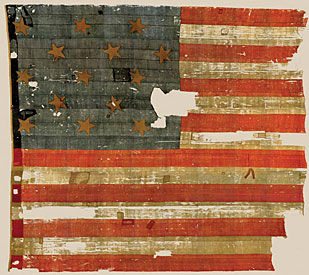
The original Star-Spangled Banner, the flag that inspired Francis Scott Key to write the song that would become our national anthem.
President James Madison, embroiled in a tight campaign for re-election, acquiesced to Congressional “war hawks” from the south and west and declared war on Britain in June 1812. Americans were emboldened by the fact that the British were deeply committed to a war with Napoleon Bonaparte that strained the resources of the crown. There was little acknowledgement in Washington that what passed for a standing army was only about half the size of Britain’s and stationed in widely scattered outposts; that the American Navy totaled about 50 ships to Britain’s more than 850; that coastal defense infrastructure was limited at best; and that there was no core of trained military officers to lead the poorly trained troops and militia. The British ships were much larger than their American counterparts.
Commercial and political interests in New York and New England, concerned about the potential destruction of shipping, opposed the war and in fact, continued to supply the British until the naval blockades were extended. Similarly, Britain saw America as an important market and supplier and only reluctantly responded to the declaration of war.
In the summer of 1812, American troops attempted to invade and conquer Canada. The poorly planned campaign ended in defeat and the withdrawal of the Americans. However, two American frigates, the USS Constitution and the USS United States, gained victories in naval battles, boosting American morale and contributing to President Madison’s re-election.
In response, the British gradually established and tightened a blockade of the American coast south of New York, impairing trade and undermining the American economy.
The attempts to invade Canada during the spring and summer of 1813 were somewhat more successful than the previous year’s, yet they ended in stalemate. By the end of the season, the British blockade had extended north to Long Island.
Remarkably, the young nation prevailed despite a long summer in the Chesapeake region. The British harassed citizens, burned towns and farms, and overwhelmed the scant American naval forces and militia. With the Americans distracted and largely unprepared, the British entered the nation’s capital and burned several public buildings, causing the President, his family and Cabinet to flee Washington. In September, however, an all-out land and sea defense of Baltimore forced the withdrawal of the British from the Chesapeake region. The same month, the British fleet in Lake Champlain was destroyed, leading to the British retreat into Canada. This defeat convinced the British to agree to a peace treaty, known as the Treaty of Ghent, with very few conditions. In January 1815, with neither side aware that the treaty had been signed the previous month, the British decisively lost the Battle of New Orleans. David had defeated Goliath.
The War of 1812 represents what many see as the definitive end of the American Revolution. A new nation, widely regarded as an upstart, successfully defended itself against the largest, most powerful navy in the world during the maritime assault on Baltimore and later at the Battle of New Orleans. America’s victory over Great Britain confirmed the legitimacy of the Revolution; established clear boundaries between eastern Canada and the United States; set conditions for control of the Oregon Territory; and freed international trade from the constraints that had led to the war. America emerged from the war with an enhanced standing among the countries of the world.
The war served as a crucial test for the U.S. Constitution and the newly established democratic government. In a bitterly divided nation, geographically influenced partisan politics led to the decision to declare war on Great Britain. Unprepared for war, under-financed, threatened by secession and open acts of treason, the multi-party democracy narrowly survived the challenge of foreign invasion.
Star-Spangled Banner Commemorative Coins
The 2012 Star-Spangled Banner Commemorative Coins are being sold by the U.S. Mint with the proceeds from the sales ($35 for each gold coin and $10 for each silver coin) to support the Maryland War of 1812 Bicentennial Commission.
-
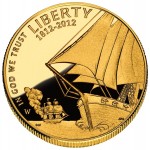
- 2012 Star-Spangled Banner Gold Commemorative Obverse depicts a naval battle scene from the War of 1812, with an American sailing ship in the foreground and a damaged and fleeing British ship in the background. Designed by Donna Weaver and engraved by Joseph Menna.
-
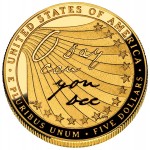
- 2012 Star-Spangled Banner Gold Commemorative Reverse Depicts the first words of the Star-Spangled Banner anthem, O say can you see, in Francis Scott Key’s handwriting against a backdrop of 15 stars and 15 stripes, representing the Star-Spangled Banner flag. Designed by Richard Masters and engraved by Joseph Menna.
-
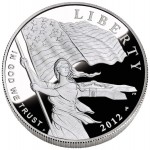
- 2012 Star-Spangled Banner Silver Commemorative Obverse depicts Lady Liberty waving the 15-star, 15-stripe Star-Spangled Banner flag with Fort McHenry in the background. Designed by Joel Iskowitz and engraved by Phebe Hemphill.
-
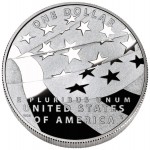
- 2012 Star-Spangled Banner Silver Commemorative Reverse depicts a waving modern American flag. Designed by William C. Burgard III and engraved by Don Everhart.
The commission will use these funds to support its bicentennial activities, educational outreach, and preservation and improvement of the sites and structures related to the War of 1812. Help support the commission’s activities by purchasing a commemorative coin today!
- Main text was adapted from Star-Spangled Banner National Historic Trail Feasibility Study and Environmental Impact Statement
 , National Park Service, U.S. Department of the Interior, Northeast Region, March 2004.
 - Image of the 15 Stars and Stripes Star-Spangled Banner courtesy of the Smithsonian Institute.
- Coin images courtesy of the U.S. Mint
Support the Coin Collectors Blog
 Buy me a coffee
Thank you for your support!
Let Me Know What You Think
Are you going to the World's Fair of Money
Total Voters: 17
 Loading ...