Weekly World Numismatic News for July 19, 2020
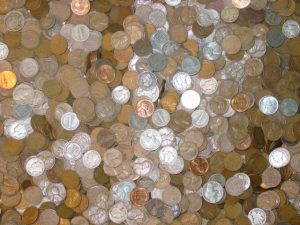 There is a coin shortage.
There is also a currency shortage, but it is not as severe as the coin shortage.
The shortage is not because the government has stopped the manufacturing process. There was a production slowdown in April and May, but that does not account for the lack of circulating coins. The West Point Mint briefly closed because the circumstances were different. West Point does not strike circulating coinage.
Although the Bureau of Engraving and Printing slowed down production in Washington, D.C., Fort Worth did not miss a beat.
The Federal Reserve, an independent organization, did not stop the circulation of money. There is money in the various cash rooms around the country. While some of the supply is lower than usual, Federal Reserve Chairman Jerome Powell testified to Congress that their supplies are adequate to meet the demand.
If the government is not causing the coin shortage, then where are the coins?
For nearly eight weeks beginning in mid-March, the amount of money circulating diminished to its lowest levels since the Great Depression. You have not been spending cash. The result is that the stores and banks were not circulating coins forcing the logistics companies to store what they can and deposit the rest with the Federal Reserve.
The Federal Reserve believes there are enough coins to satisfy commerce. The problem is that the supply chain has to restart. There is a limit to how fast the supply chain can move the coins around.
The warehouses where the coins are stored is like a gallon jug or your favorite beverage. To server your guests, you need to pour that gallon jug into glasses. But the only way to pour the jug is into a funnel to guide the liquid into each glass. How much is pouring slowed down by the bottleneck of the smaller opening at the bottom of the funnel?
In the case of coins, the smaller opening is the armored cars that deliver the money from the warehouses to the banks and other large institutions. The limited capacity of the opening will slow down the pouring of the beverage and the pouring of the coins back into the economy.
One Federal Reserve research group suggested that it could take 3-6 weeks for the supply chain to get back to normal. Compared to the lack of Clorox and Lysol cleaners in the supermarkets, that is lightning fast!
And now the news…
 July 14, 2020
 → Read more at dailyherald.com
July 14, 2020 → Read more at npr.org
July 15, 2020 → Read more at williamsondailynews.com
July 15, 2020 → Read more at moneyweb.co.za
July 16, 2020 → Read more at politifact.com
→ Read more at dailyherald.com
July 14, 2020 → Read more at npr.org
July 15, 2020 → Read more at williamsondailynews.com
July 15, 2020 → Read more at moneyweb.co.za
July 16, 2020 → Read more at politifact.com
JFK
As our 35th President, John Fitzgerald Kennedy became the youngest person to ever be elected as President and the first Roman Catholic. At 43, Kennedy was the promise of a new future; a new vision that would have the United States leading the world in fighting the “common enemies of man: tyranny, poverty, disease, and war itself.” In his inaugural address, he called the nation to arm when he said, “Ask not what your country can do for you, ask what you can do for your country.”
From standing up to the Soviet Union’s Nikita Khrushchev, to the success in defense of the nation during the Cuban Missile Crisis, to the failures of the Bay of Pigs, the starting of the Peace Corps, and challenging the United States’ resolve using the space program by proclaiming, “We choose to go to the Moon in this decade and do the other things, not because they are easy, but because they are hard.” In over two years, Kennedy made an impact on this country in such a short period of time that one can wonder what would had happened if….
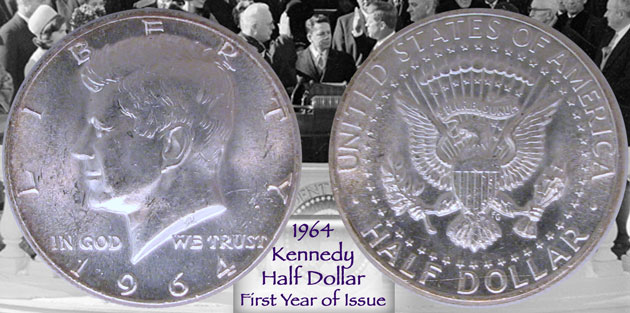 A few days after Kennedy’s assassination on November 22, 1963, U.S. Mint Director Eva Adams, Chief Engraver Gilroy Roberts reported that there was discussions about putting Kennedy’s portrait on a silver coin. Since Jacqueline Kennedy did not want to replace Washington’s portrait on the quarter, it was decided to use the half-dollar. Roberts used models from the inaugural medal for the obverse design and Assistant Engraver Frank Gasparro prepared the reverse design using the Presidential Seal.
Since the law stated that coinage design could not be changed more often than 25 years, and that the Franklin Half was only 15 years old, it required Congress to authorize the change. The Act of December 30, 1963 (Public Law No. 88-253) allowed the design to be changed.
When the coin was released in 1964, the 90-percent silver coin was saved by a grieving nation wanting something that represented the fallen President. Over 273 million coins were struck in Philadelphia and 156 million in Denver. The composition was changed in 1965 with the introduction of clad coinage. Half dollars consisted of 40-percent silver that included a core made from 79-percent copper and 21-percent silver. In 1971, the composition was changed to current copper-nickel clad that is in use today.
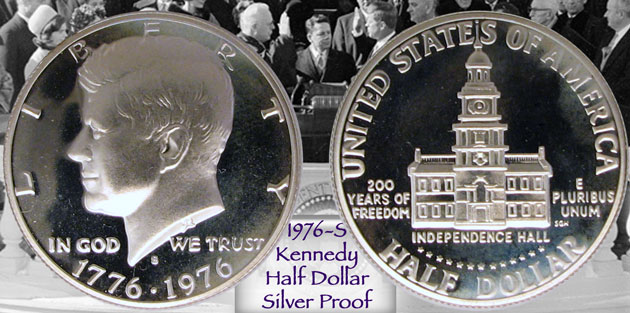 There has been one design change to the coin and that occurred in 1975 and 1976 in honor of the American Revolution Bicentennial. A special reverse depicting Independence Hall in Philadelphia was designed by Seth G. Huntington. For both years, the obverse featured the dual date 1776-1976 in celebration.
John F. Kennedy would have been 95 years old on May 29, 2012.
S Mint Celebrates 75th With Eagles and Quarters
This week, the U.S. Mint branch in San Francisco opened its doors for the press in honor of the facility’s 75th Anniversary. Reporters were given a tour of the production lines and spoke with employees of the U.S. Mint about upcoming collectibles.
Here is the story that appeared on KTVU, Channel 2 in San Francisco (commercial embedded by KTVU):
The U.S. Mint has clearly increased production to meet a potential demand for the American Silver Eagle Proof set with both regular proof and reverse proof coins for the upcoming sale. In the video we see a lot of silver planchettes and a few racks of beautiful silver coins. A pair are shown to the camera including the reverse of the reverse proof.
We also learned that the San Francisco Mint is striking circulation quality (business strikes) National Parks Quarters that will be distributed in special collectibles. These coins will not be added into circulation.
San Francisco Mint Plant Manager Larry Eckerman made an unfortunate mistake when he said that there has not been any S mintmark coins in circulation since the early 1950s. Collectors of Lincoln Cents can tell you that S mintmark cents were issued starting in 1968 through 1974.
The 2012 American Eagle San Francisco Two-Coin Silver Proof Set goes on sale starting June 7, 2012. Coins will be minted to demand based on sales through the end date of July 5, 2012. Price will be determined prior to sale and based on the cost of silver. Here’s to hoping that silver prices drop between now and June 7!
Video courtesy of KTVU San Francisco.
ANA Restructures Shows But Needs More Education
During the National Money Show in Denver two weeks ago, the American Numismatic Association Board of Governors voted to eliminate the Fall edition of the National Money Show following this fall’s show in Dallas.
The fall show, pursued by former ANA Executive Director Larry Shepherd and accepted by the previously Board of Directors. Unfortunately, it has proven to be too much of an expense for the ANA especially since the Denver show did not have a featured auction, which helps produce revenues for the ANA.
In previous press releases from the ANA, President Tom Hallenbeck has reiterated that the mission of the ANA is education. Do these shows promote their education agenda? One can argue it does because the ANA offers classes and sponsors Numismatic Theater which allows for shorter presentation of various aspects of collecting. But the Board has concluded that the costs of sponsoring the shows does not justify holding them.
There have been other articles saying that the ANA could also end the Spring National Money Show after the 2013 show in New Orleans. This would leave the World’s Fair of Money that is held every summer and for the five years starting in 2013 will be held in Chicago.
Eliminating the National Money Show and limiting the World’s Fair of Money to one city significantly reduces access to the ANA’s education services. Although the ANA does take some courses on the road to regional shows, the only way to be involved with a the broad spectrum of ANA education services is being limited to a show in Chicago and the Summer Seminar in Colorado Springs.
In previous posts, I have come out against holding the ANA premiere show in one location. While I love Chicago and have friends in the Chicagoland area, being able to move the show to different venues allows the ANA to reach more people and include it educational agenda in more places. I would rather see the ANA unbridle itself from Chicago than end the Spring edition of the National Money Show.
If the ANA Board of Governors wants to purse an educational agenda, which is a good idea, then they need to reach out beyond Chicago, Colorado Spring, and the courses held at the F.U.N. show in January.
One idea is for the ANA to work with regional clubs to bring ANA courses to shows in various areas. Even when the show is owned by a commercial entity, clubs can work with those promoters to add value to the show by offering ANA sponsored courses. The ANA can help provide materials, instructors, and training for new instructors to provide a greater educational reach.
Another idea is for the ANA to help by developing a speakers’ bureau to bring special speakers to regional shows. The ANA would help with travel expenses for those who cannot provide long distance travel to bring various numismatic topics to areas of the country that would not be able to hear these speakers.
In fact, the speakers’ bureau would help support coin club speakers. Collector willing to share their stories and industry professionals who want to share their knowledge can register with the speakers’ bureau and make themselves available to local coin clubs in support of their educational programs.
By the way, if anyone in the Mid-Atlantic region is looking for a speaker, I have two presentations ready: one on Maryland Colonial Currency and another on the history of anti-counterfeiting technologies used on currency.
In the mean time, if you have information that you can share with a local club or a regional show, reach out to them and offer yourself to help in their educational programs. It can go along way to help the hobby.
Ebay Welcomes Back ANACS and ICG
Online auction site eBay sent out a notice today to sellers of coins to remind us that their new listing policies for coins go into effect on May 31. They also announced that ANACS and ICG has met their new standards allowing coins to be sold as graded.
Coins from other services must be listed as raw including those old PCI slabs with J.T. Stanton’s autograph, which some believe are collectible in themselves.
In eBay’s last note to sellers, they wrote, “We’ve heard from both buyers and sellers that they’d like to see more coins on eBay graded by companies who meet high standards. These new requirements are an important step toward meeting these marketplace demands.”
I am still waiting to asked by eBay what I think as both a buyer and seller.
It is good to see that ANACS and ICG were able to work with eBay to be included in their new policy. Unfortunately, the policy still places restrictions on a competitive market for legitimate collectibles.
Blog News
Over the last few weeks I have taken advantage of a period of convalescence to work on a few things. I did not want this time going to waste.
First, I am writing a book about collecting. I am taking some of the stories that have been posted on the blog, rewriting them to fit in the context of a book, and adding new content. Some of that content has appeared as posts over the last few weeks. Buyers of the book will have content not published on the blog and a ready reference for their collecting need. The current working title is Collecting Numismatics: A Guide To Enjoying Your Collection.
A feature that will set this book apart from others is that it will be available in e-book format only! It will be available to purchase from the major e-book retailers. The price has not yet been determined, but it will be affordable.
Another project has been to set up an account on Pinterest. Pinterest is the newest entry on the social media scene that is based on sharing images. Think of it as Twitter but with pictures. Users create boards and pin pictures to their boards, whether the pins are from other websites or uploaded. The images of the 350 New Israeli Sheqalim I posted on Sunday May 13 were uploaded and pinned to a virtual bulletin board on Pinterest.
There are not a lot of coin people on Pinterest, yet. The ANA Pinterest account was used during the National Money Show in Denver to pin photos from the show. I will use it in June for the Whitman Baltimore Expo. Hopefully, we can interest more coin people to join and share their pictures.
 For the big news, the Coin Collectors Blog will be moving! If you follow me on Twitter, you might have seen a tweet about the “SNEAK PEEK” of the new blog. You can see the new blog at coinsblog.ws. I thought that after 5½ years and over 850 posts, it was time to try something new.
I am planning on a June 1, 2012 move.
If you are subscribed to the RSS Feed from Feedburner at http://feeds.feedburner.com/CoinCollectorsBlog or subscribed for email updates from Feedburner, then you will continue to be notified when new articles are posted. If you are not using the Feedburner feeds, you might want to change now so you do not miss anything.
Please do not submit comments on the new blog because they will be deleted! In order for me to ensure that everything is properly transferred, I will be wiping out the entire database and reloading all of the posts saved from the current blog on May 31 to start fresh.
Once the blog is transferred, I have some ideas I want to try. Stay tuned!
Support the Coin Collectors Blog
 Buy me a coffee
Thank you for your support!
Let Me Know What You Think
Are you going to the World's Fair of Money
Total Voters: 17
 Loading ...