
SCAM ALERT: LIACOO IS SELLING FAKE SILVER EAGLES!

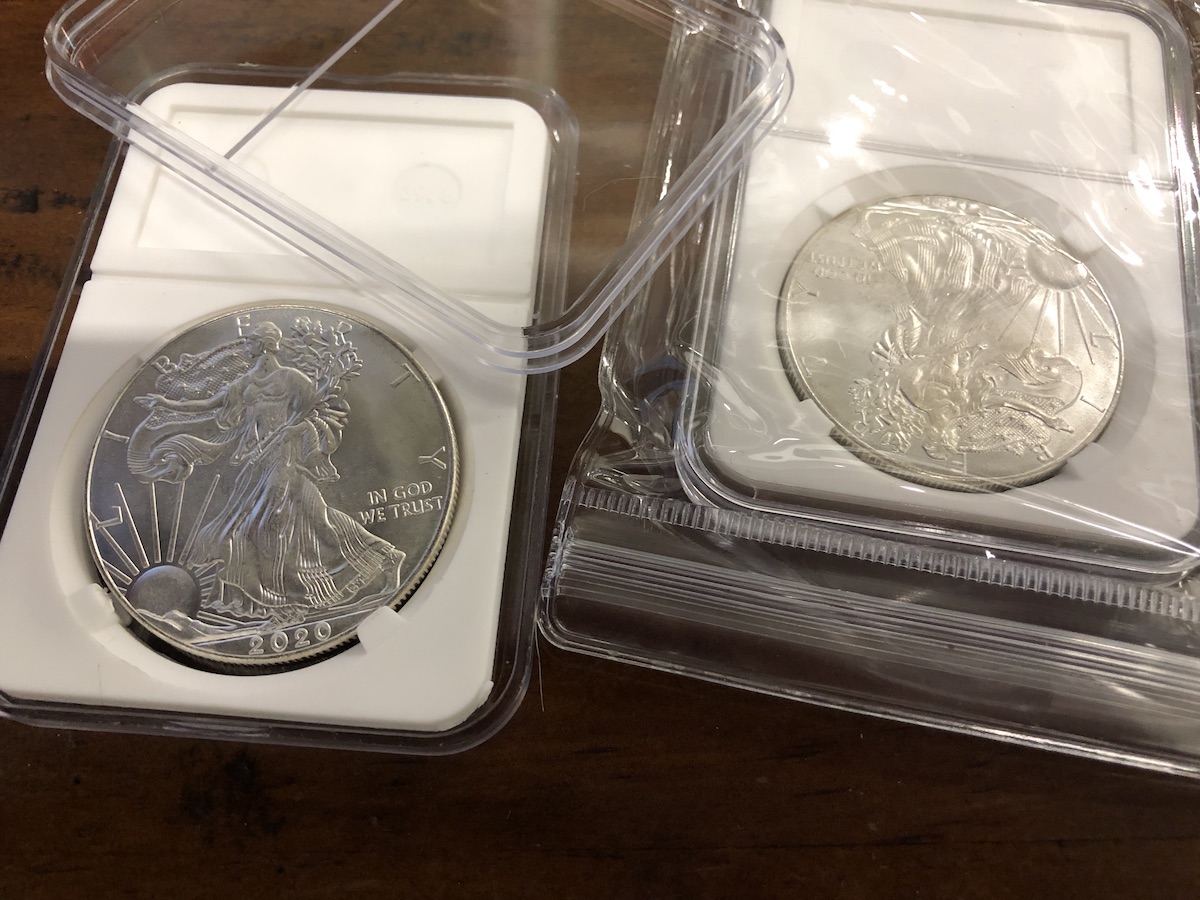
Two counterfeit American Silver Eagles purchased from LIACOO, a company based in China.
THE COINS ARE COUNTERFEIT! FAKES!
I ordered the coins on June 4, the day I posted the article. The coins were shipped from China to California to New Jersey to my office. LIACOO used the services of Newgistics, which is now a subsidiary of Pitney-Bowes. By using a logistics company in this manner, they can hide behind the anonymity of the service.
Contacting Pitney-Bowes is nearly impossible. I left a very public message on Twitter. Let’s see if they respond.
When the coins arrived, I opened the package and started to examine the contents. The coins are in a slab-like holder similar to the Coin World holders but without the Coin World logo. At first glance, they look fine, and then a closer look revealed problems.
My first impression was that there are almost no rims on the coin. A closer look at the obverse, and the font is too thin for the LIBERTY around the coin. Then I turned the coin over to focus on the U in United. It is missing the tail on the right side of the U. I did not need to see any more to be convinced this was a fake coin.
-
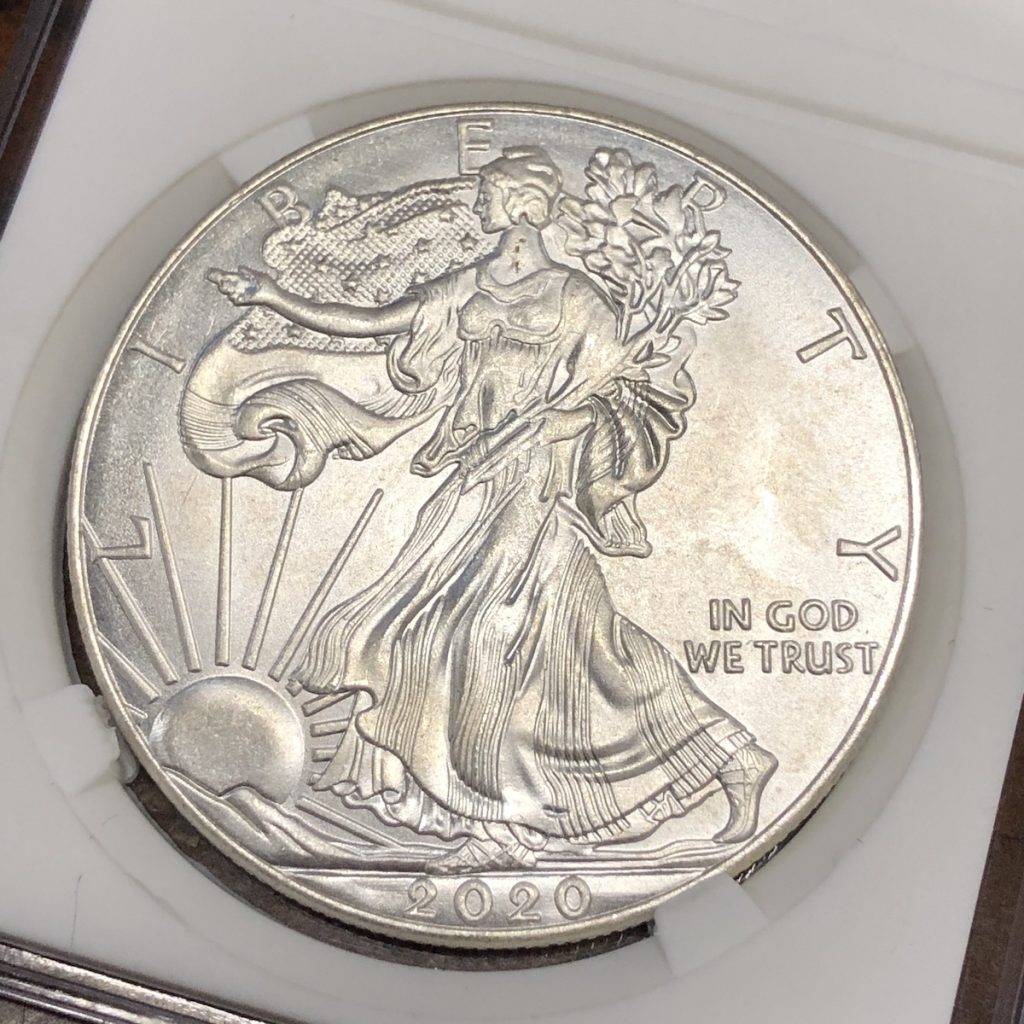
- The font for LIBERTY is too thin. Also, the stars in her flag draped over the shoulder are too small.
-
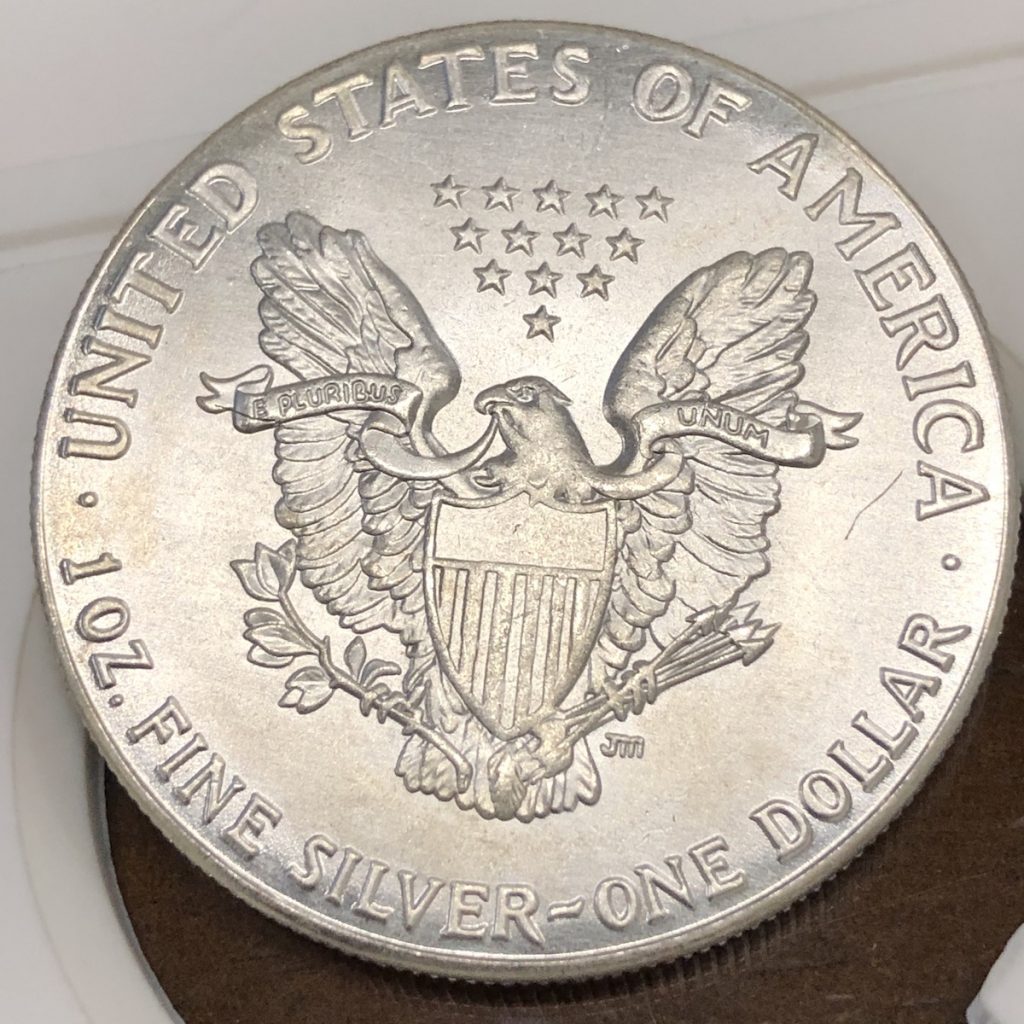
- Aside from the rims being to thin, look at the U in United and the dash between SILVER and ONE. These are not correct for the 2020 ASE.
Finally, I removed the coin to weigh it. An American Silver Eagle is supposed to weigh just slightly more than one troy ounce because it is only .999 silver. Since my scale only measures grams to the tenths of ounces, it should have weighed 31.1 grams. It weighed 25 grams.
The coin is not magnetic.
I will investigate further, but I wanted to report my initial findings.
DO NOT BUY CHEAP EAGLES FROM RANDOM WEBSITES!
I bought these coins to prove my point. I knew I was potentially buying fakes. I spent less than $30 for education aids.
Unfortunately, two correspondents wrote to tell me they each bought ten coins from different dealers. They spent $19.95 per coin. Both lost over $200 with the shipping costs.
IF YOU CANNOT IDENTIFY THE DEALER, THEIR EXACT LOCATION, AND THEIR BUSINESS STATUS, THEN DO NOT BUY THEIR COINS!
LIACOO is a scam. It is a company based in China. DO NOT BUT FROM THEM!
Follow Me On My Star-Spangled Adventure
Today, March 5, 2012, the 2012 Star-Spangled Banner Commemorative Coins will go on sale with a launch ceremony at the the Fort McHenry National Monument and Historic Shrine. Program is scheduled to begin at 11:00 A.M. at the Visitor Center and sales to begin at 11:30 A.M.
According to the media release from Maryland War of 1812 Bicentennial Commission, the group organizing the bicentennial of what historians consider America’s second revolutionary war against the British, “Those who purchase a coin that day will receive a Certificate of Authenticity from the United States Mint and a special acknowledgement from the Maryland War of 1812 Bicentennial Commission.”
In addition to the coin sales, specially made chocolate versions of the coins will be offered by Kirchmayr Chocolatiers, a Baltimore company specializing in fine European chocolate.
If you cannot make it to Baltimore for the launch, fear not! Your intrepid blogger will be making the trip, camera and iPhone in hand. As part of the trip, I will be live tweeting on Twitter from Baltimore. Follow me @coinsblog to read about the ceremony and see some the pictures I take. I plan to shoot video of the ceremony and will post an edited version later this week.
 Did You Know?
Fort McHenry aerial image and nugget courtesy of the National Park Service.
Numismatic Myths or Are They?
Coin collectors love a good story, even if it is not true. New research substantiates some myths and refutes others. Many myths and popular stories include some elements of the truth or historical events. Some are simple historical events, others concoctions to make the inventor seem more important, or to pump up the value of a coin or collection.
This essay will relate a few well known numismatic myths stories and then tell you what really happened. The reality comes from new research in the national archives, museum collections, university archives, Library of Congress and the personal papers of many of the participants. Whether you prefer the “myth” or the “reality,” it is hoped that you will find them both a good story.
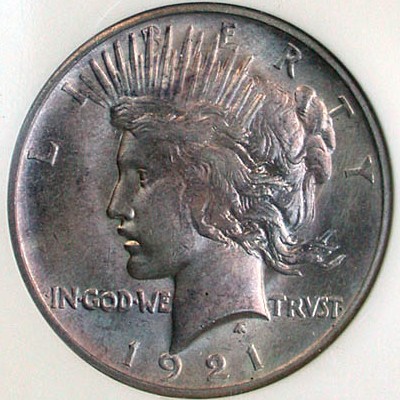 According to numismatic researcher Walter Breen, writing in his Encyclopedia of U.S. and Colonial Coins, the 1921 high relief design was too high to strike properly. So mint engraver George Morgan took a board and whacked the galvano until it was flatter and lower in relief. Morgan then cut new hubs for the 1922 and subsequent issues. Did this really happen?
Research shows that there was no flattening of the galvano as claimed by Breen because there never was a galvano. Designer Anthony de Francisci supplied his own bronze casts. Two other intermediate relief versions were made in January, 1922. Both were failures. Finally, de Francisci made new, low-relief models for 1922 and trial strikes were made and approved on February 14, 1922.
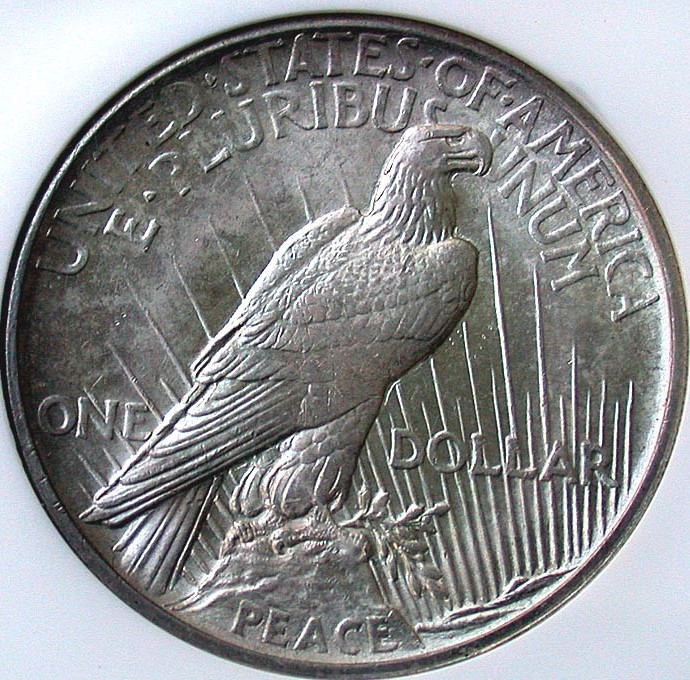 Another popular story says that in December 1921, just before the first coins were to be struck, Congress objected to a broken sword shown on the reverse. Since there was no time for the designer, Anthony de Francisci, to make new models, Mint engraver George Morgan quickly created a new reverse and used it in place of the original. This saved the project from failure. Did this really happen?
The design competition called for one obverse design and two reverse design. De Francisci submitted two reverse designs to the Commission of Fine arts on December 10, 1921. One design resembled the eventual design. De Francisci modified this reverse design using suggestions from James Fraser. This included a broken sword held by the eagle. The design was approved by the Mint director, Assistant Treasury Secretary, the Secretary of the Treasury, and President Warren G. Harding. A bronze cast was made of this design and sent to the Philadelphia Mint where engraver George Morgan cut a hub in preparation for striking coins.
In announcing the new coin, a Treasury Department press release mentioned a “broken sword” was part of the design on the reverse of the new coin. This was noted by the New York Herald in a scathing editorial. Subsequently, cards, letters, telegrams, and phone calls objecting to the broken sword swamped the Mint, Treasury, congress, and White House. Fraser and CFA chairman Moore suggested that the sword be cut out of the steel hub. Mint director Baker was on his way to San Francisco, so assistant secretary Malburn and acting director O’Reilley gave instructions for Morgan to do the work.
Beginning early on December 23, Morgan, accompanied by de Francisci, began removing the sword from the hub. He also had to work on the master die to compete the removal. Morgan added an olive branch and made other changes. No public mention was made of Morgan’s work. Treasury simply told the public that the sword was in one version but not the version that was used. Morgan saved the Peace dollar from failure.
 A persistent Buffalo tale is that in preparing the hubs and dies, engraver Charles Barber eliminated most of the field texture contrary to designer James Fraser’s wishes. Another is that Barber also made the bison on plain version without the sculptor’s approval. Fraser was very upset about the way his design had been treated. Is this true?
According to Fraser’s written comments:
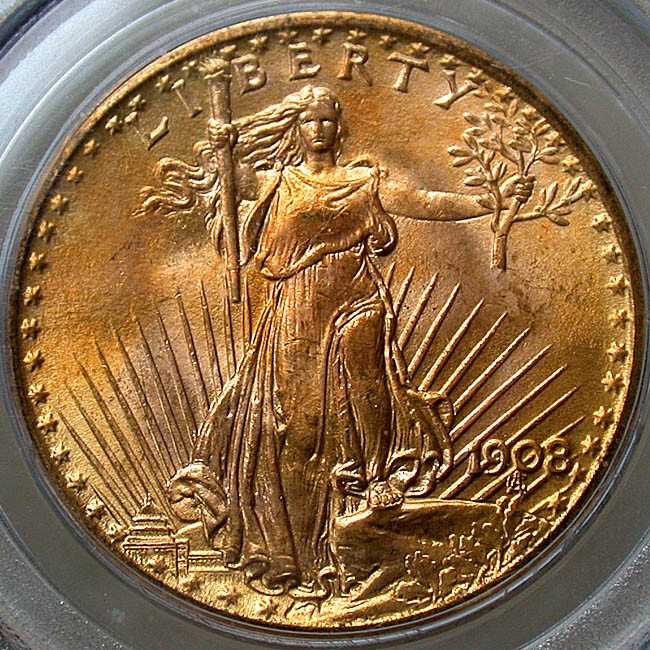 One of the most popular and attractive coins ever issued by any country. As would be expected from a coin created through the cooperation of President Teddy Roosevelt and sculptor Augustus Saints-Gaudens, there are many interesting stories about the people involved. One story goes that Mint engraver Charles Barber, who harbored an intense dislike for Saint-Gaudens, was unable to make low relief dies from Saint-Gaudens’ models in late 1907. In another story, to get the coins into normal production Barber made new models copying Saint-Gaudens’ design but introducing his own variations, including changing the date to European digits, that damaged the artistic quality of the coin.
Saint-Gaudens provided the first two plaster models. The first model was delivered in December 1906. The second was the Very High Relief model that was used to make the high relief MCMVII pieces. Henry Hering submitted a third, lower relief model with European date as agreed in May. The relief on the third model was too high to coin with the Mint’s production equipment. Using the Janvier lathe caused too much detail to be lost in the reduction making the design dull and washed out. To get the coins into production as Roosevelt wanted, Barber recut detail into the hub by hand. Result was the 1907 production coin.
Henry Hering, who was Saint-Gaudens’ principal assistant for the coin design project, says that he anticipated problems with the mint over the relief of the coins, and had reductions made of Saint-Gaudens designs in Paris. These were in several different reliefs. Although the mint eventually turned out acceptable low relief coins, the officials refused to pay Mrs. Saint-Gaudens for her late husband’s work. Henry Hering claimed in his 1947 article in the Numismatist that the quality of reductions for the reverse of the $10 coin was an issue. Hering claimed the Mint refused to pay Augusta until he proved the Mint’s reductions were inferior by comparing them with ones he had ordered from Paris.
Well, not really…
Negotiations between the mint and Saint-Gaudens’ Estate were handled by Charles Brewster, Augusta’s attorney. They finally settled on a payment of $6,000. Plus Augusta was sold one of the two Extremely High Relief (EHR) pattern pieces from the Mint collection for $20 plus postage. By November 1907, Hering was superfluous and more of a nuisance than anything else. He had no role in helping Augusta get the money the mint owed her.
Adapted from the presentation “Myths and Tall Tales” by Roger Burdette given to the Montgomery County Coin Club on March 13, 2007.
All images courtesy of The Coin Page.
How Coins Are Minted: 1920s
When I went to college for my undergraduate degree, the university’s programs did not include the ability to “minor” in a subject. Aside from the core courses, we were allowed to take eight classes in our major and four electives. Along with other requirements fill-ins I was able to take history and political science classes that would qualify as a minor today. It made taking some of those required courses tolerable.
History is what makes numismatics interesting. If you look beyond the shiny metal disks, you can follow the history of the country by studying the history of the numismatics. From the first Chain Cent through the Presidential Dollars, each coin tells the story of its time. What is even more amazing is that there are people researching further than ever before and finding new information that improves our knowledge. Others are looking at that history in different ways to better understand this history better.
When a friend sent a link to a recently discovered video about the manufacturing process at the U.S. Mint, I saw it as an opportunity to see where the U.S. Mint has come from. Ignoring the opening and closing titles from the company that posted the video which provides little relevant information, the film shows the process of manufacturing coins at the U.S. Mint in the early 20th century. Watch:
There is very little in the video to try to ascertain when the film was made. To try to date this film, let’s apply a little History Detectives-like logic. Looking at the video:
- Silent films started sometime in the late 1870s with experimental films. The first narrative film was created in 1888 and by 1894, silent movies began to be shown in public spawning the initial growth of local movie houses.
- The problem with early film was that the movies were in black and while and shown as very stark on the screens. Two methods were used to “mute” the shading. One was to shoot the movie darker using darker backgrounds and lighter foregrounds. The other was tinting. Tinting added color and contrast by using special solutions of salts or dyes replacing some of the silver particles in the developing solution. Tinting was first used in 1898 but was not used on a regular basis until the early 1910s.
- Intertitles, the full screen words drawn on paper and intermixed between scenes in the folk to help narrate the story, began in 1899 but were in common use by 1901.
- The silent film era began to fade quickly after the release of the first “talkie,” The Jazz Singer, in 1927.
Based on this, we can assume that this was filmed between 1910 and 1927. But what does the film show? A lot of manual processes but the use of electricity to drive the machinery. This does not help narrow the dating except there was a large mintage of silver coins being shown. At the beginning there were also large stores of gold and silver and it film showed how the metals were smelted, formed into bars, and rolled flat to make the planchets.
At around the 36-second mark, the intertitle says “Another tidy fortune—$60,000 worth of silver bars ready to be converted into dollars, half dollars, and church collection.” (emphasis added) Converting silver into dollars stopped in 1904 and did not start again until 1921. The scenes makes the U.S. Mint look very busy and the striking of silver dollars to back silver certificates were necessary following World War I. Remember, the Pittman Act was passed in 1918 to allow the the melting of no more than 350 million silver dollars into bullion where a total of 259,121,554 ounces were sold to Great Britain at $1 per ounce to help them pay for the war. When the silver was replaced by mining and being paid back by Great Britain, it became important to replace the melted coinage for backing of silver certificates.
Providing the maker of the film did not take a little editorial liberties, that shifts the date of the film in the era of 1921-1927.
At 3:59 an intertitle is shown that reads “A forty-ton friction drive press stamps the die which later stamps the coin.” Then at 4:07, we are show the top of the friction drive press that pans down to a Mint worker positioning the dies in the press. But the press does identify itself. Arching across the top it reads “TAYLOR & CHALLEN LTD ENGINEERS BIRMINGHAM 1907.” Then below on the house for the large screw it says “PRESS 724.”
 Taylor & Challen Ltd. Engineers were based in Birmingham, England. Founded in 1850 by Joseph Taylor, the company quickly rose as a leading maker of coining equipment. Their popularity came from being able to improve on the knuckle-joint action to efficiently strike and eject coins quickly from the press. According to one reference, the Model 724 was used in what we today call “hubbing,” the creating of the die by pressing the master hub into the die. What made the Model 724 well suited for this task was that the way Taylor & Challen was able to make construct the friction drive to provide the 40 tons of steady force at a slower speed than other presses to raise the clearest images on the dies with a single pressing. The U.S. Mint installed their first Model 724 in 1911 and was in use until 1933.
Just as Taylor & Challen out engineered their competition, they were out engineered by the Schuler company of Germany. Schuler invented the mechanisms to strike coins vertically so that gravity was used to speed up the striking process. Schuler remain the most popular presses around the world, including at the U.S. Mint. Taylor & Challen was never able to catch up and eventually went out of business in 1970.
As interesting as learning about Taylor & Challen was, it did not help narrow the date.
Unless I missed something, the only other observation was that most of the coins being shown in various forms were quarters. The bag tipping over at the end held a lot of quarters—Standing Liberty Quarters to be exact. So let’s say that this film was not taken in 1921 because the U.S. Mint was busy striking silver dollars. Since no quarters were struck in 1922, I can assert that the film was made between 1923-1927. I think that is as far as I can go with the evidence I can see.
If you have additional information or see evidence that I did not catch, please leave a comment to this post.
Image of the former Taylor & Challen building courtesy of Roger Marks on Flickr
E-BOOK REVIEW: Wild World
 For the second time in a year I read a fiction e-book because its premise is coin-related. This time, I read Wild World by Ginger Rapsus. Rapsus is the author of United States Clad Coinage published in 1992 and is currently a columnist for Numismatic News. Her website says that she began writing fiction “a few years ago.”
Wild World is the story about Stacey Morgan, a nurse’s aide that works in a large Chicago hospital, who inherited an old silver dollar. Not being an expert in coins, Stacey researches the coin on the Internet and begins to realize that she has something special but not sure how special. The coin, an 1873 Seated Liberty Dollar, is something special because none exist except in the world of fiction writers.
After discussing the coin with her friend Peg, a nurse who works on the same hospital ward, Stacey plans to go to a coin show to try to figure out what her coin was worth. The story is woven between Stacey dreaming about a better life away from the grind of being an aide at the hospital and how the grind at the hospital is driving her to find out more about the coin.
Stacey and Peg are young women, both basically starting their respective careers. In some ways, Stacey envies Peg a bit for being a nurse while she was not being treated well as a nurse’s aide. Both women are not only interested with improving their future, hopefully out of that hospital, but finding a life partner.
Not knowing how to approach the coin community at the coin show, Stacey brings Peg for moral support. Both being young women also think about meeting someone interesting at the coin show but Stacey is more interested in finding out the value of her coin. They playfully play their “what if” scenarios as they ride the train to the show.
The women arrive at the coin show and go on their separate ways. Peg is looking for someone to date as Stacey tries to figure out who to talk with about her coin. After roaming the floor for a while, Stacey approaches a dealer who is less than friendly and tries to take advantage of her. While Stacey was being disappointed by this dealer, Jacob Grant, a numismatist with a secret about his real life, steps in and rescues her from this unscrupulous dealer.
Jacob helps Stacey talk with dealer who is an expert on dollars. Ironically, it was a dealer who Stacey discounted talking with because of a mistaken impression she made from the Internet. Stacey showed the dealer the coin and the adventure begins. In a scene that resembles the authentication of the George Walton 1913 Liberty Head Nickel, the unique 1973 Seated Liberty Dollar was considered authentic and became the buzz of the show.
Stacey was overwhelmed with how the coin was received by the people at the show and how she was treated by Jacob. In fact, she began to fall for Jacob. As the story unfolds, Stacey became disturbed by an incident at the coin show involving the first dealer she spoke with which she would learn that misinterpreted. Also, Jacob has a secret life and was worried that his secret was unsavory until she learned he is a professional football player in Chicago.
Wild World is written from the perspective of Stacey Grant, a somewhat naive young woman with no experience in the numismatic world. She has some preconceived notion of the people in that world, but later discovers that while some stereotypes are true, most of the time, the coin world is filled with “normal” people with an interest in coins. For the non-numismatist, this may help change their attitudes on coin people.
As a story, Wild World flows well after the first two pages, which I have described as a “word salad” trying to say too much to set the scene. The story paints a good mental picture that would help both those experienced with coin shows and those who have attended large conferences to imagine how the scene would feel.
After Jacob and Stacey meet, the book handles the relationship building process between these two young people very well. Rapsus does not rush the relationship and keeps the Jacob and Stacey out of bed until the relationship really heats up. When it did come time for the bedroom scene, Rapsus wrote about it in a manner that I think would not be objectionable to most people—basically, not overtly descriptive while giving the reader an idea of the scene. It also helped build on the relationship between Jacob and Stacey that also helped explain how he deals with his secret life.
One lesson that I do not think Rapsus was intending on delivering was that you have to be guarded as to what you learn on the Internet. Stacey’s misinterpretation of what the good dealer had on his website is an example of how researching information online needs to go past single sources. It is also a subtle lesson to dealers that maybe they should consider hiring a non-numismatic editor to understand how those not in the numismatic community sees their public face.
My only real complaint about the book is that Rapsus uses “Clout” as the nickname for the Chicago professional football team while using the real names for other NFL teams that the Clout plays. While the team, stadium, and Chicago landmarks have been fictionalized, not using Bears seemed out of place with the rest of the football-related story.
Wild World is only available in e-book form and available from the popular digital bookstores for $2.99, which is a great price. One of those stores described the book as being 150 pages. While what constitutes a page is different between e-readers, it does come in shorter than many other books I have downloaded making it a comfortable length even for someone who prefers non-fiction, like me. The story is well developed and only part of the ending is predictable. Since this is not a numismatic book but a work of fiction surrounding a numismatic setting, I am giving Wild World a specimen grade of SP67 because the first few pages need to be tightened a bit and the end should have been less predictable. Wild World is underpriced for the quality of the writing and should be on your reading list.
Cover image courtesy of Books by Ginger at booksbyginger.com.
Politics and Money Manufacturing
There is an old adage that the two things you should not talk about in polite company is sex and politics. While it is easy to avoid talking about sex when discussing numismatics, it is nearly impossible to avoid the periodic discussion of politics when discussing what happens before United States coins are manufactured. All other countries, the mint or the central bank has the authority over coinage in the same manner that the Federal Reserve has over the printing of paper currency. While there are a few laws to govern their processes, coin content, and how the money is distributed, the United States stands alone as the only country where the entire coin manufacturing process is codified in its law.
Discussion of the politics of United States coin production came back in my previous post, “Figures Never Lie But A Liar Figures” where I wrote that Senator Scott Brown (R-MA) asked the GAO for a specific slant on their report regarding the benefit of the coin versus paper accusing him of playing politics in the light of his heated re-election campaign. Comments both public and private accused me of acting in various self interests for political reasons.
First and foremost, this is not a political blog. My look into the politics behind the actions of congress, the laws they pass, and how they go about passing those laws are in the view of the collector of the coins being produced by the U.S. Mint. The views expressed here are favorable to the collector and the collector’s interest especially since I am collector.
To answer quite a few private emails, I am not a member of any political party. I am registered as “not affiliated” in the State of Maryland, a closed primary state. I have not been registered as a member of any political party in nearly 30 years and will not change this in the future. Also, the link about the heated campaign between Sen. Brown and Elizabeth Warren was supposed to be to another story at boston.com about the race—but the stories are so fluid that I cannot find the original link. I apologize for using the wrong link and have removed it from that posting.
But when discussing the manufacturing of money, I have to remind everyone that the U.S. Mint cannot strike any coin or medal that has not been prescribed by law. If the coin or medal has not been voted on by congress, signed by the President, argued over by the Commission of Fine Arts and the Citizens Coinage Advisory Committee, and approved by the Secretary of the Treasury, then it will not be produced by the United States Mint. That is a lot of politics from the idea for a coin up until the dies are made to manufacture the coin. You can read more about this process in this story that was published in Numismatic News
When a GAO report about coins or currency is issued and the media grabs onto it like a dog grabs a bone only to find out there is more gristle than meat in the story, I will comment on it here. If the issue has a political slant to it, I apologize, but that is the nature of how the money manufacturing process in the United States works and cannot be avoided. The only way to remove the politics from the money manufacturing process is to privatize the U.S. Mint and change many of the current laws (United States Code Title 31, Subtitle IV, Chapter 51, Subchapter II ) to give the reorganized mint more authority. As I have written in the past, privatizing the U.S. Mint is not a good idea. Thus, we are stuck with the politics.
Support the Coin Collectors Blog
 Buy me a coffee
Thank you for your support!
Let Me Know What You Think
Are you going to the World's Fair of Money
Total Voters: 17
 Loading ...