
Weekly World Numismatic News for May 24, 2020
 When talking about markets, the central theme is that investors hate instability. Whether the conversation is with the professional market maker or the individual investor, there is much uncertainty in the current marketplace.
When equity markets become unstable, investors run to cash or cash equivalents. Cash equivalents include investments like bonds, especially those issued by stable governments. The other investment they run to is precious metals.
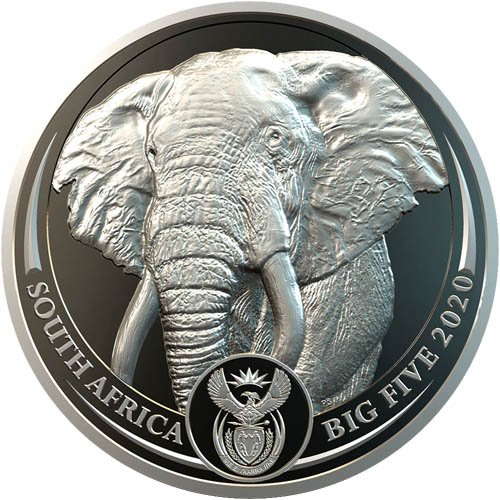
Gold is the primary safe-haven for investors. As a society, we have given this mineral an intrinsic value and trade it for a premium. With the panic of the U.S. Mint closing the West Point Mint for a short time, investors started buying platinum. The most popular form to purchase these metals is in coins where we saw the South African Platinum Elephant coins sell out its 2,000 coin production.
With the markets scrambling, it has opened up the door to scammers trying to cash in on the panic buying. Scammers use tactics like selling overpriced and overhyped coins, counterfeits, and not delivering coins after purchasing.
These scams are not new. Last year, the Accredited Precious Metals Dealer (APMD) program warned against scammers as the prices jumped. Unfortunately, the problem has only become worse.
Please do not fall for these scams. If you have any questions, contact a reputable dealer from the APMD, Professional Numismatists Guild (PNG), Industry Council for Tangible Assets (ICTA), or the American Numismatic Association dealer directories. You will be glad you did!
And now the news…
 May 18, 2020
 → Read more at fxstreet.com
May 19, 2020 → Read more at mining.com
May 21, 2020 → Read more at ca.finance.yahoo.com
May 22, 2020 → Read more at timesofindia.indiatimes.com
→ Read more at fxstreet.com
May 19, 2020 → Read more at mining.com
May 21, 2020 → Read more at ca.finance.yahoo.com
May 22, 2020 → Read more at timesofindia.indiatimes.com
How the 1955 DDO Cent Changed Numismatic History
 In the world of collecting, collecting coins with errors is a relatively new specialty. The specialty can be traced to the discovery of the famous 1955 Lincoln Cent Doubled Die Obverse (DDO), known as The King of Errors. Finding this coin lead to collectors to search for errors, varieties, and anything out of the ordinary.
What is a “Doubled Die?”
In order to strike coins, the U.S. Mint creates dies from hubs that contain the engraved image of the coins. The hubs are pressed into the dies to transfer the image. In years past, the U.S. Mint used to use what they called a two-squeeze process to make sure the die had a full image. This meant that when pressing the hubs into the dies, the die makers squeezed the two parts twice.
Sometimes, the process does not go smoothly and mistakes are embedded in the dies. In the case of the 1955 DDO Lincoln Cent, the hub and die did not line up correctly on the second squeeze. The result was lettering that appeared shifted or doubled.
Initial Reaction to the Coin
When the coin was discovered, there were two reactions. One group of people saw the coin as an exciting find and wondered whether it happened on any other coins. Another group was not as happy. They referred to the coin as “spoiled” and refused to acknowledge it as a valid collectible. Some considered the coin so unremarkable that one club publication wrote how they were having a hard time selling the coins for one dollar each.
A New Hobby Segment is Born
Those who were excited by the new find began to form clubs dedicated to the finding and education of errors and other variety in U.S. coins. They started the Collectors of Mint Errors (COME) club in 1956. As the nascent club tried to find its footing in the hobby, two factions began to form around different error and variety types. COME disbanded in 1960 because of the in fighting between the two organizations.
Some former members of COME came together again in 1963 to form the Collectors of Numismatic Errors (CONE). The people who formed CONE focused mostly on die varieties such as doubled dies, repunched mintmarks, major die breaks, die cracks, and die chips. Other collectors who were more interested in major minting errors like the 1955 DDO Lincoln Cent formed the Numismatic Error Collectors of America (NECA).
The two clubs existed for many years as rivals believing their form of collecting errors was better than the other. During this time, both clubs provided a lot of research into errors and varieties and how they could have occurred. The publications from both clubs continue to be the basis of the knowledge still used today.
Combining Forces
In 1980, the two organizations began to find common ground and discovered that it was better to work together than against each other. As the two clubs started to work together, many collectors became members of both clubs. To strengthen the hobby, both clubs voted to merge in 1983 to form the Combined Organizations of Numismatic Error Collectors of America (CONECA).
Finding Errors and Varieties
Today you can find error coins at your local coin store or by contacting a dealer specializing in errors and varieties. CONECA members will tell you that the thrill of finding errors is in the hunt. Error collectors use magnifying loupes, a good light source, and a lot of patience to examine coins to find something out of the ordinary. While there are some errors that are as visible as the 1955 DDO Lincoln Cent, others can be as subtle as outline of a small crack in the die, imperfections caused by two dies striking because the machine did not place a blank planchet properly between the dies, or the wrong die was used to strike the coin.
Errors can be found on any type of coin from any era. The error collecting community became excited when the processing of the new Presidential Dollars did not include the edge lettering; the edge letters were not aligned properly or doubled. While the U.S. Mint has improved the minting process, error collectors continue to find errors every time new coins are issued.
Starting an Error Collection
Anyone who wants to start searching for errors and varieties might want to buy a copy of Strike It Rich With Pocket Change by Brian Allen and Ken Potter published by Krause Publications (e-reader versions available). Now in its third edition, Strike it Rich will show you what to look for when you examine the coins in your pocket. According to the authors, a collector found a double die cast 1969 Lincoln cent in a roll of coins. When it was auctioned in 2008, it sold for $126,500.
Another great resource is Cherrypicker’s Guide by Bill Fivas and J.T. Stanton published by Whitman Publications. The fifth edition published in 2008 has more pictures, better descriptions, and a more complete resource with additional prices realized from various auction sources. A new edition is due later this year and should be available in e-reader formats.
Do not forget the resources of CONECA, which could be found on their website at conecaonline.org.
The 1955 DDO Lincoln Cent Today
As a coin desired by all types of collectors, a mid-grade coin you could have bought for $1 in 1960 is worth around $1,500 today. It is a coin that has held its value even during the current economic downturn but has not seen significant appreciation in the last ten years. Collectors will be happy the one they own will maintain its value. Investors should look to the highest graded coins that are designated as Red (full mint luster) or Red-Brown (some light copper oxidation) for better future returns.
More To Come
Hello. I hope you are still out there!
I am still here. I had to take time off to take care of something personal.
Over the next few days, I will post a few articles I started but did not have a chance to finish before having to take time off. I also have ideas about alternative collection options—one given to me by a member of my local coin club.
Having some time off, I had time to think about the blog and what to do in the future. I really like writing this blog and appreciate the feedback from those who read these articles. But it’s time to do more and make it more interesting. It’s time to go beyond the blog!
Over the next few months, I will be transitioning this blog off of Google’s Blogger to another hosting platform. Moving will allow me to offer more information in way that I can better manage from a central location. The new platform will include the blog, a podcast, and more. The “more” will be announced in the future.
To my advertisers: I sincerely THANK YOU for your support and I guarentee you will be transitioned to the new platform with the same terms and placement options as you have today. Eventually, there will be additional options to reach what I hope is a larger audience.
To my readers: Please patronize my advertisers. Keeping them happy will convince them to continue their support which will help with my new plans.
I promise you that my plans will be fun and different from what everyone else is doing.
Thank you for hanging out with me on the Coin Collector’s Blog. It has been a fun (almost) six years and I hope we can do many more together!
Make Me Learn Something New
Do you have a question?
Really… is there something you are trying to find out or do you have a coin you are trying to identify?
If so, drop me a note.
Over the last few weeks I have been receiving questions in some very odd places. Someone sent a question via Twitter about a coin that was made part of their avatar. Another person invited me onto Facebook wanting to ask a question. And recently, an anonymous person left a question as a comment to one of my posts.
I do not mind answering questions. In fact, I like the attention! And once I get past my ego loving the attention, I think I do a pretty good job answering questions. If I cannot answer your question, I have a few contact I can ask. A lot of times I learn something in the process, which satisfies my curiosity.
If you send questions asking about the identification of an item, I ask that you please send clear images of the front and back. These are great questions. Some of the images I have seen has lead to interesting stories including one about prohibition.
Please do not send offers to purchase or invest in anything. I will not respond to those requests.
Also, I treat all email as private communications. Private means that it will stay between you and me and will not appear on the blog. I will not publish anything we discuss on the blog without asking your permission. I promise!
You can click the link above to contact me or the Email Me link in the left column. Go ahead… make me learn something new!
A TR Collectible
My earliest memory of learning about Theodore Roosevelt was going with the Cub Scouts to visit Sagamore Hill, his estate in Oyster Bay, New York. Roaming through Sagamore Hill with my fellow Scouts brought fascinating images of Roosevelt’s trophies from his various hunts. The skins, heads, and an ashtray made from an elephant’s hoof made quite an impression on this group of 7-8 year olds.
A special memory was of the bathrooms. Aside from looking very primitive compared to what we have in our homes even in the mid-1960s, but our Cub Master, who was also my best friend’s father, was a plumber. At times, he was worked for New York City as a plumbing inspector. We had fun poking fun at him using the facilities at Sagamore Hill as a background!
When I learned more about United States history in high school, I read more about the life and presidency of Teddy Roosevelt. I was impressed with his background of working through his health issues, was fascinated to read of his life in the Badlands in South Dakota, and interested to read about his political life as someone who demonstrated a great regard for the law and someone who wanted to make things better. Although I was not as physical as Roosevelt, his principled stance made an impression on me.
Before returning to collecting, I read The Rise of Theodore Roosevelt by Edmund Morris. It was not the easiest read because Morris used the late Victorian writing style that was popular during Roosevelt’s life. Once I became used to the style, Morris brings the reader along with Roosevelt into the mud of the Badlands, the halls of the New York legislature, as one of the police chiefs of New York City, Governor of New York, Secretary of the Navy, and Vice President. Through Morris’s words, it was like riding that freight train what was Theodore Roosevelt.
I returned to collecting in 2001 following the death of my first wife. During a particular spending spree, I bought Morris’s second volume, Theodore Rex. Although I never finished this book—only because of timing—my interest in Roosevelt continued to grow.
Then I learned about Roosevelt’s “Pet Crime.” I learned how Roosevelt conspired with Augustus Saint Gaudens to improve U.S. coin design. I learned how Roosevelt was influenced by immigrant Victor David Brenner to have the U.S. Mint issue the Lincoln Cent. I learned how the seeds of his “Pet Crime” lead to what has been called a renaissance of U.S. coinage.
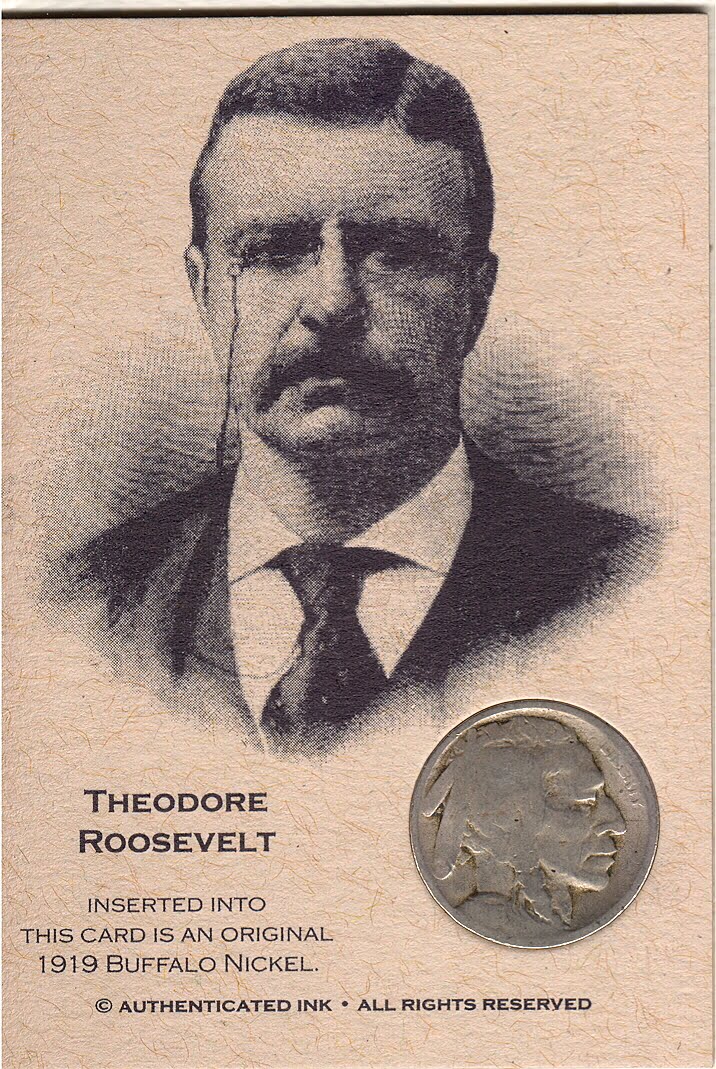 To say I am a sucker for Theodore Roosevelt memorabilia would be an understatement. Although I do not have many pieces, finding cool items is always a thrill. Imagine how my eyes lit up when I found a Theodore Roosevelt card with a 1919 Buffalo Nickel. I did not know much about it, but I had to buy it. The final cost was not that expensive, but it was so cool that I did not care.
When the card arrived, I was a little disappointed in that the card was modern and the nickel was very worn. I can change the nickel since 1919 Buffaloes are not that expensive. But I had to find out more about the card.
After asking around, I found that the company, Authenticated Ink, is an autograph collecting company that issued these cards in 2008 as a promotion. Authenticated Ink printed cards of sports and historical figures that included coins from the era of the person depicted on the card. I have had problems contacting Authenticated Ink (emails have not been returned), but sources tell me that there were not many of these cards issued.
It is a very cool collectible and has been added to my “oh neat” collection.
Always Remember
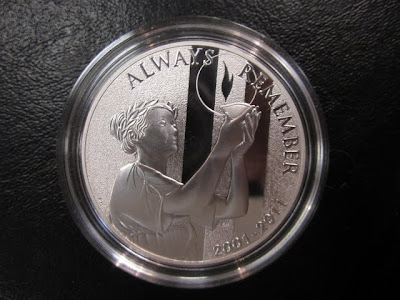 For those of us who lived through these events, the only marker we’ll ever need is the tick of a clock at the 46th minute of the eighth hour of the 11th day.
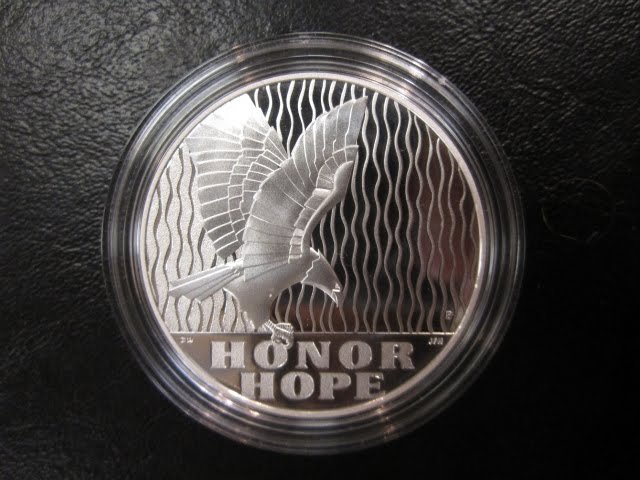
December 31, 2001
$10 from the sale of every 9/11 Commemorative Medal goes to the National September 11 Memorial & Museum.
Support the Coin Collectors Blog
 Buy me a coffee
Thank you for your support!
Let Me Know What You Think
Are you going to the World's Fair of Money
Total Voters: 17
 Loading ...