
Museum Week and Online Numismatic Collections
 The week of May 11-17, 2020, is supposed to be Museum Week. Museum Week started in 2014 to use social media to promote Galleries, Libraries, Archives, and Museums worldwide. This year, the online festival takes on a new meaning since most museums are closed because of the pandemic.
Learn more about Museum Week on their website at museum-week.org.
Let’s celebrate Museum Week by the looking at the most extensive numismatic exhibits that has some of their collection online.
National Numismatic Collection at the Smithsonian Institute
 The only way to start this list is with the largest numismatic collection of any type and that is the National Numismatic Collection at the Smithsonian Institute. With over 1.6 million coins, tokens, medals, and other numismatic objects, the collection includes United States, world, and ancient coins. The collection contains rare coins and patterns not seen anywhere else in the world. Amongst its holdings are famous rarities, including all varieties of the 1804 Draped Bust Silver Dollar, a 1913 Liberty Head Nickel, and two 1933 Saint Gaudens $20 Double Eagle coins. Also in the collection is a Brasher Doubloon, sometimes called the United State’s first gold coin, and a 1974 aluminum Lincoln Cent created by the U.S Mint to try to convince Congress to allow for its production.
When the National Museum of American History reopens, the permanent exhibit is The Value of Money that uses 400 items from the museum’s collection to portray the economic, artistic, and technology of money. Amongst the displays is the famous 1933 Saint-Gaudens Double Eagle, a $100,000 currency note, a personal check signed by James Madison, and a clamshell used to represent one-dollar during the depression.
Edward C. Rochette Money Museum
 The Edward C. Rochette Money Museum at the American Numismatic Association headquarters in Colorado Springs is the largest museum dedicated to the study of United States coins and currency that also covers the history of numismatics. With over 250,000 pieces, the collections contain famous rare coins, including the George O. Walton specimen 1913 Liberty Head Nickel, an 1804 Draped Bust Silver Dollar, and one of the three known 1866 No Motto Seated Liberty Silver Dollars.
The Rochette Money Museum is the home of the Harry W. Bass, Jr. Collection. Bass was interested in United States gold coins and had built the most complete collection ever assembled, including many one-of-a-kind specimens, of gold coins from 1795 through 1933. Bass’s collection includes the only complete set of $3 gold pieces, including the rare 1870-S, complete set of gold coins and patters from 1834-1933, and a set of 1896 Educational Series silver certificates including test printings and uncut sheets.
The ANA has posted several virtual tours for a good portion of the collection so that it can be seen without going to Colorado Springs. Collectors and ANA members might want to make a trip to visit the museum and the extensive numismatic library when they are allowed to reopen.
Coin and Currency Collections at the University of Notre Dame
 University of Notre Dame Libraries Department of Special Collections boasts one of the largest collections of colonial coins and currencies in the United States. The coin collection includes an Oak Tree one-shilling coin, a Continental dollar, and a 1792 half disme—the first coin-type struck by the newly established United States Mint. The colonial currency collection includes samples from nearly every emission and lottery tickets that were used to raise money to pay the costs of the Revolutionary War. The collection also includes Washington Tokens and Confederate Currency and our Nineteenth-Century American tokens. Visit their online gallery at coins.nd.edu.
Penn Museum Archaeology and Anthropology Coin Collection
 The University of Pennsylvania Museum of Archaeology and Anthropology has one of the most complete collections of ancient coins. But rather than displaying them as a coin collection, the curators at the museum present the coins with the various theme exhibits. Visit the ancient Roman section, and you can see the coins that defined the rule of the Roman Empire. All coins were found during archaeological visits to the regions of ancient civilizations. To see some of the coins in the collection, you can search their collection.
The Fitzwilliam Museum Coin Collection
 On the campus of Cambridge University, the Fitzwilliam Museum was founded in 1816 when Richard VII bequeathed his art and library holdings to the university. The Fitzwilliam’s Coins & Medals collection has over 200,000 objects including a nearly complete collection of ancient Roman coins issued after the murder of Nero. Amongst its collections are British and other Campaign and Gallantry Medals, European Renaissance medals, unique copper tokens handed out by the Cambridge chandler in 1668, and coins found casually and archaeological discoveries throughout England. The Fitzwilliam boasts of ongoing research into areas such as Indian and Islamic coinage. Visit their online collection Coins & Medals at fitzmuseum.cam.ac.uk.
Staatliche Museen zu Berlin
 The Coins and Medals collection at the National Museums in Berlin is well known as being very comprehensive and diverse, covering the beginnings of coinage through the coins of today. With over 500,000, it is one of the largest collections in Europe with extensive collections of Greek, Roman, and European coins from the Middle Ages to today. They also have an extensive collection of art medals dating from 1400.
The collection also contains an extensive collection of paper currency primarily from Europe and items used as money from all over the world. The non-coin collection includes tools and dies that were used to strike coins in Berlin since the 17th century.
The Staatliche Museen has one of the most extensive online catalogs of any museum in the world. Museum staff has created a website for users to browse their database of images and descriptions. The online catalog can be found (in English) at www.smb-digital.de.
State Hermitage Museum
 The State Hermitage Museum is located in Saint Petersburg, Russia is one of Europe’s largest museums. Their numismatic collection of over 1.2 million pieces is the most extensive collection known outside of the United States. The largest segment of their collection tracks this history of money in Russia from the ninth century through today.
The Hermitage Museums’ Oriental collection boasts of coins, money ingots, dies, coin-shaped amulets, and primitive currency of Asia, Africa, and neighboring Atlantic and Pacific islands. The collection includes a collection of very rate Sassanian coins and the 19th-century Chinese silver money ingots that are considered amongst the finest collections in the world. Discover more about their collection on their website at www.hermitagemuseum.org.
Do you know of any others?
Increase in Panda Production
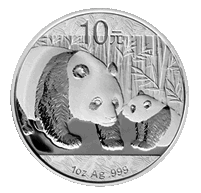 The People’s Bank, which governs the creation of coins in China, has announced that because the Panda coins are so popular they will be increasing production. In December, I wrote that the People’s Bank was plannning on a 10-fold increase in production. However, the recent announcement shows a somewhat smaller increase.
The largest increase will be in the 1⁄10 ounce and 1⁄20 ounce gold Pandas with a 4-fold increase. Silver 1 ounce Panda coins will double from last year. Mintages are being reported as follows:
| 2011 Pandas | 2010 Mintage | New Mintage |
|---|---|---|
| 1 ounce Gold | 300,000 | 500,000 |
| ½ ounce Gold | 120,000 | 200,000 |
| ¼ ounce Gold | 120,000 | 200,000 |
| 1⁄10 ounce Gold | 120,000 | 600,000 |
| 1⁄20 ounce Gold | 120,000 | 600,000 |
| 1 ounce Silver | 3,000,000 | 6,000,000 |
In some forums, it has been suggested that this increase would mark the fourth generation of the silver Panda coins. One source described the generations as:
| Generation | Weight | Content | Size |
|---|---|---|---|
| First Silver Panda Coins (1983-1985) | 27g | .900 fine | 38.6 mm |
| Sterling Silver Panda (1987) one year issue |
1 troy oz | .925 fine | 40 mm |
| Second Generation (1988-1999) | 1 troy oz | .999 fine | 40 mm |
| Third Generation (2000-2010) Change in artists |
1 troy oz | .999 fine | 40 mm |
| Fourth Generation Increased Production |
1 troy oz | .999 fine | 40 mm |
Some have called silver the investment vehicle for the masses. Silver has a silky color that allows for striking designs to be very visible. Because silver is less dense than gold, a one ounce coin made from silver is larger than a one ounce gold coin. This means there is a larger surface area for beautiful designs, like the silver Panda.
Silver Panda coin image and production data courtesy of CGCI
Explore a Money Museum on Your iPad
Have you ever been searching for something but ended up finding something even more interesting? This happened to me while searching the App Store for something to load onto my iPad. At the bottom of one page in the section “Customers Also Bought” I found an app called CoinsHD. Its description says:
The MoneyMuseum is a money and currency museum. Its core is the collection of Western leading currencies from over 2500 years.
Since it was a free app, I decided to download it and see if it was as interesting as the images on its app page.
 When the app started, there was no splash screen (GOOD!) and I was greeted with an image of a gold ½ Augustalis from the rule of Frederick II of Hohnstaufen (1220-1250) of the Holy Roman Empire. It is the first coin of 50 featured in the their main section. As I looked at the coin, an animation turned the coin over so I could see the reverse. It was so intriguing that I let the slideshow continue. The I figured that if I pressed the arrow in the upper right corner, I could advance the slides faster.
Pressing the Tours button at the bottom of the screen, there was a list of several coin types that spread a few screens worth as I scrolled down. There are 82 total tours with a variable number of coins. I came across a tour that said “From Pillar Dollars to Eagle Piasters—the History of the Peso.” Thinking it was mainly about Mexican and South American coins, I was surprised to see a Morgan and Trade Dollar as part of the tour.
 The descriptions of the tours are brief but informative without distracting from the stars of the app, the coins. The app has coins from all over the world including the United States. In the section about famous and important gold coins, there is a page dedicated to the Saint Gaudens Double Eagle displaying a 1916 coin.
Searching for coins is fast and the display shows off the coin and some basic information. Tap on any coin and see its information page. While playing with the app, I searched for Spanish coins looking for the Pillar Dollar (8 reales) coin. What I found were quite a number of interesting gold and silver coins issued by Spain over the years.
In addition to coins, there are some currency issues, most of which is from Switzerland. There is also a section about money that was created using other materials, such as a Ten Strings of Paudina Snails used in Africa during the 19th century.
 The app shows off the collection of the Money Museum in Zurich, Switzerland. The Money Museum is owned by the Sunflower Foundation. The museum and the app started with Dr. Jüerg Conzett building a private coin collection with the help of Marie-Alix Roesle and numismatist Leo Mildenberg. Wanting to share his collection with the public, Conzett create the first online virtual museum in 1999. Conzett founds the Sunflower Foundation later in 1999 with the goal to “resent the history of money and currencies to a layman audience for a better understanding.”
The app is easy to navigate and the images are fantastic. There are a few quirks in loading of the images, but they eventually work themselves out. The tours and information presented are informative, but it would be nice if there were options for a more in-depth description of the coin. Some tours could use more coins or information because there are gaps that makes me feel something is missing. Given how easy CoinsHD is to use and the excellent images, I grade this app MS66. It is a beautiful app and worth the price (FREE). I hope they can fill in some of the holes and provide more information in the future. In the mean time, there are over 2,000 images to keep you busy exploring the international world of money!
Here are screen images of CoinsHD I saved on my iPad:


NOTE: There is a a version of this app for the iPhone. I have not downloaded it but it looks as interesting as the iPad app.
What Do You Know About Your Coins and Currency?
I had a conversation with Linda, the blog author of Artifacts Collectors, she wanted to use the images of my Somalia Classic Sports Car coins in one of her blog posts. I then began to read some of her posts and found one that rang true with me.
In “How Much Do you Know About Your Collectibles?” she begins:
Part of what is so interesting about being a collector is the amount of knowledge you acquire while you are at it.
This simple, yet profound statement has greater meaning in numismatics during these economic times. Lately, collectors have been competing in the market with investors and speculators who are buying coins for their metal values with numismatic interest, such as classic (pre-1933) gold coins, or bidding up rare coins for their value and not as a collectible.
Dave Harper found out recently the differences in the mindset between the collector and investor during a recent seminar. Investors are buying silver for its silver values without understanding the nature of the coin market.
While we collectors like to see the value of our coins go up, we not only relish in the owning the coin, but what the coins says. Forget the fact that the 1909-S VDB Lincoln Cent is one of the most desirable coins by Lincoln Cent collectors, but what make it exciting is to understand why it is a great collectable. Or while the 1922 No “D” cent is as interesting as the 1955 Double Die Obverse.
Fortunately, over the last ten years there has been a an increase in the number of numismatic books that collectors can use to learn about their collectibles. We can read about the history of the U.S. Mint, the real life mystery of the most expensive coin to sell at auction, to one book for nearly every coin type.
With the growth of the Internet, we have sites that provide encyclopedic-like information, price guides, forums to discuss coin and currency collecting, and blogs for those of us who have a passion for the hobby.
Many years ago, Q. David Bowers, the noted numismatist, author, and dealer once said, “Buy the book before you buy the coins.” Bowers was convinced that the collector with knowledge would be able to protect himself from being taken advantage of when purchasing or selling coins. It is no coincidence that Bowers has been working with Whitman Publishing over the last few years to fill in the gaps of books for all U.S. coins series.
One of the goals of the Coin Collectors Blog is to help in the education process. Using my pursuits in collecting various numismatics, I enjoy researching the history behind these collectibles and share that information with you, the readers. I hope my writing has inspired you to learn more about your collection so you can share your knowledge with others.
9/11 Medal Launch
This past Tuesday, Treasurer of the United States Rosie Rios, U.S. Representative Jerrold Nadler (D-NY), and Joe Daniels, president and CEO of the National September 11 Memorial & Museum, announced the opening of sales for the 2011 September 11 National Medal at the 9/11 Memorial Preview Site. As part of the ceremony, Rios and Nadler presented a shadowbox containing the medal to Daniels.
Numismatic News’s Dave Harper reports that the U.S. Mint has sold 35,036 medals (21,256 “W” mintmarked and 13,780 “P” mintmarked). The authorizing law (Public Law No. 111-221 [Text] [PDF]) authorizes the production of 2 million one-ounce proof silver medals with a surcharge of $10 per medal will be paid to the National September 11 Memorial & Museum.
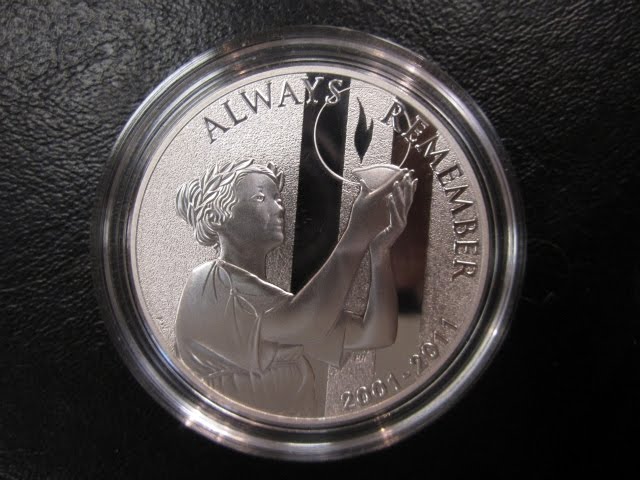
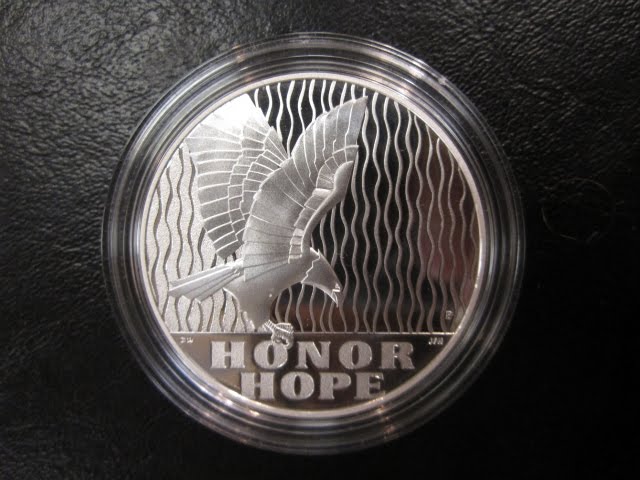 Although the images provided by the U.S. Mint are representative of the medal, there are many cases that the coin or medal looks better than the U.S. Mint’s image. While searching for a information about the launch ceremony, I came upon a story at DNAinfo.com, a website that covers news and events in Manhattan. The reporter, Julie Shaprio, was able to photograph an actual medal at the site. I was awed by the images of the actual medal. Once again, the photographs prove that the actual medal is much better looking than the U.S. Mint’s image.
The medal was designed by Donna Weaver, a former U.S. Mint sculptor-engraver now a member of the Artistic Infusion Program. The obverse was engraved by Phebe Hemphill and the reverse by Joseph Menna. All should be commended on an excellent job.
Image of the 9/11 Medal courtesy of Julie Shapiro of DNAinfo.com.
Click on the images to see larger versions.
Canada Introduces Its New Polymer $100 Note
The Bank of Canada formally unveiled their new polymer banknotes on Tuesday at its main offices in Ottawa. Canada’s central bank representatives explained the new currency designs and the security features that will be included in the notes. Minister of Finance Jim Flaherty said that the note’s “designs celebrate Canada’s achievements at home, around the world and in space. Bank notes are cultural touchstones that reflect and celebrate our Canadian experience.”
New polymer $100 notes, on schedule to be issued in November 2011, will feature images that focus on Canadian innovations in the field of medicine. The obverse of the note will include an updated portrait of Sir Robert Borden, Prime Minister of Canada between 1911 and 1920.
Security features of the note are two transparent areas that will be difficult to counterfeit yet be easy to check. Most prominent are two transparent areas: the larger area extends from the top to the bottom of the note and contains complex holographic features. The other is in the shape of a maple leaf. “The Bank’s objective with every new series is to produce a bank note that Canadians can use with the highest confidence,” said Bank of Canada Governor Mark Carney.
RCMP Commissioner William J.S. Elliott added, “These new and technically innovative notes will go a long way to deter the threat of counterfeiting in coming years.”
The Bank of Canada issued a video showing off their new $100 note and the security features:
Une version de cette vidéo en français peuvent être trouvés ici.
In the mean time, the Bureau of Engraving and Printing has been silent on the production and potential release of the United State’s new $100 Federal Reserve Note. Release of the new note has been delayed since its scheduled February release date because of production problems.
“The single biggest obstacle to successful production was the tendency of the $100 currency paper with the three dimensional security ribbon to crease as the sheets of paper fed through the intaglio printing press,” BEP Director Larry Felix reported in the bureau’s 2010 Annual Report.
I tried to contact a BEP Media Relations representative about the status of the new notes. I was told there was no additional information available.
I ask again: With the new $100 note having printing problems, why has the BEP not looked into using the polymer substrate for U.S. currency? Why does the Federal Reserve, BEP, and Secret Service cling to 19th and 20th century printing technologies in the 21st century? Or is this a matter of “not invented here” to avoid alleged controversy by using a something invented by a foreign central bank?
It is time for the money producing cabal of the Federal Reserve, BEP, and Secret Service to face reality. They need to cut their losses with paper and look to the future for something better.
Support the Coin Collectors Blog
 Buy me a coffee
Thank you for your support!
Let Me Know What You Think
Are you going to the World's Fair of Money
Total Voters: 17
 Loading ...