
Using Numismatics to Promote Remote Education

Chihuahua Revolutionary Banknotes
Inspired by “These Chihuahuas are not dogs,” that I wrote in 2018, I challenged teachers to dig through a junk box of old banknotes and use them as a teaching tool. Since we are now practicing social distancing, that is not an option.
An option would be to talk to a dealer and ask if they could help. Go to the American Numismatic Association’s dealers directory at coin-dealer-directory.money.org and find one near by. Call them and ask if they can help you and your students.
Most dealers have junk boxes. Junk boxes are coins and currency that are not worth the time and expense to handle. Ask the dealer if a student sent a self-addressed and stamped envelope with $1.00 would the dealer send the student something from the junk box. Ask the dealer to send a mix of items to different students like United States coins older than the students, world coins, currency, and a few tokens.
Once the arrangements are complete, instruct the students to write a friendly letter (gets them used to communicating in full sentences without emojis), enclose a $1.00 bill and a self-addressed and stamped envelope, and mail it to the dealer. When they receive their numismatic items, have each research the history of the era of when the coin, currency, or token was issued.
Rather than picking a topic, it is a fun way to have the students select a topic and make history come to life.
If your online classroom uses technology like Zoom, then have each student to a presentation to the class. If the class is using forums or written means only, let them write a paper and submit it for a grade.
Like my token trip to Spain and Venezuela, it will give the students something tangible to use as part of their learning experience.
-
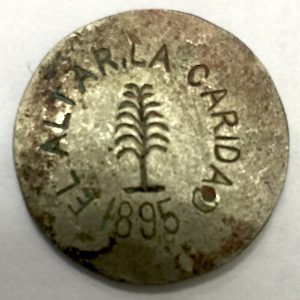
- Obverse of a token from Hacienda El Altar and La Caridad. The plant in the center is likely a cane that was popular in the region.
-
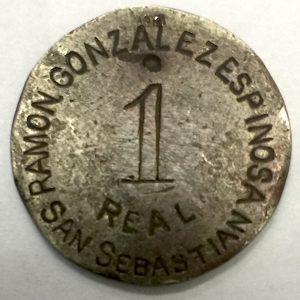
- Reverse of a Hacienda El Altar and La Caridad token declaring they were owned by Ramón González Espinosa from San Sebastián and is worth 1 Real.
Happy Birthday Teddy!
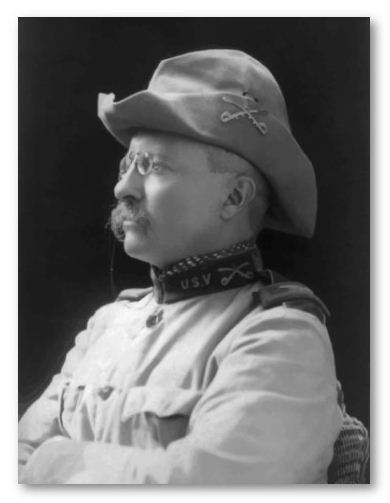 Although Theodore Roosevelt was born of wealth, he was a man of the people. Rather than becoming someone of society, Roosevelt sought to change society. From his days as an asthmatic child using hunting and other physical activities to overcome his weaknesses, his education at Harvard, conquering the Badlands of South Dakota, to a political career that changed nearly every level of government, Roosevelt was the renaissance of American history.
Before Roosevelt was 42, he was a deputy sheriff in the Dakota Territory, Police Commissioner of New York City, U.S. Civil Service Commissioner, Assistant Secretary of the Navy, and Colonel of the Rough Riders for which he was awarded the Medal of Honor. Roosevelt was elected to the New York State Assembly, Governor of New York, and Vice President of the United State. In fact, his nomination as vice president to run with William McKinley by the Republican Party was to get him out of New York because he was reforming the status quo out of existence.
 On September 14, 1901, at 42 years and 322 days of age, Roosevelt became the youngest President when McKinley was assassinated (Kennedy is the youngest elected president when he was inaugurated at 43 years, 236 days). As president he was a trust buster, conservationist, and his slogan of “Speak softly and carry a big stick” set the tone for military and foreign policy that even impacts today’s policies. Roosevelt was the first U.S. citizen and sitting to win the Nobel Peace Price for negotiating the 1905 peace treaty ending the Russo-Japanese War.
Roosevelt initiated the “Golden Age of American Coin Design.” Using his bully pulpit, he held the designs of the U.S. Mint Chief Engraver Charles E. Barber in contempt and ordered coinage whose designs were more than 25 years old to be redesigned. Roosevelt was a fan of sculptor Augustus Saint-Gaudens and asked him to help redesign American coinage.
After Saint-Gaudens died of cancer, Roosevelt continued to look to revitalize U.S. coinage. He seized upon Abraham Lincoln’s 100th birthday to redesign the small cent. He was steered to Victor David Brenner, whose bust of Lincoln was used as the model for the new Lincoln Cent first issued in 1909. Not only was Lincoln the first president to appear on a circulating coin, but Brenner’s obverse is still in use today.
Roosevelt called his coinage redesign his “pet crime”
For all his accomplishments, it is difficult to understand why our 26th President has not been honored on a coin.
Theodore Roosevelt was born on October 27, 1858, 152 years ago today. Happy Birthday, Mr. President! We numismatist thank you for your “pet crime!”
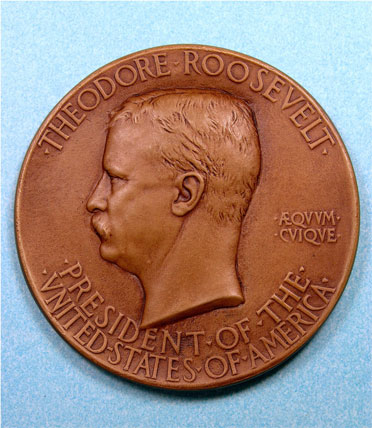
Roosevelt Inaugural Medal design by Augustus Saint-Gaudens courtesy of the Museum of American History.
History and Numismatics: Thomas Edison
Starting at the turn of the 19th century, scientists inspired by Benjamin Franklin’s study of electricity started to look at ways that electricity could be generated and its energy turned into light. The idea that a lamp could be created that used electricity for use in coal mines. Oil and gas lamps were credited with causing a rash of explosions in Europe and alternatives were needed.
It started with Sir Humphry Davy, a British chemist who is credited with the discovery of alkali metals whose properties could generate electricity. Davy experimented with different filaments and containers to make a lamp that could be used in the mines. Davy Lamp was not successful, but began a century of experimenting with electricity.

Edison in 1878
Building on a half-century of research, Thomas Edison experimented with different filaments, eventually settling on a carbon filament. Edison held the first successful test on October 22, 1879. It lasted 40 hours. Later, Edison and his team would discover materials that would last over 1,200 hours.
Even though Edison did not invent the lightbulb, his significant improvements to the design of the lightbulb raised public consciousness on the wonder of the electric light branding him as the inventor of the lightbulb. It was one of over 1,300 inventions during a remarkable career.
In 1988, the 105th congress passed the “Thomas Alva Edison Commemorative Coin Act” (Public Law 105-331 [text] [pdf]). The law called for a $1 silver commemorative issued in 2004 to honor the 125th anniversary of the “invention of the lightbulb.”
The design of the 2004 Thomas Alva Edison Commemorative Coin depicts a portrait of Thomas Edison holding an early experimental lightbulb. It was designed by U.S. Mint Engraver Donna Weaver. The reverse depicts Edison’s first lightbulb and designed by John Mercanti. These commemoratives were struck at the Philadelphia Mint and was sold out.
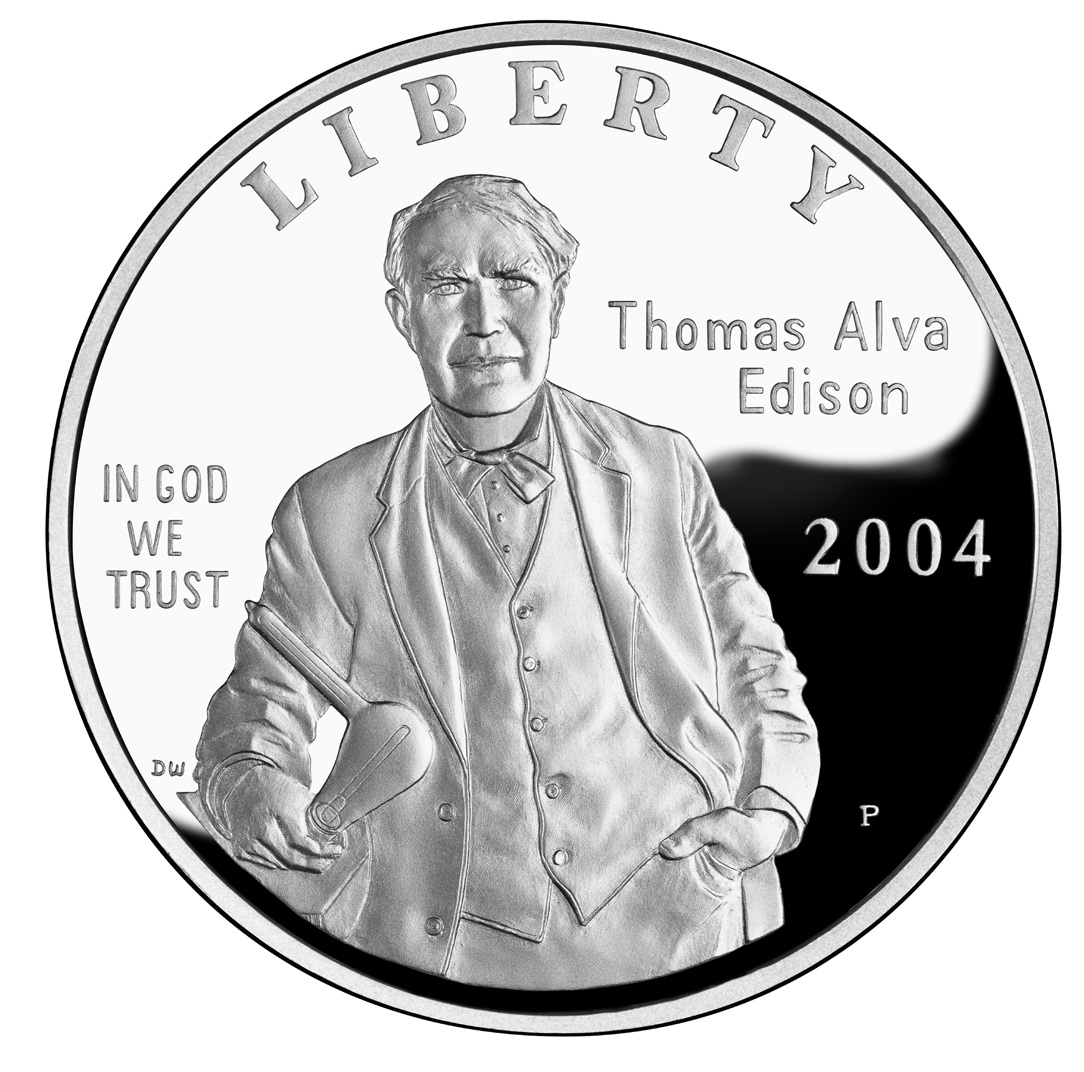
Obverse Designed by Donna Weaver

Reverse designed by John Mercanti
Whatever Happened to Bernard von NotHaus
After receiving my copy of Numismatic News in yesterday’s mail, I immediately turned to the Letters and Viewpoint section to see what the readers are saying to find a Viewpoint article: “Private ‘Coins’ Should be Collected.” In the article, Will Gragg writes that Liberty Dollar issued by the National Organization for the Repeal of the Federal Reserve (NORFED) should be collected. Aside that the article seems like a thinly veiled support for the Liberty Dollar, I began to wonder what happened to Bernard von NotHaus.
Bernard von NotHaus was a co-founder of the Royal Hawaiian Mint. He served as the mint’s supervisor before leaving and founding NORFED under the premise that the Federal Reserve is illegal and devaluing U.S. money by issuing fiat money. Believing that he could create currency using precious metals that could be used in trade, von NotHaus created the Liberty Dollar. NORFED marketed their “coins” as “Real Money” and that their associated notes are “America’s Inflation Proof Currency.”
In 2006, the U.S. Mint issued a consumer alert warning that the Liberty Dollar is not legal tender. Von NotHaus and coconspirators were arrested in 2007 by the FBI. He was release on bond. A grand jury handed down indictments against von NotHaus and his coconspirators for primarily violating 18 U.S.C. § 486, for “Uttering [circulating] coins of gold, silver or other metal.”
Von NotHaus was arrested on June 30, 2010 for violating the terms of his bond. After appearing before Judge David S. Cayer, Federal District Court for the Western District of North Carolina in Charlotte on Wednesday, July 14, von NotHaus’s bond was revoked and is in federal prison pending trial.
It was difficult to find information on the status of von NotHaus. Reports about his arrest and incarceration did not appear in the “mainstream media.” This news was found by reading other sources that reported von NotHaus’s arrest at the beginning of August.
According to the court’s calendar, the case of USA v. von NotHaus, et. al. (5:09-cr-00027-RLV-DCK-1) was scheduled for a hearing today (October 19) before Judge Richard Voorhees. No public information about the hearing was available at the time this was written.
Justice moves slowly.
CFA Meets October 21
If you are going to be in Washington, DC on October 21, you can attend the U.S. Commission of Fine Arts meeting. The meeting starts at 9:00 A.M. in Suite 312 of the National Building Museum: 401 F Street, NW, Washington, DC 20001-2728. The CFA is the third leg of the coin design system that includes the U.S. Mint’s engravers and the Citizens Coinage Advisory Committee.
On the is their review for the final designs for:
- New Frontier Congressional Gold Medal to honor: Neil A. Armstrong, Edwin E. Aldrin, Jr., Michael Collins, and John H. Glenn, Jr. The design will be for the gold medal that will be presented and the bronze duplicates that will be sold by the U.S. Mint.
- Design for the Congressional Gold Medal to be presented to Arnold Palmer and the bronze duplicates.
- Reverse designs of the 2012 America’s Beautiful National Parks Quarter Dollar Program. In 2012, the program will honor Puerto Rico, New Mexico, Maine, Hawaii, and Alaska.
The CFA was formed in 1910 to advise the government on the architectural development in Washington. While most of its work is on architectural development, the CFA is also involved in the designs of statues and memorials around Washington—except for the Capitol building and Library of Congress which is controlled by the Arcitect of the Capitol. Their review of coin designs are the only matters not related to the architectural development.
Coin Legislation in the 111th Congress
As we know, the U.S. Mint does exactly what it is told by law. In order to understand what the U.S. Mint will do in the future is to follow what coin-related laws are introduced and passed. Watching congress could be a sport in itself but for our purposes, we limit the watching to legislation concerning coin and U.S. Mint. Since congress is in recess until November and the 111th congress getting ready to adjourn for the last time before the 112th congress begins on January 3, 2011, it appeared to be a good time to review their numismatic-related work.
Bills Passed Into Public Law
These are the bills that have passed both houses of congress and sent to the President for his signature.
Girl Scouts USA Centennial Commemorative Coin Act
Introduced by Jack Kingston (R-GA) as H.R.621
Became Public Law No: 111-86 [txt, pdf] on 10/29/09
One coin issued in 2013:
- 350,000 $1 silver coins
Surcharges paid to the Girl Scouts of the United States of America
- $10 per coin for the $1 silver coin
Medal of Honor Commemorative Coin Act of 2009
Introduced by Christopher Carney (D-PA) as H.R.1209
Became Public Law No: 111-91 [txt, pdf] on 11/6/09
Two coins issued in 2011:
- 100,000 $5 gold coins
- 500,000 $1 silver coins
Surcharges paid to the Congressional Medal of Honor Foundation
- $35 per coin for the $5 gold coin
- $10 per coin for the $1 silver coin
Coin Images→Medal of Honor Commemorative $5 Gold Coin — Medal of Honor Commemorative $1 Silver Coin
Star-Spangled Banner Commemorative Coin Act
Introduced by Dutch Ruppersberger (D-MD) as H.R.2097
Became Public Law No: 111-232 [txt, pdf] on 8/16/10
Two coins issued in 2012:
- 100,000 $5 gold coins
- 500,000 $1 silver coins
Surcharges paid to the Maryland War of 1812 Bicentennial Commission
- $35 per coin for the $5 gold coin
- $10 per coin for the $1 silver coin
5-Star Generals Commemorative Coin Act
Introduced by Dennis Moore (D-KS) as H.R.1177
Became Public Law No: 111-262 [txt, pdf] on 10/8/10
Three coins issued in 2013:
- 100,000 $5 gold coins
- 500,000 $1 silver coins
- 750,000 half-dollar clad coins
Surcharges paid to the Command and General Staff College Foundation
- $35 per coin for the $5 gold coin
- $10 per coin for the $1 silver coin
- $5 per coin for the half dollar clad coin
Bills Passed by the House and Referred to the Senate
These are the bills that have gone through the legislative process in the House of Representatives, have been enrolled, and sent to the Senate for their action. Coin bills in the Senate are referred to the Committee on Banking, Housing, and Urban Affairs.
Mother’s Day Centennial Commemorative Coin Act
Introduced by Shelly Capito (R-WV) as H.R.2421
Passed by House on 5/6/10
One coin issued in 2014:
- 400,000 $1 silver coins
Surcharges paid to Susan G. Komen for the Cure and National Osteoporosis Foundation
- $10 per coin for the $1 silver coin
American Eagle Palladium Bullion Coin Act of 2010
Introduced by Denny Rehberg (R-MT) as H.R.6166
Passed by House on 9/29/10
Adds a $25 palladium bullion coin to the American Eagle Bullion Program. The bill requires the design to be as follows:
- Obverse same as Mercury Dime
- Reverse design of the 1907 American Institute of Architects medal
Coin Modernization, Oversight, and Continuity Act of 2010
Introduced by Melvin Watt (D-NC) as H.R.6162
Passed by House on 9/29/10
Requires the U.S. Mint to research minting metals used for coining money. Sets the study length to two years and requires the U.S. Mint to tie the research to Mint production. Bill includes two technical changes:
- Changes the American Eagle Bullion Program to allow the U.S. Mint to divert materials to strike collectibles
- Changes the National Park Bullion program to allow the U.S. Mint change the size of the planchet from 2.5 to 3.0 inches
Sources report that these three bills are expected to pass the Senate during the lame duck session.
Bills Introduced in the House of Representatives
Any member of the House of Representatives can submit a commemorative coin bill. All they have to do is format the bill correctly and drop it into the hopper where the Clerk of the House assigns a bill number and sent to the Speaker of the House who assigns the bill to a committee. Commemorative coin bills are assigned to the Domestic Monetary Policy and Technology subcommittee under the Committee on Financial Services. It is up to the chairman of the committee and subcommittee to determine whether the bill will be scheduled for debate or tabled indefinitely.
Bills not acted upon do not carry over between congresses meaning if they are not passed into law, they will not be part of the 112th congress unless they are introduced during that session. These bills are said that they “died in committee.”
The following bills are not coin or numismatic-related bills but they are of interest to collectors and investors:
Free Competition in Currency Act of 2009
Introduced by Ron Paul (R-TX) as H.R.4248 on 12/9/2009 and referred to the Subcommittee on Commercial and Administrative Law. The basic provisions of this bill is as follows:
- Calls for the elimnation of all taxes on the sale and tranfer of bullion and coins
- Changes the law to allow precious metals to be used as coins or a medium of exchange. This was introduced after the Justice Department stopped the production of the Amero as being illegal.
Coin and Precious Metal Disclosure Act
Introduced by Anthony D. Weiner (D-NY) as H.R.6149 on 9/16/2010 and referred to the House Committee on Energy and Commerce. Bill is intended as a consumer protection law that requires sellers of precious metal coins and bullion to provide additional information to the potential buyer. Sometimes referred to as the Goldline Act since Rep. Weiner has targeted Goldline in his commentary regarding this bill, there are side effects that may impact coin dealers that are not part of Rep. Weiner’s target.
Small Business Paperwork Mandate Elimination Act
Introduced by Dan Lungren (R-CA) as H.R.5141 and referred to the House Committee on Ways and Means. This is the bill that will remove the requirement to report all goods and services purchased in excess of $600 with an IRS 1099 form beginning in 2012 that was part of the health care reform legislation. Almost everyone in almost every industry is in favor of this bill’s passage. Sen. Mike Johanns (R-NE) has introduced S.3578 as a companion bill in the Senate. Sources report that one of the bills will be passed in the lame duck session. However, there is a concern that the President may veto the legislation if the revenues are not made up elsewhere.
The following commemorative coin bills have been introduced and are in committee waiting for action:
- NASA 50th Anniversary Commemorative Coin Act — Introduced by Sheila Jackson-Lee (D-TX) as H.R.255 on 1/7/2009
- Mark Twain Commemorative Coin Act — Introduced by John Larson (D-CT) as H.R.1195 on 2/25/2009
- Revolutionary War and War of 1812 Battlefields Commemorative Coin Act of 2009 — Introduced by Rush Holt (D-NJ) as H.R.2001 on 4/21/2009
- Robert M. La Follette, Sr. Commemorative Coin Act — Introduced by Tammy Baldwin (D-WI) as H.R.2318 on 5/7/2009
- United States Marshals Service 225th Anniversary Commemorative Coin Act — Introduced by John Boozman (R-AR) as H.R.2799 on 6/10/2009
- Ronald Reagan Commemorative Coin Act of 2009 — Introduced by Robert E. Latta (R-OH) as H.R.3341 on 7/24/2009
- Original Saint-Gaudens Double Eagle Ultra-High Relief Bullion Coin Act of 2009 — Introduced by Denny Rehberg (R-MT) as H.R.3405 on 7/30/2009
- National Future Farmers of America Commemorative Coin Act of 2009 — Introduced by Bruce L. Braley (D-IA) as H.R.3464 on 7/31/2009
- National September 11 Memorial & Museum Commemorative Coin Act of 2009 — Introduced by Jerrold Nadler (D-NY) as H.R.3549 on 9/10/2009
- 1863 Gettysburg Campaign Act — Introduced by Todd Russell Platts (R-PA) as H.R.3712 on 10/1/2009
- International Civil Rights Center and Museum Commemorative Coin Act — Introduced by Brad Miller (D-NC) as H.R.3912 on 10/22/2009
- James Monroe Commemorative Coin Act — Introduced by Robert J. Wittman (R-VA) as H.R.4329 on 12/16/2009
- United States Marshals Service 225th Anniversary Commemorative Coin Act — Introduced by John Boozman (R-AR) as H.R.5680 on 7/1/2010
Bills Introduced in the Senate
Article I, Section 7 of the U.S. constitution says “All Bills for raising Revenue shall originate in the House of Representatives.” Since all commemorative coin bills raise revenue, they must originate in the House. However, it is common for senators to introduce bills to influence their House counterparts to introduce a similar bill or they will introduce a companion bill in support. Very few of the coin-related bills introduced in the Senate become law. Those that do become law are amended versions of the House bills passed in the Senate and sent back to the House for a vote—usually with concurrence of the House leadership. This process eliminates the need for a conference committee to reconcile bills.
Coin-related bills introduced in the Senate are assigned to the Committee on Banking, Housing, and Urban Affairs. The following list are the bills that have been introduced in the Senate with the compaion bills that have become law removed:
- Mark Twain Commemorative Coin Act — Introduced by Christopher J. Dodd (D-CT) as S.483 on 2/25/2009
- Original Saint-Gaudens Double Eagle Ultra-High Relief Bullion Coin Act of 2009 — Introduced by Max Baucus (D-MT) as S.758 on 4/1/2009
- Robert M. La Follette, Sr. Commemorative Coin Act — Introduced by Russell D. Feingold (D-WI) as S.945 on 4/30/2009
- Mother’s Day Centennial Commemorative Coin Act — Introduced by John D. Rockefeller (D-WV) as S.1012 on 5/7/200
- Fair Treatment for Precious Metals Investors Act — Introduced by Mike Crapo (R-ID) as S.1367 on 6/25/2009
- National Future Farmers of America Commemorative Coin Act of 2009 — Introduced by Chuck Grassley (R-IA) as S.1553 on 7/31/2009
- Options for Investors through United States Certified Coins Act of 2009 — Introduced by David Vitter (R-LA) as S.1769 on 10/8/2009
- International Civil Rights Center and Museum Commemorative Coin Act — Introduced by Kay Hagan (D-NC) as S.1819 on 10/21/2009
- United States Marshals Service 225th Anniversary Commemorative Coin Act — Introduced by Blanche L. Lincoln (D-AR) as S.2106 on 10/29/2009
- 1863 Gettysburg Campaign Act — Introduced by Arlen Specter (D-PA) as S.3009 on 2/11/2010
- United States Marshals Service 225th Anniversary Commemorative Coin Act — Introduced by Blanche L. Lincoln (D-AR) as S.3572 on 7/13/2010
Support the Coin Collectors Blog
 Buy me a coffee
Thank you for your support!
Let Me Know What You Think
Are you going to the World's Fair of Money
Total Voters: 17
 Loading ...