
New ANA Registry has already picked winners and losers
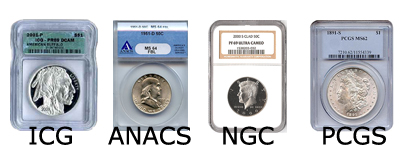 Last month, the American Numismatic Association announced that they have partnered with Numismatic Guarantee Corporation (NGC) to launch the ANA Coin Registry.
According to the ANA press release, the ANA Registry will accept coins graded by NGC and Professional Coin Grading Service (PCGS). The ANA Registry will be the only service that will allow both NGC and PCGS graded coins.
NGC has been a partner with the ANA for 25-years making it a natural choice to implement this program. Since NGC once allowed PCGS graded coins to count in their registry program, the facilities continue to exist for them to create a similar program for the ANA.
Participation is open to any collector. ANA members will receive a special icon of recognition next to their sets.
What is missing from the registry is the ability to include ANACS and ICG graded coins. Regardless of the opinion of these companies, they are competitive services to NGC and PCGS with a legitimate niche in the market.
By excluding ANACS and ICG, the ANA is telling the public that they decided who the best third-party grading services are. It is not the job of the ANA to pick market winners. Let the collecting public decide.
One advantage that ANACS and ICG has is that there are no memberships required to submit coins for grading. Anyone can directly submit coins to either company. Although ANA members can directly submit coins to NGC without an additional membership, only PCGS members can submit coins for grading.
Allowing open submission policies will allow for more people to participate. They can collect what they like and send it to ANACS and ICG without having to spend extra money or rely on a member. It will create greater access to casual collectors who might become more series if they can participate.
Could there be other reasons for not including ANACS and ICG? Since anyone can submit coins to ANACS and ICG, how will the dealers make money? If a collector buys a coin online or from another collector and sends their coins to ANACS or ICG for grading, how will the dealers make money?
Further, dealers have their own biases. They decided which grading service they like the best based on many factors, including perception and financial reasons. Whatever these reasons are should not be the policy of the ANA.
If the ANA is to fulfill its mission to encourage people to study and collect money and related items, then they cannot be picking market winners and losers. The ANA must revisit this policy and include the entire market without bias.
BEP Websites Back Online
The websites for the Bureau of Engraving and Printing and their storefront came back online sometime today. The site appears to be fully functional and a scan of accessible pages shows that all evidence of the malware discovered earlier this week have been erradicated.
BEP nor the Department of the Treasury has issued a statement regarding this incident.
BEP has not yet responded to an email inquiry about the incident.
BEP Website Down After Being Hacked
Security researchers discovered that the website for the Bureau of Engraving and Printing and associated “MoneyFactory Store” were hacked on Monday. The attacker added instructions to the front page of both sites that would run a script to allow a Ukrainian-based system insert instructions that will allow someone to attack a user’s computer through the browser.
Currently, the BEP website (moneyfactory.gov, bep.gov, and bep.treas.gov) and the BEP’s online store (moneyfactorystore.gov) are off-line. The website used to support the launch the new $100 Federal Reserve Note (newmoney.gov) was not infected by this attack.
The system that would have been used to launch the attack from the Ukraine is also down but do not count on it staying down. Attacker systems can be transient in order to throw off investigations.
As an information security professional, I urge everyone to ensure they practice safe surfing! Here are five basic rules to help you keep your system safe online:
- Make sure your system and software is up to date. While many products will check for updates on their own, you may have to check Microsoft Windows and Office on your own. In your “Start” menu select “Windows Update” to allow your system to be properly updated.
- Run an anti-virus and anti-malware program. Malware is “malicious software” that would do harm to your computer. This attack would install malware on your system through your browser. Some service providers (like Comcast) offers a free download of an anti-virus program. Take advantage of that offer! If you want a good basic anti-virus program is the AVG Anti-Virus Free Edition. It is not as full featured of others, but it provides good protection.
- Once you install your anti-virus program, make sure you keep it up to date! Keeping it up to date means that you download the information about new attacks from the manufacturers of the anti-virus program. Threats are constantly changing and you need to keep up to date. If you are using old information, it is like leaving holes in your defenses for the attackers to get through. Make sure the software keeps updated. Also, pay for the yearly service to keep it updated. Think of it an insurance policy for your critical data!
- If you are not running the latest version of your browser, upgrade it now! If you are running Internet Explorer version 5 or 6 it is similar to leaving the doors of your car unlocked in an unsafe neighborhood. I know Internet Explorer 7 looks different that others, but it is worth updating. Do so now! This also is true if you are using any other browser including Firefox, Safari, Opera, etc.
- Turn on your system’s firewall service. The firewall is software used to protect the system from threats that come directly from the Internet. All modern systems come with a firewall, turn it on and use it. Many anti-virus packages have better firewalls than the one that come with the operating systems. Use it!
Microsoft has a very good Online Safety and Privacy Education website with information and resources written in plain English (as opposed to Geek English) along with easy to follow How-To guide and instructional videos. You can find a more comprehensive information at the Home PC Firewall Guide.
Please stay safe online and watch my Twitter account (@coinsblog) for when the BEP is back online.
Catching up with the CCAC and ANA
After taking some time off from blogging following the announcement of the new $100 federal reserve note, there have been a number of news items I wanted to mention that will talk about in more details over the next few days. But I wanted to mention a few as a “preview” of things to come.
Dave Harper wrote on his blog about Citizens Coinage Advisory Committee member Donald Scarinci was tweeting from the CCAC meeting at the Philadelphia Mint this past week. You can read the tweet on his account @Scarinci. As a proponent of using technology to reach out to everyone, I was very happy to go back and read Scarinci’s tweets from the meeting and hope he continues and others follow. I will write more about this topic soon with quotes from Scarinci.
The American Numismatic Association has change how they are assigning convention sites and has decided to add a convention in the Fall. I was a bit confused by the announcement after reading the the World’s Fair of Money will be centered in Chicago and the National Money Show will be part of a rotating series of cities. This is clearly a nod to finding what has been described as “the best bourse cities” which benefits the dealers more than the collectors. Interesting, in the May 2010 edition of The Numismatist, President Cliff Mishler quoted ANA Governor Jeff Garrett that Mishler told him, “He reminded me that there are not two classes of ANA membership—dealers and collectors—but rather a single community, one that cares about the well-being of the hobby.” It is interesting how Mishler could tell an ANA governor that the ANA is a community yet support a convention policy that is clearly geared to the dealer community.
In the April 2010 edition of The Numismatist, Q. David Bowers writes about the aging of the ANA membership noting that 47-percent of its membership is between the ages of 50 and 60. While Bowers notes that there “are several reasons why numismatics has lost its appeal to younger people,” he claims that it is nothing “the ANA has done or not done.” Bowers sites studies that show that younger people have embraced technology and social media to fill their spare time. With all due respect to Mr. Bowers, then why has the ANA not embraced this new social media paradigm? Why isn’t the ANA trying to fit in that electronic social networking space? The ANA has no social media presence or outreach program to these users with the exception of a website and Facebook page and not real electronics communication policy. By the way, did you know the ANA was on Facebook? It is not even advertised on the front page or the ANA’s website!
Finally, your intrepid blogger was recently interviewed for a national publication that will be printed in the late summer. I will write more when it gets closer to the publication date.
Ben Looks a Bit Green
 The Bureau of Engraving and Printing unveiled the new $100 Federal Reserve Note earlier today in Washington, DC. Along with the watermark, security thread, and color-shifting ink, the new note now includes enhanced micro printing, a new application for color-shifting ink, and a security ribbon that appears to animate as the note is tilted. Since the $100 note is the most circulated and most counterfeited note in the world, the BEP has been working with the U.S. Secret Service and the Federal Reserve Board to stay ahead of the counterfeiters.
“The $100 is the highest value denomination that we issue, and it circulates broadly around the world,” said Michael Lambert, Assistant Director for Cash at the Federal Reserve Board. “Therefore, we took the necessary time to develop advanced security features that are easy for the public to use in everyday transactions, but difficult for counterfeiters to replicate.”
“As with previous U.S. currency redesigns, this note incorporates the best technology available to ensure we’re staying ahead of counterfeiters,” said Secretary of the Treasury Tim Geithner.
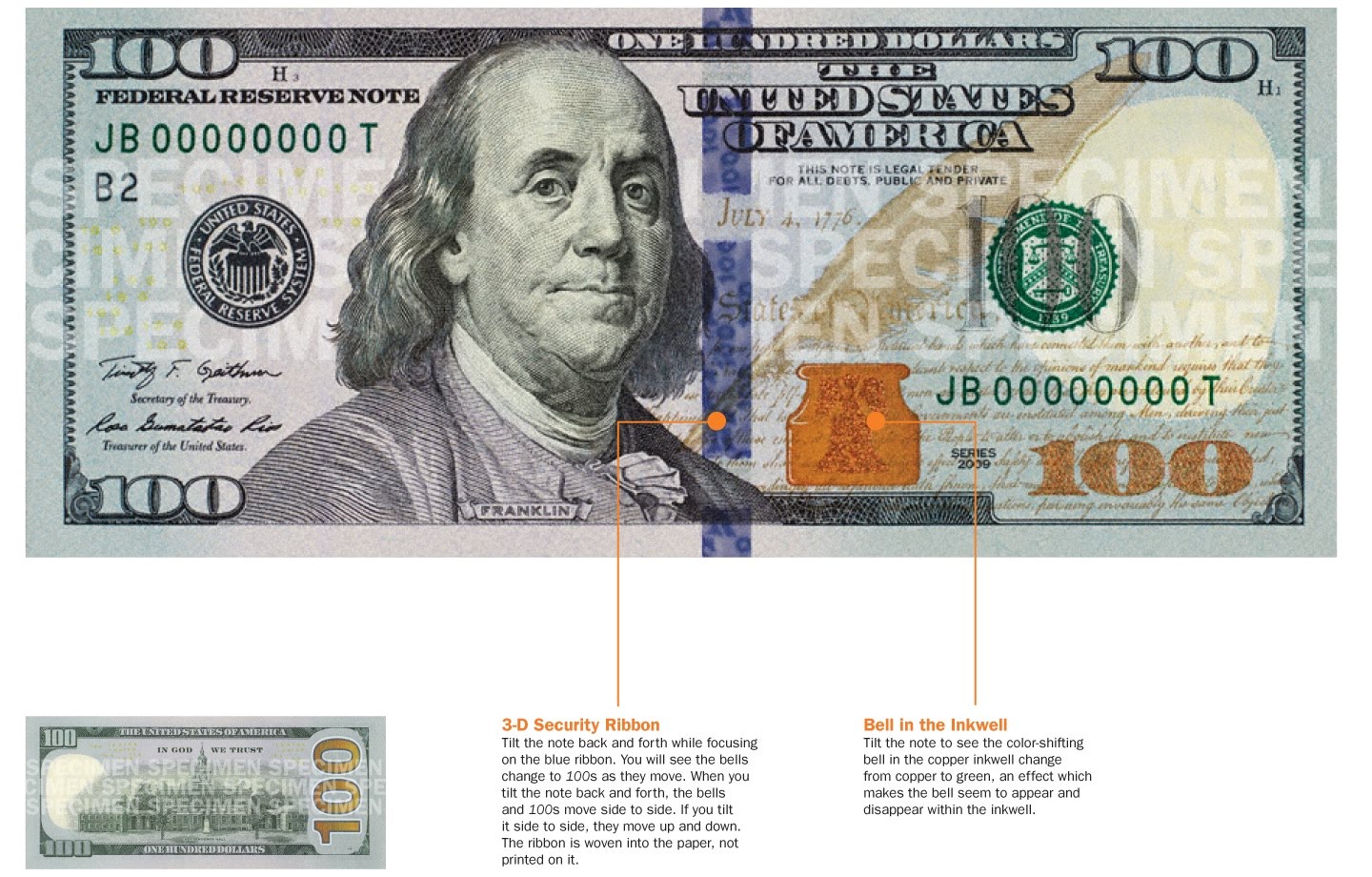 The redesigned $100 note includes a new security ribbon. The blue 3-D Security Ribbon on the front of the new $100 note contains images of bells and 100s that move and change from one to the other as you tilt the note as if it was animated. Next to the ribbon at the bottom of the front of the new note is the Bell in the Inkwell. The bell changes color from copper to green when the note is tilted, an effect that makes it seem to appear and disappear within the copper inkwell.
In addition to the new security features, the BEP also retained three security features from the old $100 note design including:
- Portrait Watermark: Hold the note to light to see a faint image of Benjamin Franklin in the blank space to the right of the large portrait. It is visible from either side of the note.
- Security Thread: Hold the note to light to see an embedded thread that runs vertically to the left of the portrait. The letters USA and the numeral 100 appear in an alternating pattern and can be seen from both sides of the note. The thread glows pink when illuminated by ultraviolet light.
- Color-Shifting 100: Tilt the note to see the numeral 100 in the lower right corner of the front of the note change from copper to green.
“The advanced security features we’ve included in the new $100 note will thwart potential counterfeiters from producing high-quality fakes that can fool consumers and merchants,” said Larry R. Felix, Director of the Treasury’s Bureau of Engraving and Printing. “Protect yourself—it only takes a few seconds to check the new $100 note and know it’s real.”
The new $100 note also displays American symbols of freedom including phrases from the Declaration of Independence and the quill the Founding Fathers used to sign this historic document. Both are located to the right of the portrait on the front of the note.
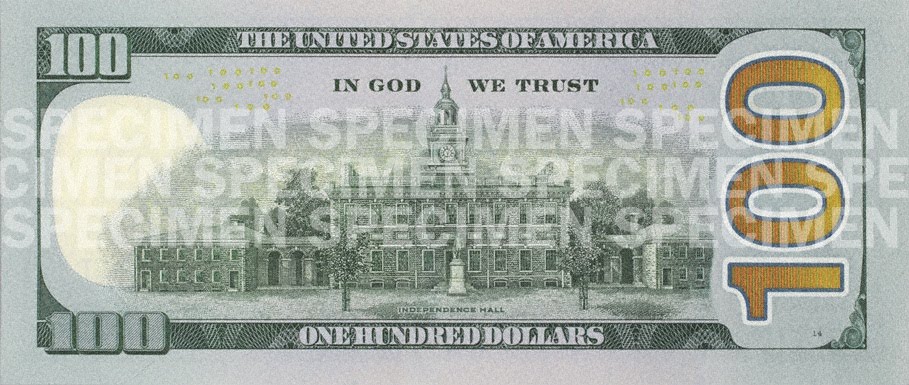 The back of the note has a new vignette of Independence Hall featuring the rear, rather than the front, of the building. Both the vignette on the back of the note and the portrait on the front have been enlarged, and the oval that previously appeared around both images has been removed. Also on the right of the reverse is a large “100” printed in gold ink. It is expected that this feature will help those with visual impairments distinguish the denomination.
Review
After the animation stopped on the front page of newmoney.gov the first thing I noticed is that Ben looks a little green. With a better use of color that does not make the note look close to the money seen in common board games, the portrait of Benjamin Franklin retains that green tint from the previous note while every other aspect of the note has changed. Since the BEP chose to use a portrait of an elderly Franklin, he looks like he could be ill.
As opposed to other notes, the there are no splashes of color that makes it look like a mistake. The design is better balanced and using the inkwell as a design element and part of the security features works well. If the BEP wanted to do better with color, it would have worked better by making the portrait of Franklin in color. That would have given the note a nice look and even seemed progressive in currency design.
The back of the note is still green. I guess if US currency will continue to be nicknamed the greenback, the BEP must keep the back of the note green. It is interesting that as part of the redesign, the BEP enlarged the “100” on the back of the note to take up almost the entire height of the area. It is being printed in gold. The size should help the visual impaired but it is unclear if the gold color will help those with visual impairments.
The most interesting change to the note is the 3-D security ribbon. It appears that the BEP has adapted holographic technology in a manner to embed into the fibers of the note to make it more difficult to counterfeit. It will be interesting to see how this looks with the note in hand since it looks very interesting in the videos distributed by the BEP.
It is a better redesign than their other efforts, but I would still like to see a better use of color.
Here is the Unveiling Video and B-roll videos produced for the BEP:
All images and video complements of the United States Bureau of Engraving and Printing.
Hot Springs Quarters Launched
On the 178th anniversary of its establishment as a Federally protected national site, the U.S. Mint launched the America the Beautiful Quarters Program with the launch at the Hot Sprints National Park in Arkansas. The ceremony was held at the park’s headquarters lead by U.S. Mint Director Ed Moy who was joined by National Park Service Midwest Regional Director Ernie Quintana and Hot Springs National Park Superintendent Josie Fernandez.
“It’s fitting that Hot Springs National Park, among the early lands set aside by the federal government to protect natural and cultural resources, be the first featured in the United States Mint’s America the Beautiful Quarters series,” Quintana said. “The release of this commemorative coin will bring about greater awareness of our national parks and emphasize the importance of continued protection and preservation of these natural, cultural and historical wonders for future generations.”
Hot Springs Reservation was initially created by an act of congress on April 20, 1832, the first area of the United States protected in this manner. Prior to the passage of the National Park Service Organic Act in 1916, lands that congress wanted protected were named national reservations and managed by the Bureau of Land Management. Hot Springs was made a national park on March 4, 1921.
If you missed the live broadcast of the release, the U.S. Mint has provided the following highlights:
The U.S. Mint also released the following “official” images from the quarter give away:


Video courtesy of the U.S. Mint
Still images courtesy of the AP Images for the U.S. Mint
Support the Coin Collectors Blog
 Buy me a coffee
Thank you for your support!
Let Me Know What You Think
Are you going to the World's Fair of Money
Total Voters: 17
 Loading ...