
Weekly World Numismatic News for February 16, 2020
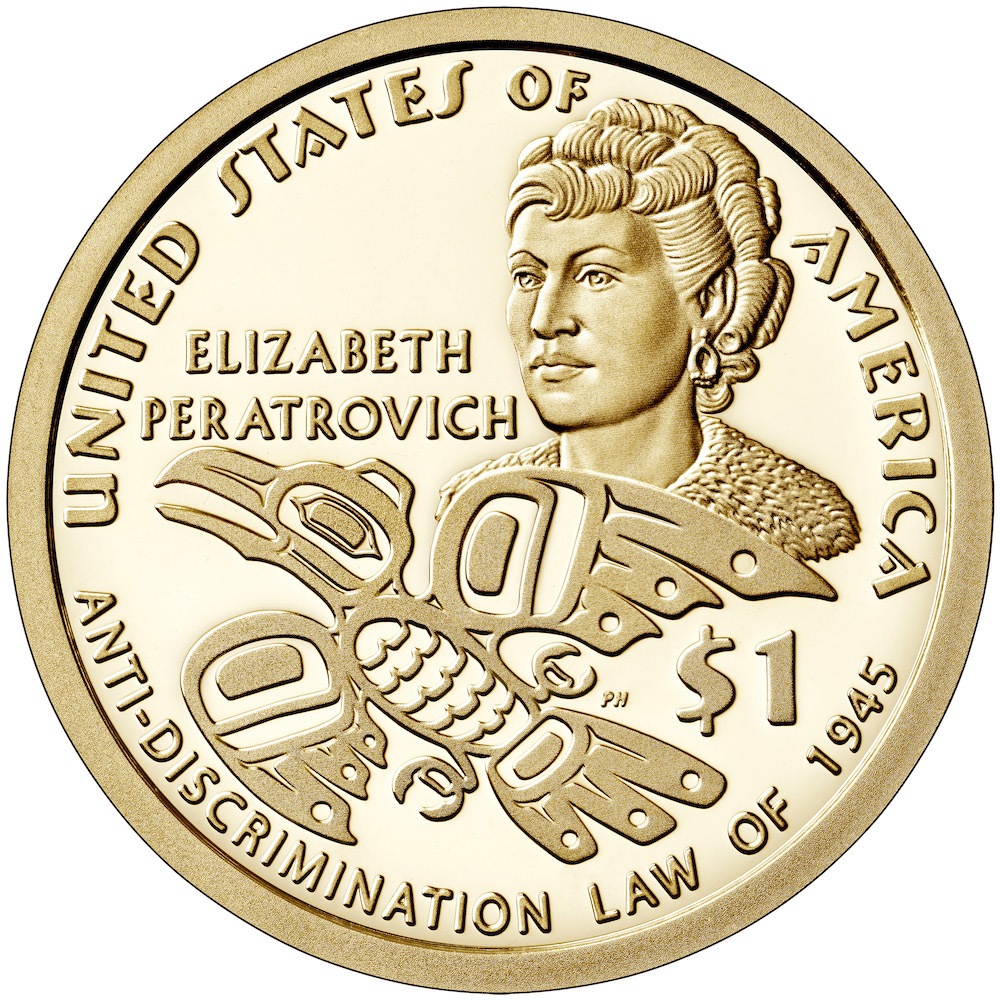 In our never-ending quest to convince more people to be interested in coin collecting, this week’s news provided us with another example of “if you do something that people like, they will be interested.”
As the U.S. Mint released the Native American dollar coin with the image of Civil Rights leader Elizabeth Peratrovich, Alaskans are clamoring for a wider release of the coin. It is the first time since the early days of the small-dollar programs that there is a broad interest in $1 coins.
Elizabeth Peratrovich was an Alaskan native who was instrumental in having Alaska’s Anti-Discrimination Law passed by the territorial government. It was the first anti-discrimination law of any type passed in the United States.
Alaskans are asking that the Federal Reserve release 5 million coins into general circulation. The Seattle Branch of the San Francisco Federal Reserve Bank is responsible for banking in Alaska.
The Alaska State Legislature passed a resolution requesting the Federal Reserve make these coins available to Alaskans.
Although the Federal Reserve has not publically responded, they should be talking with the U.S. Mint to strike the 5 million coins necessary to send to Alaska. The coins may not circulate, but it is an excellent promotion for coin collecting.
Over the last few years, we have learned that interesting themes have sold well. Look at the interest in the American Somoa National Park fruit bat design. It is a well-executed design that is very interesting and has people looking for the coin in change. It will likely be in the one America the Beautiful Quarter in the most demand.
Other commemorative coins did very well when there was an exciting topic. With no offense to the American Legion, an outstanding organization, but what was the difference in the interest between their commemorative coin and the National Baseball Hall of Fame commemorative?
Remember the Girl Scouts’ commemorative coin fiasco?
You do not have to be a rocket scientist or a marketing guru to understand people will buy what they like. It is why the Royal Canadian Mint and the New Zealand Mint sign deals with entertainment companies to sell coins with movies, comics, and other images. These coins sell.
Unfortunately, we have a congress in the way that prevents the U.S. Mint from expanding its product line. Without being able to create collector coins for a new audience, we will continue to try to figure out ways to do the impossible: get more people interested in collecting coins.
And now the news…
 January 23, 2020
 → Read more at realitytitbit.com
February 11, 2020 → Read more at irishcentral.com
February 11, 2020 → Read more at nhl.com
February 13, 2020 → Read more at alaskapublic.org
February 13, 2020 → Read more at auburnpub.com
February 14, 2020 → Read more at patch.com
→ Read more at realitytitbit.com
February 11, 2020 → Read more at irishcentral.com
February 11, 2020 → Read more at nhl.com
February 13, 2020 → Read more at alaskapublic.org
February 13, 2020 → Read more at auburnpub.com
February 14, 2020 → Read more at patch.com
Review: An Ultimate Coins Game for iPhone (with update)
Somewhere in my travels across the Internets, I found out about the iPhone game An Ultimate Coins Game by Flavio Passa, an Argentina-based developer. It seemed like a cute concept, a matching-like game based on coins. So the numismatist and iPhone time waster in me thought the 99-cents price tag was a reasonable price to give the game a try.
Starting the program yielded two issues: Sound effects cannot be controlled or muted within the program and the instructions are sparse and must be read on the programmer’s time frame. Beginning with the sound effects, the noises are not optional. Sounds cannot be turned off and the only way to control the volume is using the iPhone’s volume. The problem is that when controlling the volume on the iPhone it affects the the volume of the ringer. When I turned down the volume for the game I missed a later telephone call when the ringer was too low to hear from my jacket pocket. It would benefit the iPhone user to be able to control the sound effects as an option that would include turning off the sound effects without using the iPhone controls.
 One issue with using the iPhone is reading on a small screen. In addition to the small screen, the stylized text some applications use on the small screen and trying to use the a new program can make reading a help screen difficult. While reading the instructions for An Ultimate Coins Game I was surprised when they disappeared! Rather than having a “back” button or some other mechanism to allow me to finish reading the instructions, the developer decided decided how much time I can use to read the instructions. I use the iPhone’s ability to easily take a screen shot to capture the instructions so I can read them at my own pace. This is something that the developer should fix.
Unfortunately, the instructions does not tell you everything. For example, for the collecting coins by type level, I discovered that if I was able to find three coins without moving other coins I would receive a bonus. There may be other bonus opportunities, but I could not find this documented.
Another omission is that for the levels that has piled coins, you can shake the iPhone to move the coins around. Unfortunately, shaking the iPhone does not move the coins around enough to be useful. This feature would be more useful if the coins were re-stacked or reordered on the screen.
The game has three sub-games called levels: Collecting Coins where you double-tap on the coins of the type asked for before the level begins; Tag Price where you collect coins from the pile that add up to the amount shown on the price tag; and Country Flag where you match the coin to the flag of the country it is from. All three “levels” are fun. I like the concepts in the game but there are problems. First, more than once in the Tag Price level I could not reach the tag price because the coins were not available. One time I was not provided a Canadian 5-cent piece or enough Canadian 1-cent coins in order to make the required amount. In several other cases, I was not given enough 1-cent or 1-pence coins to make the price.
 Within the Country Flag level, I found several cases where two of the same flags were presented for a coin. In one case, I had to pick the right Australian flag to get credit for the coin. If I chose the wrong flag, I would be told that I was wrong.
One thing that drove me crazy is that when a level was finished, the game switched to its scoreboard instead of giving me a second to admire my work or a “continue” button to let me proceed when I am ready. I know this is a nit, but playing a game is a bit of ego boost and I want my ego boost! Also, give me the option to admire the scoreboard between levels before going to the next level. Aside from being allowed to boost my ego, this will give me a chance to pause the game in case something else needs my attention.
Although it is not documented, the game becomes more difficult with each level. But the levels are not consistent. It is possible to play two straight levels of type matching before playing a level of Price Tag. Difficulty increases with each type level and not what others would consider a level. This means I can play three progressively more difficult levels of Collecting Coins before seeing the first level Price Tag. Other times, I could see several levels before seeing one level of Country Flag. In fact, I do not remember ever seeing a level of Country Flag before playing five levels of the other two.
Two future enhancements that would help the game would be a high score keeper and a mechanism to save a game in the middle.
Overall, the issues seem to be those of a programmer not experienced with developing iPhone games. That is not a problem because we do not learn without trying. I believe that the programmer made an above average effort and hope that my comments help.
I do not regret buying this game. It has tremendous potential and can be addicting. I give the game a grade of EF-45 with hopes that future editions will improve.
NOTE (updated 3/18): I have been conversing with Flavio Passa, the program’s author, about the review. Mr. Passa agrees with most of what I wrote and will be working on an update for version 1.2. However, Mr. Passa disagrees with my review on the Tag Price level. Mr. Passa wrote to me and said:
In the Tag Price Level, there is always a way to match the tag price shown. Believe me, in fact tag price is built based on coins available during the level, it sumarizes the odd coins as they appears on the screen to build the tag price, therefore there is always a way to match the tag price amount.
It may be possible that Mr. Passa is correct but I have not been able to verify it. Regardless, it does not materially change my review. I continue to play the game and continue to believe that it has a lot of potential. I do appreciate Mr. Passa writing to me about his program and promise to re-review it following the next release.
Numismatics Meet Multi-Level Marketing
Over the last few months I have been receiving invites to join Numis Network. Numis Network is a multi-level marketing (MLM) program whose primary purpose seems to have people recruit a network of other interested people and have them join the network. There is a fee to join and a commission that is paid up the organization chart as new members join.
Multi-level marketing goes under many names: network marketing, direct selling, referral marketing, and pyramid selling. Regardless of the name, it is a marketing scheme where the structure creates a marketing and sales force through the use of compensating promoters for selling products but creating additional distributors. The multiple levels creates a type of pyramid where those closer to the top of the pyramid makes the most money. Numis Network exhibits all of the characteristics of an MLM scheme. It emphasizes the network, growing the network, and receiving commission from the network.
It is important to note that a MLM scheme is not the same as a Ponzi scheme (which is what Bernie Madoff did) since there is supposed to be real marketing behind the network. In the case of Numis Network, they try to keep this scheme on this side of legal by touting their compensation is derived from the sales of certified coins. Numis Network uses a binary plan to grow the network using two subtrees, a power leg, which has new members, and the profit leg, which has your direct recruits. The key is supposed to be that your profit leg provides your best chance to make money. However, I found the following in Wikipedia:
In truth this benefit is slight because the new members who are recruited by your ancestors are shared among all the available leaf nodes. For example, your immediate ancestor in the tree only puts half of his new recruits in your downline, on average. Likewise, his ancestor only puts one fourth of his recruits in your downline. Following this argument to the root of the tree, the total approaches just one person recruiting for your downline (1/2 + 1/4 + 1/8 + 1/16 + 1/32 + … + 1/2n, where n is your tree depth). This is often insignificant in comparison to the number of people required in your downline to make yourself profitable.
If you calculate the amount of compensation per person diminishes as the number of downline people increases. In order to make money, you would need to recruit quite a few people and have them buy and/or sell coins in order for you to make a profit.
The only people making money in a MLM scheme are those at the top of the overall pyramid—the root node. Not only are they making money on the your initial purchases, but they are collecting on the commissions from the new recruits, which they earn a share of every one of them since they are at the root of the scheme. Remember, they are also the ones selling the coins. Once you buy the coins to resell, they have made their profit and it is up to you to sell the coins at a higher profit in order to earn a large enough commission.
Most of the people who have sent an email note asking me to join will probably never see a profit. I hope they can earn back their original investment.
While it is legal to create a pyramid scheme whose compensation is based on a real sales commission, the truth of the matter is that the further you are away from the top of the pyramid, the less money you will make. And think about it, how many coins would you have to sell to make a profit and how many coins could be sold? How many coins will you have to sell in order to break even after spending $500 (for the Fast Track Collector’s Kit) or the $75 (Basic option) plus the $9.95 per month for the Numis Network ecommerce website? Think about how the premiums on bullion coins have lowered as the US Mint has raised the supply then ask yourself if there are enough interested customers out there to even sustain the effort.
Since Numis Network is located in Tampa, Florida you may want to familiarize yourself with the well written advice from Florida Attorney General Bill McCollum. If there are any questions, you may want to contact Attorney General McCollum’s office for assistance.
While Numis Network may technically be legal I question its ethics. It is something I would never be involved with. If someone were to ask me for advice I would suggest that you not involve yourself with this program.
Stories on Today’s Odd Denomination Coins
Normally, I do not make it a practice to post stories that are sent to me but I think I can relate to what this correspondent wrote. Reader Troy Brown wrote:
Remember the Taco Bell $2 bill story? Well today I was reliving it at Wendy’s with a few Kennedy Half Dollars! After a day of searching for 40% & 90% silver halves I took a few to the gas station then a few more to get some lunch. When I tried to pay for lunch at the local Wendy’s with a few half dollars the casher told me that she didn’t know if they could accept the coins. She then went to the other casher who took the halves to the manager. After a few minutes (and after the food was made sitting in front of me) I was told that they could not accept the money. I asked why and the cashier said because her manager said she couldn’t. With the line growing longer I asked, “so with all the starving people in the world you would rather throw away this food and not take the money?” She replied, “it’s not me, it’s my boss”. They then told me, “take the money to the bank and come back”. Really, you want me to spend my money here? I ended up at KFC where they took the money.
Troy wrote that he called Wendy’s corporate offices who said that they will look into the situation.
Today I went to a Subway sandwich shop near where I am working. When I went to pay for my “Five Dollar Foot-Long” I handed the cashier a five dollar bill and a 2010 Native American $1 coin to cover the sales tax. The cashier looked at the coin and I asked if there was a problem. She said that she cannot take foreign money. I showed her where it said “United States of America” and “$1” on the reverse. She was so afraid of taking the coin that I switched my payment to a $20 bill to pay for my lunch. I will not be calling Subway’s corporate offices. I am not sure Jared is interested!
As part of the Presidential $1 Coin Act of 2005 (Pub. Law 109-145 [pdf]) told the US Mint to research how the one-dollar coins could gain more acceptance and for the US Mint to launch an education campaign along with the new coins. Not only is it clear that the education process failed, but the research lead to same conclusion everyone else has made using reason: if you want the one-dollar coin to be more accepted, stop printing the one-dollar Federal Reserve Note. This is why I wish I could take members of congress out to lunch in the real world so they could see the failures of their actions first hand.
On Wastweet Appointment to CCAC
Over the last week, it was announced that Heidi Wastweet of Seattle, Washington was appointed to the Citizens Coinage Advisory Committee as a specialist in medallic sculpture. Wastweet is an accomplished artist whose credits include the design of many medals, the founder of the Seattle Sculpture Guild, and a member of FIDEM.
 There have been other articles about Wastweet’s biography. I want to focus on her work. To visit her website gallery it is clear that she can be best described as an awesome artist! From bonze sculptures to commissioned medals, I click on every image and am just in awe of her work. Wastweet created a fantasy piece of what could be my favorite allegedly non-coin, the 1964-D Peace Dollar (seen here).
 Of Wastweet’s sculptures, I was most intrigued by the her “Tribute to Auguste Rodin,” a study of Rodin’s Gates of Hell created for a private collector. Having only read about Rodin’s sculpture in Paris, I am intrigued by her work and the imagery that Wastweet used to create her work.
After visiting her virtual gallery with mouth agape, I can only say that Wastweet may be on the wrong side of the table. Maybe she should be creating the artwork instead of judging them. I see Wastweet’s addition as a good move for the CCAC and hope she can provide valuable input to the designs of US coins.
Olympic Memories and Medals
Tonight, I watched the last medal event of the 2010 Winter Olympics. I love hockey and being a crass American, I was rooting for Ryan Miller (Buffalo Sabres), Zach Parise (New Jersey Devils), and Patrick Kane (Chicago Blackhawks) to lead the USA team to the gold. There was also Ryan Suter (Nashville Predators) of the Suter family that seemed to dominate the NHL in the 1980s and into the 1990s whose dad, Bob, played for the 1980 Miracle on Ice team in Lake Placid. But Team Canada played well and won the gold when the Pittsburgh Penguin’s Sidney Crosby shot it past Ryan Miller for the game winning goal in overtime. It was a thrilling game and fitting for the Olympic Hockey finals.
Hockey is to Canada as basketball is to the United States. Hockey was invented in Canada and they consider it their birthright to win. In the United States we had that same feeling about basketball. Those of us who were around for the 1972 Munich clock controversy remembers how it felt when the Soviet Union was given the break to win the game. The US Basketball Federation protested the game to FIBA, international basketball’s governing body. The protest was denied when the representatives from the communist nations out voted the non-communist nations 3-2.
As much as the Olympic committee wants to keep politics out of the games it will play a role as long as the athletes wear country designations. The 1972 Munich summer games included the killing 17 members of the Israeli Olympic team by Palestinian terrorists. Israel withdrew its remaining members while the Soviet Union, most of the eastern bloc under the control of the Soviet Union, North Korea, and ten Arab nations refused to allow their flags to fly at half-staff for the rest of the games. With the Cold War becoming its chilliest, the loss in basketball was not only a national tragedy but fueled a nationwide hatred against the Soviets.
 This is not to say hockey does not have its place in the United States. We celebrate the 1980 Miracle on Ice when the United States sent true amateurs against the world, especially those countries from the eastern bloc whose players were technically in the army but played hockey all of the time. The Soviet Union were the prohibitive favorites but hated by Americans for being professionals and for being Soviets. There was a lot of Cold War hatred between the countries. But nobody gave the U.S. team a chance except for Coach Herb Brooks. That 4-3 win against the Soviet team continues to raise emotion not only because how the team won, but for the political attitudes at the time. Democracy and fair play prevailed over the communists and cheaters. Even USA Basketball took great pride in watching the hockey team stick it to the Soviets.
What people forget is that the game against the Soviets was not the gold medal game. The US team had to play one more game against Finland in order to win the gold. It was a tight game which the US won 4-2 allowing the US to stand atop of the hockey medal stand. One of my memories was that after the game Ken Morrow joined the roster of the New York Islanders (my favorite team) and won a Stanley Cup making him the first player to win a gold medal and the Stanley Cup in the same year.
 We should not forget about what is being called the Forgotten Miracle of the 1960 US Hockey team. The winter games that were held in Squaw Valley, California featured the powerhouse Soviet team and the Canadians who were also considered favorites for a gold or a silver medal. But the US team of “nobodys” beat Sweden, Germany, Canada, Soviet Union, and Czechoslovakia in the round-robin series to be the only undefeated team in the final round. The team celebrated while the news made front page news but the celebration did not rise to the levels of the 1980 team. While the Cold War was ongoing, it was ongoing (remember Duck and Cover?) it was not considered at the same level as in 1980. The level of rhetoric had not started to climb. Tensions would begin to increase in October 1960 when Soviet Union Prime Minister Nikita Khruschev banged his shoe on a table in protest during a meeting at the United Nations while denouncing “American Imperialism.” This was two years before the Cuban Missile Crisis.
 The actual medals that the Olympians receive are the physical reward for winning. In years past medals used to made of the metal they represented (e.g., the gold medal was made of gold), nowadays the price to create solid gold, silver, and bronze medals are prohibitive. Medals are made of less expensive alloys with plating of the precious metal. Although Royal Canadian Mint does not publish the makeup of the metals on their website, the fact that they are the largest and heaviest medals ever produced allows us to make a logical assumption that the medals are made of base metals plated with the precious metals. Regardless, the medals created by the RCM are the most uniqued in the history of the Olympic games. The wavy medals feature a unique design where no two are alike that are based on four designs that are imprinted randomly on each medal. While the medals received by the 1960 and 1980 hockey teams can be considered traditional in their design, the 2010 medals have a unique artistic quality that will make them memorable for years to come.
In the future, the 2010 US Hockey team will be prouder of their silver medal accomplishment than they feel tonight. But tonight belongs to the Canadians. They played a good game and deserve their gold medals.
Congratulations also goes to Vancouver, the province of British Columbia, and the people of Canada for helping make these two weeks one of the most memorable in Olympic history.
P.S., I love visiting the west coast of Canada. If you can go to Vancouver and even Vancouver Island (take the ferry, it’s a great trip), it will be a very enjoyable vacation. I look forward to my next visit!
Support the Coin Collectors Blog
 Buy me a coffee
Thank you for your support!
Let Me Know What You Think
Are you going to the World's Fair of Money
Total Voters: 17
 Loading ...