
Weekly World Numismatic News for January 26, 2020

Queen 2020 UK Half Ounce Silver Proof Coin
You younguns found out about this song in Wayne’s World. I remember listening to it on FM radio when FM radio was cool. (You can now say collectively: OK, BOOMER!)
Their next album, A Day at the Races, produced several hits, including a song with fantastic harmony “Somebody to Love,” but it was News of the World that gave us the stadium anthems “We Will Rock You” and “We Are the Champions.” In case you forgot, “We Will Rock You” was on the B-side of “We Are the Champions.” Now they are played as if they are one song.
So why am I waxing poetic about Queen, and what does that have to do with numismatics? This week, the Royal Mint announced that they released a coin with the queen, as in Queen Elizabeth II, and a tribute to Queen on the reverse.
According to the Royal Mint, it is the first of a “Music Legends” collection. Other British musical artists will be featured on coins, but Queen is the first.
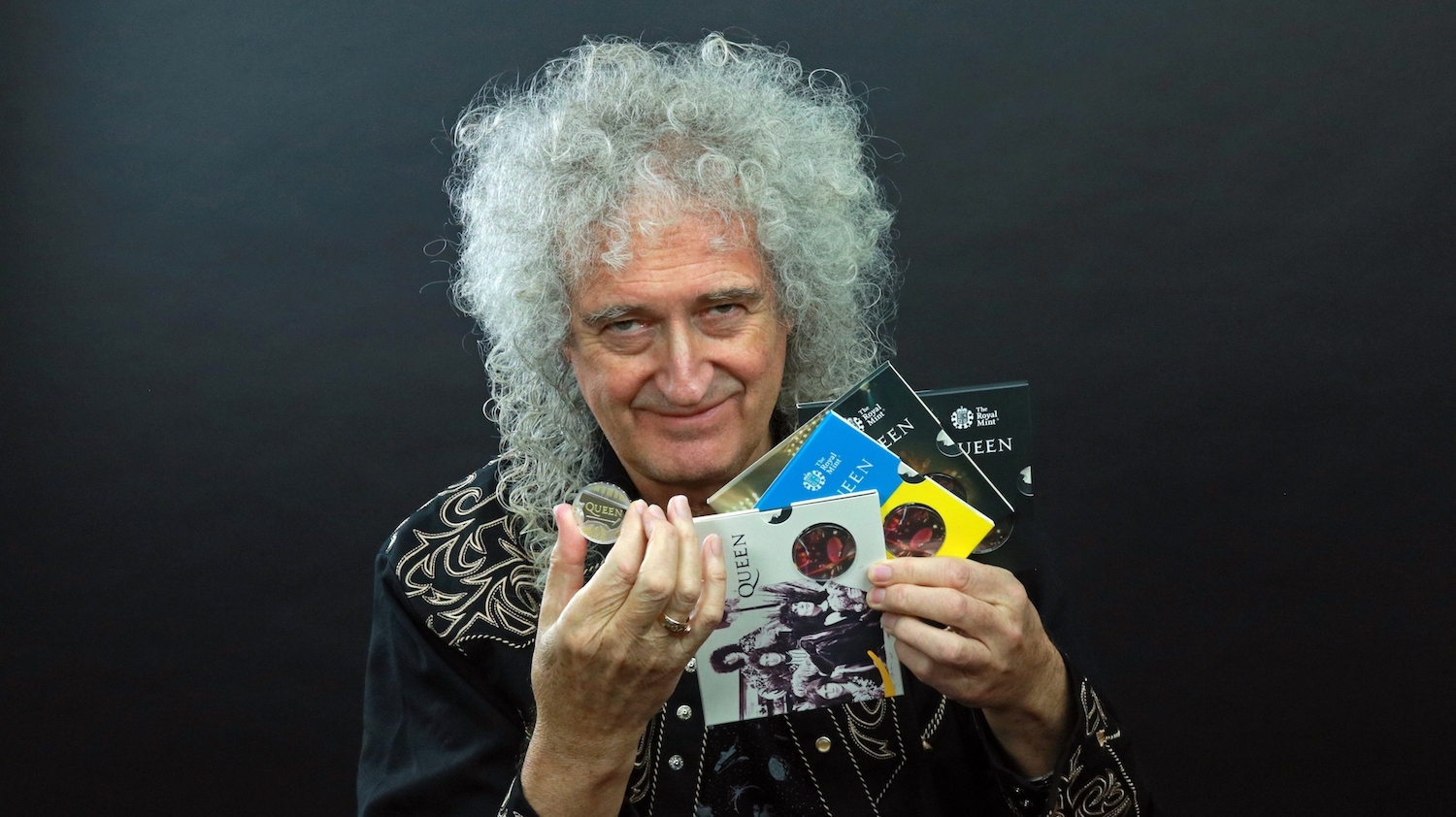
Dr. Brian May of Queen holding a 50p coin produced by the Royal Mint celebrating the band.
As someone who owns their first 12 albums on vinyl and their last three on compact disc plus several gigabytes of downloads because it is difficult to rip vinyl, I will be a buyer of some version of this coin.
For the record (pun intended), Queen is the third most requested artist in my shop, after the Beatles and the Grateful Dead.
And now the News of the Numismatic World…
 January 20, 2020
 → Read more at abcnews.go.com
January 21, 2020 → Read more at loudersound.com
January 22, 2020 → Read more at kitco.com
January 25, 2020 → Read more at wtop.com
→ Read more at abcnews.go.com
January 21, 2020 → Read more at loudersound.com
January 22, 2020 → Read more at kitco.com
January 25, 2020 → Read more at wtop.com
Marks Comments Again
There once was a saying that you should not argue with someone who buys ink by the barrel. In this case, maybe Gary Marks of the Citizens Coinage Advisory Committee should consider how they deal with a blogger with an active blog. Mr. Marks commented on my response without understanding the point that if the CCAC had better communications outlets, we may not be having this discussion.
Here is the follow-up from CoinNews.net:
Mr. Berman [sic]wants to know how he would have known about the CCAC’s recommendation to put Roosevelt on the quarter obverse. Actually I known that it received prominent coverage in Coin World. He also asks why the CCAC’s documents are not on the web. Well, actually they are. Please go to ccac.gov and you will find them — right out there for the public to see. In fact, if you go to the January 27, 2009 CCAC meeting minutes you will find the following excerpt concerning the Roosevelt recommendation:
“9. Reverend Meier mentioned to the committee that he, as a private citizen, is urging legislation to place Theodore Roosevelt on the obverse of National Parks Quarters, in tribute to President Roosevelt’s role in establishing America’s national parks.
10. Members expressed considerable enthusiasm for Reverend Meier’s idea. Several members pointed out that any such change would, be definition, be temporary, because the legislation creating the National Parks Quarter Program specifies that an image of George Washington will appear on the quarter after the program’s conclusion.
11. After extensive discussion about whether a sua sponte suggestion was within the CCAC’s mandate, the committee voted 8-0 to recommend to the Secretary of the Treasury that consideration should be given to placing an image of Theodore Roosevelt on the obverse of quarters issued as part of the National Parks Quarter Program.”Mr. Berman [sic] then suggests that the CCAC has “coordinated” talking points because he has heard from two members concerning the idea of improving the “spaghetti” haired Washington image on the quarter. Wow, I’m not sure who Mr. Berman thinks we are, but I can tell you that our committee is made up of hard working volunteers — most of them coin collectors — who share many of the same thoughts, aspirations and concerns held by many in the coin collecting world. We are certainly not career politicians who sit around “coordinating” talking points. If Mr. Berman has heard the same thing from two of us its simply because that is an area the committee is now focusing on.
To which I responded:
With all due respect to Gary Marks, I tried to subtly point out that you are spelling my name wrong by including “[sic]” in the quotes from his response to indicate that the previous word is not a transcription error. Mr. Marks responds to my comment by continuing the same mistake in the spelling of my name. Respecting the name of the person you are conversing with is important to having disparate points of view discussed in a respectful manner. Therefore, if Mr. Marks would like to continue this discussion, I would appreciate that he spells my name properly!
Mr. Marks notes that the information is on the CCAC website. However, with no search capabilities and with information less than what is available to those who attend the meetings, it is difficult to sit and read back through past meetings to find the information. It should also be noted that as of this writing, the minutes from the last FOUR CCAC meetings have not been posted.
What should be obvious from my response is that there is a communications issue. While the information is there, its usage and accessibility is lacking, even using the basic technology tools available to the CCAC and the US Mint. It should be incumbent on the CCAC and the US Mint to fix these communications issues to provide the public a better view into their work.
Again, if the CCAC and the US Mint cannot perform these basic functions, then my conclusion on how they perform their function does not change.
This is my last work in this forum. I will have a full comment on this on the Coin Collector’s Blog (coinsblog.blogspot.com) this weekend.
Stay tuned!
A CCAC Response
My last blog entry, CCAC Dropped the Ball… AGAIN! appeared on CoinNews.net and generated an interesting response from Gary Marks, a member of the Citizens Coinage Advisory Committee. Mr. Marks writes:
As a member of the CCAC, I read Scott Barman’s article, “America the Beautiful Quarters, CCAC dropped the ball again” with great interest.
According to Berman, [sic] his opinion about the CCAC’s actions concerning the call to put Theodore Roosevelt on the obverse of “America the Beautiful Quarters” stems soley from his reading of an article entitled, “Debate rages in coin world: Theodore Roosevelt or George Washington on new quarter?”, published on January 20th.
Although he might have read the January 20th article, I was left to ponder if he might have misread or inadvertantly skipped over a part of it. His conclusions seem to suggest that he might have missed the following key sentence from the January 20th article, “Unfortunately, the change attracted no support in Congress, which initiates all changes in U.S. coins, including denominations, size, weight, metallic content and subject.” The key phase here is “the change attracted no support”.
Berman [sic] writes, “I am sure that members of the CCAC will ask that if there is no support for the design then why propose it?” The statement seems to suggest that Berman [sic] is unaware that the committee actually proposed it. But once we proposed it, it fell flat. No support materialized. Yet, Berman [sic] interprets the lack of support this way: “the CCAC wilted at the chance to refresh the sameness of the one coin’s design”. Did the CCAC wilt? I think not. We were the committee that started this discussion in the first place by making a bold recommendation! Yet, when no support materialized, the committee was faced with the option of “tilting at windmills” by trying to breathe life into an idea that was clearly and unfortunately dead, or to move on and consider doing something else to refresh the quarter obverse – like making improvements to Washington’s image. The committee is currently considering the latter.
Contrary to Berman’s [sic] interpretation of this situation, the committee did exactly what it was suppose to do – it provided independent advice based on what we thought was best for American coin design. But that advice was not taken.
Is refreshing Washington’s image an option with the same excitement as placing Roosevelt on the Quarter? Clearly not. Is it an idea that might actually have a chance of happening? Yes. Will it be an improvement over the “spagetti” [sic] haired Washington that currently exists on the quarter? Yes. On that basis alone, it is worth pursuing.
In my response to Mr. Marks, I followed up with:
I read the article correctly, Mr. Marks. I read the statement you emphasized and drew my conclusion from the statement and the information in the article.
Mr. Marks then said, “The statement seems to suggest that Berman [sic] is unaware that the committee actually proposed it. But once we proposed it, it fell flat.” How would I know that that the CCAC proposed this? Where was the reporting? Better yet, with the various directives from the President on the executive branch toward open government, then why aren’t the CCAC’s documents available on the web? What is on the web is so sparse it is difficult to understand what happened at the meetings. Maybe, if the CCAC published their materials on the web the concerned public would be able to understand what is happening without relying on the word count limitations of a non-numismatic publication.
I have heard the comment about the new design being better than Washington’s “spagetti” [sic] hair used since 1999 from another CCAC member. I am glad to know that the CCAC has coordinated its talking points on this consolation prize. Of course Washington’s spaghetti hair would not be an issue if Teddy Roosevelt appeared on the quarter’s obverse.
For the record, I have “applied” to gain access to the artwork presented to the CCAC. Unfortunately, the US Mint, which manages this process, does not recognize bloggers in the same manner as journalists and my application was denied. Therefore, if the CCAC wants me to comment on the facts, provide them to me in a timely manner. Otherwise, you are a victim of your own bureaucracy which does not change my conclusion.
I invite the CCAC, including Chairman Mitch Sanders and representatives from the US Mint, to an open discussion on the issues of open government and how that could best provide their materials to the numismatic public for a better understanding of why filtered information garners responses they do not agree with.
CCAC Dropped the Ball… AGAIN!
While catching up on the weekend’s reading I came across an article Debate rages in coin world: Theodore Roosevelt or George Washington on new quarter? The article is about how the Citizens Coinage Advisory Committee debated whether to recommend that Teddy Roosevelt be placed on the obverse of the new America the Beautiful Quarters.
Introduced in 1932, the Washington Quarter was intended to be issued as a one-time circulating commemorative to honor the 200th anniversary of George Washington’s birth. The quarter was born of controversy when Secretary of the Treasury Andrew Mellon chose John Flanagan’s depictions over what had been determined to be a more artistic version by Laura Gardin Fraser. Although Mellon was a collector of great fine art that was later donated to the National Gallery of Art, many knew he was a sexist and refused to consider that a woman’s work was better than a man’s.
As the Great Depression deepened, no quarters were struck in 1933. Toward the end of the year, US Mint director Nellie Tayloe Ross was asked by the Federal Reserve to produce more quarters for circulation. Rather than use a new design, Ross ask the Treasury Secretary William Woodin for permission to continue to use Fraser’s design. Since Ross and Woodin did not want to undergo a new design competition, the Fraser designed continued until it was “updated” in 1999 for the 50 State Quarters Program.
Numismatist see Teddy Roosevelt as the father of the coinage renaissance when he tried to conspire with Augustus Saint-Gaudens to bring classic design to American coinage. Roosevelt call this his Pet Crime. Roosevelt was instrumental in the Mint using Saint-Gauden’s designs for the $10 gold eagle and his famous design on the $20 gold double eagle coin that continues to be celebrated today. Add the wonderful work by Bela Lyon Pratt on the gold quarter and half eagle coins along with Victor David Brenner’s Lincoln cent and the stage was set for a period of timeless classics.
Under his presidency, Roosevelt made conservation a national priority. He placed more land into the public trust than any other president and created the US Forest Serive to care for that land. Roosevelt elevated the importance of the National Park Service to be more than a caretaker of public land but make it accessible to everyone while protecting its beauty. His service to conservation has not been matched by any president since.
With his work on coinage and the lands that will be featured on the new series, it would be a natural recommendation to have Roosevelt adorn the obverse of these quarter. However, the article reports that the CCAC backed down because of the alleged lack of support by congress.
The CCAC is supposed to be an independent organization that is supposed to recommend what is best for the design of American coinage. It is supposed to be a non-partisan and non-political organization that apparently succumbed to the politics of the day. Rather than doing what is right, the CCAC wilted at the chance to refresh the sameness of the one coin’s design in the same way that Roosevelt bristled at the designs of Charles Barber in the early 20th century.
I am sure that members of the CCAC will ask that if there is no support for the design then why propose it? Because at some point, it is more important to do the right thing than taking the politically expedient path. It would put congress on record as being against a populist idea, albeit a small population of populists. It would show that the CCAC was an organization that understand the issues of coin design and not a rubber stamp body of sometimes bland coin designs.
The CCAC must re-evaluate their role as and advisory committee and advise. If this is not possible, then the CCAC only duplicates the role of the Commission of Fine Arts and should be disbanded.
Images for a Buck
For a light hearted start to the weekend, how about a little “Dollar Art?” An artist who identifies himself as Rj55.com has taken high resolution photos of one dollar US Federal Reserve Note from different angles and perspectives. Artists call this series a study of the object.
As part of the study, the artist compares elements between the reverse of a 2007 or 2009 Presidential Dollar on top of the note to compare elements. In one photo, the national motto is compared to the the national motto on the note. It is a very interesting picture.
On a different page, the artist presents Pennies on the Dollar. In the context, the page contains high resolution images of pennies on top of dollar bills. As a numismatist, the last image is the most interesting. It shows a 1966 cent next to a 2009-D cent. The first thing I notices is a difference in the rim. Then if you compare the portrait, there is a significant difference in the relief and its size. It might be interesting to do a study of the Lincoln Memorial Cent to watch the changes as the US Mint adjusts their dies.
Just for fun, here is the artist’s conception of a colorized Eye of Providence with dramatic music in the background:
Have a good weekend.
Review: PCGS Photograde Online or iPhone
With my background in computers, I love technology. When technology can be used to enhance what we do, I am one of the first people there to participate. This week, I downloaded my first coin-related iPhone application, PCGS Photograde for the iPhone.
 While reading an article reviewing PCGS Photograde website, I noticed they included a banner announcing that the information was available for the iPhone and iPod Touch was available via the iTunes App Store. Excitedly, I clicked the link, read the information, and downloaded the application. After syncing my iPhone with iTunes, the app appeared on my phone.
Unlike other iPhone apps, PCGS Photograde starts and stays in landscape mode without an option to change that. Even with that minor nit, the app starts right at the home page no splash screen (a good thing), with an image similar to the one on the website. Although PCGS does not use key date coins for the initial image, the coins used do a very good job in representing their section.
 The first limitation I noticed for both the web and iPhone app is that the coins listed were struck in the 20th century. Even if the series started in the 19th century, no series that ended before 1901 was listed. Further, modern coins are not listed unless the series started before the change to clad coinage in 1965. This means that there are no grading images for the Eisenhower, Susan B. Anthony, or Sacagawea dollars. Given that there were some circulation of the Eisenhower and Susie B’s as well as striking issues with the Eisenhower dollar, it would be nice to have an image reference of these coins.
As with the website, the user taps either the obverse or reverse image of the coin representing the series to show a page for you to pick the coin type. One more tap displays the coin in various “common” grades, usually from G04 through MS65. The app shows three images at a time and you can scroll left or right by flicking your finger across the screen. To see the details close up, you can double tap the image you want to see and it will expand to show the entire coin on the screen. If you want to see more detail, use the pinch motion to adjust the size.
 Once you expand the images, you will find that coin images are beautiful. Even when looking at lower grade cents or high grade silver, the images clearly show the criteria for the the grade. The only complaint I have for the images is the use of toned coins. While some people like toned coins, I am not one of them. To me the images with the toning detract from the coins beauty and does tend to obfuscate some of the differences between grades especially Mint State grades which can be difficult without toning. For example, the MS67 and MS68 Kennedy Halves are toned coins which makes it difficult to tell the differences between the two grades.
One advantage the iPhone app has over the website is that while viewing coin images there is a button to back up one page. On the website there is a “[home]” link. Although you can go back a page by using your browser’s navigation buttons, having a “go back” link would be helpful.
Both the Web site and iPhone app are very useful. But I like the iPhone application for being portable and being able to come with me to shows or coin shops to help me with coin grading. I give both the website and iPhone app a grade of MS64, a common high grade for being very well done but could be better.
Support the Coin Collectors Blog
 Buy me a coffee
Thank you for your support!
Let Me Know What You Think
Are you going to the World's Fair of Money
Total Voters: 17
 Loading ...