
Weekly World Numismatic News for December 8, 2019
After a week of being busier than a one-armed paper hanger, I sat down to write a blog post and found that this was marked as a draft and never published. Sorry for the delay!
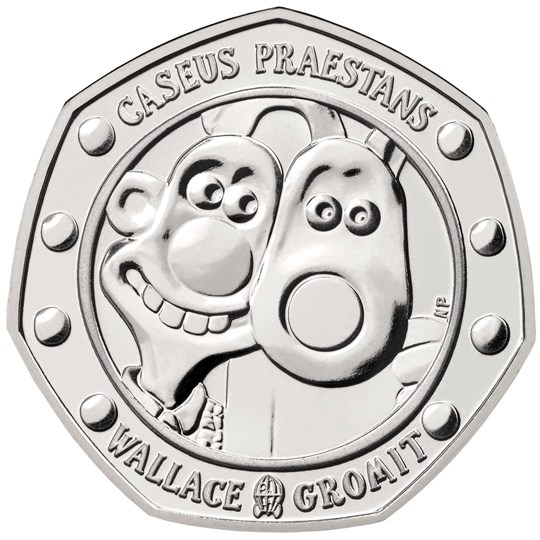
The Brits love collecting these coins that would be called “gimmicks” in the United States
(Royal Mint image)
The study that was commissioned by the Royal Mint sampled 2,000 adults and showed that more than 50-percent of the respondents collected coins or stamps, the most in the survey.
Although age was a factor in the type and size of the collection, the study showed that themed coins were more popular with younger collectors than the traditional set building.
When it comes to advancement in electronic payments, e-commerce, and similar conveniences, the UK is no different than the United States. One Bank of England study showed that younger adults are adapting to credit cards and electronic payment options more than their parents and grandparents. The difference is that the average value of the transactions is higher.
In addition to the 1-, 2-, 5-, 10-, 20-, and 50-pence coins, the Royal Mint produces £1 and £2 circulating coins. Brittons are used to carrying these coins and using them for low-value transactions. While many stores will accept micro-transactions using credit cards, the cost structures are different that using coins is encouraged.
In the United States, the credit card companies have pushed the use of cards to the point of lowering transaction fees to the merchants to encourage microtransactions. While it is common to see someone in the United States pay for a $2 large soda with a credit card, the studies show that this does not happen as much in the United Kingdom.
Aside from the societal norms that continue to promote coins for commerce, the Royal Mint has done an excellent job promoting coin collecting by producing different designs. They produced 20p and 50p circulating coins that have promoted various aspects of British cultural history. It is common to see weekly stories of a limited edition circulating coins to sell for high values in online auctions.
Not only are these coins accepted by the British numismatic community, but they are also used to promote the hobby more than the sovereigns of the higher-priced collectibles. News reports demonstrate that the British collecting public would instead collect coins about Wallace & Gromit or Paddington Bear than a sovereign.
Rather than embrace change in United States coinage, the numismatic Illuminati would rather bemoan the state of “modern coinage.” They forgot how the 50 States Quarters Program brought back interest in collecting coins. But they were happy when people started showing up at their shops and shows while ignoring the hucksters out there who were selling overpriced packages which has lead to giving the hobby a proverbial black eye.
The situation is understandable. Dealers have to make a living, and it is more profitable to sell Morgan Dollars than it is to sell Presidential Dollars. Unfortunately, the way dealers turn their noses up to the lower-end market is turning away future customers. Collectors have to start somewhere and if it means getting someone interested in collecting National Parks Quarters or encouraging a series of quarters based on cultural icons, then embrace the change. Your future may depend on it!
And now the news…
 December 3, 2019
 → Read more at mirror.co.uk
December 3, 2019 → Read more at hurriyetdailynews.com
December 3, 2019 → Read more at mining.com
December 3, 2019 → Read more at bbc.com
December 6, 2019 → Read more at qz.com
December 6, 2019 → Read more at princegeorgematters.com
→ Read more at mirror.co.uk
December 3, 2019 → Read more at hurriyetdailynews.com
December 3, 2019 → Read more at mining.com
December 3, 2019 → Read more at bbc.com
December 6, 2019 → Read more at qz.com
December 6, 2019 → Read more at princegeorgematters.com
Read the Blog Before Buying the Coin or Writing the Editor
One of the more interesting aspects of writing this blog is to be able to look into various aspects of numismatics and being able to explain what I discover to my readers. Sometimes, this research allows me to use what I write as a teachable moment to others. While I certainly subscribe to Aaron R. Feldman’s recommendation to “buy the book before you buy the coin,” but sometimes it may pay to read the blog.
Not long ago, I read an article printed in Numismatic News that had the valid point that the US Mint needs new and innovative direction. However, the writer placed the blame on the Mint itself without considering the law that govern everything the Mint does.
Long time readers may have remembered my post Sausage Making And Coin Production that described the process of how a coin or medal goes from being an idea to becoming a coin in detail. It is a sausage making process that would even scare Otto von Bismarck!
I felt that the writer of the opinion piece did not take into consideration that nearly everything the US Mint does is prescribed by law, as i described in my posting. So I took that posting, reworked it a bit to be more suitable for printed media, and sent it to Dave Harper, editor of Numismatic News. I learned from a colleague that the article has appeared on their website.
Long time readers will recognize the topic. Newer readers can use it to catch up. In either case, we might want to alter Feldman’s advice to “read the blog before buying the coin or writing the editor.”
Thank you to all of my readers for being my inspiration.
PCGS Offers Second Tier Registry Competition
In an attempt to try to boost their business, the Professional Coin Grading Service (PCGS) has announced the launch of the “Everyman” category as part of their PCGS Set Registry competition. The main rule of the “Everyman” Collection are classic coins (mostly pre-1964) not grated higher than AU-58 by PCGS.
PCGS has been running their Set Registry since 2001. The PCGS Set Registry will only accept coins graded by PCGS. This is different from Numismatic Guarantee Corporation (NGC) whose registry competition will accept coins graded by NGC and PCGS. No other grading service offers registry sets.
While I do not begrudge PCGS for doing this, it seems like they have created a category for the “best of the rest.” Rather than compete for the best, you can compete for less than the best. It is like awarding someone for mediocrity. It reminds of the movie Meet the Fockers when Bernie (Dustin Hoffman) and Rozalin Focker (Barbara Streisand) were showing off fourth and fifth place ribbons and participation trophies to the over-acheiving Jack Byrnes (Robert De Niro). As I am looking at PCGS’s announcement as if I was looking at it through the eyes of Jack Byrnes.
I am not against registry sets. After all, I have written about my sets and even wrote when a set was called a top ranking set because it became third in its category. By the way, that set is now second in its category!
But why have a second tier competition? The only reason I can think of is that PCGS is trying to encourage more people to submit their coins for grading. There may not be many more higher grade coins to encapsulate, so this could be a reason to encourage those with coins that were not considered cost effective to grade to be submitted.
Who am I to question capitalism? Let’s see how many circulated 1935 Mercury Dimes (valued at $11 in AU58 according to the PCGS price guide) will be submitted for grading at $15 per coin in order for them to be entered in an “Everyman” set.
1933 Double Eagles May Become Legal Tender
 Thanks to an article that appeared in The New York Times, the case of Langbord v. U.S. Mint was back in the news. Apparently, the order [PDF] for the government to turn over the ten 1933 Saint-Gaudens Double Eagle coins to the Langbord family was posted to the website for the US District Court for Eastern Pennsylvania.
In the order, Judge Legrome D. Davis, Jr. agreed with the plaintiff (Langbord family) that the coins were illegally seized and order the government to turn over the coins or initiate a judicial forfeiture procedure by September 28, 2009. There has been no comment issued by the US Mint or the Department of the Treasury. It is expected that the government would file a forfeiture procedure that would have to prove the coins were stolen from the US Mint. Since the alleged crime occurred 75 years ago and none of the principals are still alive, the government has a very high standard to meet.
The 1933 Saint-Gaudens Double Eagle coins has been the source of legends. After the sale of the Farouk-Fenton Coin for $7.59 million in 2002, its story became the inspiration for two books, Illegal Tender and Double Eagle, and inspired legislation to protect older coins and patterns that left the Mint under allegedly nefarious conditions.
But would the addition of ten coins reduce the value of the Farouk-Fenton specimen?
Along with condition and rarity, any special story or provenance of a coin will affect its price. The story and provenance of the Farouk-Fenton specimen is extraordinary. It was the subject of international intrigue including the overthrow of King Farouk of Egypt and the chase by the US Secret Service for the coin that lead to the sting at the Waldorf Astoria Hotel where British coin dealer Stephen Fenton was arrested trying to buy the coin.
Two books, a court case, and a sale by Southeby’s for $6.6 million (plus the 15-percent buyer’s fee making the total $7.59 million) makes it a one-of-a-kind coin.
Even if the Switt-Langbord coins enter the market they may never reach the status of the Farouk-Fenton example. The only factor that could bring down the price of the Farouk-Fenton coin would the be effect of the economy. Otherwise, it will stand alone as the first 1933 Saint-Gaudens Double Eagle that comes with a very unique story.
Image courtesy of the US Mint and NY Times.
Heritage Accused of Racketeering
Heritage Auction Galleries, the third largest auction house in the country and probably the largest auctioneer of coins, is being sued by a former employee alleging that Heritage executives perpetuated a “massive auction scam.” The lawsuit charges that the Heritage used an undisclosed shill bidder at auctions to inflate the price. Co-defendants of the suit include Heritage executives Gregory J. Rohan, Steve Ivy, James L. Halperin, Marc D. Emory, Paul R. Minshull, and Dagmar Byers.
Filed on May 22, the suit alleges that Heritage and its executives violated the Racketeer Influenced and Corrupt Organizations Act (RICO, Title 18, Chapter 96), and the Texas Pawn Shop Act [PDF].
The suit was brought by Gary Hendershott, an alleged expert in Civil Was memorabilia and was recently joined by Montana businessman Chris Kortlander. Kortlander claims to have “consigned thousands of individual historical manuscripts and photographs to Heritage,” and claims to have been deprived of profits because of the use of the shill bidder.
Along with Kortlander’s claim, Hendershott claims he is owed $1.6 million for commissions on auction sales. Part of the sale includes two paintings purchased by a trust Hendershott was working with. A judge ordered that sale be arbitrated after the filing of suits and countersuits.
So let me see if I understand this lawsuit. Kortlander is suing Heritage because they use a shill bidder to increase the hammer price to levels higher than if the shill was not participating and Kortlander claims he was deprived of profits? What would the profits have been if the shill was not bidding on the auction? Would the same prices have been realized?
With Hendershott’s attorney Mark Senter being accused by Heritage President Greg Rohan of rewriting the suit with “salacious headlines,” the filing reads like one of a disgruntled employee and his attorney looking for attention to force Heritage to settle rather and experience the negative press.
One could only wonder what Judge Judy would say!
Corrected second to last paragraph (as marked) to clarify the quote.
Yet Another Rotating Coin Series
On Wednesday, the US Mint announced the America the Beautiful Quarter Series, a 56 quarter series to “honor” national parks in the 50 states, District of Columbia, and territories. As part of the announcement, the US Mint announced the schedule of the national parks and historic areas that will be depicted.
 According to the US Mint, a “restored” version of the 1932 portrait of George Washington designed by John Flanagan. Either this could mean that the Mint engravers will either fix the “spaghetti hair” portrait of the 50 State Quarters or change it to resemble linguini.
Pardon me if I fail to show excitement.
 We just finished the State Quarters program and had the DC and Territories Quarters added to the end. This year we celebrate the bicentennial of Abraham Lincoln’s birth and the century anniversary of the Lincoln Cent. The Presidential $1 Coin series is in the middle of some of the dullest presidents in US history. And we cannot forget the Native American $1 Coin that probably has the best reverse design of all 2009 coins. Including the circulating coins without rotating reverses the total is 18 different coins being struck this year.
I agree with Mike Zielinski when he wrote on the Coin Update blog:
Although I did enjoy the 50 State Quarters series, I think reusing the same concept over and over again becomes dull. With no disrespect to the sites selected for the impending quarter series, I would rather see a single design that could become an iconic and lasting symbol of our generation [rather] than another collection of 56 designs representing 56 different things.
Let’s think of these quarters as a stimulus package for the collecting suppliers who will sell new folder and albums to house the coins in this series.
Below is the B-roll provided by the US Mint. Starting around 2:23 of the clip are scenes from within one of the branch mints showing the production of quarters.
Support the Coin Collectors Blog
 Buy me a coffee
Thank you for your support!
Let Me Know What You Think
Are you going to the World's Fair of Money
Total Voters: 17
 Loading ...