
Collecting Apollo 11
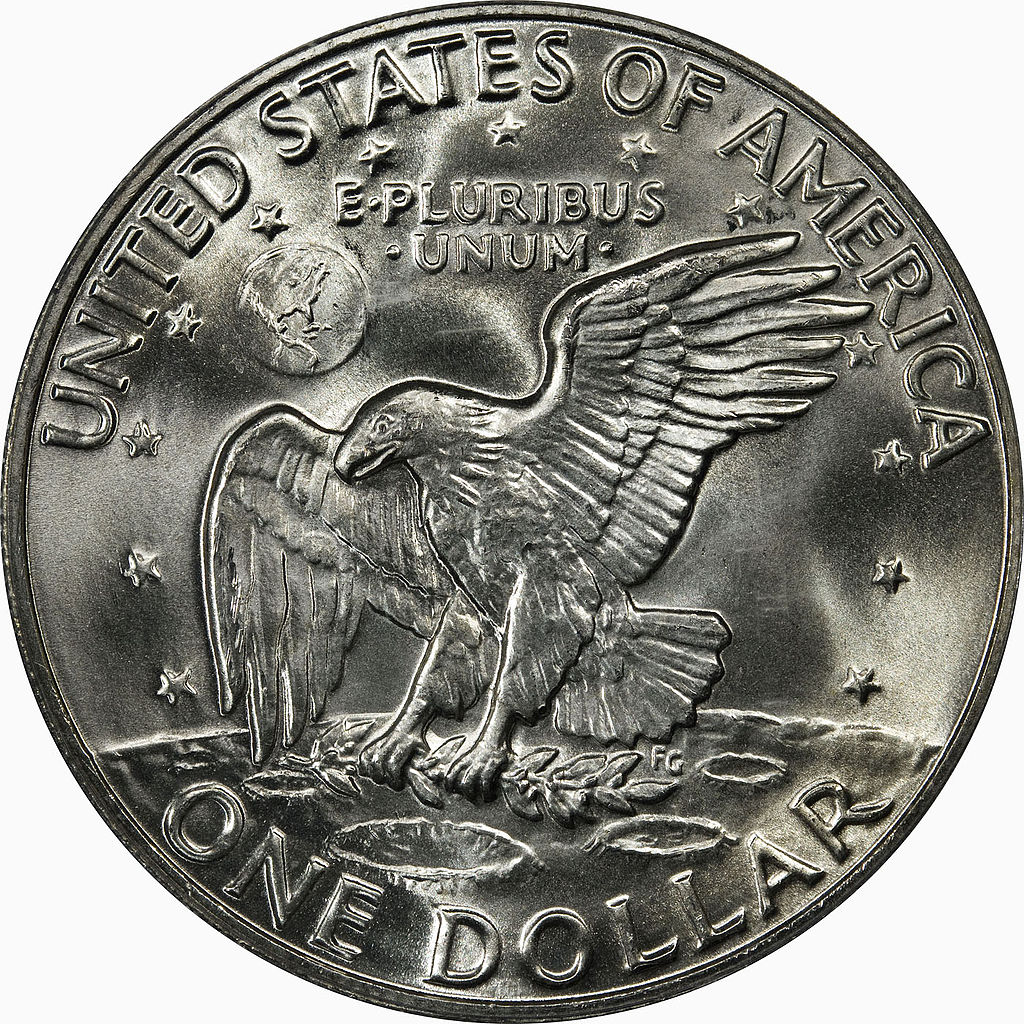
Eisenhower Dollar Reverse featuring the Apollo 11 mission insignia
Kennedy’s vision was accomplished by the Apollo 11 crew of Commander Neil Armstrong, Command Module Pilot Michael Collins, and Lunar Module Pilot Edwin “Buzz” Aldrin along with the thousands of support people on Earth. A little more than eight years after Kennedy made it the nation’s policy, Apollo 11 launched from Cape Kennedy on July 16, 1969.
From within the capsule attached to the top of the Saturn V launch vehicle, a rocket once described as a giant Roman candle, the rocket roared to life to lift the three pioneers into the final frontier. Even though the liftoff occurred at 9:32 AM in Florida, it was watched worldwide regardless of the local time.
Four days later, on Sunday, July 20, 1969, the world held its collective breath as the Lunar Module (LM), call-sign Eagle, was guided to the moon’s Sea of Tranquility and landed at 4:18 PM Central Time. Relief came when Neil Armstrong transmitted a message to Mission Control in Houston:
CAPCOM (Capsule Communicator) Charles Duke’s response summed up the feel of those of us on Earth as he stumbled a bit at the beginning:
According to the official schedule, Armstrong and Aldrin were supposed to get five hours of sleep. Realizing that it was unlikely they would be able to sleep, the crew prepared for the first walk on the moon’s surface.
Six and a half hours after landing, after Walter Cronkite and the CBS News team showed models as to how Armstrong will descend from the LM, pull the D-Ring to activate the camera, Armstrong left the LM and went down the latter. He pulled the D-Ring, and the world watched his progress. Just before reaching the surface of the moon, Armstrong uncovered a plaque mounted on the LM that read:
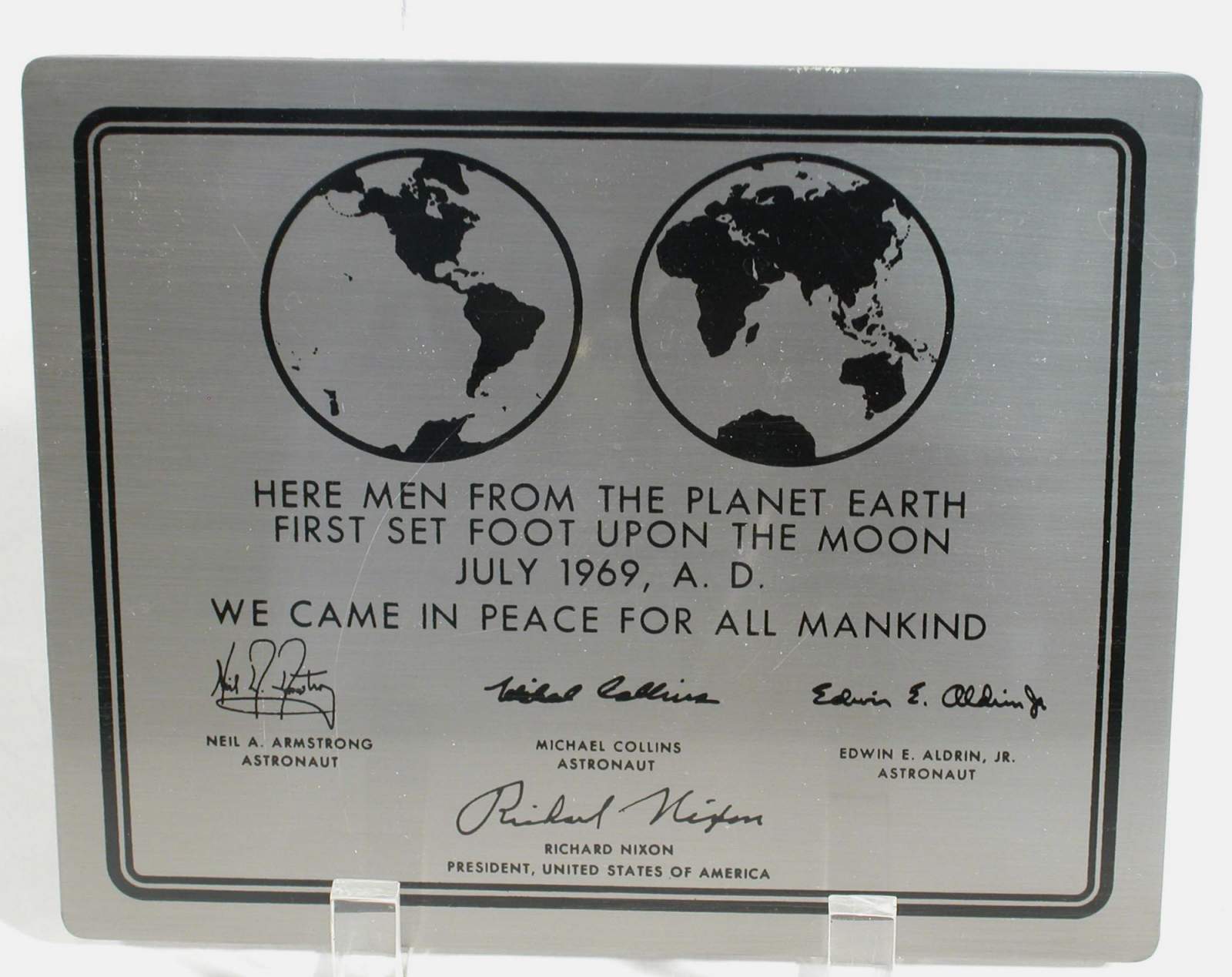
Replica of the plaque on Eagle, the Apollo 11 Lunar Module (Courtesy of the Smithsonian Institute)
Armstrong looked at the surface and described the moon’s dust as “very fine-grained” and “almost like a powder.” Then with a short jump, he left the bottom rung of the ladder and was standing on the surface of the moon.
Over the years, there has been a debate about whether Armstrong included the word“a” in the statement. That is not what was heard at the time, and modern examinations of the audio tapes neither confirm or deny the claim. Regardless of what he said, Neil Armstrong was the first man to walk on the surface of the moon, a little more than eight years since President Kennedy said it was his goal.
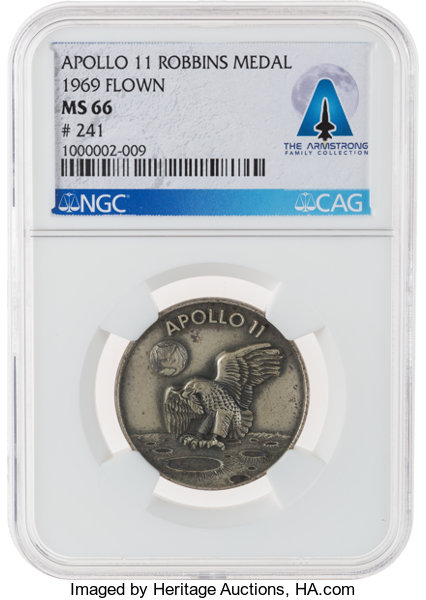
Apollo 11 Flown MS66 NGC Sterling Silver Robbins Medallion, Serial Number 241, from The Armstrong Family Collection (Courtesy of Heritage Auctions)
The practice of carrying Fliteline medals started in 1965 with the flight of Gemini 3, NASA’s first manned mission in the Gemini program. In 1968, the Robbins Company of Attleboro, Mass. was contracted to produce the Fliteline medals starting with Apollo 7.
It is reported that 480 of these 28mm medals were carried aboard Apollo 11.
According to Heritage Auctions, the most paid for a mission flown Robbins Medal was medal #241, a silver medal graded MS66 by NGC, that sold for $112,500 (including buyer’s premium) on November 1, 2018. It was sold with a Statement of Provenance signed by Armstrong’s sons as being once owned by Neil Armstrong. The provenance likely accounts for its high price.
Weekend Change Hunting
Needing to catch up on a number of tasks this weekend, I decided to take time out and go through my pocket change. While I like to examine my change, sometimes it is not possible. So I drop the coins in a small box and promise myself to search them later. The box was overflowing making it time to search.
First, I separate quarters. Quarters are easier to examine because of their size and the fewer errors I have found. I also fill up coin tubes so that my wife has soda money for work. While searching this small box, I found two 1976 quarter with the Drummer Boy Reverse designed by Jack Ahr. It still remains one of my favorite designs.
While searching the quarters, I found a 1992 Great Britain 10 pence coin. This coin is 24.5 mm in diameter and 1.8 mm thick with a reeded edge. A US quarter dollar is 24.26 mm and 1.75 mm thick with a reeded edge. Although the design is different, the size and the silver-like color could easily have this coin mistaken for a US quarter. My only problem is that even at the current exchange rate (it takes $2 to equal £1) the coin’s value is 20-cents leaving me 5-cents short!
Within the nickels, I was able to find a well circulated 1954-S coin. It is not worth much in its current condition, but it is nice to find a coin older than me and with the mint mark on the reverse.
When searching change, there seems to always be more to find within the little brown coins that many want to complain about and eliminate. For change searching, pennies usually yield some of the more interesting finds. Aside from the number of early Memorial reverse copper cents, I was able to find 1972-S and 1974-S cents. For someone on the east coast, finding San Francisco Mint coins in change is not usual.
Of course I found a few wheat back cents. The oldest is a well circulated 1941 cent. Two others, 1956-D and 1957, are in good to very good condition with a nice, even chocolate brown toning.
We cannot forgot our neighbors to the north. With the dollar about on par with the Canadian dollar, the prospect of making a virtual profit on finding Canadian cents induces dreams of past economic times. But this time, I found two 1979 and one 2000 cents. The 1979 cents have the modified tiara portrait, a smaller portrait from previous versions, and 3.26 grams of .980 copper. It contains 2.57 (US) cents worth of metals.
The copper-plated zinc 2000 Canadian cent, contains about one (US) cent worth of zinc.
If nothing else, it gave me a couple of hours to relax.
Sausage Making And Coin Production
On a stormy Saturday in your nation’s capital, I have been taking my inside time to watch the Rules and Bylaws Committee [PDF] of the Democratic National Committee argue about what to do with the delegates from Florida and Michigan. During one of the interruptions because the storms knocked out the signal, MSNBC’s Chris Matthews commented “welcome to the sausage factory of politics,” a twist on the Otto von Bismarck quote “Laws are like sausages, it is better not to see them being made.”
After a brief chuckle, I thought how this was true in the world of coin production in the United States since every coin and medal that the US Mint produces is governed by law. In fact, I think the United States is the only country the regulates coins in this manner.
Rather than go into how laws are made here in the United States, I point the reader to this excellent write up provided at the Library of Congress. The PDF version describes this sausage making recipe in 58 pages.
The laws that are passed which govern the US Mint are codified in Title 31, Subtitle IV, Chapter 51, Subchapter II of the United States Code (U.S.C.). Section 5111 (31 U.S.C. §5111) give the authority to strike coins and medals to the Department of the Treasury. Section 5113 (31 U.S.C. §5113) talks about the tolerance in the weight of minted coins and orders that their weights and content be verified.
But the significant section of coinage law is Section 5112 (31 U.S.C. §5112), Denominations, specifications, and design of coins. Section 5112 covers all of the specification for every coin struck by the Mint. It describes the size, weight, content, and the design of the coin. Very little is left up to the Mint in coinage design.
Within Section 5112, there are specific paragraphs that tell the Mint exactly what coins are to look like. For example, paragraph (q) (31 U.S.C. §5112(q)) titled Gold Bullion Coins, that tells the Mint that the $50 gold coin is to “bear the original designs by James Earle Fraser, which appear on the 5-cent coin commonly referred to as the ‘Buffalo nickel’ or the ‘1913 Type 1’.”
Other paragraphs, like paragraph (l) that authorizes the 50 State Quarter Program, describes the process which the design will be made. In the case of the state quarters, the recommendation starts with the states then goes through the Mint’s regular design process.
The Mint’s design process is another example of the sausage making that governs US coinage. Once the Mint receives the Public Law, it either takes the input from the state or commemorative group involved to the Mint’s artists and engravers so they can create several designs that meet the legal requirements. Coin designs go through an internal review process before they are given to the Director of the Mint to submit them to the next process.
Once the designs are created, they are forwarded to the Citizens Coinage Advisory Committee to review and recommend a design. The CCAC may also ask the artists to alter designs for historical or aesthetic reasons and return with updated designs.
The CCAC was established by congress in 1992 as part of Public Law 102-390 (31 U.S.C. §5135) “to advise the Secretary on the selection of subjects and designs for commemorative coins.” (emphasis added)
Once advised by the CCAC, many paragraphs within Section 5112 requires that the designs are then sent to the US Commission of Fine Arts for their “review.” The CFA reviews the same designs as the CCAC and are not bound by the CCAC’s decision. In fact, there are many cases where the CFA will choose a different design or request different changes than decided by the CCAC. Changes are then vetted by the CCAC and the CFA. Many times, the CCAC and CFA will continue to disagree. An example of this version of the sausage grinder was evident on selecting the designs for the reverse of the 2009 Lincoln Cents.
But the process does not end there. The recommendations of the CCAC and CFA are forwarded to the Secretary of the Treasury, who has the final approval of all designs. Since the founding of the CCAC, no Treasury Secretary has ignored the recommendations of either organization. Typically, the Secretary approves the same design as recommended by the CFA, but is not required to do so. A classic example of this was the decision by Treasury Secretary Andrew Mellon to ignore the CFA recommendation on the design of the original Washington Quarter.
During the design process, the Mint ensures that the metals are procured to strike the coins or medal. Within Section 5112 are many paragraph that require that the metals used to strike the coins be purchased from US mines on the open market. The US Mint is the single largest purchaser of gold and silver in the United States while they compete with everyone else for the stores of copper, tin, and nickel to strike circulating coinage. The law prohibits the Mint from paying anything other than market value for coinage metals.
Once the Secretary approves the design, the Mint’s engravers do what is necessary to make the dies that will be used to strike the coins or medals. The Mint then gets to decide on the packaging and the price of the commemorative coin, bullion issue, or medal. Commemoratives will usually add a surcharge that will be donated to a particular organization. The parameters for pricing coins is also described in Section 5112.
Sometimes, the Mint does not even get to control where the coins are struck. Some laws will specify which branch mint will strike the coins. Others, like bullion issues are predetermined in other sections within Title 31.
Before collectibles can be sold, the Mint has to determine the price that will be charged for these items. Section 5112 requires the Mint to take into consideration of the market value of the metals used, the costs required to produce and sell the item, and the surcharge that will be donated to a particular organization. As we have seen in the past year, the Mint will re-price precious metals issues as the volatile market adjusts prices.
Finally, the coins and medals are struck. If they are circulating coins, the Mint strikes enough to meet the demand of the Federal Reserve plus additional for sale to collectors. Commemorative and collectible bullion can have mintage limits that are defined in Section 5112
The only part of the process that the Mint has complete control over is the marketing and packaging for numismatic sales. While the Mint may not produce more than the legal limit for any coin, they are allowed to create special packaging for collectors. The Mint has created special sets for some commemorative issues that include “coins and chronicles” sets that includes commemorative and proof strikes of circulating coins.
Whether it is the 50 State Quarter in circulation, a commemorative issue, or a medal honoring someone for their contribution to society, you are looking at the end result of the sausage making process that goes into making our coinage. Remember that when you think, “why did the Mint do that?”
Finally Found An Ugly $5
A few weeks ago, I wrote about not finding new coins or the new $5 note in circulation. Since that posting, I found a few additional Oklahoma state quarters and New Mexico quarters. Added to the hunt for new money was a Series 2006 $5 Federal Reserve Note handed to me in change.
This is the first time that I have a note in hand. Like the other note designs, it has a hint of color that makes it look like the addition of color was a mistake. As an artistic composition, it is as ugly as the other “new” notes while individual elements, such as the portraits, show remarkable artwork.
New currency designs look like the Bureau of Engraving and Printing is dabbling in currency design after being mired using the same basic designs for over sixty years. I do not know why BEP never changed the designs for so long since they are not regulated in the same manner as the US Mint. BEP does not have to consult with the Committee of Fine Arts on the designs.
 Prior to the 1920’s, BEP created some fascinating currency designs that currency collectors desire. In the book 100 Greatest American Currency Notes by Q. David Bowers and David M. Sundman, they list phenomenal notes and designs that included designs created by the BEP. Bowers and Sundman called the $1,000 “Grand Watermelon” Note as the greatest note produced in the United States. Named because the zeroes on the reverse look like watermelons, with only seven known notes that have survived, the Grand Watermelon is consider the penultimate prize for currency collectors. In December, 2006, Heritage Auction Galleries sold one for $2,225,000.
 Currency used to be topical, modern, and represented a theme of the time. The Series 1901, $10 Legal Tender “Buffalo Note” is ranked sixth by Bowers and Sundman. With portraits of Merriwether Lewis and William Clark surrounding an American Bison, the note was issued to celebrate the American west and the trail blazed by Lewis and Clark. This is my favorite note.
 For some reason, the BEP stopped creating classics. When given the opportunity to create new classics, the BEP went for plain and bland. When I wrote about the new polymer 20 New Israeli Shekelim notes. Aside from the polymer material, this colorful note whose dominant green color honor’s Moshe Sharrett, Israel’s first ambassador to the United Nation. The reverse features Jewish Brigade volunteers and parts of his first speech to the UN.
The 20 NIS note is beautiful, colorful, and very patriotic for Israel. With the potential that BEP has to change US currency to accommodate the visually impaired, why not take the opportunity to issue modern classic designs?
Images courtesy of Heritage Auction Galleries and the Bank of Israel.
I Have Not Owned It For All Of Its 125 Years!
On May 24, 1883, thousands of people crowded lower Manhattan and Brooklyn for the grandest of all ceremonies from all over the area—even as far away as Philadelphia. Dignitaries gathered at the armory of the Seventh Regiment on Park Avenue to board carriages to join a colour guard, a 70-piece band, and a 22-piece drum corp for the festivities. Forty mounted police officers accompanied the parade.
The list of dignitaries was a Who’s Who of the political America that included President Chester A. Arthur, New York Governor Grover Cleveland, and New York City Mayor Franklin Edson. The carriage carrying President Arthur and Mayor Edson lead the parade surrounded by a very large cheering crowd.
 At 1:50 PM, the processional arrived at the entrance of the new bridge, President Arthur and Mayor Edson left their carriage and crossed what was the world’s longest suspension bridge arm-in-arm to a cheering crowd who paid $2 for tickets to watch from the bridge.
The band played Hail to the Chief as ships who came to the ceremony and anchored around the East River blew horns to honor the President. Navy ships who were invited to the ceremonies took turns giving 21-gun salutes.
 Present Arthur and Mayor Edson were joined by Brooklyn Mayor Seth Low when they arrived on the other side of the new bridge. The three men locked arms and marched to the Brooklyn Pier to complete the ceremony dedicating the Brooklyn Bridge to the people of the New York City and Brooklyn.
Kickoff for the Brooklyn Bridge 125th Anniversary Celebration began on May 22 with a concert by the Brooklyn Philharmonic and fireworks by the Gruccis, the first family of fireworks. The celebration extends through Monday that includes a walking tour of this impressive structure on Saturday, the anniversary.
 In honor of the 125th Birthday of the bridge everyone owns, the image to the right is a bronze medal commemorating her Centennial (click to enlarge). This medal was produced by the Medallic Arts Company for Brooklyn Union Gas. Silver medals were made for the company’s executives. Bronze medals were given to some employees and offered for sale to the public. When the company that owns Brooklyn Union Gas merged with the Long Island Lighting Company (LILCo) in 1998, the company changed its name to KeySpan Energy. In 2007, KeySpan was bought by National Grid plc of London.
By the way… I have a bridge I can sell to you. Let me know and I can give you a good deal!
Source: “Two Great Cities United,” [PDF] The New York Times, May 25, 1883.
As We Start Memorial Day Weekend…
Following the Civil War, many communities set aside one day to honor those who lost their life in this nation’s worst war. As time went on, many of the celebrations were merged into one Decoration Day. The first day proclaimed as “Memorial Day” was in 1862. Decoration Day was recognized as a federal holiday beginning in 1868 but was not celebrated in the south. Many southern states celebrated Confederate Memorial Day on different dates.
Memorial Day was not widely recognized until after World War II.
Memorial Day was traditionally celebrated on May 30. When the Uniform Holidays Bill (sometimes referred to as the “Monday Holliday Act”) came into effect in 1971, Memorial Day was moved to the last Monday in May.
With overseas wars on two fronts and remembering all of the past conflicts, I would like to take this opportunity to honor the memory of all who gave the ultimate sacrifice for the country. I recognize that without their sacrifice I would not have the freedom to write this blog.

 To honor their service, I re-introduce the 2005 Marine Corps 230th Anniversary Commemorative Silver Dollar. The obverse features the National Marine Corps War Memorial (sometimes referred to as the “Iwo Jima Memorial&rdquo) and the reverse has the Marine Corps emblem. This powerful design allowed the US Mint to capture the 2007 Coin of the Year Award.
Between now and Monday, please make sure that you take at least one moment to remember those brave men and women.
Images courtesy of the US Mint.
Support the Coin Collectors Blog
 Buy me a coffee
Thank you for your support!
Let Me Know What You Think
Are you going to the World's Fair of Money
Total Voters: 17
 Loading ...