
Thank you Dave Harper, and good luck!
 After having time to catch up on my reading, I was perusing the news from the numismatic press when I came upon a blog post by Dave Harper announcing his retirement from Numismatic News.
Shortly after I started this blog in October 2005, I found I liked writing about coins and all about numismatics. Aside from giving me an outlet to express my opinions, it also gave me the ability to learn more about everything surrounding numismatics. Writing provides me with the ability to learn more about history and politics, my undergraduate minor and the concentration when I earned my masters.
When I reached out to the numismatic publication, I was able to talk Dave to publishing a few articles. I originally wanted to write for a little money, knowing I would not get rich. But I was satisfied with just having the byline!
My greatest thrill was my front-page story in Numismatic News about the launch of the 2012 Star-Spangled Banner Commemorative Coin. It was an easy task since the drive to Fort McHenry is a little more than an hour from home.
A few months later, Barry Stuppler, a past ANA president and founder of the Gold & Silver Political Action Committee, was looking for someone to help write a newsletter. Dave recommended that Barry contact me. After helping cover an event for the PAC on Capital Hill, Barry offered me the job of Political Coordinator.
From July 2012 until February 2018, I wrote the PAC’s monthly email newsletter. It was a way to combine my Masters in public policy with numismatics. It was a great experience and I have Dave Harper to thank for recommending me for the job.
Thank you, Dave, for helping me when I was looking for a writing outlet.
Thank you for your nearly 41-year service to the numismatic community.
And much naches to you and your family as you embark on your next adventure!
Edmund Moy Now Mint Director
On Saturday, September 5, 2006, the US Mint announced that Edmund C. Moy was sworn in as the 38th Director of the US Mint. Moy succeeds Henrietta Holsman Fore who became the Under Secretary of State for Management. David A. Lebrynk was acting director between Fore’s appointment at the State Department and the installation of Moy. Lebrynk returns to his Assistant Director role.
Moy served on the transition team for George W. Bush and has served in various offices in the Bush administration. Previously, Moy served in the Department of Health and Human Services for President George H.W. Bush.
Pursuant to the Coinage Act of 1873 (31 U.S.C. §304), the Director of the Mint is appointed for a term of five years. However, it is common in today’s political environment that many appointees resign at the end of the president’s term in office to allow the new president to appoint a new team. The last director to serve full terms under two presidents was Donna Pope, who was appointed by President Ronald Regan but served under President George H.W. Bush as well.
Good luck to Director Moy!
BOOK REVIEW: Illegal Tender
Having some time to myself over the last few days allowed me to finish reading Illegal Tender: Gold, Greed, and the Mystery of the Lost 1933 Double Eagle by David Tripp. Tripp is was a director of Sotheby’s in the department responsible for the 2002 sale of the only legal 1933 Saint Gaudens $20 Gold Double Eagle coin. His book is about the history and the over $7.5 million auction sale of this coin.
As with any thriller, the book opens with the background and history of the our protagonist, in this case, the Saint-Gaudens $20 Double Eagle. Tripp repeats the well known history of how President Theodore Roosevelt wanted to extend the gilded age and update the design of US coinage. Roosevelt thought the design of the Mint’s Chief Engraver Charles E. Barber’s were bland and not fitting of a great nation. Tripp reproduces reports of conversations and letters from Roosevelt to Barber and other US Mint officials demanding they follow the instructions of sculptor, Augustus Saint-Gaudens, as to how the coin would be minted. If you have not heard the details of this history, the first chapter is a must read.
From the history of the rise of the Saint-Gaudens $20 Double Eagle, Tripp then talks about its demise. With the country in the throes of the Great Depression and the country revolting against President Herbert Hoover at the polls, Tripp discusses the tension between Hoover and the transition team of Franklin D. Roosevelt. While the country was experience a near total economic collapse, Tripp writes how FDR did not want to do anything that would give Hoover credit for doing anything before the March, 1933 inauguration.
Hours after FDR’s inauguration, the Senate approved the appointment of William H. Woodin as the Secretary of the Treasury. Woodin worked tirelessly with the Hoover administration to try to stop the damage. Tripp paints a great word picture as to how Woodin and FDR created a policy that helped the country pull out of the depression.
One of the problem was the amount of gold leaving the United States and being used for overseas trade. More gold was leaving the Treasury than they were taking in. At Woodin’s urging, FDR signed an executive order recalling all privately held gold. As this executive order goes through many updates, Tripp brings us inside the Philadelphia Mint facilities as they continue to mint 1933 $20 Double Eagles. Tripp puts us right in the Mint and traces the path of these gold beauties.
With the order to melt these coins in 1934, the mystery begins. Tripp weaves the story in true mystery novel style following the trail of several of these coins as they leave the Mint. This includes the one coin with a legal export receipt that was shipped to King Farouk of Egypt. Tripp’ coverage of the “Palace Collections of Egypt” or King Farouk’s by the Egyptian government (website in English) is a classic twist of capitalism and greed meeting politics.
The book bogs down a bit starting in the late 1950s as the trail for all of the Double Eagles gets cold and the various law suits are settled. The story picks up again with the discovery of the Farouk coin. Tripp follows the trail from its consignment in England through the seizure in the Waldorf Astoria Hotel in New York City by the United States Secret Service. From there, the book reads like an episode of Law and Order leading up to the settlement and auction of this one-of-a-kind coin.
The only thing that makes this only a four-star (out of five) book is that Tripp’s prosaic tome makes this composition a somewhat arduous read. One may require a dictionary close at hand to fully understand the lexicon he uses. If nothing else, the book did help improve my vocabulary. Otherwise, Illegal Tender is a wonderful book to read and better than most mystery novels because it is true!
Illegal Tender won the 2005 Book of the Year award from the Numismatic Literary Guild.
American Eagle 20th Anniversary Features Reverse Proof
After taking some time off for the end of the summer, I went over the US Mint’s website to see if anything interesting was released. On the front page, the Mint is advertising the American Eagle 20th Anniversary Sets. Starting at noon on August 30th, the Mint is selling three sets celebrating the 20th anniversary of the American Eagle Coin program.
The Mint is offering three sets of coins: silver, gold, and one with a single silver and gold Eagle using the same designs as previous coins. The combined set is a two coin set with a one-ounce uncirculated Silver American Eagle and a one-ounce uncirculated Gold American Eagle. Both coins are minted at the West Point facility and will include a “informative booklet outlining the history of gold and silver in coins throughout history.” The set is priced at $850.
Each of the three-coin silver set and gold set have one-ounce uncirculated and two proof coins. One of the proofs in these sets will feature a new reverse proof Eagle coin minted at the Philadelphia Mint. The uncirculated and regular proof coins are minted at West Point. The silver set is priced at $100 and the gold set is $2,610.
The reverse proof is intriguing. Although not a new concept as Australia, Canada, and Great Britain produce reverse proof bullion coins, I believe these Eagles will be the first reverse proof for the US Mint. These reverse proof coins will only be offered as part of the 20th anniversary set.
The Mint is limiting pre-sale orders to 10 sets each. I have already ordered mine!
BEP Redefines FAIR
This past weekend I visited my local branch of the US Postal Service holding one of those salmon-colored forms saying that I had a package that needed to be singed for. The form said that the item was from the US Department of the Treasury. Not thinking about it, I thought that the mail was work-related as in real-life I do some work for Treasury. But when the Postal worker brought out a box, I knew that it was my order for the Texas Coin and Currency Set.
After signing the form, I picked up the box and thought it was a little light. When I persevered in the dash to the Internet to place my order, I ordered five. The box did not feel like it held five sets. After placing the box in my trunk, I used my car key to cut through the packaging tape. In the box were TWO carefully wrapped Texas Coin and Currency Sets. I fumbled through the box looking for an explanation and found a letter from Kevin Brown, Division of Marketing Manager of the Bureau of Engraving and Printing.
The letter blames system failures “… due to the high volume of users trying to access the website.” It further blames “… the Bureau’s Automatic Call Distribution telephone system…” for a “… Treasury wide…” failure that “… also affected other agencies.” This caused BEP to oversell the sets. Although I work with computers for a living, I will not comment on the technology behind this statement except to say I am very disappointed as to how my tax dollars have been misued.
As for the order, in the BEP’s version of “fair,” the powers that be changed the quantities of the orders. With an original limit of 25 sets per order, the reductions were made as follows:
| Original Request | Reduced Quantity |
| 1–2 sets | 1 set |
| 3–9 sets | 2 sets |
| 10–20 sets | 4 sets |
| 21–25 sets | 5 sets |
When you place an order from BEP via the Internet, they immediately charge your credit card. When you place an order on the telephone, they charge your credit card when the order is placed. Since I was able to place my order over the Internet, my credit card was charged for five sets, which three were credited at the end of July. For a month, Treasury held my money with no intention of filling my order.
It bothers me that BEP charged my credit card prior to shipping the product. If this was done by a commercial vendor I am sure that an oversight group like the Federal Trade Commission would be jumping in with both feet to investigate. I think it is time to write my members of congress to call BEP to task for this fiasco.
San Francisco Commem Now On Sale
Today I received a notice from the US Mint announcing that the they are taking orders for the San Francisco Old Mint Commemorative Coins. According to the email, “The San Francisco Old Mint Commemorative Coin Program features a silver dollar, with a limited mintage of 500,000 coins, and a $5 gold coin, limited to 100,000 coins. Each coin is available with a proof or an uncirculated finish.” The Granite Lady is noted for surviving the Great Earthquake of 1906.

 The gold commemorative will be made from 90-percent gold and will be 21.6 mm in diameter and has a nominal value of $5. Its obverse design is based on the 1869 construction drawing by Alfred B. Mullett and the reverse design uses the reverse of the 1906 Liberty Half-Eagle eagle reverse, designed by Christian Gobrecht. The pre-issue price is set at $230 for the proof coin and $220 for the uncirculated version. Both prices will be increased by $25 October 17. Public Law 109-230 (GPO: text or pdf) requires that $35 per coin is donated to the San Francisco Museum and Historical Society to rehabilitate “the Historic Old Mint in San Francisco as a city museum and an American Coin and Gold Rush Museum.”
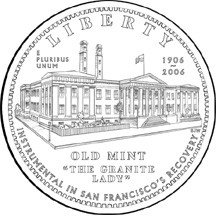
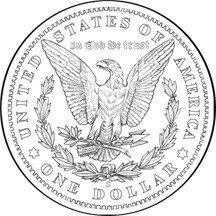 The silver commemorative will be minted in a 90-percent silver and 10-percent copper alloy and will be 1.5 inches (38mm) in diameter. The obverse design is based on the San Francisco Mint Medal by Sherl J. Winter. The reverse will use the reverse design of the 1904 Morgan Dollar design by George T. Morgan (remember, the Morgan Dollar was not minted during the period 1905-1920). The pre-issue price is set at $35 for the proof coin and $33 for the uncirculated. After October 17, the proof coin will cost $39 and the uncirculated will cost $35. By law, $10 from the sale of each coin will be donated to the San Francisco Museum and Historical Society.
When visiting the Mint’s online catalog, there is an entry for the 2006 United States Mint American Legacy Collection. The set will contain proof version of the 2006 circulating coins and proof version of both the Benjamin Franklin Founding Father Silver Dollar and the San Francisco Old Mint Silver Dollar. This set will be presented in “unique prestigious packaging.” Price is advertised at $135 and will be available for shipping in December.
According to the Mint’s Product Schedule page, the next special set will be the American Eagle 20th Anniversary Coin Set. There is no further description as to what will be in that set. Maybe, there will be an announcement this week at the American Numismatic Association’s World’s Fair of Money® in Denver. Stay tuned!
Coin line art images from the US Mint Image Library
Support the Coin Collectors Blog
 Buy me a coffee
Thank you for your support!
Let Me Know What You Think
Are you going to the World's Fair of Money
Total Voters: 17
 Loading ...