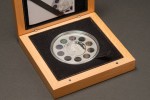
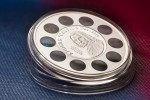
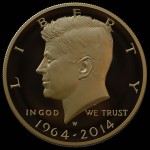
U.S. Mint mock-up of the 24 karat gold 50th anniversary Kennedy half dollar
Recent events have caused the amateurs to come out of the woodwork to decry that the U.S. Mint is doing something illegal. While the U.S. Mint is an agency run by fallible humans, they are less prone to issues as seen in other bureaus within the Department of the Treasury. However, understanding what the U.S. Mint can or cannot do is a matter of understanding the law.
It has been an ongoing theme written on this blog, the latest was about the nonsensical $1 Trillion coin, is that all you have to do to understand what the U.S. Mint can and cannot do is clearly documented in Title 31, Section 5112 of the United States Code (31 U.S.C. § 5112), Denominations, specifications, and design of coins.
You can read Section 5112 without having to obtain a law degree. It is very readable. It is the section that covers all of the specification for every coin struck by the Mint. It describes the size, weight, content, and the design of the coin. Very little is left up to the Mint in coinage design. But as the U.S. Mint is run by fallible humans, these laws were written by even more fallible humans: congress. This means that some of the laws are very clear while others are open to some interpretation.
First, it has been questioned whether the U.S. Mint can strike more 2014 National Baseball Hall of Fame commemorative coins since they sold out of the gold and silver coins. The answer to that question can be found in law (31 U.S.C. § 5112(m)). This is the section that describes the legal requirements for commemorative coins. Paragraph (2)(B) (31 U.S.C. § 5112(m)(2)(B)) says (emphasis mine):
If the Secretary determines, based on independent, market-based research conducted by a designated recipient organization of a commemorative coin program, that the mintage levels described in subparagraph (A) are not adequate to meet public demand for that commemorative coin, the Secretary may waive one or more of the requirements of subparagraph (A) with respect to that commemorative coin program.
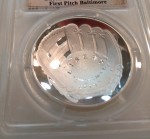
2014 National Baseball Hall of Fame commemorative silver dollars and gold commemoratives are sold out at the U.S. Mint.
Since subparagraph (A) codifies the limits of commemorative programs, and if the mintage levels are not adequate to meet public demand, then the Secretary can authorize high limits for the commemorative coin program.
As was the case with the 2005 Marine Corps Commemorative Silver Dollar, a quick sellout of the coins does satisfy the evidence necessary for the Secretary to make the decision to increase the production limits. In 2005, then Secretary of the Treasury John W. Snow authorized the U.S. Mint to produce 100,000 additional silver dollars. This was the last commemorative program sellout prior to the Hall of Fame coins.
However, the proposal to increase the production of the National Baseball Hall of Fame coins is speculation. This rumor has not been acknowledged by the U.S. Mint or the Department of the Treasury.
The other claim is that it is illegal or questionable that the U.S. Mint can produce the 2014 Kennedy Half Dollar gold coin. In an op-ed printed in Coin World, William T. Gibbs wrote, “The Mint is using what it cites as existing authority to produce a .9999 fine gold half dollar struck at the West Point Mint, with a 1964–2014 dual date and the higher relief 1964 portrait. The logic behind this coin is hard to understand. We’ve never had a gold half dollar before and the Mint’s legal authority to issue it is open to debate.”
Equating the fact that the U.S. Mint has never produced a gold half dollar coin is a parochial discussion and not whether the U.S. Mint can legally produce the coin. After all, the U.S. Mint produces quarter dollars made of five ounces of silver.
Congress makes the laws and they can change at almost any time!
The U.S. Mint is allowed to mint the coin under the authority of 31 U.S.C. § 5112(q), the law that authorizes the Gold Buffalo bullion coin. According to the law, the U.S. Mint is only required to produce the coin with the James Earl Fraser Type 1 Buffalo design the first year. Any changes in subsequent years must then be vetted by the Citizens Coinage Advisory Committee and U.S. Commission of Fine Arts.
The same questions were raised when the U.S. Mint issued the 2009 Ultra High Relief Double Eagle Gold Coin. The coin was based on the 1907 design by Augustus Saint-Gaudens was produced in .9999 fine gold and was issued under the Gold Bullion Coins provision of the law (31 U.S.C. § 5112(q)).
Gibbs further says, “When the Mint struck gold versions of the 2000 Sacagawea dollar and announced plans to sell them to the public, Congress stopped the Mint, stating that Mint officials lacked constitutional authority to issue the dollar coin in gold” as an additional argument against the U.S. Mint producing the Kennedy gold coin. In 2000, the law authorizing the U.S. Mint to strike 24-karat coins did not exit. The Buffalo Gold Bullion coin program that the decision is based was signed into law on December 22, 2005 as part of the Presidential $1 Coin Act of 2005 (Public Law 109–145 [PDF]).
The U.S. Mint may not be the most perfect agency and you may not like their decisions, but to accuse them of questionable legal practices is a bit naive.
This will be the third time that the U.S. Mint has launched a gold coin at a coin show. Last year, the U.S. Mint sold out of the 2013 Reverse Proof 24-karat Gold Buffalo coin at the World’s Fair of Money. They received a secondary shipment which also sold out. Similarly, the National Baseball Hall of Fame commemorative was sold at the Whitman Coin and Currency Expo this past March. It also sold out even after receiving a secondary shipment.
Although past performance does not guarantee future results, there is significant anecdotal evidence that the Kennedy gold coin will also sell very well.
So let’s see what you think. Will you buy this coin?
Are you going to buy the 2014 Gold John F Kennedy Half Dollar tribute coin?
Yes, I will buy the gold, silver, and clad set if it is offered (29%, 19 Votes)
Yes, I will buy the gold coin. (25%, 16 Votes)
No, a gold coin would be too expensive (25%, 16 Votes)
No, I'm not interested (20%, 13 Votes)
I don't buy any coins from the U.S. Mint (2%, 1 Votes)
Total Voters: 65
Loading ...
For those who cannot afford gold, the U.S. Mint is planning on producing silver coins with just the 2014 date. The set will feature coins from all four branch mints and include a proof coin struck in Philadelphia, a reverse proof produced in West Point, an enhanced uncirculated from San Francisco, and an uncirculated coin minted in Denver.
Although the U.S. Mint has not announced the price of these coins, they plan to place order limits to prevent the situation that happened with the National Baseball Hall of Fame commemorative coin that appears to have been bought out by dealers.
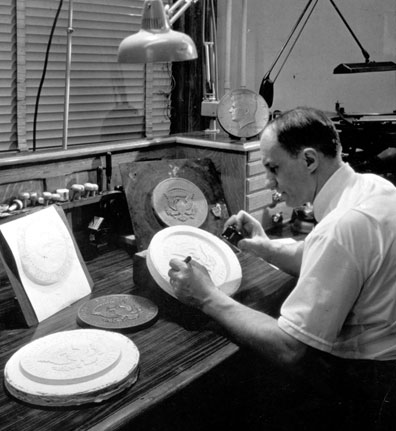
As part of the design process, Frank Gasparro sculpted different variations of the presidential eagle in plaster.
Cook Islands will be issuing a coin with an embedded thermometer to commemorate the 270th anniversary of the death of Anders Celsius. While his name does sound familiar, the results of his work is known in most of the world except for the daily lives of most Americans.
Celsius was a Swedish physicist, mathematician and a professor of astronomy at Uppsala University. As one of Sweden’s premier scientists of his day, Celsius traveled extensively to research ways to measure degrees from the poles in order to improve mapping and navigation. He believed that by studying the stars we could learn more about the composition of the earth and its origins, something we are still doing today.
The research he is most known for was as the first scientist to experiment with temperature in order to define a definitive scale to be used by all scientists as the basis for their experiments. In 1742, Celsius published the paper Observations of two persistent degrees on a thermometer where he defined 100 as the freezing point of water and 0 as its boiling point with a scale of units in between. He called his scale “centigrade” derived from the Latin for “hundred steps.”
Independently, physicist Jean-Pierre Christin of France developed a similar scale with 0 as the freezing point of water and 100 as its boiling point. In 1743, Christin commissioned the building of the “Thermometer of Lyon,” a mercury thermometer based on his research.
Celsius died in 1744 at the age of 42 from tuberculosis. A year after his death, colleague Carolus Linneaus, a botanist interested in the effects of temperature on growing plants, reversed Celsius’ scale and improved on the design for the thermometer. In a paper published in 1745, Linneaus first used the Celsius to describe the temperature scale. He later convinced the Royal Swedish Academy of Sciences to change the name of the scale to Celsius in memory of his late colleague.
To honor Celsius, the Cook Islands hired Coin Invest Trust of Balzers, Liechtenstein to design and strike a coin to honor Andres Celsius. The coin with a 5 Dollar face value will 50mm in diameter and proof struck using one troy ounce of .925 silver. Mintage will be limited to 1744 pieces.
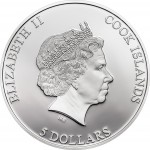
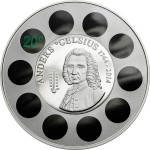
The coin’s unique reverse design will include a thermometer that will be integrated around the center of the coin that will feature the portrait of Anders Celsius. Based on the images, the thermometer looks like it will be based on the same technology as those used in temperature strips. The area where the portrait will be features a little degree mark before the C in Celsius, the date 1744-2014, and a small depiction of a thermometer.
Since Cook Islands are under the sovereignty of New Zealand and New Zealand is a member of the Commonwealth Realm, Queen Elizabeth II is the legal head of state and appears on the obverse of the coin. The portrait is by British sculptor Ian Rank-Broadley whose work appears on all coins of the Commonwealth Realm.
Obverse of the 2014 Cook Island Anders Celsius NCLT features the Ian Rank-Broadley image of Queen Elizabeth II.
Reverse of the 2014 Cook Island Anders Celsius NCLT features a portrait of Celsius surrounded by a working thermometer.
No announcement has been made as to when it will be available and the purchase price.
Given my resistance to gimmicks on coins (with my own admitted hypocrisy), there is still something compelling about the proposed design for this non-circulating legal tender (NCLT) coin. I will wait to see how much the coin will cost before making a commitment one way or the other.
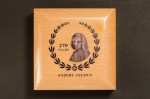
An image of how the 2014 Cook Island Anders Celsius NCLT coin presentation case.
An image of how the 2014 Cook Island Anders Celsius NCLT coin will look in its presentation case.
An image of how the 2014 Cook Island Anders Celsius NCLT coin will look in its holder.
Image of Anders Celsius from Wikimedia Commons Coin images courtesy of Coin Invest Trust
U.S. cents have been made of copper, steel, and copper plated zinc. What’s next?
If you have not provided your opinion to the U.S. Mint about their study of alternative metals for circulating coins, the time to provide comments have been extended. According to the Federal Register (79 F.R. 32363 [PDF]), the National Armored Carriers Association (NACA) requested an extension stating that additional time is necessary to provide an appropriate and comprehensive response. The U.S. Mint agreed with the NACA and has extended the comment period until the close of business on Tuesday, June 24, 2014.
Even though the U.S. Mind does not define who its stakeholders are, I believe that collects are part of the stakeholder community and should be heard. If you do comment, the U.S. Mint is looking for input on the following factors:
Costs to convert to circulating coins composed of alternative metals given the following possible changes to coins:
Weight
Electromagnetic signature
Visual changes, such as color and relief
Transition time needed to introduce a circulating coin composed of an alternative metal.
Comments on how best to inform and educate both affected industries and the public on changes to circulating coins.
Environmental impact from the use of circulating coins composed of alternative metals.
Other issues of importance not identified above.
When commenting, note that the U.S. Mint said it is not considering aluminum alloy metals.
Comments may be sent by email to Coin.StakeholdersResponse@usmint.treas.gov. If you prefer to send your comments the traditional way, mail them to Coin Stakeholders Response, Office of Coin Studies, United States Mint, 801 9th Street NW., Washington, DC 20220.
If you do comment and would like to share what you said with the rest of the community, either send it to me via email or post it as a comment below.
Note that the likelihood of these bills passing is slim-to-none and Slim just left town. Since Sen. Rockefeller is retiring after this session, there is a small chance that Mother’s Day commemorative could be voted on by unanimous consent in December as a legislative “going away present.”
Too many serious topics lately. Let’s have a little numismatic fun.
It was a busy day. While I really wanted to go out for lunch, all I had time for was to go to the cafeteria in the building where I work to get something quick. After settling on something I went to pay handing the cashier a piece of paper with the portrait of Andrew Jackson. In the change returned were three quarters. Most of the time I will just drop the change in my pocket and check it out later. But on this day, I took a glance at the coins and something struck me. Well, it didn’t strike me but it looks like something struck one of my quarter. Twice!
Closing my hands around the coins I walked away from the cash register and found a place I could stop to better examine what I had. Did I just find a rare double-strike quarter? Is it really an error? How much could it be worth?
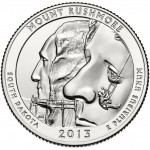
Putting down my lunch container, I opened my hand and found quarters. Not just one but three quarters. Three 2013 Mount Rushmore quarters. It was not a double-strike but the double-image of the side-by-side portraits that fooled me.
And this happened more than once. If I take a quick glance at change that contains the Mount Rushmore quarters I get the impression that I found a double-struck coin.
The Mount Rushmore quarter has to be one of the better designs of the America the Beautiful Quarters® Program. Rather than attempting to be a pretty postcard-like image of the place of honor, the design is more about the sculpting of the impressive monument.
So be careful when glancing at your change. Those two faces side-by-side is not a double-strike or double-die. It is just a portrait of a portrait of George and Thomas being immortalized in granite.
Before I begin today’s missive, please read the story I wrote about my friends who were arrested at the airport of a foreign country after digging up the $20 worth of ancients coins they found on a beach while playing in the sand. Go ahead… (click here) I’ll wait!
It is difficult to ignore the law of unintended consequences of Cultural Property Implementation Act (CPIA; 19 U.S.C. §§ 2601et seq.) and how it is implementation by the State Department’s Cultural Property Advisory Committee (CPAC). Unfortunately, they are at it again.
CPAC will hold meetings on June 2-4, 2014 to review a new cultural property request from the Government of the Arab Republic of Egypt seeking import restrictions on archaeological and ethnological material. As with all of the other Memos of Understand (MOU), it will include ancient coins, even those that are common for ancient collectors and will also contain fuzzy language to make it look like Egypt could try to seek the return of undocumented items no matter when they were purchased.
The Ancient Coin Collectors Guild (ACCG) needs your help to make sure that the MOU between the United States and the Arab Republic of Egypt does not turn ancient coin collecting into a hobby where collectors have to look over their shoulders to watch out for foreign agents looking to confiscate their collections. This is not conspiracy theory talk. It has actually happened. Read the account by Patrick Heller in this article printed in Numismatic News (see the paragraph beginning with “Number four….”).
I ask that you support the ACCG and its efforts to prevent the government overreach into coin collecting by asking the State Department to “Exempt Ancient Coins” in whatever words or with whatever reasons you wish to offer. All you have to do is go to http://www.regulations.gov/#!docketDetail;D=DOS-2014-0008 and click on the blue “Comment Now” button on the right side of the page.
Comments are due by WEDNESDAY, May 14, 2014 before midnight.
Your effort is important and will be very much appreciated by the ACCG and the entire collecting community.
U.S. cents have been made of copper, steel, and copper plated zinc. What’s next?
As part of its ongoing study of alternative medals to be used for coinage mandated by the Coin Modernization, Oversight, and Continuity Act of 2010, (Public Law 111-302 [PDF]), the U.S. Mint is seeking comment from “ stakeholders” as to the impact expected if congress was to approve a change in coinage metals. The Request for Comment (RFC) was published in the Federal Register (79 F.R. 19971 [PDF]) asking for stakeholders to provide more input to its ongoing research effort.
Although the U.S. Mint does not define who they consider stakeholders but does mention the “coin industry” in one paragraph, the guideline questions are clearly targeted to the coin-operated machine industry. Coin-op machines are more than the soda and candy machines that may be in the break room where you work. These machines include toll booth machines, machines that produce bus and/or train fare cards, parking meters, game machines, and even the few pay telephones that are still in use. Everything that accepts coins will have to be replaced, repaired, adjusted, or scrapped should there be a change in coinage metals.
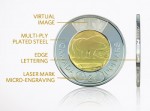
The new technology used by the Royal Canadian Mint to protect the Toonie (C$2)
The trouble that the United States is in for can be seen just across the border in Canada. Although the Royal Canadian Mint produced test tokens that anyone could have used to verify and adjust their systems two years prior to the introduction of the new Loonie (C$1) and Toonie (C$2) coins, Canadian news followed the trials and tribulations of many communities whose parking meters and other parking-related systems would not accept the new coins.
In the United Kingdom, the Bank of England and law enforcement is engaged in a difficult fight against counterfeit £1 coins. Sources estimate that between 3-percent of the £1 coins in circulation are fake amounting to more than 45 million counterfeit coins. These fakes are so convincing and very well constructed that they can be successfully used in vending machines for payment including in London’s Underground. In an attempt to stem the problem, the Royal Mint has designed a new £1 coin to be circulated by 2017 in hopes to cut the counterfeiting rate.
New edge view of the coin the Royal Mint hopes will be able to thwart counterfeiters.
Changes in the Loonie and Toonie were subtle as compared to the changes in the £1 coin. While the size of the coin will remain about the same, it will go from being round to have 12 sides. Rather than it being make of one metal, the new coin will be bi-metallic with a yellow metal on the outer ring and a silver-colored inner core. Rather than the edge being milled with a single incuse inscription, the edge will have alternating milling and the year in Roman numerals on each of the sides.
The coin-operated businesses in Britain are beginning to complain about the changes even though they are being given nearly three years to adjust. For their systems, the new coins will have a different weight, specific gravity, and the electromagnetic signature will differ from the current coin. Every system from the Underground to parking systems to food and beverage vending machines will have to be upgraded to accept the new coins. One report estimates that it will cost up to £50 million (approximately $82.3 million) just to update parking systems.
The Automatic Vending Association, the U.K.’s vending industry trade group, estimates that the new coin will costs its members over £100 million ($168.5 million) to convert their machines.
Expect the costs in the United States to be much higher mainly because of scale. The National Automatic Merchandising Association (NAMA), the $45 billion per year vending industry trade association in the United States, has already issued a report saying that it will cost from $100 to $500 per machine to convert them to accept new coinage.
The American Amusement Machine Association (AAMA) has come out against any change in U.S. coinage. It was reported that AAMA president John Schultz said to leave the coinage alone “because it works, rather than risk the costly consequences.” AAMA has not provided an estimate for those costly consequences.
The last significant change in coinage composition was in 2000 on the introduction of the Sacagawea “Golden” dollar coin. Following the debacle of the Susan B. Anthony small dollar coin that was mistaken for a quarter, the coin was redesigned without a reeded edge and given a golden color by adding manganese to the metals mix. Although this change primarily impacted the gaming industry that relied on the dollar coin, the vending machine industry did respond by converting old machines and manufacturing new ones that accepted the new coin.
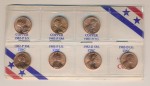
The change to copper-coated zinc cents created a seven coin set for 1982
Previously, the one cent coin went from being made of 95-percent copper and the rest zinc to being made of 98.5-percent zinc with a copper coating. Not only did this change occur in the middle of 1982, but it created seven collectible varieties of coins that are not that expensive to own. Although this change did not affect many industries, new automated cash registers being used primarily at grocery and home improvement stores can accept both the copper and zinc coins without problems.
Any discussion of coin composition changes has to include the change from silver to clad coinage. When President Lyndon B. Johnson signed the Coinage Act of 1965 (Pub. L. 89-81) into law on July 23, 1965, the composition of the dime and quarter dollar was change from 90-percent silver and 10-copper to 75-percent copper and 25-percent nickel bonded to a core of pure copper. This mix of metals was selected so that the coins would have an electromagnetic signature that was very similar to their silver counterparts. The half-dollar was reduced to 40-percent silver surrounding a pure copper core.
This change in coinage was done for the same reason that congress has asked the U.S. Mint to study alternative metals: the cost of materials and labor to make the coins is higher than the face value of the coin. As of the Fiscal Year 2013 (October 2012-September 2013) Annual Report, it costs the U.S. Mint 1.83 cents in labor and materials to manufacture the one cent coin and 9.41 cents for the five cents coin.
As a comparison, the cost for the dime including labor and materials is 4.56 cents per coin while the quarter dollar costs 10.5 cents to make.
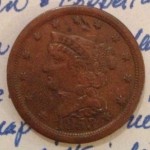
1853 Braided Hair Half Cent Obverse – The last lowest denomination coin eliminated by the congress.
Deciding what to do about U.S. coinage goes beyond the accounting details. A change by the federal government will impact everyone domestically and those overseas that use the dollar as their currency. There will be quite a few collateral issues including economic, political, and philosophical considerations. From a policy perspective, congress will have to think about the following before making any changes to our change:
Does the U.S. eliminate the one cent coin?
Does the U.S. eliminate the one dollar note in favor of a coin?
If a transition to new metals is approved, does the government provide economic assistance to small businesses and sectors that will feel a bigger impact from this change?
Will the federal government provide assistance to communities to help convert municipal services to be able to take the new coins?
Should the U.S. Mint, a government agency, be allowed and/or required to earn a profit from its operations?
How will the people be educated on the new coinage?
Since the U.S. Mint did not define who their stakeholders are, it is fair to say that the stakeholders are all citizens of the United States. If you would like to comment, the U.S. Mint is looking for input on the following factors:
Costs to convert to circulating coins composed of alternative metals given the following possible changes to coins:
Weight
Electromagnetic signature
Visual changes, such as color and relief
Transition time needed to introduce a circulating coin composed of an alternative metal.
Comments on how best to inform and educate both affected industries and the public on changes to circulating coins.
Environmental impact from the use of circulating coins composed of alternative metals.
Other issues of importance not identified above.
When commenting, note that the U.S. Mint said it is not considering aluminum alloy metals.
Responses are due to the U.S. Mint 60-days following its printing in the Federal Register (April 10, 2014 making the due date June 9, 2014). Electronic comments can be sent to Coin.StakeholdersResponse@usmint.treas.gov. If you prefer to send your comments the traditional way, mail them to Coin Stakeholders Response, Office of Coin Studies, United States Mint, 801 9th Street NW., Washington, DC 20220.
If you do comment and would like to share what you said with the rest of the community, either send it to me via email or post it as a comment below.
Photo credits: All photographs are the author’s except the image of the Toonie from the Royal Canadian Mint and the One-pound coin prototype from the Royal Mint.
Our long national nightmare is over, congress finally passed some sort of numismatic-related legislation. But do not get too excited because today’s news out of the House of Representatives is only the beginning. Next is for the Senate to do nothing while the bill languishes in committee.
H.R. 627: National Park Service 100th Anniversary Commemorative Coin Act
Sponsor: Rep. Erik Paulsen (R-MN)
• To provide for the issuance of coins to commemorate the 100th anniversary of the establishment of the National Park Service.
• Passed the House of Representatives: April 29, 2014
• Received in the Senate on April 29, 2014 and referred to the Senate Committee on Banking, Housing, and Urban Affairs
Computer and online security has been a topic for the news lately. This was because of a mistake made in software that was being used to try to keep your password from being seen by criminal hackers was making it visible to those criminals. In the wake of the news, the Doug Davis of the Numismatic Crime Information Center sent out a message to his list of contacts that had one central message for every dealer and collector:
Shooting simple photos from your smart phone or personal camera can lead criminals right to your location… with pinpoint accuracy using GPS satellites.
You might have heard the term “metadata” in the news in the context of its collection by the National Security Agency. For those who do not know what metadata is, think of it as a description of the data. Think about an exhibit in a museum. The exhibit contains several artifacts arranged in a certain way to try to tell a story. But the story is incomplete because a little more information is needed to put it into context. But the information cannot be shown as an artifact in the exhibit, so the person setting up the exhibit adds a description added to the exhibit to make it more understandable. That description would be the metadata to the exhibit.
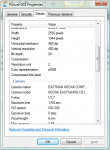
Example of what you can find out about your image in the file’s Properties under Windows
Embedded within the pictures you take with your digital camera is a description of the picture that is not visual on the picture. Within this description is the type of camera you are using, the shutter speed, and other exposure information. One of the descriptive items that your camera can record is where the picture was taken. This is called geotagging or geocoding.
Modern cameras, cameras built into smartphones, and even some memory cards that can be inserted into older cameras can determine where you are located and record that in the metadata in the picture you take. And contrary to what you have read, new technologies do not have to use the Global Positioning System (GPS) to figure out where you are located. There are services that use WiFi to record your position. It is called WiFi Positioning System (WPS). Basically, WPS determines where it is located and communicates that to WiFi connected services so that it could be used to determine your location.
I know geotagging can be a lot of fun. A few years ago when my wife and I drove from Portland, Maine to Canada, I had taken pictures of the scenery along the way hoping to find a moose. After all, how can you go through the woods of Maine without seeing a moose?! When I loaded the pictures on my Mac in iPhoto, it was fun to see the plot of where the pictures were taken on the built-in map. I was able to follow the road into Canada just based on the geocodes.
What I did not do is post those pictures while on the road. Aside from the lack of cellular connectivity, posting those pictures would advertise to evil doers that I was not home and too far away to do anything.
If you take geocoded pictures of your coins and post them online, whether it you are posting them to a social media site or a discussion forum, you are advertising where the coin is located. This might not be a problem if you collection consists of what dealers would call ordinary or common coins. But if that 1937-D Buffalo nickel has only three legs, that geocoded picture announces that you have at least one high value coin that someone might want to acquire through less than legal means.
The problem is that I love to see pictures of interesting coins. This is one of the reasons I love Pinterest. Aside from sharing my own picture, Pinterest allows me to pin coin images from around the Internet to create virtual scrapbooks. Do you have an interesting coin? I want to see it. Different types of tokens and medals are excellent artwork.
However, when you take the pictures of your prized collection, make sure you turn off geotagging!
Unfortunately, I cannot tell you how to do it on every camera because the process is different. To help, I found the following two articles that provides an overview of how to turn off geotagging on the common smartphones:


 Loading ...