Apr 9, 2012 | cents, coins, currency, policy
Since the Canadian government announced that the Royal Canadian Mint will stop striking “pennies” in the Fall of 2012 and that cash transactions will be rounded to the nearest five-cent increment. Non-cash transactions will not be rounded.
As part of the transition to the centless society, Canada will withdraw these coins from the market using redemption programs to allow citizens to return the coins for compensation. The Canadian government has also committed to working with charities to use this as an opportunity to raise money for their causes.
Since the announcement, there has been a lot of chatter from around the world regarding the elimination of the lowest denomination coin from various countries, including here in the United States. While other countries have eliminated their lowest denomination coin, Canada is the largest economy who have made this move.
Canada’s proximity to the United States has generated a lot of discussion about the United States doing the same. Those arguing for the elimination of the cent begin with that it costs the U.S. Mint 2.11-cents to produce one coin, losing 1.11-cents per coin. Similarly, Canada began their discussion with that it costs the Royal Canadian Mint 1.6-cents to produce their one-cent coin.
If Canada can drop their penny, then why can’t we do that in the United States?
In 1986, Canada stopped producing one-dollar currency notes and went to exclusively coins. Nearly ten years later, Canada began to produce two-dollar coins eliminating the two-dollar paper note from circulation. If Canada can drop their lowest paper currency denominations, why can’t the U.S. do the same?
Those of us who use the argument that other countries no longer use paper currency as their basic unit of currency are told (paraphrasing) “we are the United States, we don’t have to do what others are doing.” Now those same people who want the U.S. Mint to stop striking cents are pointing to Canada using a similar argument and bristle when given the same response to their argument.
Every study by even the most partisan group shows that the government will “save money” by eliminating the one-cent coin, change the composition of the nickel, and produce the dollar coin rather than paper. The differences in the studies are what they call opportunity costs—the cost borne through the changes and processing by the businesses, banks, and citizens affected by the changes.
The concept of the government “saving money” is wrong. Production of money does not cost taxpayers any money. The high production costs of the cent and nickel does reduce the amount of seigniorage the government earns when the coins are sold to the Federal Reserve.
Ending the production of specific denominations is not new to U.S. coinage. The last change occurred in 1933 when the gold was no longer used for coinage eliminating the quarter eagle, half-eagle, eagle, and double eagle coins. At times in the past, the U.S. Mint also produced half-cent, 2-cent nickel, 3-cent, 20-cent, and dollar gold coins. All were seen as a good idea at the time but fell out of favor for many reasons and were discontinued.
At some point, the decision criteria must be baselined in order to come up with a fair analysis in order to determine the best policy. To start that analysis, let the policy basis be on the least amount the government could do in order to maximize seigniorage while treating all markets fairly. Based on those guidelines, eliminate the one-cent coin, but also eliminate the half-dollar and the one-dollar paper note. Even if the five-cent coin does not undergo a composition change, all studies show that the government will earn more in seigniorage than any other option.
Based on other studies, this policy will have an economic impact on the markets outside of the government and the Federal Reserve. But that is for the markets to work out on their own and not for the government to dictate.
It is also a policy recommendation that will make everyone upset on all sides of the issue, meaning that it wreaks of compromise—which should not be a dirty word when making serious policy decisions.
Mar 18, 2012 | coin design, coins
What will they think of today’s coins
The “they” I am talking about are the collectors 50 and 100 years from now.
By that time, those of us who remember non-clad coins will be long gone or elderly. But what would our successors in this hobby say about us?
For the last few years, I have been putting together a set of Barber coinage to cover the 20th century. From the Liberty Head Nickel, to the Barber dimes, quarters, and half-dollars, these coins had an interesting sameness whose aesthetic roots appear to be from Victorian culture. Even the dollar designed by George Morgan had a similar look to those Barber coinage.
While there are fans of Charles Barber’s coin design, we tend to concentrate on Theodore Roosevelt’s “pet crime.” Roosevelt was not fond of Barber’s designs. In fact, he called the “atrociously hideous” and “conspired” with Augusts Saint-Gaudens to design coins that would be considered more artistic.
Judging the aesthetics of any coin design is subjective, but a closer and more objective look at Barber’s designs do have a lot of character for the time they were produced at the height of the Victorian era. When TR took office in October 1901, Queen Victoria had passed 9 months earlier and Roosevelt, whose was not a fan of Victorian Era designs, wanted something different.
Barber’s designs appear to be a victim of Roosevelt’s efforts rather than being a sign of its times. It has produced a general opinion that Barber was not a good artist or that his designs were lacking without considering the times in which he worked.
So how will today’s coins be thought of in the future?
The “modern era” of U.S. coinage started with the introduction of clad coins. This marked the end of silver circulating coinage with the exception of the half-dollar, which was silver-clad until 1970. Forty-eight years later, modern coinage does not have the same appeal to many collectors as its silver predecessors mainly because of the impression from older numismatist that these coins are not silver or copper. Some believe that the only excitement generated by clad-coinage in the last half of the 20th century were the bicentennial designs of 1975-1976.
Even though the 50 State Quarter program started in 1999, the 21st century has been the century of the circulating commemoratives. The introduction of the Sacagawea Dollar introduced a new dollar coin in an attempt to “fix” the problems caused by the Susan B. Anthony dollars (too much look a quarter) while new designs representing four states were issued each year. During that program, we were treated to the 2004-2006 Westwood Journey Nickel Program honoring the “Corps of Discovery Expedition” lead by Meriwether Lewis and William Clark to the far reaches of the Louisiana Purchase. There was also the Abraham Lincoln Bicentennial Cent Program honoring the 200th birthday of our 16th president. All have been seen as positive programs.
Then there are what some consider failures, such as the Presidential Dollar and Native American programs. These failures are not because of their designs but because they are based on the one dollar coin that does not circulate in the United States. In fact, most of the presidential portraits are well executed and the reverse designs of the Native American dollars are inspiring. But numismatists, collectors, and the public are more focused on the politics surrounding the use of dollar coins rather than the designs.
Similarly, the National Parks Quarters have not lived up the expectations that it would be as popular as the 50 State Quarters program. Some have even seen the program as jumping the shark on circulating commemoratives, but the designs have been very interesting and even well representative of the site which is being commemorated.
Again, how will today’s coins be thought of in the future?
As new, younger collectors enter the hobby, the stigma of clad versus silver coinage has waned since clad coinage is all these collectors know. They have seen world coins made of base metals dating back to times earlier than the United States change to clad coinage and do not wax nostalgic for “simpler times.” These are their simpler times!
While speaking with some younger collectors, many of whom started collecting state quarters, they like the new programs. State quarters have helped them learn about the states and some have said it helped them learn the history of the United States and its geography. Some like the Presidential Dollars not as circulating coins but as a collectible representing the democratic succession of peaceful leadership represented by the office. And they wish that the National Parks Quarters would see better circulation to add to the history behind the United States coins.
Looking at the short history of 21st century coinage, some might not believe it will be well thought of but the future numismatic leaders are more accepting of these coins meaning the future is bright. Older numismatists may not like what has been happening to U.S. coinage, but years down the road the future for their popularity seems bright, albeit without the values of pre-modern coinage because of the differences in metals used and their ample supply.
Mar 14, 2012 | coins, pocket change
It was just an ordinary trip to run some errands. It was not a special shopping sprees except that it included essentials to get through the next week. After all, it was the weekend and I really wanted a little rest. I was not expecting to find anything remarkable.
In the first store, I was handed three very brilliant Lincoln Cents. I looked at the one on top and it was dated “2011.” Thinking that the establishment must have received a roll of 2011 cents from the bank, I dropped the coins in my pocket and went to my next stop.
After paying for my items at my second stop, I did not look at the coins as I dropped them into my pocket so I can get this trip over with.
One more stop before going to the grocery store. Grab some essentials, something nice for dinner, and then pay for my purchase so I can hurry home to put the perishables away. As I am handed the change, I noticed a very shiny Jefferson nickel. Since it was tails-up, I did not see the date.
That evening, I empty my pocket and place the coins on the top of my dresser. There they stayed until last night when I started to sift through my finds. When I looked at the three brilliant cents, I found the 2011 but the other two were dated 2012, making it the first 2012 coins found in 2012. This is the earliest I have found 2012 coins this early since the start of the current recession.
That shiny Jefferson nickel was dated 2012-D. Not only was it the first 2012 nickel of the year, but it is from Denver. Since the Washington, D.C. area receives its primary deliveries from the Philadelphia Mint, finding a D mintmark was an unexpected pleasure.
Recently, I have been finding quite a few quarters from the 1970s, but this time I found something different: an El Yunque National Forest quarter! While I have been finding quite a few 2010 quarters in change, I cannot recall finding any 2011 quarters and definitely not the latest release.
Also found in the change was a 1995 Canadian Cent, which at the current exchange rate is on par with the U.S. one cent coin.
There are still interesting finds in pocket change!
Mar 4, 2012 | coins, education
Coin collectors love a good story, even if it is not true. New research substantiates some myths and refutes others. Many myths and popular stories include some elements of the truth or historical events. Some are simple historical events, others concoctions to make the inventor seem more important, or to pump up the value of a coin or collection.
This essay will relate a few well known numismatic myths stories and then tell you what really happened. The reality comes from new research in the national archives, museum collections, university archives, Library of Congress and the personal papers of many of the participants. Whether you prefer the “myth” or the “reality,” it is hoped that you will find them both a good story.
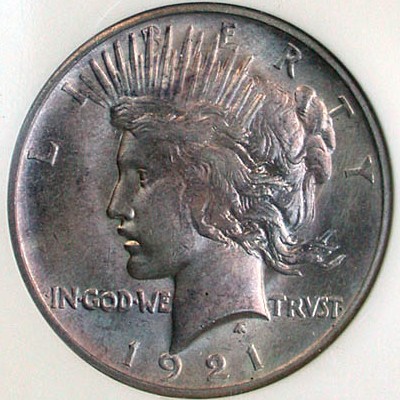
Peace Dollar High Relief Story
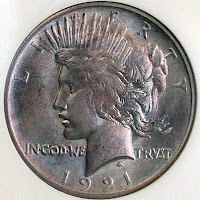 According to numismatic researcher Walter Breen, writing in his Encyclopedia of U.S. and Colonial Coins, the 1921 high relief design was too high to strike properly. So mint engraver George Morgan took a board and whacked the galvano until it was flatter and lower in relief. Morgan then cut new hubs for the 1922 and subsequent issues. Did this really happen?
Research shows that there was no flattening of the galvano as claimed by Breen because there never was a galvano. Designer Anthony de Francisci supplied his own bronze casts. Two other intermediate relief versions were made in January, 1922. Both were failures. Finally, de Francisci made new, low-relief models for 1922 and trial strikes were made and approved on February 14, 1922.
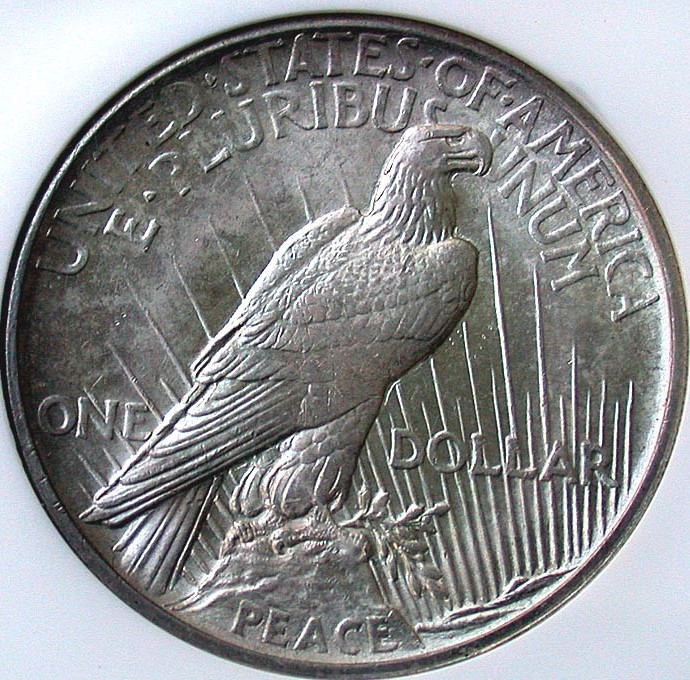
Peace Dollar Replacement Reverse Story
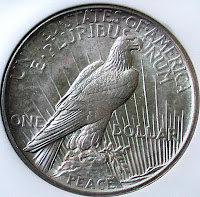 Another popular story says that in December 1921, just before the first coins were to be struck, Congress objected to a broken sword shown on the reverse. Since there was no time for the designer, Anthony de Francisci, to make new models, Mint engraver George Morgan quickly created a new reverse and used it in place of the original. This saved the project from failure. Did this really happen?
The design competition called for one obverse design and two reverse design. De Francisci submitted two reverse designs to the Commission of Fine arts on December 10, 1921. One design resembled the eventual design. De Francisci modified this reverse design using suggestions from James Fraser. This included a broken sword held by the eagle. The design was approved by the Mint director, Assistant Treasury Secretary, the Secretary of the Treasury, and President Warren G. Harding. A bronze cast was made of this design and sent to the Philadelphia Mint where engraver George Morgan cut a hub in preparation for striking coins.
In announcing the new coin, a Treasury Department press release mentioned a “broken sword” was part of the design on the reverse of the new coin. This was noted by the New York Herald in a scathing editorial. Subsequently, cards, letters, telegrams, and phone calls objecting to the broken sword swamped the Mint, Treasury, congress, and White House. Fraser and CFA chairman Moore suggested that the sword be cut out of the steel hub. Mint director Baker was on his way to San Francisco, so assistant secretary Malburn and acting director O’Reilley gave instructions for Morgan to do the work.
Beginning early on December 23, Morgan, accompanied by de Francisci, began removing the sword from the hub. He also had to work on the master die to compete the removal. Morgan added an olive branch and made other changes. No public mention was made of Morgan’s work. Treasury simply told the public that the sword was in one version but not the version that was used. Morgan saved the Peace dollar from failure.
Buffalo Nickel
 A persistent Buffalo tale is that in preparing the hubs and dies, engraver Charles Barber eliminated most of the field texture contrary to designer James Fraser’s wishes. Another is that Barber also made the bison on plain version without the sculptor’s approval. Fraser was very upset about the way his design had been treated. Is this true?
According to Fraser’s written comments:
I find the engraving which was necessary to make the two sides of the coin fit exactly, the reduction of the edge and the simplifying of the background under the Buffalo’s head is beautifully done, showing no difference between the surface which I put on the models and the one they have made. I am delighted with their work at the Mint.
(Fraser—January 26, 1913)
Your letter of April 22nd last [sic—April 23rd] together with enclosure reached me in due course, and it seems to me that the nickel enclosed with the “Five Cents” made clearer is good and does not at all interfere with general design.
(Fraser—April 23, 1913)
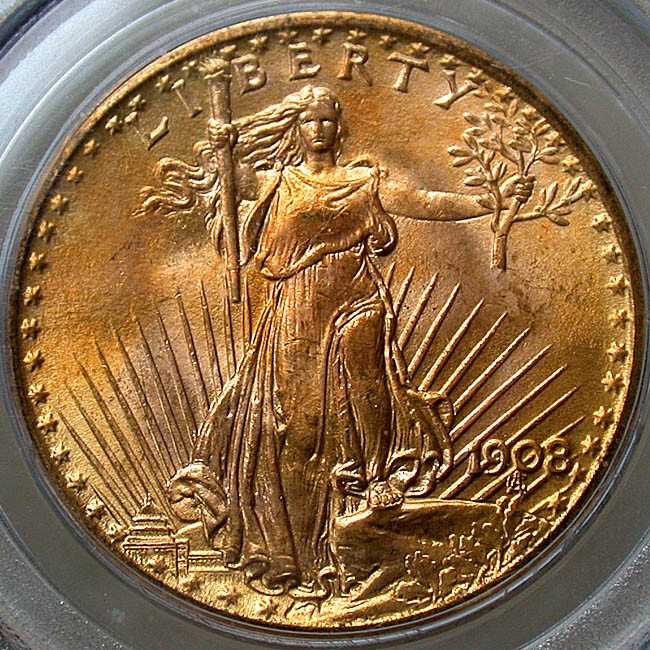
Saint-Gaudens Double Eagle
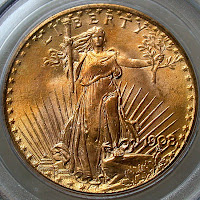 One of the most popular and attractive coins ever issued by any country. As would be expected from a coin created through the cooperation of President Teddy Roosevelt and sculptor Augustus Saints-Gaudens, there are many interesting stories about the people involved. One story goes that Mint engraver Charles Barber, who harbored an intense dislike for Saint-Gaudens, was unable to make low relief dies from Saint-Gaudens’ models in late 1907. In another story, to get the coins into normal production Barber made new models copying Saint-Gaudens’ design but introducing his own variations, including changing the date to European digits, that damaged the artistic quality of the coin.
Saint-Gaudens provided the first two plaster models. The first model was delivered in December 1906. The second was the Very High Relief model that was used to make the high relief MCMVII pieces. Henry Hering submitted a third, lower relief model with European date as agreed in May. The relief on the third model was too high to coin with the Mint’s production equipment. Using the Janvier lathe caused too much detail to be lost in the reduction making the design dull and washed out. To get the coins into production as Roosevelt wanted, Barber recut detail into the hub by hand. Result was the 1907 production coin.
Henry Hering, who was Saint-Gaudens’ principal assistant for the coin design project, says that he anticipated problems with the mint over the relief of the coins, and had reductions made of Saint-Gaudens designs in Paris. These were in several different reliefs. Although the mint eventually turned out acceptable low relief coins, the officials refused to pay Mrs. Saint-Gaudens for her late husband’s work. Henry Hering claimed in his 1947 article in the Numismatist that the quality of reductions for the reverse of the $10 coin was an issue. Hering claimed the Mint refused to pay Augusta until he proved the Mint’s reductions were inferior by comparing them with ones he had ordered from Paris.
Well, not really…
Negotiations between the mint and Saint-Gaudens’ Estate were handled by Charles Brewster, Augusta’s attorney. They finally settled on a payment of $6,000. Plus Augusta was sold one of the two Extremely High Relief (EHR) pattern pieces from the Mint collection for $20 plus postage. By November 1907, Hering was superfluous and more of a nuisance than anything else. He had no role in helping Augusta get the money the mint owed her.
Adapted from the presentation “Myths and Tall Tales” by Roger Burdette given to the Montgomery County Coin Club on March 13, 2007.
All images courtesy of The Coin Page.
Feb 25, 2012 | coins, education, US Mint, video
When I went to college for my undergraduate degree, the university’s programs did not include the ability to “minor” in a subject. Aside from the core courses, we were allowed to take eight classes in our major and four electives. Along with other requirements fill-ins I was able to take history and political science classes that would qualify as a minor today. It made taking some of those required courses tolerable.
History is what makes numismatics interesting. If you look beyond the shiny metal disks, you can follow the history of the country by studying the history of the numismatics. From the first Chain Cent through the Presidential Dollars, each coin tells the story of its time. What is even more amazing is that there are people researching further than ever before and finding new information that improves our knowledge. Others are looking at that history in different ways to better understand this history better.
When a friend sent a link to a recently discovered video about the manufacturing process at the U.S. Mint, I saw it as an opportunity to see where the U.S. Mint has come from. Ignoring the opening and closing titles from the company that posted the video which provides little relevant information, the film shows the process of manufacturing coins at the U.S. Mint in the early 20th century. Watch:
There is very little in the video to try to ascertain when the film was made. To try to date this film, let’s apply a little History Detectives-like logic. Looking at the video:
- Silent films started sometime in the late 1870s with experimental films. The first narrative film was created in 1888 and by 1894, silent movies began to be shown in public spawning the initial growth of local movie houses.
- The problem with early film was that the movies were in black and while and shown as very stark on the screens. Two methods were used to “mute” the shading. One was to shoot the movie darker using darker backgrounds and lighter foregrounds. The other was tinting. Tinting added color and contrast by using special solutions of salts or dyes replacing some of the silver particles in the developing solution. Tinting was first used in 1898 but was not used on a regular basis until the early 1910s.
- Intertitles, the full screen words drawn on paper and intermixed between scenes in the folk to help narrate the story, began in 1899 but were in common use by 1901.
- The silent film era began to fade quickly after the release of the first “talkie,” The Jazz Singer, in 1927.
Based on this, we can assume that this was filmed between 1910 and 1927. But what does the film show? A lot of manual processes but the use of electricity to drive the machinery. This does not help narrow the dating except there was a large mintage of silver coins being shown. At the beginning there were also large stores of gold and silver and it film showed how the metals were smelted, formed into bars, and rolled flat to make the planchets.
At around the 36-second mark, the intertitle says “Another tidy fortune—$60,000 worth of silver bars ready to be converted into dollars, half dollars, and church collection.” (emphasis added) Converting silver into dollars stopped in 1904 and did not start again until 1921. The scenes makes the U.S. Mint look very busy and the striking of silver dollars to back silver certificates were necessary following World War I. Remember, the Pittman Act was passed in 1918 to allow the the melting of no more than 350 million silver dollars into bullion where a total of 259,121,554 ounces were sold to Great Britain at $1 per ounce to help them pay for the war. When the silver was replaced by mining and being paid back by Great Britain, it became important to replace the melted coinage for backing of silver certificates.
Providing the maker of the film did not take a little editorial liberties, that shifts the date of the film in the era of 1921-1927.
At 3:59 an intertitle is shown that reads “A forty-ton friction drive press stamps the die which later stamps the coin.” Then at 4:07, we are show the top of the friction drive press that pans down to a Mint worker positioning the dies in the press. But the press does identify itself. Arching across the top it reads “TAYLOR & CHALLEN LTD ENGINEERS BIRMINGHAM 1907.” Then below on the house for the large screw it says “PRESS 724.”
 Taylor & Challen Ltd. Engineers were based in Birmingham, England. Founded in 1850 by Joseph Taylor, the company quickly rose as a leading maker of coining equipment. Their popularity came from being able to improve on the knuckle-joint action to efficiently strike and eject coins quickly from the press. According to one reference, the Model 724 was used in what we today call “hubbing,” the creating of the die by pressing the master hub into the die. What made the Model 724 well suited for this task was that the way Taylor & Challen was able to make construct the friction drive to provide the 40 tons of steady force at a slower speed than other presses to raise the clearest images on the dies with a single pressing. The U.S. Mint installed their first Model 724 in 1911 and was in use until 1933.
Just as Taylor & Challen out engineered their competition, they were out engineered by the Schuler company of Germany. Schuler invented the mechanisms to strike coins vertically so that gravity was used to speed up the striking process. Schuler remain the most popular presses around the world, including at the U.S. Mint. Taylor & Challen was never able to catch up and eventually went out of business in 1970.
As interesting as learning about Taylor & Challen was, it did not help narrow the date.
Unless I missed something, the only other observation was that most of the coins being shown in various forms were quarters. The bag tipping over at the end held a lot of quarters—Standing Liberty Quarters to be exact. So let’s say that this film was not taken in 1921 because the U.S. Mint was busy striking silver dollars. Since no quarters were struck in 1922, I can assert that the film was made between 1923-1927. I think that is as far as I can go with the evidence I can see.
If you have additional information or see evidence that I did not catch, please leave a comment to this post.
Image of the former Taylor & Challen building courtesy of Roger Marks on Flickr
Feb 9, 2012 | coins, counterfeit, grading
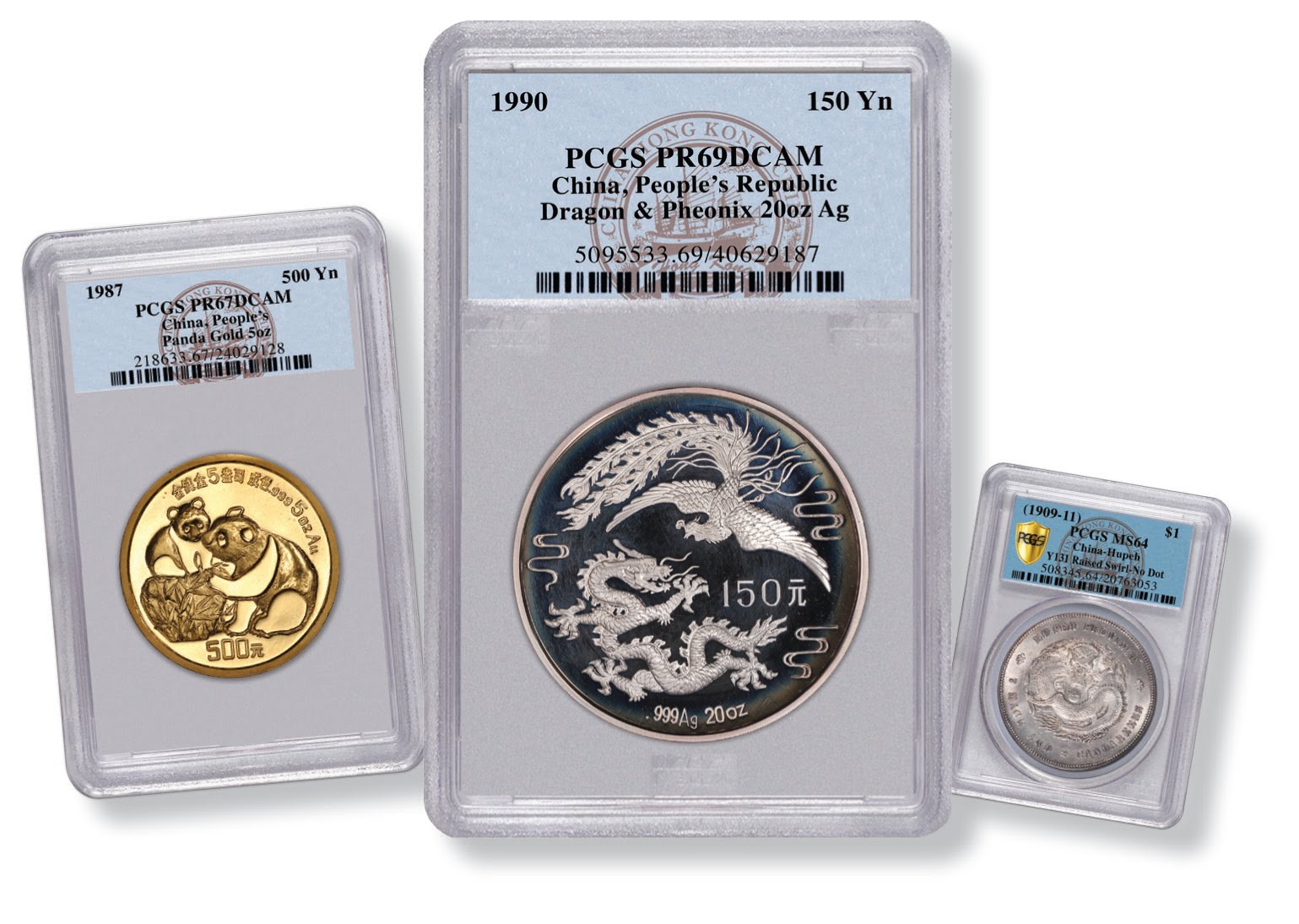
Last month, PCGS announced they will open an office in Hong Kong to help Asian dealers authenticate and grade coins for their market. With the flood of counterfeits from that area of the world, providing access to a third-party grading service could help in reducing the proliferation of fake coins.
Recently, PCGS announced that their new Hong Kong company will be grading coins prior to and during the Hong Kong International Coin Convention and Antique Watch Fair beginning on March 24 and continuing through April 6, 2012. If you are interested in submitting coins to PCGS Hong Kong, read the story at coinnews.net.
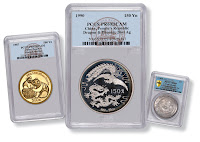 More interesting are the sample of the holders PCGS published with the press release. PCGS will continue to use slabs similar to those used in the United States without the edge-revealing prongs. The medium sized slab in the image (right) appears similar to those used to encase the 5 ounce America The Beautiful Silver Bullion Coins. What appears to be new is the large-size slab for those large silver coins issued for the new lunar year, for example.
To identify coins graded by the PCGS Hong Kong subsidiary, the label used on the slab apparently will have a circular logo colored in red.
This is reported with mixed feelings. While I prefer raw (ungraded) coins, I understand the the necessity to authenticate coins especially from that area of the world. If you do not know about the extent of the problem with Chinese counterfeit coins, this article by Susan Headly includes detailed images of a Chinese counterfeiting operation and should be a scary reminder.
Feb 6, 2012 | coins, commemorative, video
Your blog host is happy today as his favorite team, New York Giants, lead by MVP Eli Manning, beat the New England Patriots in Super Bowl XLVI. As a die-hard Giants fan, I worried if the team that was dominated by the 5-11 Redskins in Week 16 would show up or would the run that started the next week against the Jets continue. Like every game in the run, the Giants did just enough to hang in before putting the ball in Eli’s hands to let him do his magic.
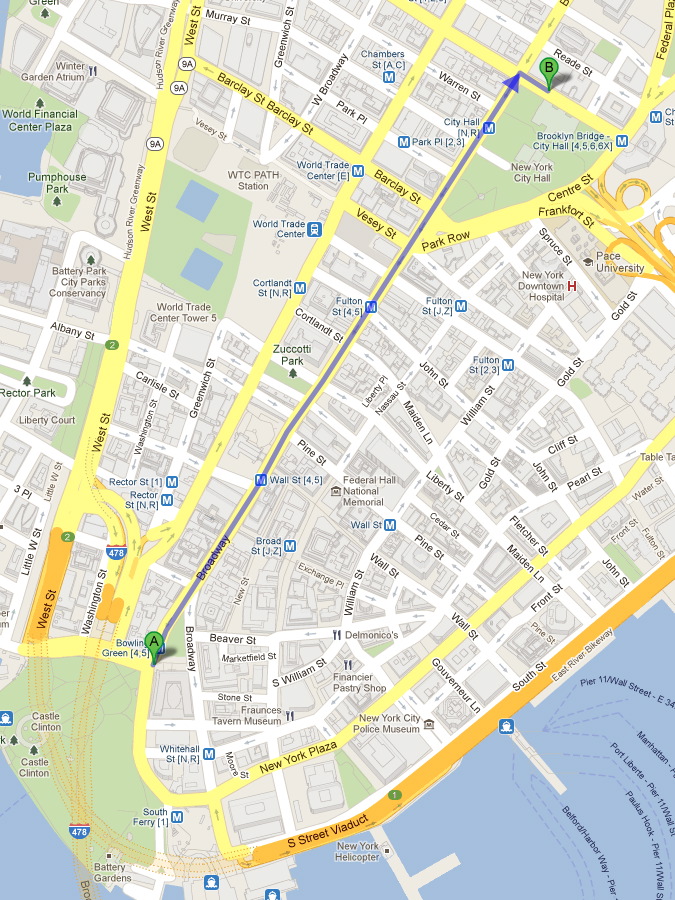
 Next stop for the Giants is a ticker-tape parade down the Canyon of Heroes on Tuesday February 7. The Canyon of Heroes is the section of lower Broadway in the Financial District that runs from Bowling Green to City Hall Park.
The game started like every other football game does with the coin toss. For the last 21 Super Bowls, including Sunday’s Super Bowl XLVI, the Official Coin used for the coin toss is made by The Highland Mint of Melbourne, Florida.
You can find out more about how the coin is made complements of FloridaToday.com:
The Highland Mint strikes 10,000 coins and are numbered. The first 100 are sent to the NFL where number 1 is used for the coin toss. After the game, it is sent to the Pro Football Hall of Fame in Canton, Ohio.
In the following video, you can see more of the manual aspects of the minting process, including the gentleman sitting at a machine that stamps numbers into the coins which is shown in the second-to-last scene.
If you are a member of the Papa Rewards Program, the loyalty program for Papa John’s Pizza, your interest in the coin toss ended when it landed on heads and you won a free pizza and soda. Enjoy your pizza!
Feb 2, 2012 | coins, policy, shows
During Maryland Governor Martin O’Malley’s (D) State of the State Address in front of the Maryland General Assembly, he outlined his vision for the state and how it will support its citizens. As a resident, I was interested in what Governor O’Malley said because of some of the rumored policy initiatives.
Like every other state, Maryland needs to raise money in order to fulfill state current state obligations without considering new initiatives. O’Malley, who is in his second term and has not shied away from talk about seeking a federal office, put forward an aggressive agenda that includes “revenue enhancers” to pay for his proposal.
One revenue enhancer is one that was defeated last year: the repeal of the sales tax exemption for coin sales of more than $1,000, bullion, and coin shows. According to the Budget Highlights published by the governor’s office, it is estimated that repealing the exemption will bring in an addition $3 million in revenue.
One difference between the bill introduced in 2011 and this one being proposed by the governor is that last year’s bill was introduced late in the session making it easier for delegates to prevent it from being reported out of committee. This year, the bill will introduced early, possibly this week, giving legislators the entire session to work on its provisions.
I received a note from David Crenshaw, General Manager of Whitman Expos as I did last year talking about this proposal. Once again, Whitman is saying that if the law was repealed they would likely move their shows “to a friendlier state with no sales tax.” This would effect the loss of ancillary taxes at hotels, restaurants, and other establishments in the Inner Harbor that would be generated by show participants.
While the proposed tax change is yet another example of a government not looking at the collateral damage that may be caused by this type of proposal, I do not agree with Crenshaw that now is the time to act. Since the bill has not been introduced in the legislature for consideration, referencing an issue without a bill to associate it with will not make an impact. With the limited time that the legislature is in session (four months), comments need to be concise and germane to the legislative agenda—basically a bill that has been introduced. This was confirmed to me after a conversation with one of my representative to the General Assembly.
I will oppose this bill and some of the other “revenue enhancers” that will have regressive effects on Maryland’s economy. Once the bills are introduced and assigned bill numbers, I will have something specific to tell my representatives my opposition.
Jan 23, 2012 | coins, education, values
Understanding how coins or any numismatic item is priced cannot be complete without the final transaction between the current owner of a coin to a new owner. The current owner could be a dealer, auction house, or another collector that is looking to sell a coin. Each seller has different motivations for selling and different factors goes into the final price that you might pay when buying that coin.
Wholesale versus Retail
In Part I, I mentioned that there was a difference between the “price” of the coin and it’s “value.” The price of the coin is what you pay when you buy the coin—sometimes called the retail price. The value of the coin is what a dealer will pay you for the coin—also called the wholesale price. Another designation you might are the “bid/ask” price spread, a term that comes from auction-based transactions. The bid price is what the dealer is willing to pay for inventory and ask is what they will ask to be paid for that item.
Regardless of what its called, there is one price that a dealer or other reseller will buy the item and the other is the price they will sell the item. As in any business where there is a product being sold, the seller buys low and sells high. However, that markup can be different based on various factors.
Determining the Price
Setting these prices require more thought than guessing. The primary references are the price guides published by many companies. Price guides come in various forms from catalogs, auction catalogs, publishers whose market is producing works for the collectors market, or specialized publishers who watch the market on a continual basis and publish their findings.
Although there are a few references, for most dealers, the basis of their pricing begins with a publication entitled The Coin Dealer Newsletter, called the “Grey Sheet” for its grey color. The Grey Sheet surveys the market provides to provide weekly bid and ask wholesale prices for the dealers to use as guidelines. In addition to the Grey Sheet, the same company publishes the Certified Coin Dealer Newsletter, called the Blue Sheet for its use of blue ink, and The Currency Dealer Newsletter, the Green Sheet, for currency. These publications can be purchased by anyone to gauge the market.
Up until the last few years, price guides for collectors have have been limited to the long running A Guide Book of United States Coins, known as the Red Book for its red color, from Whitman Publishing and later joined by the U.S. Coin Digest from Krause Publications and price guides published by CoinWorld (sometimes referred to as “Trends”), the guidelines have opened a bit with the help of technology. Whether you get your guide price from Numismedia, Numismaster whose prices are driven by the Krause database, PCGS whose own market drives their price guide, or by checking prices amongst online dealers, the resources provide more options for collectors not to be surprised when they go to purchase coins or currency.
Another good are to investigate coin prices are auction results. Most auction houses use their websites to advertise their sales online, but also maintain the price realized from their auctions with some having online archives dating back many years. Accessing the prices realized is as simple as registering on the site and searching previous auctions. Like anything on the Internet, some sites are better than others so your experience will differ from site to site. However, the advantage is that rather than guessing based on surveys, you will know exactly what has been paid in the past and can adjust your expectations according. There will be more on the auction process later.
Buying from the U.S. Government
Two agencies within the Department of the Treasury are responsible for the manufacture of money in the United States: the U.S. Mint and Bureau of Engraving and Printing. Both agencies are responsible for supplying the Federal Reserve with the physical currency necessary for the economy. In fact, both the U.S. Mint and BEP sells their products to other governments for use where the U.S. dollar is the standard currency.
Both agencies have collector products they sell to the general public (see the BEP Store and U.S. Mint online Catalog) that are sold at a fixed price. The difference between the two is that the BEP does not produce commemorative or something similar to proof coins, the U.S. Mint does produce coins specifically marketed to collectors and investors. Both agencies will package their regular products in a way to entice collectors to buy them at a premium whether these are Federal Reserve Notes with special numbers, uncut currency, or packaging of uncirculated coins. When these items sell out or withdrawn from their respective catalogs, the collector can buy them from the secondary market.
Dealers
Meet the seller to the secondary market, the dealer. A dealer is someone who will buy coins from collectors, estates, auctions, or other dealers and resell them for a profit to an interested collector. Some dealers sell at wholesale rates (bid or value) to other dealers to move stagnant inventory or to trade inventory in order that both are able to meet their customer’s demands.
Dealers work in different areas of expertise. Some will only deal in raw coins while others will only sell coins in slabs. They will specialize in coin types while others will sell currency, ancient coins, or foreign coins. There are dealers who sell numismatic books, supplies, tokens, bullion, and exonumia. Dealers may also sell jewelry as part of their inventory. If you had to classify most dealers, they are usually small businesses, many with a few employees, whose livelihoods depends on acquiring and turning over inventory.
Although there are suggested prices, as described above, dealers set their own prices on their inventory. They do take into consideration what the price guides say, but they also have to consider what they paid for the coin and what it costs for them to sell that coin. Costs include everything it takes to run the shop from the lease to utilities plus security and employees. The dealer also has to make a profit—after all, they are in business to make money.
Buying at Coin Shows
Coin shows present a different buying experience from dealers in that you have a lot of people to potentially buy from. Even the smallest coin show offers a variety of products that many shops could not replicate and while there is a camaraderie amongst the dealers, they are also in competition with each other. As a buyer or someone who is selling their coins, this is the variety provides many opportunities to get the best price.
The best experience you can have in numismatics is going to a coin show regardless of whether it is a large or small show. As you walk around the bourse floor, look around, talk with the dealers, and talk with other collectors. It is a way to learn more about the hobby and the people in the hobby. Use the opportunity to build a rapport with the dealers. Not only are many the most knowledgable in the industry, but they may offer you discounts if you buy from them based on the recommendations. You can also take the opportunity to shop around to find that perfect coin.
There are all types of dealers who attend shows with a varying type of inventory. At the largest shows, you can meet dealers with a brick-and-mortar presence back home, dealers who just travel to shows to buy and sell, part time dealers who have a regular job during the week and sell at shows on the weekend, and vest pocket dealers who may not have a table but walks the floor and tries to sell their wares. Remember, dealers who travel to these shows have inventory that they bought, travel expenses, and fees for setting up at the show that will factor into their prices.
Mail Order Dealers
Mail order dealers may be as old as the Post Office itself. They grew out of the need to be able to sell to collectors that may not have a coin shop nearby or cannot travel to shows. Lately, a few of the very large mail order dealers have received criticism for their higher pricing structure without considering their business model.
In the last few years, mail order dealers have marketed themselves to new and inexperienced collectors offering various clubs and other promotional items to convince people to collect then retain them as casual collectors. Their business model is similar to any mail order business with catalog production costs, a telephone sales force, and a full shipping staff. Mail order dealers usually do not attend many coin shows but may attend some to set up a table for buying only. Their pricing reflects their business model.
Another service of mail order dealers is that once they get you on their mailing list, they will send coins on approval. This service not only helps the casual collector put together sets of their favorite coins, but it helps those who cannot go to shows or to a coin shop regularly. There is also a cost for this service including postage and the possibility of loss that has to be accounted for in their business model. They still have a market niche and are a way to add to your collection.
Auctions
Auctions are the oldest type of marketplace with the earliest recorded auction occurring in 500 BCE. Numismatic auctions sell goods by offering them for bid, accepting bids, and then selling the item to the highest bidder. Auctions begin with a minimum price and go until a bidding ends with no further bids where the highest bidder is obligated to pay for the item at that price. Some auctions have a reserve price, the minimum price the seller would accept for the item. If the reserve price is not met, the seller can withdraw the item without selling it.
Internet auctions have changed the process by adding a time limit on the sale of a single lot. Rather than wait for the last bidder as with a live auction, the highest bidder at the time of the end of the Internet-based auction purchases the item at their highest bid.
When auctions started, participants had to be present or send an agent in order to bid on the item. As technologies have changed, the nature of bidding has change. The first change was the introduction of the Postal Service that introduced bidding by mail. Bids could be sent by mail or some firms offer auction exclusively by mail called mail bid sales. Telephones added the ability for people to attend an auction from far away by communicating their bid through a representative of the auction company. Some could even contact an auction company and leave a proxy bid for specific auctions. The invention of facsimile technologies added the ability to quickly send proxy bids along with other verification information for those who are not or infrequent customers of the auction company.
Buying and selling via an auction requires payment to the auction company for selling the item. Seller fees are either a fixed price or percentage of the final price of the item sold, also called the price realized. If the item sells, the seller is paid the final price less the seller fees. The buyer pays a buyer’s fee as a percentage of the price realized with an advertised minimum. Seller fees range from 10-15 percent and buyer fees range from 15-20 percent. Sellers can negotiate the seller fees. Buyers are told what the buyer fees as part of the terms of sale and are not negotiable. Buyers may also be required to pay for shipping of items when they are not present at the live auction.
Online auctions are a bit different in that the sellers pay a listing fee and a final value fee based on the price realized. In these venues, sellers bear all of the fees while the buyers pay the price realized plus shipping. Some sellers will add “handling” charges to offset the fees paid as part of the auction.
Negotiating
Negotiating is difficult for some for many reasons. For others, not only can it be fun but there is an additional thrill of being able to negotiate a price. There is no rule that you have to negotiate. You can accept a dealer’s price and either buy or not. However, in my world, everything is negotiable and it is part of the thrill of buying that perfect collectible.
There are no set rules for negotiating and how you negotiate will change with the situation. When purchasing a coin, I will ask the dealer for a price. Depending on the price and situation, I will either pay the price if I think it is a fair price or ask if the dealer could do better. Sometimes I ask if I can offer a lower price. The dealer may come down in price or say that the price is firm. The negotiation continues until either a price is agreed upon or we cannot settle on a price. For those times I am unwilling to pay the dealer’s price, I will always thank the dealer for the time before turning them down.
When negotiating, I follow three guidelines that you might want to consider adopting:
- Be nice. The dealer is a human being and should be treated with the respect shown to anyone else. As you are talking, if you get the feel that you can be a little more aggressive, then do so only if the dealer seems receptive. Do not insult the dealer and do not turn the negotiation into an attack. Do not make it personal, it’s business.
- Do your homework. Before trying to negotiate, you should know the price and value of the coin and be prepared to use those as guidelines. Also, know what the bullion value of the coin is and never offer less than that value for the coin. Trying to buy coins below melt value may be insulting to the dealer and your attempt at negotiating will not be taken seriously. In some cases, it would help to know what is selling in the overall market. At shows I would ask dealers how their sales were doing and what was selling. If a dealer is having a slow show, they may be willing to accept a lower price to make a sale. Once you have the information and talk with a dealer, you have to remember and respect that this is the dealer’s livelihood. Trying to shave pennies off the price may be fun for you but you may make the dealer upset and will refuse to sell the coin.
- Know when to stop. At some point in the negotiation the dealer may decide that they are offering you the best deal and will stop the negotiation. If you are far apart on what you wanted to spend for the item, you may want increase your last offer, but doing that more than once could cause hard feelings. Sometimes, if you are nice (see the first rule), you can turn this last part into a game: “Gee, I am having a hard time deciding.” “I really want the coin but I didn’t want to pay more than x,” where x is a realistic number. If you try this method, do not try more than once. You will either have to buy the coin or walk way.
If you buy the coin, be gracious. You might have paid more than you expected, but you did get that special coin for your collection. It is appropriate to thank the dealer, shake their hand, smile, and be appreciative. Good will is always appreciated and will be remembered the next time you encounter this dealer again.
If you do not buy the coin, be gracious. Thank the dealer for speaking with you and say, “maybe next time.” Do not waste the dealer’s time especially if there are other customers around. While you may be disappointed do not walk away like the dealer just kicked your dog. Who knows, next time may be in a few hours after the coin is still on the dealer’s table at closing time. The dealer may be willing to “work the price further” if they perceive that you are a serious and courteous buyer.
Finally…
Finally, have fun! Unless you are an investor, this is a hobby. Hobbies are supposed to be fun and you can have fun with numismatics. Whether it is the thrill of the chase, finding that special coin, or putting together a great set of coins, you can have even more fun when you are smart about what you buy. To borrow a phrase, Live, Learn, and Collect!
Jan 11, 2012 | coins, education, values
Amongst the questions that are asked of me is what makes one coin worth more than another and why does one dealer charge more than others. The numismatic community was reminded that coin prices can vary based on a lot of conditions when a 1793 Chain Cent was auctioned for $1.38 Million at this year’s F.U.N. show in Orlando, Florida. In this article, I will discuss price and value of coins.
There is a difference between the “price” of a coin and its “value.” The “price” of the coin is what you pay when you buy the coin—sometimes called the retail price. The “value” of the coin is what a dealer will pay you for the coin—also called the wholesale price. Sometimes, the difference between the two concepts frustrates collectors who look at price guides as the price tag of a coin when it is a guideline. Dealers become frustrated because collectors fail to understand the business aspect of buying and selling coins. Hopefully, I can educate both sides.
Factor 1: Supply and Demand
Of all the factors that go into setting prices, the major consideration is supply and demand. While there are a lot of good definitions of the basic laws of supply and demand, in the numismatics industry the supply drives the price harder than the demand. This is because once a coin is minted, it is rare that they will be re-minted. There are exceptions to that rule, such as the 1804 silver dollar and 1942 Mexican Dos Pesos gold coin, but once the mintage period for those coins pass, no more will be struck.
Another factor that drives supply is how many of the coins survived the various melting and recalls that occurred over the years. While there have been many good educated guesses as to how many coins have survived, the only definitive answer are the population reports from the grading services. But those reports may not be accurate because of the number of people who crack the slabs and resubmit the coins hoping they receive a higher grade without reporting this to the grading services.
Supply factors do not apply to the bullion market. Coins minted strictly for their metal content, such as the American Eagles, are usually not affect by the supply. Of course there are exceptions that include the coins associated with American Eagle Anniversary Sets.
Although supply is a significant issue, demand should not be underestimated. The demand is determined by how many of us collectors want to purchase a particular coin. The easiest way to envision how demand drives up the price is to take the classic 1909-S VDB Lincoln Cent. With 484,000 struck by the branch mint in San Francisco, it is the key to completing a Lincoln Cent collection making the demand higher than almost any other coin in the over 100 year old series. Since the supply remains unchanged but the demand increases with the number of new collectors entering the hobby or as collectors could afford a coin, it leads to a higher price.
Factor 2: State of Preservation
Whenever supply and demand is explained to a new collector, they pull out their favorite reference book and point out that the 1914-D Lincoln Cent is worth more than the 1931-S Lincoln Cent even though more 1914-D cents were produced. That is when I bring up the third factor that determines price and value: state of preservation, or as many collectors call it, the coin’s grade.
Coin grading is one of those topics you do not want to bring up in polite company because the differences in opinions are akin to religious discussions—not only is everyone wrong, everyone is right. In other words, contrary to what many are lead to believe there are no right answers. After all, the two top grading services cannot agree amongst themselves. This is why the rest of this article will not discuss grading but use the concept as a relative term.
The higher grade of a coin, the better the state of preservation. The better the state of preservation, the more desirable the coin. Thus, it could be said that the state of preservation decreases the supply. Even if the demand remains the same, when the supply decreases the value increases. In the case of the 1914-D Lincoln Cent, the issue is that the coin did not feature a sharp strike as other coins and finding problem-free coins are difficult. Because the economy of 1914 was not strong, not only was the need to strike new coins were reduced, but citizens were more likely to spend their coins rather than save them. With the weak strike and heavy circulation, the actual supply of desirable collector coins is much lower than its mintage figures suggest.
Although there were fewer 1931-S cents struck (886,000 versus 1.193 million for the 1914-D cent), there are more 1931-S coins that were well struck resulting more desirable coins survived. Although 1931 was near the beginning of The Great Depression, enough coins were produced in the 1920s that the many 1931 coins were spared heavy circulation. In short, the supply of desirable collector coins is closer to its mintage than that of the 1914-S.
State of preservation also considers environmental factors of the coin. Using the copper cents as an example, a cent that still has its red luster as if it came right out of the Mint’s presses is worth more than a similar coin that has tarnished to a red-brown or even dark brown color. Because it is difficult to prevent copper from oxidizing, the number of copper coins (pre-1982) that still have their red color is far less than others lowering the supply for a high demand item. As the coin oxidizes, it joins a larger supply of others and lowers the value.
Similar to the red-to-brown oxidation of copper coins is toning on silver coins. Toning describes the result of the natural oxidation process of the silver-copper or gold-copper alloy used to strike older coins that create a tarnish or patina on the coins. The nature of the alloy can create very colorful toning on the surface of a coin making it more desirable to collectors. The condition that creates toned coins vary and not every coin becomes toned leaving a smaller supply. However, collecting toned coins is a matter of taste which reduces the demand for these coins and lower the expected price of a coin in a smaller supply.
Factor 3: Melt Value
Coins made of precious metals such as gold, silver, or platinum, at a minimum, will be worth the intrinsic value of the metals used in its manufacture. For example, a Morgan dollar was made with an alloy of 90-percent silver, 10-percent copper, and weighs 26.73 grams. Thus, a Morgan dollar contains 24.057 grams of silver and 2.673 grams of copper. Using the current price of silver and copper, known as the spot price, of the metals ($28.81 per troy ounce for silver and $3.3836 per pound of copper), the value of the metals in the Morgan dollar, called the melt value, is $22.30. You should never expect to pay less than the melt value for any coin even for the most common coins. If you find someone who will sell you coins for less than the melt value then please contact me—I am always in the market for a bargain!
Starting in 1965, the United States changed the composition of its coins because the spot price of silver was making the coin’s melt values worth more than their face value. Silver was replaced with a copper-nickel alloy that is still in use today. However, the Kennedy Half Dollars struck from 1965 through 1970 were struck using an alloy that contained 40-percent silver. Also, the U.S. Mint has continued to strike commemorative coins and special sets using silver and gold. These coins use the traditional alloy of 90-percent silver or gold along with 10-percent copper. They were not struck for circulation and are valued in much the same way as circulating coins.
Up until 1982, the Lincoln Cent was struck using an alloy of 95-percent copper and 5-percent zinc weighing 3.11 grams. In 1982, the law was changed to allow the U.S. Mint to strike Lincoln Cents on a copper-coated zinc planchet. The coin is 99.2-percent zinc with .8-percent copper weighing in at 2.50 grams. Since the change occurred in the middle of the year, the U.S. Mint struck coins of both types. Specially packaged sets of these Lincoln Cents are in high supply with a low demand translating into an affordable collectible.
To learn more about the melt values of various U.S. and Canadian coins, you should read the information at coinflation.com.
Factor 4: Artificial Factors
Artificial factors are those that usually detract from a coin’s value. Coins that have been cleaned, doctored, tooled, dipped, whizzed, polished, or any other way that someone can use in an attempt to make the coins better will lessen the coin’s value. At one time, it was acceptable to clean and polish coins to make them look better. One method that was once acceptable to preserve the red color of copper cents was to use clear shellack to coat the coins. Do not clean, polish, scratch, or try to make your coin look better. If the coin has an issue that is not a permanent problem with a coin, you may want to consult a company like Numismatic Conservation Service to find out of professional conservation could save a coin that may have been damaged by accident.
Not only will altering a coin to make a common coin look like a rare coin lower the coin’s value, it is also illegal. Changing mint marks, dates, using a tool to make the coin look like another variety—usually with Morgan Dollars—will make the coin worthless and if you try to sell it as genuine will genuinely land you in jail.
Buffalo Nickels and the Standing Liberty Quarter Dollar were coins whose design did not wear well in circulation. On the Buffalo Nickel, the date was easily worn from the coin. Some people take dateless coin and use a special acid to determine what the date was on the coin. Acid can also be used on the reverse of the 1913 Type 1 Buffalo Nickels to show a mint mark that might have been on the mound the buffalo is standing on. These are known as “acid coins.” Both Buffalo Nickels and Standing Liberty Quarters can be enhanced using engraving tools. These altered coins are worth much less than their counterparts with original, non-altered, surfaces.
Tooling for altered surfaces can have value in certain circumstances. One of these collectibles are Hobo Nickels. The Hobo Nickel is an art for where the surface of a small denomination coin is carved to create a mini work of art. The nickel was the popular coin for its low cost and the softness of the metal. This art form became popular during The Great Depression when Hobos would carve designs in these coins and sell them in order to earn money. Hobo Nickels vary in value depending on the aesthetic value of the artwork and the artist. Two artists of the 1930s, Bertram Wiegand, known as Bert, was the first great Hobo Nickel artist. His student, George Washington Hughes, known as Bo, have both carved Hobo Nickels that have sold for prices equivalent to semi-key date coins.
Another type of tooled coin is a Love Token. The artist who creates a Love Token takes a coin, smooths one side and hand engraves a design. Many of the designs are an expression of love and given to a woman by her suitor. Love Tokens were more popular in the mid 19th century and mostly engraved on Seated Liberty Dimes, although other coins were used. After engraving, holes were punched in the coin or loops added to it in order to turn the new art work into jewelry. Prices vary with the type of material used and the quality of the artwork.
If you are not yet confused, then let’s take a new look at toning. When toning is natural or created accidentally over the years because of environmental factors, these coins are called “naturally toned” and desirable to some collectors. However, natural toning can have detrimental effects such as toning that occurs on coins because they were improperly stored. “Album toning” occurs when the coin is store in an old album that may be made of an acid-based paper that has leached chemicals on the coin. Verdigris is the green “toning” that appears on any coin containing copper that came from being stored in or near plastic that was made with chemical softeners such as polyvinyl chloride (PVC). Toning from improper storage can be ugly and not desirable which will lower the coin’s value.
Those who collect toned coins like the rainbow of colors. However, it is possible for coins to be artificially toned and made to look as if it was naturally toned. Determining the difference between naturally and artificially toned coins can cause an argument whose passion rivals that of a religious debate. Naturally toned coins are worth more to toned coin collectors than artificially toned coins, if you can tell the difference between the two.
Confused?
If you dig further into pricing and exceptions of various numismatic items, determining price can be even more confusing. One area I did not discuss is paper currency, which is never worth less than face value. And this is only half the story. In the next installment, the discussion will look at how this information determines “price” and “value” when you visit a show or a coin dealer.




 Loading ...