Oct 16, 2013 | coin design, coins, commemorative, US Mint
After canceling the announcement of the winning design for the 2014 Baseball Hall of Fame Commemorative Coin competition because of the government shutdown, the U.S. Mint posted the information on their website yesterday with little fanfare.

Cassie McFarland
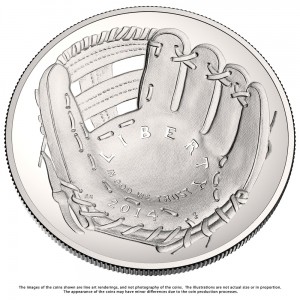
Winning design for the obverse of the 2014 Baseball Hall of Fame commemorative
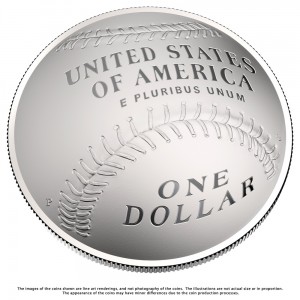
Reverse design of the 2014 Baseball Hall of Fame commemorative
In sperate meetings, the U.S. Commission of Fine Arts and Citizens Coinage Advisory Committee both recommended McFarland’s design for the coin. These recommendations were forwarded to Secretary of the Treasury Jacob “Jack” Lew for the final decision. It is being reported that the selection was made on September 4, 2013.
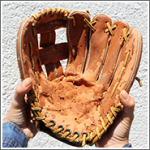
The baseball glove that inspired Cassie McFarland’s winning entry.
U.S. Mint Sculptor-Engraver Don Everhart will do the engraving of McFarland’s winning design. Everhart created the reverse design.
Originally, the U.S. Mint had scheduled this announcement at the capital on October 8, 2013. The event was cancelled because of the shutdown of the government. Even though the U.S. Mint is fully operational because it is funded by the seignorage earned by the sales of the coins it produces, support services necessary for the U.S. Mint to make the announcement elsewhere were not available. A local suggestion to hold a ceremony at Nationals Park was quickly discounted since security services could not support the event. Remember, the Washington, D.C. budget is held hostage by congress because of antediluvian laws preventing the United States citizens living in the nation’s capital from governing themselves.
This was not my favorite design. My favorite was “The Big Three,” an image of a left-handed better swinging at a pitch with the catcher ready to catch the ball and the umpire behind him. In fact, I though could be improved, so I did a mock-up of “The Big Three” portrait with the elements around the image from the coin “The proud American classic” to come up with something I liked better.
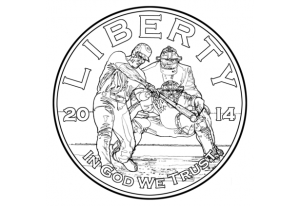
Candidate Design: The Big Three
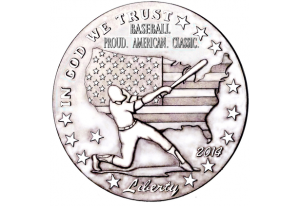
Candidate design: The Proud American Classic
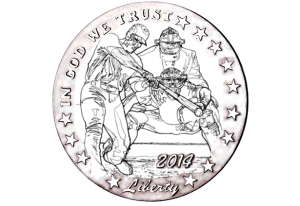
My idea combining design elements from two of the design candidates.
Admittedly, McFarland’s design works better on the curved coin where other designs would look better on a flat coin. While the renderings makes the coins intriguing, it will be interesting to see how the coin looks in hand. Hopefully, the government will be open for the launch ceremony which is likely to be held at the National Baseball Hall of Fame and Museum.
All images courtesy of the U.S. Mint. To use the images, the U.S. Mint requires the following statement: The images of the coins shown are line art renderings, and not photography of the coins. The illustrations are not actual size or in proportion. The appearance of the coins may have minor differences due to the coin production processes.
Oct 13, 2013 | BEP, coins, currency, news, US Mint, web
On Friday, the U.S. Mint and the Bureau of Engraving and Printing announced that they would be cross-promoting each other’s products. As one of the few agencies in full operation, the U.S. Mint and BEP updated their website with two pages, one provides information about the other agency and the other points to their online store.
This probably would have gone unnoticed except for the email announcement sent by the Bureau of Engraving and Printing to subscribers. It was sent in such haste that the link they provided to the U.S. Mint’s site is broken.
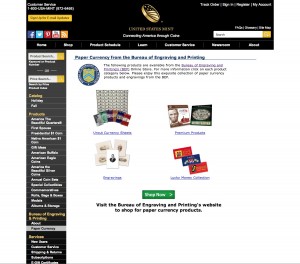
Promoting BEP’s Currency at the U.S. Mint
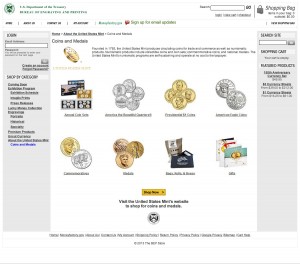
Promoting U.S. Mint’s coins at the BEP
Click on the preview to visit the site.
I bet you thought there was no good news to come out of Washington, D.C. last week!
Oct 3, 2013 | coins, commemorative, legislative, policy, US Mint
H.R. 3146: Savings, Accountability, Value, and Efficiency (SAVE) II Act
Sponsor: Rep. Patrick Murphy (D-FL)
• To take steps to reduce the deficit of the Federal Government.
• Sec. 8. Prohibition On Non-Cost Effective Minting and Printing Of Coins and Currency
• Introduced: September 18, 2013
• Referred to many committees including the Committee on Ways and Means
Track this bill at http://www.govtrack.us/congress/bills/113/hr3146
H.R. 3186: Hank Aaron Congressional Gold Medal Act
Sponsor: Rep. Ron Kind (D-WI)
• To award a Congressional Gold Medal to Hank Aaron, in recognition of his contributions to the national pastime of baseball and his perseverance in overcoming discrimination and adversity to become a role model for all Americans.
• Introduced: September 26, 2013
• Referred to the House Financial Services Committee
Track this bill at http://www.govtrack.us/congress/bills/113/hr3186
I usually do not include bill for congressional gold medals. As a fan of Hank Aaron, I am including it to show my support. If congress should ever get its act together, it would be nice if they would immediately pass this by unanimous consent.
Sep 30, 2013 | BEP, coins, currency, Federal Reserve, news, policy, US Mint
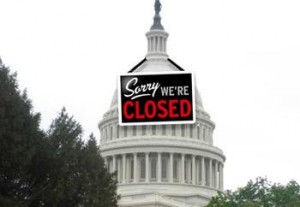 In the ongoing drama that is United States Federal government, a shutdown is looming over the shear idiocy of idiot-loges on both sides of the aisle attempting the rule and not govern. All 537 politicians elected to federal office are in need of a good spanking.
First, here are some impacts:
- According to the Office of Management and Budget, a government shutdown will cost taxpayers an extra $40-60 million per day.
- The District of Columbia is reporting that a shutdown will cost the city about $2 million per day in lost revenues.
- Maryland and Virginia has not reported their potential economic impact of a shutdown.
- UPDATE (4:40pm): Local news reports say that over 835,000 workers will be effected by a shutdown with at least 80-percent being in the Washington, D.C. metropolitan area. Some estimates are saying that it could cost the region up to $20 million per day.
What does this mean for the money manufacturing bureaus of the country?
- The U.S. Mint is not answering inquiries about pending shutdown. Media is directed to contact OMB for more information.
UPDATE (1:40pm): The U.S. Mint will not allow tours of the Philadelphia and Denver mints during a government shutdown.
- Office of Management and Budget is not answering the telephone. Rather, they requested that an email be sent with detailed questions. Email inquiries have yet to be answered.
- When calling the Bureau of Engraving and Printing, their phone is either busy or when trying to get past the voice response system for the Office of External Relations, the system says “the person you attempted to reach is unavailable.” An email was sent to the BEP’s general inquiry account and OMB asking about the operations at the BEP.
UPDATE (3:30pm): An email note was received from the BEP saying to contact a spokesperson at the Department of the Treasury. Telephone and email messages have not been returned.
UPDATE (4:10pm): Both the Washington and Fort Worth plants will not hold tours if there is a government shutdown at midnight tonight.
- Since the Federal Reserve is an independent organization and not subject to congressional appropriations, they will remain open during a shutdown. The shutdown will not affect the launch of the new $100 Federal Reserve Note planned for October 8.
UPDATE (5:30pm): According to the Treasury Department:
Operations of the following bureaus are funded from sources other than annual Congressional appropriations, and would operate normally if a government shutdown were to occur: the Office of the Comptroller of the Currency (OCC), the United States Mint, and the Bureau of Engraving and Printing (BEP).
This post will be updated as new information is provided.
Representatives of these agencies may contact me via email to provide additional information. Please note that I do respect the confidentiality of sources!
NOTE: I am not a member of any political party. I am a proponent of government employees who do not deserve the way they are being treated by the elected officials.
Sep 22, 2013 | celebration, coins, national park quarters, quarter, US Mint
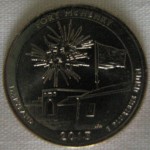 On Monday, September 12, 1814 the British invasion fleet landed at North Point in Baltimore and tried to capture Baltimore by attacking Fort McHenry. Before the attack on Baltimore, the British marched through Washington, D.C. and burned the capital building. On their march to Baltimore, the British took Dr. William Beanes as a prisoner for his role in capturing British stragglers and deserters. Beanes was imprisoned in Baltimore as the Royal Navy gathered forces for their attack on Fort McHenry in Baltimore Harbor.
Word of Beanes’s capture reached Francis Scott Key, an accomplished lawyer, prosecutor, poet, and friend of Dr. Beanes. Key, who was known as a skilled negotiator and a very temperate man, was asked by the Army to accompany prisoner exchange agent Colonel John Stuart Skinner to Baltimore to secure the release of Dr. Beanes. On September 7, 1814, Key and COL Skinner dined with British officers abroad the HMS Tonnant to negotiate the release of prisoners. Although Beanes was released, the British would not let the men leave the ship because they had heard about the British plans to attack Fort McHenry.
Key, Skinner, and Beanes watched as the Royal Navy bombarded the fort and surrounding areas of Baltimore. As the smoke cleared on the morning of September 14, 1814, after 25-hours of bombardment, Key was able to see the U.S. flag still flying over Fort McHenry. Key was so moved by the sight that after returning home, he wrote the poem “The Defence of Fort McHenry.” The poem was published in the Baltimore Patriot on September 20, 1814.
Following the War of 1812, Baltimoreans celebrated the victory every year on September 12 but did not gain statewide recognition until the centennial celebration in 1914, even though the celebration was overshadowed by World War I. Celebrations waned during the Great Depression until it became an official holiday in 1957. Defenders Day would become popular again in the 1980s with the help of the National Park Service and the Fort McHenry Guard.
-
-
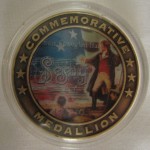
Obverse of the Fort McHenry Commemorative Medallion for sale at the gift shop.
-
-
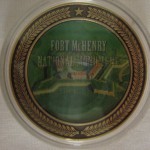
Reverse of the Fort McHenry Commemorative Medallion for sale at the gift shop.
This year, Defenders Day was celebrated on Friday, September 13. With a crowd of area students, area residents, dignitaries, and members of the Maryland State Numismatic Association, the Defenders Day celebration kicked off at Fort McHenry with the launch ceremony of the Fort McHenry National Monument and Historic Shrine quarter.
With Ranger Bailey as the master of ceremonies, the program features Park Superintendent Tina Cappetta, Maryland Senator Ben Cardin (D), Representative John Sarbanes (D) whose district includes Fort McHenry, Representative C.A. “Dutch” Ruppersberger (D) whose district covers parts of Baltimore not in Sarbanes’ district, Baltimore Mayor Stephanie Rawlings-Blake (D), and Treasurer of the United States Rosie Rios.
Speeches were interspersed with a performance from the Notre Dame Prep (Towson, MD) Choir, ceremonial drills from the Fort McHenry Guard, and the Fort McHenry Fife and Drum Corps. Prior to end of the ceremony, Treasurer Rosie Rios presented a special plaque with examples of the Fort McHenry Quarters to Superintendent Cappetta.
The ceremony ended with the dignitaries on the stage pouring a bucket of quarters into a old ammunition box.
Following the ceremony the dignitaries handed out quarters to to the students who sat through the ceremony. These children were attentive and appreciative of the ceremony and the quarter.
Clearly, the most popular person giving out quarters was Mayor Rawlings-Blake of Baltimore. Rawlings-Blake is a native of Baltimore, mother, and younger than the other politicians in attendance. It was clear that she connected better with the students than the other politicians.
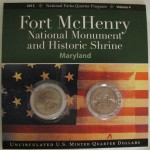
Fort McHenry Quarters display folder issued by the National Park Service
On my way out of the park, I made the obligatory stop in the gift shop. Surrounded by students having fun looking at the items for sale, I found a card issued by the National Park Service with the Fort McHenry quarters commemorating the fort. The back of the card says that a portion of the proceeds are donated to the National Park Conservation Alliance. I also purchased a commemorative medal with a hologram on both sides. The images on the obverse commemorate the Star-Spangled Banner while the reverse shows the fort.
Not a bad way to spend the morning in Baltimore before having to return to work.
All images owned by the author.
Sep 6, 2013 | coins, commemorative, legislative, policy, US Mint
H.R. 2932: United States Coast Guard Commemorative Coin Act
Sponsor: Rep. Joe Courtney (D-CT)
• To require the Secretary of the Treasury to mint coins in commemoration of the United States Coast Guard.
• Introduced: August 1, 2013
• Referred to the House Committee on Financial Services
Track this bill at http://www.govtrack.us/congress/bills/113/hr2932
Aug 2, 2013 | coins, commemorative, legislative, policy, US Mint
H.R. 2633: Thirteenth Amendment Commemorative Coin Act
Sponsor: Rep. Danny Davis (D-IL)
• To require the Treasury to mint coins in commemoration of the Sesquicentennial Anniversary of the adoption of the Thirteenth Amendment to the United States Constitution, which officially marked the abolishment of slavery in the United States.
• Introduced: July 9, 2013
• Referred to the House Committee on Financial Services
Track this bill at http://www.govtrack.us/congress/bills/113/hr2633
H.R. 2754: Collectible Coin Protection Act
Sponsor: Rep. George “G.K.” Butterfield, Jr. (D-NC)
• To amend the Hobby Protection Act to make unlawful the provision of assistance or support in violation of that Act
• Introduced: Jul 19, 2013; Referred to House Energy and Commerce Committee
• Passed in the House of Representatives: Jul 30, 2013 (voice vote)
• Received in the Senate: July 31, 2013; Referred to Senate Committee on Commerce, Science, and Transportation
Track this bill at http://www.govtrack.us/congress/bills/113/hr2754
H.R. 2760: Panama Canal and Pan-Pacific Exhibition Centennial Celebration Act
Sponsor: Rep. Nancy Pelosi (D-CA)
• To require the Secretary of the Treasury to mint coins in commemoration of the centennial of the Panama-Pacific International Exposition and the Panama Canal
• Introduced: July 19, 2013
• Referred to the House Committee on Financial Services
Track this bill at http://www.govtrack.us/congress/bills/113/hr2760
Jul 27, 2013 | coins, nickels, US Mint
The other day I was talking with a someone who was not a coin collector to explain why I liked collecting coins. One of the reasons I mentioned was the thrill of the hunt. To be able to find that one coin to add to a collection or even reaching into my pocket and finding something interesting, even if it was not valuable.
To demonstrate what could happen, I reached into my pocket and happen to pull out what could be considered a type set of Jefferson nickels. I first found the 2012-P nickel that seems to now be in common circulation. Next was a 1982-D nickel with what looks like a filled “D” mintmark. For the time period, the blob for the mintmark was common and not worth anything more than a curiosity.
As I slid the 1982-D aside, I found the reverse the the Keelboat type 2004-P nickel. The person I was talking with was not aware of the Westward Journey nickel program commemorating the Lewis and Clark expedition to the west. I mentioned that the 2005 American Bison design was my favorite. Not only does it have the the American Bison on the reverse, the animal that most represents the country’s westward expansion, but the front has that wonderful bust of Jefferson designed by Joe Fitzgerald.
When I started to look at the last nickel, I said, “oh… this is older.” When asked how I knew before looking at the date, I explained how the relief had changed over the years. Using the four coins in hand, I could demonstrate how the relief and designs have been altered over the years to accommodate striking requirements. Even though the composition of the United States 5-cent coin has not changed since 1883 except for the silver-copper-manganese composition during World War II (1942-45), the U.S. Mint has lowered the relief of the coins in order to make the dies last longer and reduce production costs. According to the U.S. Mint’s 2012 Annual Report (PDF) it costs 10.9 cents to make one nickel. It could be more if the U.S. Mint had to use more dies to strike coinage for circulation.
I adjusted my glasses to see that the coin had the year 1956 then I flipped it over to see if there is a mintmark. When asked why I was looking for the mintmark on the back when it appeared on the front of the other coins, I said that up until 1964 the mintmark on the Jefferson nickel was to the right of Monticello and only if the coin was struck in Denver or San Francisco. Only the War Nickels had a mintmark prior to 1964. Luckily, I was able to demonstrate when a “D” mintmark appeared on the coin.
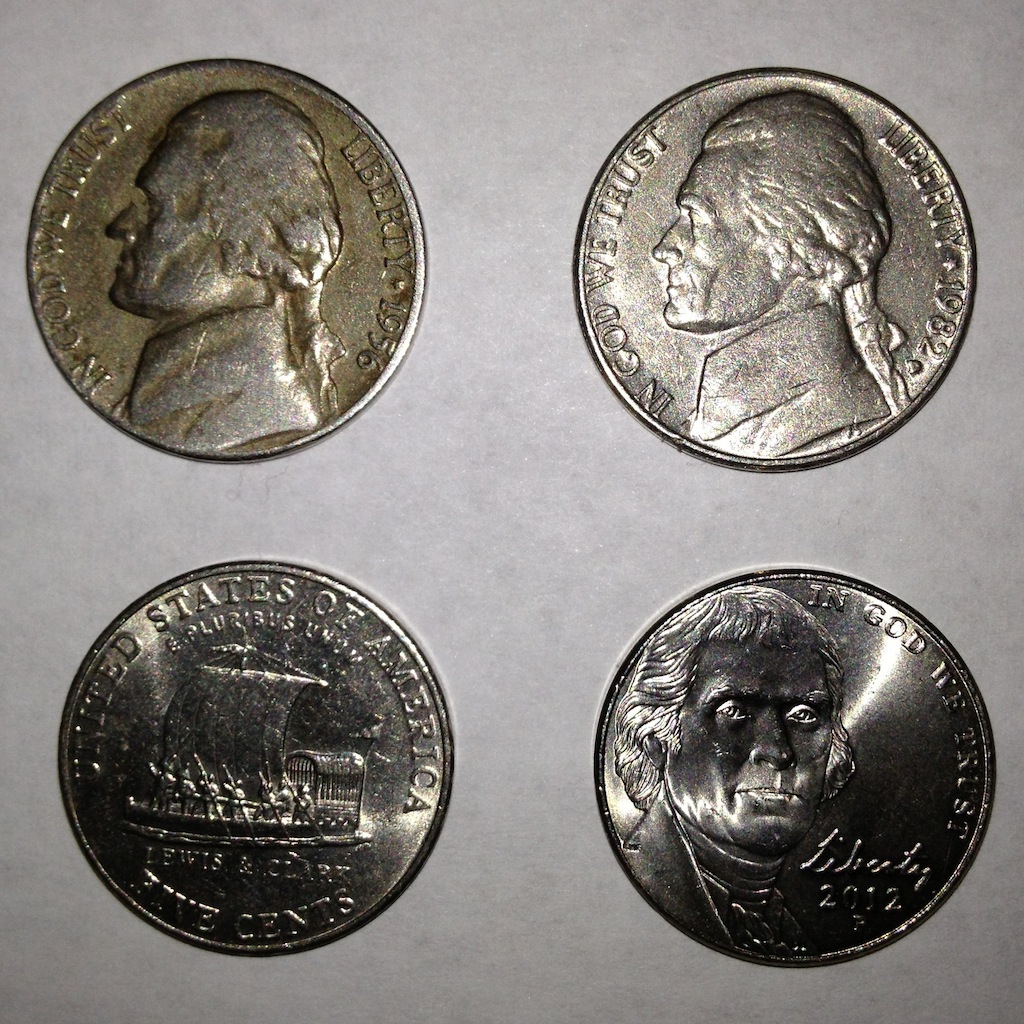
A small type set of Jefferson nickels found in pocket change.
Top row: 1956-D and 1982-P. Bottom row: 2004-P Keelboat design and 2012-P.
The next question was “How much is it worth?” Since the coin could be graded Good-4 at best, I said it would probably be worth 5-cents, face value. I decided to look up the price and saw that it was worth 6-cents! It is hardly worth the effort to sell. But the person that I was showing the coins found my little pocket-change type set was interesting.
Now that I have written about them, all four coins will go back into circulation for someone else to find. Who knows, maybe a young numismatist will find the 1956-D, think it is cool and add it to their collection. If you are in the Washington, D.C. metro area, you can be on the lookout for the 1956-D and other nickels I just wrote about. Happy change hunting!
Jul 26, 2013 | coins, US Mint
 If you have not heard, the U.S. Mint is offering free standard shipping starting today at noon eastern time through September 30, 2013. This means that all orders made over the telephone (800-USA-MINT or 800-872-6468) or their online catalog will not be charged the $4.95 shipping costs regardless of the purchase price and size of the order.
Expedited shipping will be charged only the UPS 2nd Day Air fee of $12.95.
Bag and box orders will be charged only the $7.95 surcharge.
If your order qualifies for free expedited shipping upgrades by costing more than $300, then your expedited shipping will be free.
Because this offer is only for domestic standard shipping service, international orders will continue to be charged $14.95 + $2.95 per item.
Although the U.S. Mint has not announced why they are doing this, they might feel that they need collectors to spend more money in order raise revenues. Since the U.S. Mint is largely self-sustaining, revenue projections may be lower because of the lowered production, the lack of enthusiasm for commemorative coins, and a reduction in sales of bullion products as the costs of precious metals continue to trade off their highs from earlier this year.
Since this offer will be good through the end of September, I probably will not buy anything from the U.S. Mint at the World’s Fair of Money. After all, I think it will be easier to have my collectibles shipped home than have to schlep it through the airport.
Jun 7, 2013 | bullion, coins, Eagles, gold, news, silver, US Mint, video
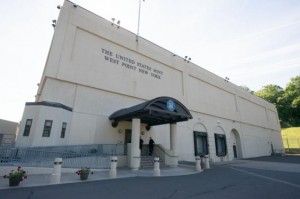 This year, the U.S. Mint Facility at West Point, New York turn 75 years old. When opened in 1937, it was to be the nation’s silver bullion depository giving it the nickname “The Fort Knox of Silver.” In 1988, West Point was granted mint status.
The “W” mintmark on U.S. coins is highly prized since it is the only mint not to strike circulating coins with its own mintmark. While the West Point Mint did strike cents from 1973 through 1986, the coins produced were not struck with a mintmark.
Today, the West Point Mint only strikes precious metal coins. From commemoratives through bullion American Eagle coins, West Point produces more precious metal coins than any other Mint in the world, including the San Francisco Mint.
Located just outside the United States Military Academy, the West Point Mint does not allow visitors or tours for security reasons. However, exceptions are made. With the facility celebrating its 75th anniversary, the U.S. Mint has been allowing journalists to visit and take pictures of their operations.
Thus far, the best set of images were published in the Daily News. In the article, “West Point Mint, with $80 billion in precious metals, celebrates 75th anniversary,” the reporters visit the West Point Mint and bring back some very interesting picture. You can read the story on the Daily News’s website or if you just want to see the pictures, you can see this board I created on Pinterest.
The Daily News also created a two-minute video looking inside the facility. The video follows (if it begins with a commercial, it is being sent by the Daily News—the cost of embedding their video):
If you are having problems seeing the video, go here.
All images and the video courtesy of the Daily News.



 Loading ...