Franklin Delano Roosevelt was inaugurated on March 4, 1933 at the height of the Great Depression. Unemployment was over 25-percent, inflations was rampant, farm prices have plummeted so low that it was cheaper for farmers to plow under crops, and banks were failing at record numbers.
Two weeks prior to his inauguration, FDR asked his old friend and Wall Street executive William H. Woodin, to be the Secretary of the Treasury and help implement a new monetary policy. Woodin rushed to Washington to work with Ogden Mills, President Herbert Hoover’s Secretary of the Treasury, in order to understand the issues. On the day of FDR’s inauguration, Mills resigned and voluntarily stayed in Washington to help Woodin with various policy changes.
Hours after FDR’s inauguration, the Senate approved the appointment of Woodin as the Secretary of the Treasury. With his new Treasury Secretary in place, Woodin’s first act was to declare a three-day bank holiday in order to try to stop the failures.
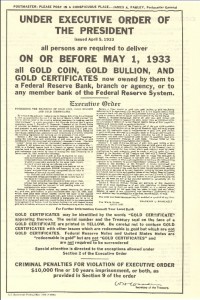
Handbill that was displayed in Post Offices calling for the recall of gold with the text of Executive Order 6102
One of the problems facing Woodin was the amount of gold leaving the United States and being used for overseas trade. More gold was leaving the Treasury than they were taking in. At Woodin’s urging, FDR signed Executive Order 6102 recalling all privately held gold. This executive order required everyone to return his or her gold to the Federal Reserve by May 1, 1933 in exchange for $20.67 per troy ounce (equivalent to $369.72 when this was written).
Executive Order 6102 specifically exempted certain industrial uses of gold, art, and allowed people to keep up to $100 in face value in gold coins. It also exempted “gold coins having recognized special value to collectors of rare and unusual coins.” The protection of collectible coins was credited to Woodin since he was a collector of coins and patterns he acquired while director of the New York Federal Reserve Bank.
Although most of the country complied with the executive order, some challenged the law and started to sue the government to stop the gold recall. With the challenges mounting, on June 5, 1933, congress formally takes the United States off the gold standard by enacting a joint resolution (48 Stat. 112) nullifying the right of creditors to demand payment in gold.
For weeks after FDR issued EO 6102, the U.S. Mint continued strike gold double eagle coins because they did not have an order to stop. After receiving the stop work order, the coins were stored until they were ordered melted in 1934.
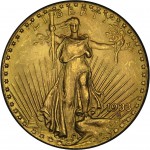
Even though the double eagles were melted, several examples of the 1933 Saint Gaudens double eagle gold coin did find its way out of the Mint. While most were tracked and confiscated, one example found its way to Egypt into the collection of King Farouk. This was the coin that eventually was sold in 2002 for $7,590,020 ($20 given to the government to monetize the coin) to a private collector. Half of the proceeds were paid to the government as part of a settlement with British coin dealer Stephen Fenton, who was arrested trying to sell the coin at the Waldorf Astoria Hotel in 1998.
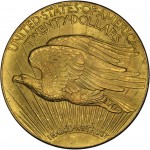
Reverse of the iconic 1933 Saint Gaudens $20 Double Eagle gold coin
But that does not end the story of the 1933 Saint Gaudens double eagle. Since the sale of the only legal tender 1933 Double Eagle, ten coins found by the family of the late jeweler and coin dealer Israel Switt. The coins were sent to the U.S. Mint for authentication and were subsequently confiscated when they were determined to be genuine.
These coins are known as the “Langboard Hoard,” named for Joan Landbord, the daughter of Israel Switt, who claims to have found the coins while searching through her father’s old goods. On more than one occasion, Switt has been accused of being the source of the 1933 Double Eagle coins that made it out of the Philadelphia Mint.
In July 2011, a jury ruled that the 10 coins in the Langboard Hoard belong to the government. The case is currently being appealed.
The story of 1933 Saint Gaudens double eagle is truly an example of the law of unintended consequences. In an effort to rescue the economy, the cascading series of events that took the United States off the gold standard turned what was supposed to be an ordinary coin into one of the most intriguing stories of the 20th and now 21st century.
One of the most pleasantly surprising find at the National Money Show in New Orleans was at the U.S. Mint booth. On the right side of the booth, almost in the middle of the floor, was a single display case with a sign that read “Upcoming Products.” In the case was an example of the 2013 American Eagle West Point Two-Coin Silver Set.
The U.S. Mint began its four week sale period on May 9, 2013, the first day of the National Money Show. All orders are being taken via their website or by telephone at 800-USA-MINT (800-872-6468). The two coin set with one American Eagle Silver Reverse Proof Coin and one “enhanced” American Eagle Silver Uncirculated Coin minted at the United States Mint at West Point. Selling price is $139.95 with shipping to begin on September 30.
This set will mark the fourth time that the American Silver Eagle will be produced in reverse proof. Prior to this year, the U.S. Mint produced the American Silver Eagle for the 2006 20th Anniversary Silver Eagle set, 2011 25th Anniversary Silver Eagle set, and the 2012 75th Anniversary of the San Francisco Mint set. As far as I am concerned, the U.S. Mint can continue to produce the reverse proof American Silver Eagle every year.
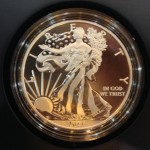
2013-W American Silver Eagle reverse proof
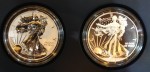
2013 American Eagle West Point Two-Coin Silver Set with reverse proof and enhanced uncirculated coins.
2013-W American Silver Eagle enhanced uncirculated coin
What made the set stand out what the U.S. Mint calls the “enhanced uncirculated” coin. While it looks like a proof coin, the enhanced portion are the selective frosting of elements. Introduced earlier this year, the new laser frosting technique allows the U.S. Mint to selectively apply the frosting texture to areas of the dies in a matter that leaves fine details of the coins. For the enhanced American Silver Eagles, the selective frosting leaves the folds of Miss Liberty’s skirt mirrored and is used to show off the flag she is holding. Adolph A. Weinman’s Walking Liberty image is one of the best designs every to appear on a U.S. coin. Enhancing it in this manner just makes it pop in a way Weinman could never imagine.
Even if you are “board” with the reverse proof, the set it worth purchasing just for the enhanced uncirculated coin. You will not be disappointed.
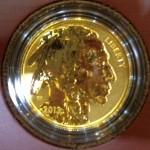
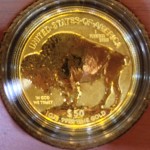
But the coin that really caught my eye was on the right side of the case. A 2013 Reverse Proof American Buffalo 24-Karat gold coin. Previously unannounced, it did not get noticed until I posted one of the first pins on Pinterest. After, it seem that the story spread around the numismatic press.
According to the U.S. Mint representatives at the show, the gold coin that was first issued in 2006 featuring the 1913 Type 1 Buffalo Nickel, will celebrate the 100th anniversary of the design by James Earle Fraser.
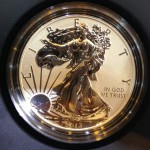
2013-W American Buffalo gold reverse proof obverse
Reverse of the 2013-W American Buffalo gold reverse proof
As striking other reverse proof coins have been, the American Buffalo gold coin is just as striking. It could be called just plain beautiful. Aside from being my second favorite coin design behind Weinman’s Walking Liberty, it makes a big impression as a reverse proof coin.
Since the coin has not been issued, the price has not been set. Since the price is based on the market price of gold, and considering that gold closed today (May 16) at $1,395.05 per troy ounce, and using the United States Mint 2013 Pricing of Numismatic and Commemorative Gold and Platinum Products [PDF] for the regular American Buffalo gold proof coin, the coin would cost $1,740. If the price of gold continues to go down, of course the sales price will go down.
Both coins bring the U.S. Mint back into the forefront of numismatic art. These coins use the best coin designs and brings them to a new level while keeping with their classic elegance without the gimmickry of color, embedded stones, odd shapes, or any combination of extras to sell non-circulating legal tender coins at an inflated price. It would be wonderful if the U.S. Mint could use these processes to enhance future designs. Both coins should be in the running for Coin of the Year honors when they are selected next year (and awarded in 2015).
As with many announcements, there was little news other that what was published in the past. The U.S. Mint did bring out a plaster model of a curved coin to show the media what it could potentially look like.
The following video shows the plaster model of the coin and the introduction by Treasurer of the United States Rosie Rios:
This is the animation that the U.S. Mint published showing the shape of the coin:
But the real news of the day is the comedy routine by Brooks Robinson. Robinson takes his sense of humor to a deprecating sense of self. It is worth watching!
Remember, this week’s poll asks if you are going to participate in this contest. Are you?
Will you try to submit a design for the National Baseball Hall of Fame commemorative?
No, I am not artistic enough. (54%, 7 Votes)
No, it's a dumb idea. (38%, 5 Votes)
Yes I am! (8%, 1 Votes)
I would like to, but I do not have the time. (0%, 0 Votes)
Maybe, I am thinking about it. (0%, 0 Votes)
Total Voters: 13
Loading ...
Videos from the launch ceremony courtesy of Gannett by Brian Tumulty. Animation video courtesy of the U.S. Mint.
As a result of the the president signed the National Baseball Hall of Fame Commemorative Coin Act (Public Law No. 112-152 [TXT][PDF]), the U.S. Mint is required to hold a competition for the design of the obverse (heads) side of the three coins that will be issued as part of the set. The law states:
IN GENERAL- The Secretary shall hold a competition to determine the design of the common obverse of the coins minted under this Act, with such design being emblematic of the game of baseball.
SELECTION AND APPROVAL- Proposals for the design of coins minted under this Act may be submitted in accordance with the design selection and approval process developed by the Secretary in the sole discretion of the Secretary. The Secretary shall encourage 3-dimensional models to be submitted as part of the design proposals.
PROPOSALS- As part of the competition described in this subsection, the Secretary may accept proposals from artists, engravers of the United States Mint, and members of the general public.
COMPENSATION- The Secretary shall determine compensation for the winning design under this subsection, which shall be not less than $5,000. The Secretary shall take into account this compensation amount when determining the sale price described in section 6(a).
Here is your chance to design a coin that will be sold to collectors everywhere and if you create the winning design, you will win $5,000!
The obverse design must represent baseball and include the inscriptions “Liberty,” “In God We Trust,” and “2014.”
Your design must be able to look good on a coin about the size of a nickel, which is close to the size of the $5 gold coin.
You must be a 14 years old and older, a U.S. citizen or permanent resident to enter. Employees in any area of the Department of the Treasury, current and former members of the Artistic Infusion Program, and contractor to the Department of the Treasury are ineligible.
Your design must not depict any real person, name, logo, stadium, field, etc. from now or in the past. It must be original artwork.
When you are ready to submit your entries, you must submit your line art in black and while (no color) to http://www.batterup.challenge.gov/. This site is not up but will be there, ready to accept your submissions on April 11 starting at noon EDT. Deadline is May 11, 2013 at noon EDT. You can also submit a plaster or plastic model approximately 8-inches in diameter.
Do not procrastinate because the U.S. Mint has said that if 10,000 entries are received prior the May 11 deadline, they will suspend the contest early with 48 hours notice. They also said that the contest will not end before noon EDT of April 26.
If you have an idea give it a try! You do not have to be that artistic because the engravers at the U.S. Mint can translate your design into something that can be struck into coins. They are good, so give it a try!
While we are talking about the design of these coin, will you try to submit a design for this commemorative? Let me know in this week’s poll:
To understand the post’s true condition, you have to consider the following:
The Chairman of the Federal Reserve is Ben S. Bernanke. His first name is really Ben, not Benjamin.
The law requires the Federal Reserve to distribute the one-dollar note. Only congress can vote to stop producing the note.
The Acting Director of the U.S. Mint is Richard A. Peterson, not Pederson.
Seignorage is deposited in the Public Enterprise Fund. No, the leaving out of the “d” in the original post was not a typo because I was having fun!
The Director of the Bureau of Engraving and Printing is Larry Felix. I do not know a Larry Felinks. Maybe he is a long lost cousin of the director?
The company that supplies currency paper to the BEP is “Crane and Company.” The Sandhill Crane Company does not exist, but there is a bird called the sandhill crane. There is also a blue crane, but I am reasonably sure that there is no such person as Violet “Blue” Crane; or at least there is not one associated with Crane and Company. Maybe there is a Blue Crane working for Sandhill Crane? There is a joke in there that can use “Whooping Crane” which I will leave as an exercise to the reader!
Finally, when was the last time you heard the Fed Chairman concerned with coin collectors? The last line was added to emphasize the date.
In other words:
Besides, who is giving a blogger an exclusive story that does not appear elsewhere? Like the Orson Well’s broadcast of The War of the Worlds, all you had to do is change the channel (or check another source).
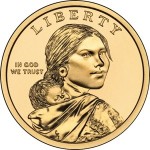
Obverse of the 2009-present Native American Dollar
In a move that will shake the markets for time to come, Federal Reserve Chairman Benjamin S. Bernanke announced that the Federal Reserve and its member banks will no longer order one dollar Federal Reserve Notes from the Bureau of Engraving and Printing. To replace the paper, the Fed will start to distribute the over one billion one-dollar coins currently being stored in the money storage facilities around the country.
“We have so many dollar coins, it makes sense to find a way to get them into circulation,” Bernanke said. “It will also help reduce the storage requirements to hold these coins.”
Bernanke, who has been both complemented and reviled over the Fed’s handling of the Great Recession, said that now that the economy was more solid, he would turn his attention to doing what he can for the federal government. Citing the GAO report that estimated the federal government could save at least $4.4 billion by using coins rather than money, Bernanke will use his power as Chairman of the Fed to determine the independent bank’s policy over circulating money.
“Not only will this keep our facilities busy but it will help the U.S. Mint maintain and increase its profitability,” said Richard A. Pederson, Acting Director of the U.S. Mint. “The reduction of dollar coins previous ordered by [then Treasury Secretary Tim] Geithner really hurt our bottom line. It significantly lowered our seigniorage and the size of our deposit into our Public Enterprise Fun.”
Pederson assured Bernanke that the U.S. Mint will be able to meet the new demand for circulating dollar coins.
Director of the Bureau of Engraving and Printing Larry Felinks said that this change will help increase productivity in other areas of their operation. “Printing of the one dollar note is over 50-percent of our production. This reduction will allow us to concentrate on other projects including trying to figure out why we have not been able to produce $100 notes.”
“Obviously, we are not happy about this,” said Violet “Blue” Crane, family spokesperson for the Sandhill Crane Company who manufactures the paper for the Bureau of Engraving and Printing. “Manufacturing paper for the one dollar bill was half of our business and gave us the most profit since that paper did not have to include anti-counterfeiting features.”
The U.S. Secret Service declined to comment for this story and any other story they were asked about.
Bernanke, sitting in his office obviously pleased with his new policy, also understood the impact of his decision on the numismatic industry. Leaning back in his chair, Bernanke closed with, “Collectors of United States coins will remember April 1, 2013 as the day I gave their dollar coin collection more meaning.”
Native American Dollar image courtesy of the U.S. Mint.
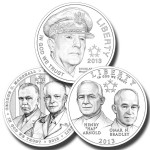
On March 21, the U.S. Mint is scheduled to start selling the 2013 5-Star Generals Commemorative Coins. The program commemorates the United States Army Command and General Staff College (CGSC) by commemorating the 5-star generals who attended or taught at the college. The generals that will be depicted on the coins are Douglas MacArthur, George C. Marshall, Henry “Hap” Arnold, Dwight D. Eisenhower, and Omar N. Bradley. General Bradley was the last to hold the rank General of the Army.
The 5-Star Generals Commemorative Program includes a $5 gold coin, silver dollar, and clad half-dollar that will be offered in proof and uncirculated options. The U.S. Mint will also offer a three-coin proof set. Surcharges of $35 for each gold coin, $10 for each silver coin and $5 for each clad coin sold will to go the CGSC Foundation to support the college. With mintage limits of the 100,000 for the gold coin, 500,000 silver dollars, and 750,000 clad half-dollars, the program can raise a maximum of $16 million for the CGSC Foundation.
Do you plan to buy any of these commemorative coins? This week’s poll asks which, if any, of these commemoratives you will buy.
Do you plan to buy any of the 2013 commemorative coins?
I don't plan to buy any of these commemorative coins (38%, 13 Votes)
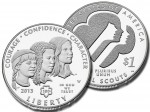
2013 Girl Scouts of the USA Centennial Proof Silver Dollar (12%, 4 Votes)
A few weeks ago, I wrote about a one page collection starting with the one cent coin. The set also included an example of a half-cent to cover the lowest denomination of coins produced by the U.S. Mint.
The concept of the one-page collection is to create a meaningful collection using a single 20 pocket page that holds 2×2 holders. Using this format, I can create any type of collection without being bound to the albums and folders that are published by the numismatic press. I can also personalize the collection with information I find and other stories, some that I write.
When creating a one page collection, I am looking at ungraded coins that could be graded Fine or better and costs under $100 each. While I try to keep purchases under $50, having the ability to go over for certain coins gives me a little flexibility while staying closer to affordable.
I was asked what I used as a price guide to determine affordability. For full disclosure, I had been consulting the NumisMediaOnline Fair Market Value Price Guide of collector coin. The site is free, updated monthly, and is the same information printed in their monthly publication. The NumisMedia Online Dealer Price Guide as well as their printed version requires a subscription.
Since my first one-pager was of the lowest denominations, I will move up a bit and put together a collection of 2, 3, and 5-cent coins.
The first coin struck by the newly created Mint was the half disme in 1794. As one of the original coins designated by the Coinage Act of 1792, legend has it that the coins were struck using silver donated by Martha Washington. Although there is no proof that our first First Lady donated her silver, it makes for a good story.
The first half-dismes were really not struck for circulation but over 86,000 coins of the 20.8 grains (1.35 grams) of .8924 fine silver were delivered to Secretary of State Thomas Jefferson (under the First Coinage Act, the Mint was placed under the Department of State). Originally designed by Robert Scot, the early Flowing Hair and Draped Bust half-dimes (the “s” was dropped in 1796 since it was silent anyway). Production ceased in 1805 with the shortage of silver.
Production picked up again in 1829 with the Capped Bust design by William Kneass and continued until 1837. After the passage of the Act of January 18, 1837, the weight of the coin was reduced to 20 5/8 grains (1.34 grams) and the fineness raised to .900 silver. For this change, Christian Gobrecht’s Seated Liberty design was used for the new coin.
This is where the series gets interesting. First, there was a change in design in 1838 to add stars to the obverse. In 1853, to show that the size and weight was change, arrows were added to the date from 1853 through 1855 before being removed in 1856 when the weight was returned to the old standard. In 1860, the legend was move to the obverse replacing the stars and the reverse laurel leaves were made larger.
The silver half-dime was made through 1874 after the successful release of the copper-nickel coin we call the Shield nickel. Nobody is sure when the coin started to be called a nickel, especially since it is made of only 25-percent nickel. It has been speculated that it was called a “nickel” because of the composition while it circulated along side the silver half-dime.
The U.S. nickel is unique in that it is the only coin that has been made of the same .750 copper and .250 nickel composition since its introduction in 1866 except for the silver alloy used during World War II from 1942-1945.
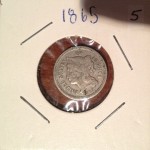
Starting this collection with an easy to find 1865 3¢ Nickel
Two and three cent coins were conceived out of the coin shortages during the mid-19th century. The three-cent coin, nicknamed the trime, was conceived in 1851 for better handling by the post office for buying postage. The silver three-cent coin was struck between 1851 and 1873. However, when silver became expensive and people were hoarding the coins for their silver content, congress authorized the striking of copper-nickel three-cent coins where were called to as three-cent nickels. Mint engraver James B. Longacre designed both coins that used a Roman numeral “III” on the reverse.
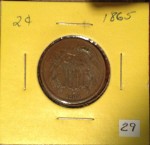
Bought this 1865 2¢ coin from my coin club’s auction
During the Civil War, the silver shortage caused hoarding of coins. The only circulating coins were the copper large cents. In order to produce more coins that would circulate, congress passed the Coinage Act of 1864 that eliminated the silver half-dime, the silver three-cent piece (trime), and authorized the production of the bronze two-cent coin. The Longacre-designed coin featured a shield on the front and the denomination “2 CENTS” on the reverse between two wheat stalks.
Beginning with the Liberty Head “V” nickel, most of the coins should be easy to find and not cost a lot of money. In fact, it may be easier to find an 1883 Liberty Head nickel without the “CENTS” on the reverse, also called the Racketeer Nickel, than an 1883 nickel with the “CENTS” in Fine to Very Fine grades. It may be easier to find a 20th century version that would fit this collection nicely.
For the rest of the series, you can find nice coins at all grades without problems. Just be aware of the major varieties, such as the two types of Buffalo nickels, and the modern changes in the Jefferson nickel. It should be fun to complete this set:
✓ 1964-1873 Two Cent piece: When I started to look for a an example of a two-cent coin, I was surprised as to how many I could find that were nicely preserved and affordable. Most VF-XF coins in this series can be purchased for $40-60 or even less if you find a dealer having a good day.
✓ 1851-1873 Silver Three Cent piece (trime): It will be difficult to find silver three-cent coins from 1863 through 1872 because most were melted in 1873. One of the best examples I have seen were the 1852 coins. Not only are they affordable but the mintage of over 18 million make them the most available coins of the set.
✓ 1865-1889 Nickel Three Cent piece: After the two-cent coin, this was the other coin minted in reaction to the hoarding during the Civil War. Early dates are easily found because of their mintage figures in the millions and for affordable prices. It should not be difficult to find a nice Extra Fine coin for around $40.
✓ 1829-1837 Capped Bust half-dimes: If you want a real challenge, put together a typeset of all half-dime types. Part of the problem with that is the Flowing Hair half-dimes will cost thousands of dollars, if you can find them. For the average collector, I suggest a Capped Bust half-dime to start the five cent part of this set. Based on the price guides and what I have seen at dealer tables, you should be able to buy a nice one graded around Fine for $60-65. This should be a good representative start of the five cent series.
✓ 1837-1873 Seated Liberty half-dimes Types 3 & 4: No collection is complete without a representation of Christian Gobrect’s Seated Liberty design. Inspired by the similar image of Britannia, Gobrect posed Miss Liberty in the same manner except holding a union shield and a phrygian cap on a pole that signifies liberty and the pursuit of freedom. For this set, I recommend the 1853-1855 “Arrows at Date” (Type 3) variety. Aside being affordable at $60-70 in XF, the arrows tell the story of how the composition was changed while the coin was being used. The “Legend on the Obverse” (Type 4) variety is an interesting change and would be even more affordable. For the “Arrows at Date” variety, you may want to consider finding one with the “O” mint mark from the New Orleans mint to keep it interesting. “Legend on the Obverse” varieties from San Francisco are affordable and would make for an interesting addition to this collection.
✓ 1866-1833 Shield nickel: Rather than worry about the “Rays” versus “No Rays” types, I decided on the “No Rays” to keep this coin around $40. However, it is your collection and if you what to spend about $100 for a VF-XF Shield Nickel with Rays, go ahead since it will give your collection a little more depth.
✓ 1883 Liberty Head nickel “Without Cents” When Charles Barber designed the coin, his idea was to use a Roman numeral “V” on the reverse and not include the word “CENTS.” Since the three-cent coins used the Roman number “III” it was a logical progression. However, since the coin was about the same size of the $5 gold-half eagle, the Liberty Head nickel was gold plated in an attempt to pass them off as the $5 gold coin. These coins were then nicknamed Racketeer Nickels. It was then decided to add “CENTS” to the bottom of the reverse. After this decision was made, people thought that the coins would be recalled and started to save them, thus making it easier to find the 1883 without CENTS nickel than it is to find an 1883 with CENTS coin.
✓ 1883-1912 Liberty Head “V” nickel: Most XF coins in this series will be around $40 each, if you can find them. It is easy to find very worn coins and very expensive to find the higher grades. In fact, if you can find a nice XF 20th century issue, that would make a nice entry in this collection and only cost around $30.
✓ 1913 Type 1 Buffalo nickel: This iconic American design by James Earle Frasier ranks as one of my favorite. While it is a great design, the coin did not wear well and it is possible to find a lot of coins where the dates have been worn flat. On the reverse, Fraser designed the coin where the buffalo (actually, an American Bison) is standing on a grassy mound. On the mound was the denomination and mint mark. This high surface wore easily in circulation. It was later changed to remove most of the mound for a line. You can find nicely preserved Type 1 Buffalo nickels from Philadelphia for around $25. Spend as little as $10-15 more for an example from Denver. San Francisco coins will be $40 more.
✓ 1913-1938 Type 2 Buffalo nickel: Basically, the mound was hollowed out leaving the buffalo standing on what looks like a line. While not as aesthetically pleasing, it did preserve the denomination and mint mark on the reverse from wear. Best bet for this collection is to find a late 1930s example for $10-15. If you spend a little more, you can own an uncirculated 1935 or 1936 with a mint mark for $35-40. These make stare-worthy coin in any collection.
✓ 1938-1942,1946-2003 Jefferson nickel: Jefferson nickels come in four types with the left-facing portrait being the dominant coin of the series. With the exception of the 1939-D, you can find an uncirculated example for under $10. If you want an example with the mintmark on the reverse, select a coin from 1964 and earlier since the mint marks were move to the obverse starting in 1968 and no coins had mint marks from 1965 through 1967. Maybe you would want to add a 1970-S coin which was the last year the nickel was produced in San Francisco and had an obverse mint mark.
✓ 1942-1945 Wartime Silver Nickels: to reduce the amount of copper and eliminate the nickel that were need for the war, the Mint produced nickels using an alloy of .560 copper, .350 silver, and .090 manganese. To distinguish these coins from regular nickels, the Mint added a large mint mark over Monticello on the reverse. It was the first time the Mint used a “P” mint mark on any coin. Since the mint mark makes them unique, one from each mint would make a nice example. Maybe one from each year with each on representing one Mint. You can find nice uncirculated examples for an average of $5 each without looking too hard.
✓ 2004-2005 Westward Journey Nickel Series: After the success with the start of the 50 State Quarters series, to honor the 200th anniversary of the exidition by Meriwether Lewis and William Clark in the newly purchase Louisiana Territory and westward, congress authorized this two-year four coin series to commemorate the journey. These modern circulating commemoratives are readily available and the four should not cost a lot of money, even as uncirculated coins. Make sure you find all four coins: 2004 coins with the left-facing portrait with the Peace Medal and Keelboat designs on the reverse. The 2005 coins had a wonderful obverse portrait designed by Joe Fitzgerald that included the word “Liberty” reproduced from Jefferson’s writing. The reverse included the American Bison and “Ocean in View.”
✓ 2006-Present Front Facing Portrait: With the return of Monticello on the reverse, a new front-facing portrait by Jamie Franki based on the 1800 portrait painted by Rembrant Peale and includes the “hand written” version of “Liberty” on the obverse.
An interesting aspect of this collection is that the coins are of all the basic metals used in non-gold coins. The 2-cent pieces were made from copper while the 3-cent coins had one type made in silver and anther in nickel. While most of the 5-cent coins were made of copper-nickel, the wartime composition removed the nickel and lowered the copper content by adding silver and manganese. It is a good representation of coinage metals circulating in the United States.
This is one set where it was difficult to think about how to keep it to 20 coins. Depending on where you shop, your patience, and your budget, this is a collection that can easily be expanded.
If you decide to use this guideline for your set, do not limit yourself to my suggestions. Consider other options. Consider adding another page. Make it personal. Make it yours.
It was reported in the numismatic press but not formally announced by the U.S. Mint that they filed a notice that appeared in the Federal Register (78 FR 11954) raising precious metal prices. The new prices, which are as much as 30-percent higher than the previous became effective as of noon (ET) on Wednesday, February 27, 2013.
It was noted in the U.S. Mint’s annual report that seigniorage on precious metal products were lower in 2012 than in years past. This move appears that the U.S. Mint is trying to make up for that lost revenue.
Someone who may be interested in collecting coins may look at the options and think that they are too daunting. Guide books talk about series of dates, mint marks, and varieties. Type books talk about every representative type, even ones that are not affordable to the average collector. Then the folder and album publishers give their interpretation of what a type collection should look like. What the novice to average collector is left with is confusion.
Collecting coins, specifically United States coins does not have to be daunting. You can put together sets of your own design that represents any time or any period. What is great is that once you define your goals, you can have the fun in putting the set together and showing it off to friends and relatives. It is also something that you can develop your own story and include it in your own album.
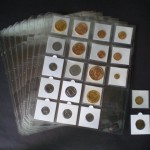
Supersafe 20 Coin Pocket Page for 2×2 holders
This is why I decided to create the One Page Collection. My one-page is a 20 pocket archival safe page to hold 2×2 holders of some type—for this, I prefer the self-adhesive cardboard holders with mylar windows. These pages can be placed in three-ring binders that can be used to build any number of collections. It is as flexible as your collecting whims can be.
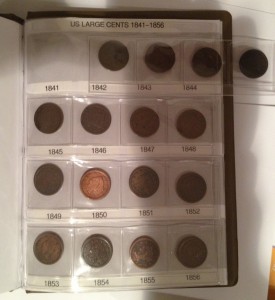
An alternative to the pocket page are Gardmaster Coin Albums. Gardmaster is made by Collector’s Supply House of Paris, Ontario in Canada. Their albums are based on a slide system where the coins are placed into pockets of a strip and the strip is slid into the page keeping the coin in place without the need for an extra holder. The albums are a smaller size with a “Snappy” binder to remove, mix, and match pages. I discovered these albums while putting together a collection of Canadian coins. I then adapted a blank 16-pocket version to create a year set for large cents. You can do an Internet search to find a dealer who sells Gardmaster albums.
For these articles, I will stick with creating a collection using the 20-coin pocket page.
As a general rule, the coins in this collection must gradable at Fine or better and cost under $100. When I create a set of half-dollars and dollars, the limit will have to be raised because of the silver values and the rarity of earlier coins.
Since these are 20-coin sets, many die varieties are ignored to a certain degree. However, design and composition changes are always significant.
The first set I will create are the copper coins. Cents and half-cents were specified in the Coinage Act of 1792 that authorized the creation of the U.S. Mint. Under the new law, the half-cent and its larger cousin the one-cent coin was struck in pure copper from 1793 through 1857.
The first half-cent struck in 1793 weighed 6.74 grams and was 22 mm in diameter. Subsequently, the half-cent weighed 5.44 grams and its diameter varied between 22 mm and 22½ mm.
The 1793 large cent had two designs, the controversial chain reverse which was then changed to a wreath weighed 13.48 grams and varied between 26-28 mm in diameter. In the 19th century, the large cent weighed 10.89 grams and its diameter varied between 27 and 27½ mm.
Consistency in the size of both coins would not be achieved until the introduction of steam-based coining equipment starting in 1836.
Large copper coins were eliminated by the Coinage Act of 1857. Signed into law by President Franklin Pierce February 21, 1857, this act repealed the legal tender status for foreign coins in the United States. It required the Treasury to exchange foreign coins at a market rate set by Treasury. This act discontinued the half-cent and reduced the size of the one-cent coin from 27mm (large cent) to the modern size of 19.05mm (small cent) that is still being used today.
First small cent was the Flying Eagle cent designed by James B. Longacre. The eagle was based on a design Christian Gobrecht used on the reverse of the Seated Liberty dollars. The Flying Eagle cent was a short lived series because of its difficulty to strike properly.
After having problems with the Flying Eagle cent, Longacre designed the Indian Head cent—which is not the image of an Indian but a representation of Libery wearing an Indian-style headdress.
Rounding out our copper collection is the Lincoln cent. Introduced as part of President Theodore Roosevelt’s “pet crime,” the Victor D. Brenner designed coin has been around over 100 years with a periodic change in reverses including the new Shield reverse that began in 2010, 101 years after the coin’s debut with the wheat stalks on the reverse.
Looking at over 230 years of copper coinage there is a lot to choose from to try to make a representative set. The following is what I came up with:
✓ 1840-1857 Braided Hair Half-Cent: A typeset of copper coins has to include a half-cent. To represent I am including a later version of the coin. Not only are these coins readily available but you can purchase a quality example for under $100. Choose one with nice features and a rich chocolate brown color to best represent this series.
✓ 1816-1863 Matron Head Large Cent: For large cents, I am picking two coins. For the early Matron Head cent, I would look at the early dates. They are readily available in better grades at reasonable prices. If you can find a version before 1836, that would represent the pre-steam press era.
✓ 1839-1857 Braided Head large cent: Walk any bourse floor and you will find later large cents that are nicely struck and at reasonable prices. If you want to spend more money you can find a red-brown example, but those with that deep brown color are well struck and wonderful. Having a large cent from this era is a good representation of the pre-small cent times.
✓ 1857-1858 Flying Eagle cent: Forget the lettering varieties. Concentrate on finding a nice coin that would grade Fine or Very Fine for your collection.
✓ 1859 Indian Head cent: This copper-nickel coin with a lauren wreath reverse is a one-coin type.
✓ 1864-1909 Indian Head cent: While there is a copper-nickel version whose reverse has an oak wreath with a shield over the wreath, the bronze version is a new composition with the same reverse. I consider the 1859 copper-nickel covers the composition and the bronze oak wreath reverse covers the change in metals. Coins from the 20th century are very available and affordable. In some cases, if you can spend more than $100 for a coin, you can purchase a nice red or red-brown example.
✓ 1909 VDB Lincoln cent: First year of issue with the “VDB” initials on the reverse is much less expensive than the San Francisco minted coins. For a few extra dollars you can even find a nice red or red-brown coin.
✓ 1909-1958 Lincoln cent: With almost 50 year of coins you can find an affordable example as a bright red coin. Spend a little more money and try for a 1909 cent without the “VDB” initials to get a first year of issue.
✓ 1943 P-D-S Lincoln steel cents: The only coin produced for circulation by the U.S. Mint that did not contain copper (the .999 silver coins contains .001 copper and the .9999 American Buffalo Gold Coin contains .0001 copper). This is worthy of adding one of each to this set.
✓ 1944-1946 Lincoln shotgun cents: Although they are Lincoln cents in every way as the 1942 and earlier cents, these coins were made from the spent shells taken from the training fields around the country. These coins might look a little darker and very available at higher grades for the average collector.
✓ 1959-1981 Lincoln cent with Memorial Reverse: These coins are made from .950 copper with the Lincoln Memorial on the reverse. These are the last copper coins struck for circulation. Adding a 1959 coin would give you the first year or add your birth year.
✓ 1982 Lincoln cent copper and copper-plated zinc coins: In 1982, the U.S. Mint transitioned from copper cents to copper-plated zinc coins. If you do not want to supplement this part with the entire seven-coin collection, then it is not a problem to ignore the lettering size and find an example of a copper and a copper-plated zinc coin. Otherwise, any coin from 1983-2008 Lincoln cent could be used for the copper-plated zinc coin.
✓ 2009 Lincoln Bicentennial cents: This four coin set should not cost more than 50-cents per coin. For a bigger challenge, find proof version that were struck on .950 copper planchets.
✓ 2010-today Lincoln cent with Union Shield reverse: The end of this set pending and further updates.
A page of Scott’s Large cent collection in a Gardmaster album
With these 20 coin you now have a set that represents the history of half- and one-cent coins ever struck by the U.S. Mint. While my concentration has been on affordable and easier to find the coins for this collection, you can extend it by looking for more expensive coins or even better grades. One challenge would be to find all of the Lincoln and Indian Head cents as red or red-brown coins. I have seen nice red-brown Flying Eagle coins but were very expensive. And for a little more money, find an 1850s Large cent that is more red-brown than brown.
Another idea is to use the Gardmaster album, buy two 16-coin pages, and expand your collection. As you look through the types, you may want to start with my “Manageable Lincoln Cent Collection” for an idea on expanding your Lincoln cent typeset. From there, you can adapt those concepts to the other cent series.
Showgard pocket pages image courtesy of Vidiforms/Showgard.

 Loading ...
 It was reported in the numismatic press but not formally announced by the
 ![[PDF]](http://coinsblog.ws/library/images/pdf.png) or you can find a printable version at on the
or you can find a printable version at on the