
QUARANTINE READING LIST: Reading History for FREE
 Even as some areas of the country are easing quarantine restrictions, the best way to prevent the spread of COVID-19 is to stay home. Although the United States has 4.25-percent of the world’s population, it has 33.19-percent of the reported cases of the disease with a death rate of 5.77-percent.
The dangers of the novel coronavirus are not only to older people, who dominate the hobby, reports that younger people who may not have shown symptoms have experienced strokes. Even the youngest children are showing symptoms that resemble Kawasaki disease.
I know it is a financially and mentally tough situation. The business I worked hard to build was beginning to break through when Maryland ordered non-essential companies to close. When I am not working alone to organize a warehouse, I am finding solace in numismatics.
During the last few weeks, I have been reducing the to-be-read pile of books. But I am beginning to run out of books. I am looking for something different. Since I like history and tying history with numismatics, I am looking to learn something new. With a tight budget, I am also looking for something new that does not cost much.
I found four entries to my Quarantine Reading List that are interesting and have taught me something. The best thing about each of the books is that each is available online.
U.S. Mint Modern Era
 Other than the formation of the U.S. Mint, there is no single seminal event that marks its history than the elimination of silver from circulating coinage. It is the dividing line between what is considered classical coinage and the modern era.
When you find information about the era, it discusses the discussion and the result that created clad coinage. But when you dig into the policy, there is a bigger story. As with a lot of history, the details help us understand the road to where we are today.
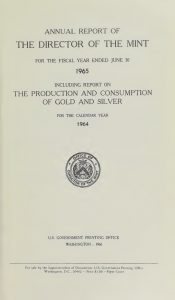
The road to modern coinage began with changes in the laws and policies at the U.S. Mint. The one place that every law and policy announcement documented is in the “Annual Report of the Director of the Mint Fiscal Year June 30, 1965.”
What makes this over 300-page document interesting to read are the details that are no longer present in present-day Annual Reports. The text reprints congressional testimony, reports, announcements, policies, and the laws that affected the U.S. Mint. Since this report covers the last half of calendar year 1964 and the first half of calendar year 1965, it is ideally situated to document the government’s action from silver to clad coinage.
The first numbered page begins with the text of the Coinage Act of 1965.
For those that like charts and data, you can go to page 201 to read the section on “The World’s Monetary Stocks of Gold, Silver, and Coins in 1964.” It is a look at circulating coinage of the entire world for 1964. It is a fascinating view that the U.S. Mint stopped doing in 1972.
Download your copy of this Annual Report → here.
Colonial Currency
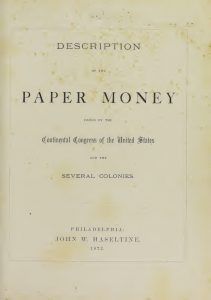 While looking for records about colonial currency, I stumbled on an electronic copy of Description of the Paper Money Issued by the Continental Congress of the United States and the Several Colonies by John W. Haseltine, published in 1872. Haseltine was a dealer, auctioneer, and cataloger of many collectibles, including coins. Many of his catalogs were sparsely illustrated, but the listings have proven invaluable.
Paper Money Issued by the Continental Congress is one of those catalogs. Its contents are nothing more than lists of colonial currency issued in the 18th century. It is a useful reference for anyone with interest in the currency of that era. Download a copy → here.
If you want a colonial currency reference that is more extensive, you can download The Early Paper Money of America by Eric P. Newman → here.
Branch Mints and Gold Coins
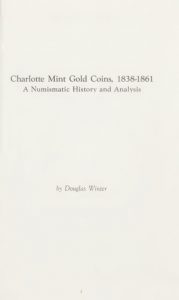 Did you know that the Charlotte Mint was the first branch mint outside of Philadelphia? Authorized in 1835 following the gold strike at the Reed Gold Mine, it became operational in 1838. The Charlotte branch mint was closed when the building was seized in 1861 by the Confederacy during the Civil War.
When I wanted to learn more about the Charlotte Mint, I was pleasantly surprised to discover that Charlotte Mint Gold Coins, 1838-1861 by Douglas Winter is available to read online or to download. The book is an easy read with illustrations, and a catalog of the coins struck at the mint. You can find the book → here.
The branch mint in Dahlonega, Georgia, opened after Charlotte also to mint gold coins from a nearby gold strike. Dahlonega was also seized by the Confederacy in 1861 and did not reopened.
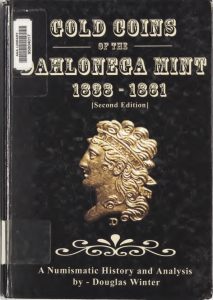 Gold coins minted at Dahlonega carry the “D” mintmark. Since Dahlonega only struck gold coins and gold coins were not struck in Denver, this has not been an issue. To read about the colorful history of this branch mint, read Gold Coins of the Dahlonega Mint 1838-1861, Second Edition, by Douglas Winter. The book is similar in format to Winter’s Charlotte book. You can find this book → here.
Winter did write books about the gold coins struck at the New Orleans and Carson City Mints, but I had not read either book at the time of this writing. These books and more free resources are available through the Newman Numismatic Portal.
Maryland Colony’s First Currency Emission
The Maryland Colony was founded by George Calvert, the First Baron of Baltimore, when he sailed from Newfoundland to Virginia in 1629. Calvert travelled up the Chesapeake Bay and settled in the area now known as Saint Mary’s City. Calvert applied to Charles I for a charter in 1630 but died in April 1632 before receiving it. On June 20, 1632, Charles I granted a charter for the colony to Cecil Calvert, the Second Baron of Baltimore. Charles I declared that the colony would be called Maryland, named for the Queen Consort Henrietta Maria.
In 1727, King George II named Charles Calvert the Fifth Baron of Baltimore. Charles then appointed himself Maryland’s governor in 1732, succeeding his brother, Benedict Calvert. When Charles took office, the colonial treasury was in need of funding. Charles used his political connections in London, he was granted permission to authorize and fund the first emission of bills of credit in the Maryland colony.
Calvert arranged for the printing of notes in England to replace low quality tobacco leaves that were circulating as ad hoc currency. The notes were issued in denominations based on the British pound sterling of 20 shillings: 1/- (one shilling), 1/6 (one shilling 6 pence), 2/6, 5/-, 10/-, 15/-, and 20/-. The first issue consisted of £90,000 in bills of credit that were issued as legal tender for most debts except for fees due to a minister or an officer. Each taxpayer was to be given 30/- in notes in return for burning 150 pounds of tobacco currency. History does not record why colonists were paid to burn tobacco. The notes were to be redeemed in 1748 with profits through Calvert’s investments in Bank of England stock that was purchased from the proceeds of a tax on tobacco exports. The notes were engraved in England and the paper was watermarked “Maryland.” When issued, the notes were hand dated with two signers.
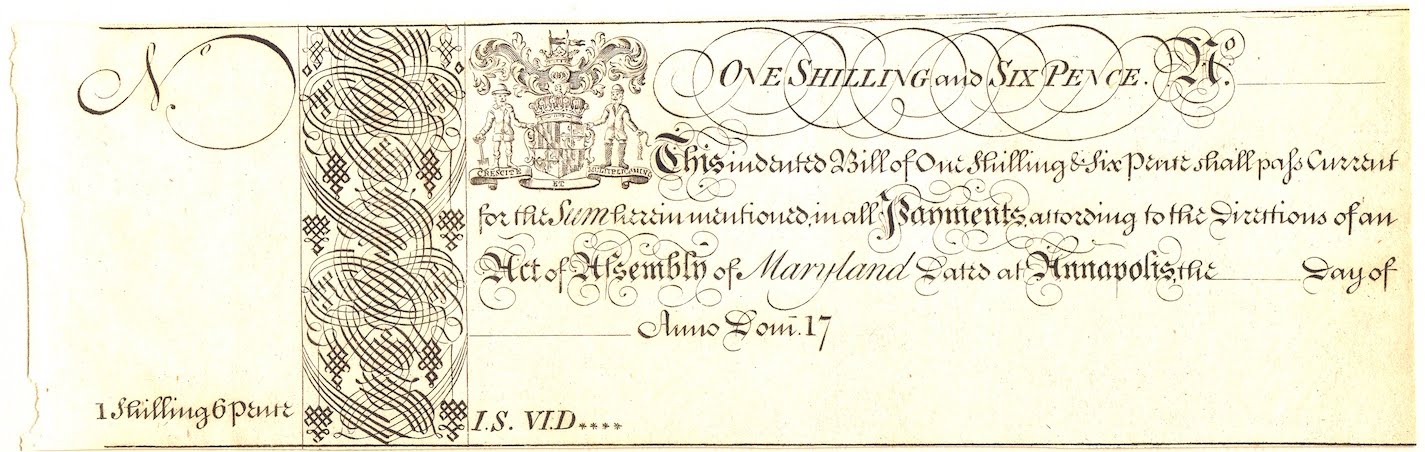
Following that first issue, the Maryland Assembly voted to issue smaller emissions for specific purposes. For example, £5,000 was authorized in 1740 to help support a British expedition to the Spanish West Indies. This emission used the stock of unused notes from the 1733 issue but was signed with the current date. In 1749, the Maryland Assembly issued £60,000 in new notes, printed in England using the same plates as the 1733 emission except that the words “New Bill” were added below the denomination.
During the French and Indian War, the British government expected the affected colonies to contribute men and money. Royal Governor Horatio Sharpe asked the legislature to loan £2,000 to the war effort, to be used as rewards for enemy scalps. This emission used the same notes that were backed by a tax on carriage and wagon wheels, import duties on wine and rum, import duties on slaves, and license fees for peddlers. A further emission of £40,000 was authorized to pay for soldiers and the building of defenses to protect Maryland colonists. To support the loan, the Assembly added taxes to bachelors, billiard tables, legal documents, land, and also import taxes on horses, pitch, tar, and turpentine. An emission of £650 was authorized to help the British government pay gifts to allied native nations who fought in the war and a £3,000 loan to Virginia to help their reparations for the war.
In my new quest to find an example of every emission of Maryland Colonial currency, I was able to purchase an unused 1733 1 shilling 6 pence note from Heritage Auctions (pictured above, reverse is blank). The note is graded Choice About New 58PPQ by PCGS Currency. This beautiful note survived the 1733 and 1740 emissions and were saved by souvenir hunters when the Maryland Assembly began authorizing Jonas Green of Annapolis to print notes for later emissions. I am really having fun searching for Maryland Colonial notes.
"Always Remember"
We learned from President Barack Obama that the Joint Special Operations Command found Osama Bin Laden in a compound outside of Islamabad, Pakistan and killed him during a raid. A grateful nation thanks the members of JSOC for your successful operation and we are glad that none of your members were injured in the process.
 With the death of Osama Bin Laden nearly ten years after the attacks on September 11, 2001, we should remember all of those that died in those attacks on U.S. soil at the World Trade Center, the Pentagon, and Shanksville, Pennsylvania. We should also honor the sacrifices made by the members of the United States military and their families who gave of themselves and lives in the war on terrorism.
As numismatists, we can show our support in many ways. One way is to remember that later this year, the U.S. Mint will issue a silver commemorative medal whose surcharge of $10 per medal will be paid to the National September 11 Memorial & Museum at the World Trade Center to support the operations and maintenance. The bill, National September 11 Memorial & Museum Commemorative Medal Act of 2010, was signed into law on August 6, 2010 (Public Law No. 111-221 [Text] [PDF]) authorizes the production of 2 million one-ounce proof silver medals.
 According to the law, the “design of the medals struck under this Act shall be emblematic of the courage, sacrifice, and strength of those individuals who perished in the terrorist attacks of September 11, 2001, the bravery of those who risked their lives to save others that day, and the endurance, resilience, and hope of those who survived.” Each medal must include the inscription of the years “2001-2011” and “Always Remember.” Medals can only be struck at the U.S. Mint facility at West Point and at Philadelphia.
At last report, the images in this post are those that have been recommended by the U.S. Commission of Fine Arts and the Citizens Coinage Advisory Committee. The U.S. Mint has not announced the whether they accepted the recommendations or when the medals will be available for purchase. Although I am not a medal collector, this is one medal I will purchase!
As for my feelings, I think the great jurist Clarence Darrow summed it up best: “I never wanted to see anybody die, but there are a few obituary notices I have read with pleasure.”
Money Reader For iPhone Is Impressive
Following my review of EyeNote from the Bureau of Engraving and Printing, I was contacted Phillip Yang of Ipplex asking if I wanted to look at LookTel Money Reader. LookTel Money Reader is an iPhone application that performs the same functions as EyeNote, but I found to be even better.
According to the LookTel website, the app was developed by Ipplex under sponsorship from the National Institutes of Health (NIH) and was awarded two research grants from the National Eye Institute (NEI) and the National Institute on Aging (NIA). The app was awarded first place at the 2010 CTIA E-Tech Awards for Mobile Applications in the Healthcare category.
I was given a code from Mr. Yang to download the app for free. I did tell let Mr. Yang know that it receiving the app for free would not influence my review. The code was redeemed, downloaded to my iPhone 4, and started testing.
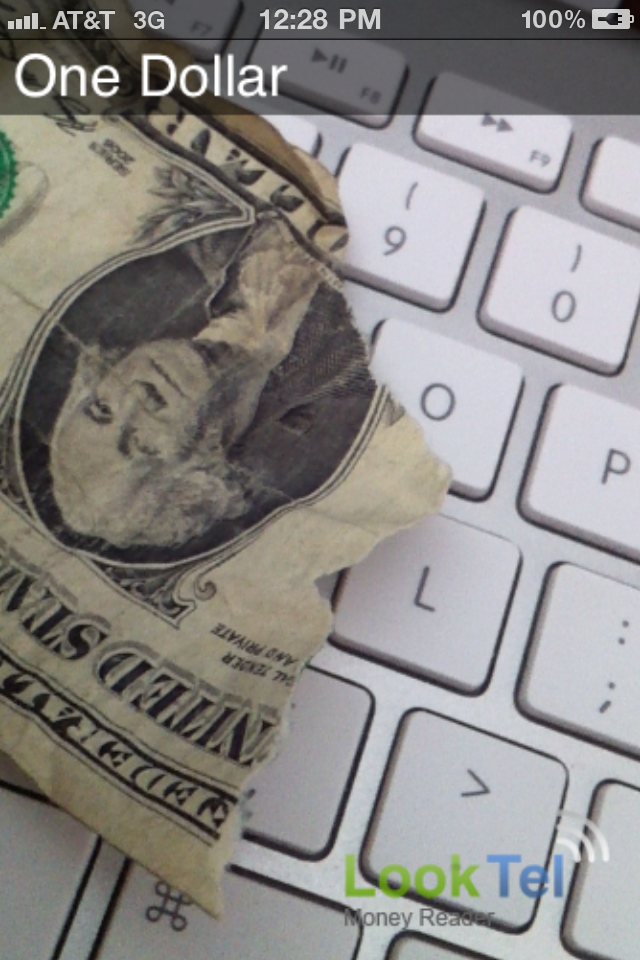 To use Money Reader, you start the app and move the note to be identified in front of the camera—no special positioning or clicking required. First, I grabbed the $1 note that one of my dogs used as a chew toy. Before I was able to situate the iPhone over the note, it caught a piece of it and started to speak, “One Dollar. One Dollar. One Dollar.” While the note is identifiable, Money Reader will speak the denomination until you move the note out of view. I moved the note, turned it over with the same result. The note was turned upside down, folded, moved in sideways, and Money Reader identified the note when about one-sixth of the note covered the screen.
To say I was impressed with Money Reader’s performance would be an understatement. I had to try more. Using the money in my pocket, the app identified each note. It did not matter whether I used the front, back, turned the note upside down, sideways and even crumpled a one dollar note, all were identified.
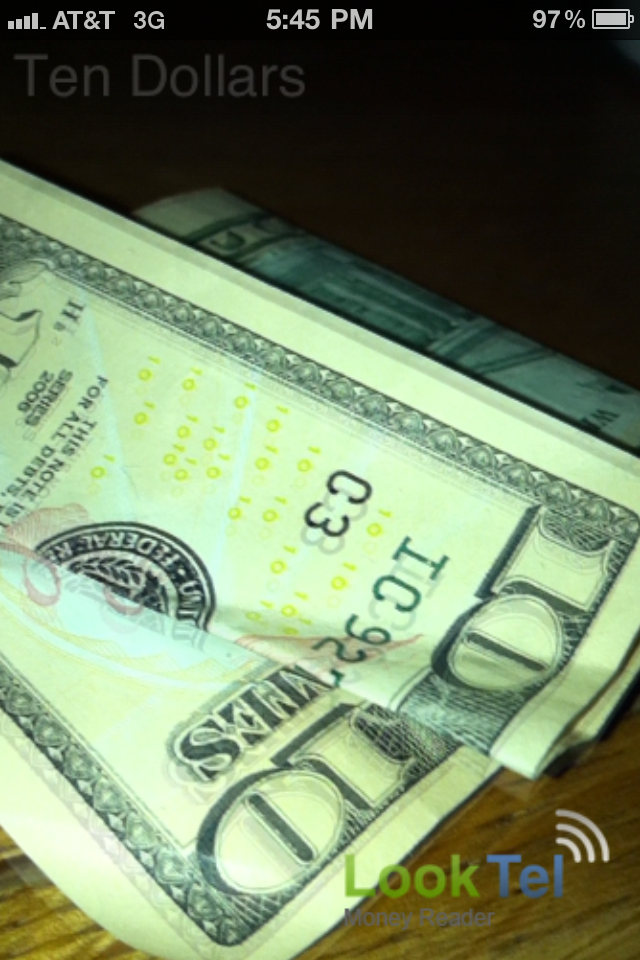 I tried to think about ways to fool the app. Rather than trying to identify a $10 note, I tried folding it to make the “10” look like something else. No matter what I tried, Money Reader identified it as a $10 note. A small pile of notes were also identified. Money Reader was also able to identify the last three generations of small $20 notes and a $2 note with a stamp and postmark from 1976. No matter what I tried to do, I could not confuse Money Reader.
When I started to test Money Reader, it was during the day and the sun was out. The room I was in had the shades open. A few moments later a storm began rolling and and the room darkened. Money Reader was able to continue working after turning on the LED “flash” on the reverse of the iPhone 4. Obviously, this will be a problem for those using the iPhone 3Gs and iPod Touch that does not include the reverse LED.
I tried to identify multiple notes laying on a table or held in my hand. With similar notes, it was difficult to tell which note it was identifying. I used a set of $5 and $1 notes. While flipping the folded notes in my hand, Money Reader would identify the $1 I had just flipped and not the $5 note on top. It would be nice if the app could highlight or somehow indicate which note is being identified. When I made this comment to Mr. Yang, he said this is a planned future enhancement.
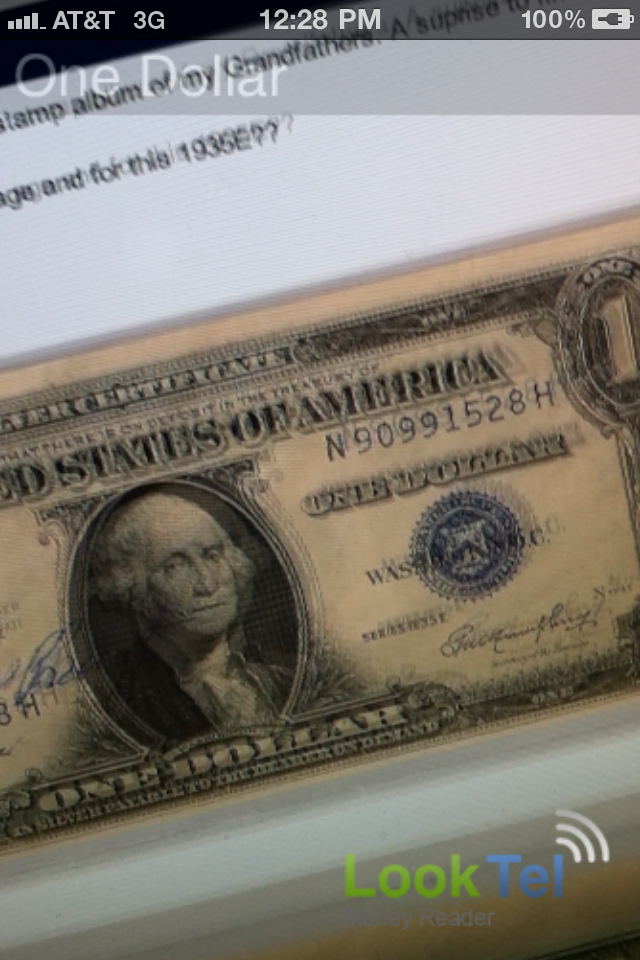 On a whim, I pointed Money Reader at my computer screen with an image of a $1 Silver Certificate. To my surprise, Money Reader identified the blue-sealed note properly!
Money Reader is fast, accurate, and easier to use than EyeNote. It does not need instructions as EyeNote does because it just works. I love apps that just work! I also cannot believe that the app is $1.99—it is worth every cent and more! I grade this app PR69+. As we numismatists know, proof coins are specially made coins with high quality dies and planchets. Money Reader gives the appearance of specially made software of a very high quality justifying the PROOF grade. Money Reader gets the plus rating because of its superior performance and providing the “that’s neat” response. The slight confusion in identifying multiple notes in front of the camera prevents me from giving it a perfect PR70.
Here are the screen images of Money Reader I saved from my iPhone:


I’m Bored
I’m bored with the America The Beautiful Quarters Program.
I’m bored with the commemorative coins that is produced by the U.S. Mint.
I’m bored with soap opera surrounding what U.S. Mint is going to do with the American Eagle coins.
I’m bored with many of the designs that the U.S. Mint has produced while ignoring the best efforts of the Citizens Coinage Advisory Committee and the U.S. Commission of Fine Arts to tell them otherwise.
I’m bored with what is coming out of the U.S. Mint and looking at the interesting collector coins coming out of other mints who are being more innovative with their designs. Where the U.S. Mint has produced one ultra-high relief coin, the Royal Canadian Mint has three high-relief coin designs for 2011.
I’m bored with the themes of the coins coming out of the U.S. Mint. While the Medal of Honor Commemorative is a worthy coin and one of the few good designs to come out of the U.S. Mint, but I am fascinated by what some of the other mints are doing. The Mongolia 2011 500 Tugrog Endangered Wildlife silver commemorative features the Ural Owl struck in high relief with an antique finish and Swarovski Crystal Eyes. This is part of the same series that produced the 2007 Wolverine coin that was named the 2009 Coin of the Year. It also was a high relief coin with an antique finish and Swarovski Crystal eyes. We have great artists in the United States, why can’t the U.S. Mint create coins like this?
Why can’t the U.S. Mint celebrate the history of auto making in the United States the way Tuvalu celebrates Classic Sports Cars or great American motorcycles the same way Somalia did in 2007?
My late mother was a fan of impressionism. She could tell you anything about the artists and the art of that era. One day, I showed here the 2007 Niue Island Van Gogh rectangular silver dollars and thought the design was one of the neatest things she saw. Every time I see on online I am reminded of her interest in a coin when she was not a coin collector. Could we interest others artists if the U.S. Mint created coins honoring American artists? Can you imagine what could be done with Georgia O’Keeffe’s flowers, Andy Warhol’s pop art, or even Louis Comfort Tiffany’s glass designs? These could become popular collectibles and generate significant seignorage for the U.S. Mint.
The reason why the U.S. Mint is behind the rest of the world is because of congress. Congress has taken its power to coin money and has clutched it in such a pedantic manner that it has turned the U.S. Mint into a tired looking organization that is falling behind the rest of the world. Although as a factory for circulating coin, the U.S. Mint produces more coins than any other world mint, they are losing the potential seignorage and artistic prestige to other mints that are producing interesting coins that people want to collect.
There is nothing in the constitution that says the U.S. Mint has to be structured the way it is. All we have is 219 years of “this is the way we wrote the law” that binds the United States to a system that is questioned every few years.
One idea is the model an independent U.S. Mint after the operating model of other world mints. One example that could be adopted is to model a new public corporation after the Royal Canadian Mint. While the RCM is required to produce circulating coinage for the Bank of Canada, they have a little more freedom to produce a portfolio of non-circulating legal tender coins that appears to have a broad appeal. Since many of these NCLT coins are made of precious metals, collectors and investors have been purchasing the RCM’s coins as investments.
As a public corporation, the U.S. Mint would continue to be required to supply circulating coins to the Federal Reserve, maintain the American Eagle Bullion program, and the current commemorative program. As a public corporation, they could add support for additional NCLT coins coins that could compete with other world mints to sell coins with great designs.
I realize that this is a very high-level idea of a new future for the U.S. Mint that requires additional details but it would be a waste of time to pursue this further. Given the personalities in congress who would have to approve such a measure, the chance of this happening is the same as the chance of ending the printing of the one-dollar note.
Colombia Notes Now Include Braille
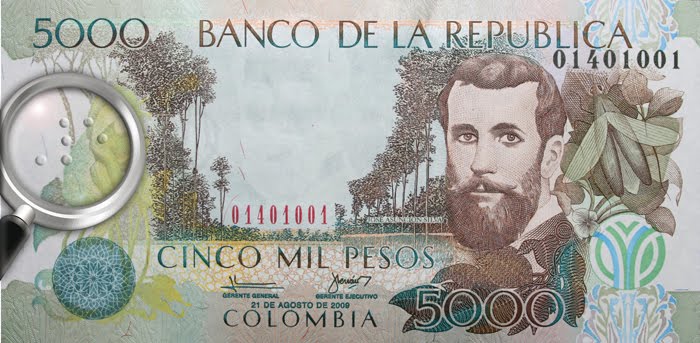 In March, the Banco de la Republica Colombia began circulating new 5,000 peso banknotes with the addition of the number 5 in Braille on the left side of the note. The Braille “5” is the only addition to the note that retains the previous design and security features.
News stories from Colombia report that the COL$50,000 note include the number “50” in Braille in the bottom left next to the serial number. The COL$2,000 note includes the number “2” in Braille in the same location as the new COL$5,000 note.
The Colombian Central bank reports that it will be updating the rest of their banknotes to include the Braille numbers.
Colombian $5,000 note image courtesy of La República
Support the Coin Collectors Blog
 Buy me a coffee
Thank you for your support!
Let Me Know What You Think
Are you going to the World's Fair of Money
Total Voters: 17
 Loading ...