
Why the ANA does not have online education
 On Wednesday, April 8, 2020, the ANA announced the cancellation of the Summer Seminar. The announcement came two days after Colorado College, the site of the Summer Seminar programs, announced limited access to the campus for summer activities because of the novel coronavirus.
As COVID-19 spreads across the United States, most states have a stay-at-home order in place, preventing people from venturing out. Schools, businesses, religious services, and minor medical appointments are meeting online. Services like Zoom and Microsoft Teams that were once the domain of a few companies have dramatically grown.
Colleges started to move to online courses almost 20 years ago. Lower grades followed with classroom software that enabled virtual lessons. Entrepreneurs found a willing market and started to create an online curriculum to help parents home school their students.
The question is that if this is available to colleges, schools, corporate training, and seminars were online, then why the ANA is not able to offer Summer Seminar online?
ANA President Steve Ellsworth killed an attempt to create online education.
In 2017, then ANA President Gary Adkins initiated the proposal to bring online education to the ANA. Although the concept was good, the process was fraught with members of the Board of Governors thinking they knew better than the headquarters staff and the Technology Committee.
The membership does not give the ANA staff enough credit. The ANA is a complicated organization with a constituency from the novice collector to the largest auction houses. Very few organizations have a mission as broad as “numismatics.” Yet, with dwindling resources, the staff in Colorado Springs manage to keep the ANA running. When someone from the headquarters, including the executive director, says something that would make it easier on them, I will pay attention.
The question of, “What do you want?” became a nagging question. Nobody can tell us what they wanted? How can the Technology Committee write requirements for a system that we do not know what it is supposed to do? The direction was supposed to come from the Education Committee. Participation from the Education Committee ranged from non-existent to inconsistent. We tried to get better input, but they did not seem interested.
The Technology Committee came up with something that resembled requirements, questions about what online education systems can do remained. Executive Director Kim Kiick suggested that we send out a Request for Information (RFI) to potential vendors.
As part of the RFI, the ANA requested that the interested vendors come to the 2018 World’s Fair of Money in Philadelphia to demonstrate their system. Three vendors answered the RFI, and three vendors came to Philadelphia to show their systems.
Two of the three demonstrations were informative. These were companies that provide online educational services to schools, training services for companies, and seminar services for many organizations. The third was a smaller company with a limited educational background but more knowledgable about numismatics.
The company with a limited educational background either was not able or chose not to provide a demonstration of their system. Since some members of the Board favored this company, they were given additional opportunities to answer how their system would meet ANA requirements.
For the next four months, there were significant discussions about what to do next. One member of the Board of Governors was pushing to use the company that could not provide satisfactory answers. It appeared as if this Governor had an agenda to have this company do the work rather than finding the right solution.
The cost was a significant concern. Creating any significant technical project has a very high upfront cost. Every aspect of the initial installation, configuration, integration, and initial operations has a higher price than continual maintenance and incremental updates.
Every indication that working with the company that could not provide satisfactory answers to our basic questions was a penny-wise solution. The company would be able to transition some existing software and make it work quickly. Where that decision would have been pound foolish would have come from the recent crisis because the questions that they could not answer would have been key to maintaining the system in this environment.
In other words, for a short-term win, the ANA would have been hit with a significant black eye when the COVID-19 pandemic drove everyone looking for online content. The proposed system may not have been able to scale, it was not mobile device friendly, and the authoring process is too restrictive to move quickly.
By December 2018, the Board agreed to open the process to competitive bidding. I worked with the headquarters staff to draft a Request for Proposal (RFP). The completed rough draft of the RFP was passed around for internal review.
Unfortunately, the process slowed down because of time restrictions for the understaffed headquarters and the volunteer Tech Committee. There was also a slowdown following the 2019 Board of Governors’ election. After the election, there was little guidance as to how the new president and Board wanted to proceed. The impression was that the new Board did not want to move forward.
The new Board of Governors took control at the 2019 World’s Fair of Money. Instantly everything stopped. Standing committees, whose members are appointed by the president, were left in limbo. There was little communication from President Steve Ellsworth, and nobody was sure what to do next.
It took over a month to hear from Ellsworth. Few people who were talking behind the scenes heard anything. It was known he wanted to make changes, but he was not communicating with anyone who would be impacted.
The silence was curious. The ANA announced the results in early July, and the World’s Fair of Money was four weeks later. Ellsworth was already a member of the Board and knew his way around. Why did he not have a transition? Instead, everything stopped for one month.
In early September, Ellsworth sent his guidelines for the Technology Committee. Missing from his objectives was online education. Regardless of the time and effort that occurred before the World’s Fair of Money, ANA President Steve Ellsworth eliminated the online education program.
According to his goals, it was to be replaced by an e-commerce system to sell goods from the ANA Shop in Colorado Springs.
Which is more important, the American Numismatic Association, a federally chartered organization to provide numismatic education, creating an educational initiative, or selling trinkets from the store? I will leave that as an exercise to the reader.
Will Virginia Coin Its Own Money
I am not one who looks at our current monetary system and believes that changes must revert back to a standard based on precious metals. I understand that such a standard requires government intervention by controlling the prices of the metals in order to create a monetary standard that does not allow for growth and expansion. History shows that the attempt to control the prices of precious metals while trying to maintain economic growth has not worked. We can look at the Coin Act of 1873, also known as the Crime of 1873, for manipulating silver out of the monetary system and creating a series of recessions and depressions because of the lack of real growth.
On the other end, taking the U.S. off the gold standard in 1933 was the first step in expansion of the U.S. economy. The final step in economic growth was fully breaking the dollar’s tie to gold while allowing the price of gold and the U.S. dollar to trade freely on open markets. Even though the United States experienced a concept call stagflation in the 1970s, the strength of the U.S. dollar was growing around the world. It was during this time that many economies were basing their own currencies on dollars to where some countries use dollars instead of their local currency.
After many years of seeing the dollar take over economies all over the world, the European Union joined to form a common currency in order to offer an alternative to the U.S. dollar. When the Euro was launched in 1999, the two European economic powers went in different directions. Germany, which has a significant manufacturing and technology base, joined the Euro while Great Britain, worrying about its sovereignty because it could not control its currency, kept its currency based on the Pound. Today, the Euro is having problems with the economic programs throughout Europe (Greece, Ireland, and Portugal with Spain not far behind) and Great Britain able to weather their own storm, albeit not without protest. Talk about replacing the Dollar with the Euro as the benchmark currency have subsided.
The issue of sovereignty becomes an interesting question with a joint resolution introduced to the Virginia House of Delegates. House Joint Resolution No. 557, introduced by Del. Bob Marshall (R-Manassas 13th district), to “[Establish] a joint subcommittee to study whether the Commonwealth should adopt a currency to serve as an alternative to the currency distributed by the Federal Reserve System in the event of a major breakdown of the Federal Reserve System.”
As with many bills on both the federal and state level, the bill begins with paragraphs what begin “Whereas….” For this joint resolution, it claims authority by cherry picking rulings from 19th century rulings made during the height of the Robber Barron era before the introduction of the various Anti-Trust Acts to justify the assumptions. They also cherry pick statements from the United States Code (U.S.C.) that take the statements out of context in order to pervert their meanings.
The “Whereas…” section also claims that “many widely recognized experts predict the inevitable destruction of the Federal Reserve System&rsuqo;s currency through hyperinflation in the foreseeable future.” Who are these experts?
If the resolution passes, it directs that a joint committee will be created to study whether the Treasurer of the Commonwealth of Virginia and the Bureau of Financial Institutions can and should coin its own money for use within the Commonwealth should the Federal Reserve or other sources collapse. The committee is supposed to report its findings by the first day of the 2012 Regular Session of the General Assembly.
After living in the Washington, DC area for almost 20 years and having jobs that worked with the federal government, I have seen my share of wingnuts from both sides of the aisle. But I have come to learn that the extremes on either side is aptly described as extreme. The extreme nature of this resolution ignores Article I, Section 10 of the U.S. Constitution that says “No State shall… coin Money.”
While the Federal Reserve and the U.S. Mint has its issues regarding the policies of the manufacture and distribution of money (remember the Bureau of Engraving and Printing prints the currency), proposing to violate the constitution is unconscionable. Besides, if it ever gets to the point that the Federal Reserve fails, Virginia coining their own money may be the least of our problems.
Looking Back at 2010 to Look Forward for 2011
Many things can be said about 2010, but for numismatics and precious metals it was quite a ride. What could this ride tell us about 2011?
Looking at the economy, the real gross domestic product—the output of goods and services produced by labor and property located in the United States—increased at an annual rate of 2.6 percent in the third quarter of 2010. A rate greater than in 2009. Although real disposable personal income increased 0.2 percent through November, the consumer price index rose at a faster rate of 1.1-percent while unemployment reached a one-year high of 9.8 percent in November.
If the slow improving economy and expanding unemployment has you confused, the simple explanation is that if the economy was a bus, it just pulled away from the curb and the driver started to shift into second gear while employment has yet to be allowed aboard. Although economists agree that employment and Consumer Confidence Index are lagging indicators, neither have seen improvement in 2010. Although the politicians are hoping their lame duck legislative efforts will help the unemployed to board the employment bus, it is possible that the bus will be too far down the road to make a difference in 2011. Let’s hope it is not too late!
In an attempt to provide its version of stimulus in 2010, the Federal Reserve’s lowered its discount rates and its ability to manipulate the money supply to try to provide relief. Although the Fed has increased the money supply, the United States dollar has not been significantly weakened against most of the world currencies—although some would say that it was seriously weakened in 2009. While the dollar has fluctuated against other major currencies throughout the year, the dollar has shown marginal only weakness against the British Pound, Euro, and Yen year-over-year while there were no weaknesses against the Reniminbi (or Yuan) because of institutionalized currency manipulation in China. Many economists believe that the avoidance of a dollar free-fall was because of the failure and pending failure of some Eurozone economies and China’s desire to reduce its own inflation concerns. The rumblings to remove the dollar as the standard and benchmark currency that we heard in 2009 subsided in 2010.
To measure the effect of the economy on the numismatic markets, I use the PCGS3000® Index as an indicator. The PCGS3000 Index is a market basket of 3,000 coins that PCGS their analysts believe represents the broad market. The variety of coins makes for a good indicator but as a broad market basket, movement indicates trends rather than a real-time indicator (similar to the Russell 2000).

The PCGS3000 Index opened 2010 with at 68,476.87. After dropping to a 12-month low of 66,886.27 (↓2.3-percent) in August, the index closed at 67,323.11, down ↓1.68-percent for the year. For a market basket that consists of 3,000 non-volatile items made from a variety of metals an in different grades, a downward trend of one-to-two percentage points indicates a weakness in the numismatic market. While some think the markets are strong—and there has been no slow down in the high-end coin market—collectors and some investors are either pushing prices downward or waiting for prices to drop before buying. Like in retail sales, many purchasers are standing on the sidelines waiting for the bargains or the market to settle.
But if the economic indicators do not show weaknesses except in employment, then why should the numismatic market show a weakness? The answer can be summed up in two words: gold and silver.

Some dealers and auction houses have found that the buyers for the high-end coins have continued their strong buying but the rest of the market has not joined them. One of the factors can be that the price of gold has scared many people away. When the markets opened on January 4, 2010, the price was $1,087.50 for one troy ounce of gold. During the year, the price never dipped below $1,050 climbing to $1,420 on December 7 before closing at $1,405.50 on December 30. As a result, investors who bought gold prior to 2010 saw their investment to rise 29.2 during the year. One would think it makes sense that the generic gold coin market would rise with the gold market. But a look at the PCGS Generic Gold Coin Index found that even with gold’s rise through the year, the generic gold coin market also saw a 17.76-percent drop in prices. However, Proof Gold rose only four-tenths of one-percent (0.41%) showing that there continued to be a little activity in the high-end market.

If there was a bull market in 2010 they were running for silver. After opening the year at $16.99 per troy ounce, silver closed at $30.63—a whopping 80.4-percent increase! Although less than the $54 ($143 adjusted for inflation in 2010 dollars) that it reached when the Hunt Brothers tried to corner the silver market in 1980, the 2010 rise is significant because few believe that the markets are being manipulated. In fact, one analyst believes that the silver market is undervalued as compared to the gold market. He said, “The gold rush of the 2000s is going to be nothing [compared] to the silver rush of the 2010s.”
When looking at the numismatics market, silver is the key metal. Up until 1964, every dime, quarter, half-dollar, and non-gold dollars were made of silver. Silver has been a key coining metal since the creation of the United States Mint in 1792. Many of the most collectible coin ever created by the U.S. Mint were struck in silver. Nothing represents silver coins like Morgan and Peace Dollars. Arguably one of the most popular numismatic collectibles, Morgan and Peace dollars are 26.73 grams made of 90-percent silver and 10-percent copper making its melt value $23.03 at the end of 2010.
But the value of Morgan and Peace dollars extend beyond their melt value. Morgan and Peace dollars are tied to the late 19th and early 20th century history of silver manipulation in the United States with designs popular with collectors. Morgan dollars struct at the Carson City mint are amongst the most desired. Since the GSA sales in the 1970s, the prices of these coins have gone up—in some cases beyond the reach of the average collector. Of the Peace dollar series, the high-relief 1921-D dollar is very desirable as is the low mintage 1928 dollar, and the 1935 last year of issue dollars. And the rumor that not all of the 1964-D Peace dollars were melted makes finding out the absolute truth a great interest to the numismatic world. However, with the rest of the market trending downward and silver skyrocketing, the PCGS3000 Morgan and Peace Dollar Index found the market rise-then-fall-then-rise again to end the year up eight-tenths of one-percent (0.825-percent) for 2010. Not a great showing, but demonstrating that Morgan and Peace dollars are still popular amongst collectors.
What is clear is that the coin market was down in 2010 while investors and even some collectors might have been concentrating on gold and silver bullion.
In speaking with some dealers, many have said that they have survived the last two years buying and selling bullion including American Eagle coins. One said that the numismatic market has been very slow that the bullion market has allowed him to stay in business during this era being dubbed “The Great Recession.”
Just because the calendar turns does not mean the market will turn along with it. Even though the lame duck congress passed significant stimulus legislation, it will take some time for those measures to settle into the markets. Some experts think that the eventual hiring may not occur for at least six monist and that there will not be a significant drop in unemployment until the fall. Others point to the infrastructure project the new laws are supposed to support forgetting that even shovel-ready projects have legal requirements, such as contract and environmental restrictions, that have to be address before a shovel can be used. In short, we may be in for more of the same through the first and even second quarters of 2011.
The new congress will help keep the economic uncertainty alive. Although the Republicans will control the House of Representatives, the Senate will be controlled by the Democrats with an active Republican minority who has shown that they will use the body’s rules to try to force their will. In other words, prepare for gridlock. None of this takes into consideration that Rep. Ron Paul (R-TX) will be the chairman of the House Finance Committee, thus allowing him to have control over economic policy in the House!
Neither the lame duck stimulus or the new congress will do anything to settle the markets in the short term. With the uncertainty, investors will continue hedge their bets using precious metals. Gold will continue to rise but at a rate less than in 2010. It is fair to say that with the current valuation being so high, it is likely that 2011 will end with gold only rising by 20-percent. However, the argument that the gold-to-silver ratio is out of balance being very compelling, we may see silver continue to climb. Silver may not climb at the 80-percent rate we saw in 2010, but a 40-percent rate may be reasonable. If this holds true, this time next year we could be talking about gold being $1,680 per troy ounce and silver closing at $42.
During the Fall of 2010, the PCGS3000 Index rose a bit from its low for the year and the low since the index’s all-time high in 2008. But with other factors not changing in the short term, could this be the coin market’s version of a “dead cat bounce?” A dead cat bounce is a small yet brief market recovery derived from the idea that “even a dead cat will bounce if it falls from a great height.” It is more likely that the numismatic market will flatten a bit while the rest of the markets figure out which direction they will go.
The first indication of how the numismatic market starts the year will be at the F.U.N. Show held January 4-9 in Tampa, Florida. With F.U.N. being one of the largest non-ANA shows of the year, sales and dealer impressions will set the tone for at least the next few months. Under the premise that markets do not turnaround quickly and that the last major show, Whitman Baltimore Expo in November, saw only nominal sales, one can assume a similar atmosphere for F.U.N. It will be more reasonable to wait until the National Money Show March 17-19 in Sacramento and the Whitman Baltimore Expo held March 31-April 3 to determine if the numismatic market will be better in 2011. At the end of the year, it is reasonable to expect that the PCGS3000 Index will be up 2.5-percent by the end of 2011 given the other market forces.
Of course predicting any market is a total crap shoot. While my roll of the dice may be no better than others, I would caution against thinking that my crystal ball is clearer than anyone else’s. All I have done is read the proverbial tea leaves and drank the tea while throwing darts at the wall trying to guess what the future will bring. Or as one comedian used to say, “That’s my opinion, I could be wrong.”
Metals charts courtesy of Kitco.
The PCGS300® Index courtesy of the Professional Coin Grading Service.
Happy 2011!
As we begin 2011, we should look forward to better times for our hobby, our nation, and our world. I wish you and yours a Happy and Healthy 2010 and hope that you find the key coin of your dreams!
Silver Is Still Beautiful—Britannia Edition
Silver can bring out the best in nearly every design. Another silver coin worth collecting is the Britannia. After joining the United States and other countries to offer gold bullion coins in 1987, the Royal Mint celebrated the tenth anniversary of their program by introducing a £2 silver coin. Silver Britannias are struck in what is called Britannia silver, an alloy consisting of 958 parts per thousand silver. As a comparison, sterling silver consists of 925 parts per thousand silver. Comparatively, the American Silver Eagle contains 999 parts per thousand silver and the Canadian Maple Leaf consists of 999.9 parts per thousand silver. The balance of the alloy is usually copper.
Britannia was originally the Latin name that the Roman Empire gave to the island of Great Britain and its possessions. After the fall of the Roman Empire it had lost most symbolic meaning until the rise of British influence and being renewed during the time of Queen Victoria. Still depicted as a young woman with brown or golden hair, she kept her Corinthian helmet and her white robes, but now she held Poseidon’s three-pronged trident and often stood in the ocean, representing British naval power. She also usually held or stood beside a Greek hoplon shield which sports the British Union Jack. At her feet was often the British Lion, the national animal of England. Britannia first appeared on the farthing in 1672, followed by the halfpenny later the same year under Charles II.
When introduced in 1997, the Silver Britannia was minted with the official “hid Portrait” of HM Queen Elizabeth II on the obverse. This portrait was designed by Raphael Maklouf FRSA and shows the Queen with the Royal Diadem which she wears on her way to and from the State Opening of Parliament. The fourth official portrait of Her Majesty the Queen was introduced for all Commonwealth coinage in 1998. It is the work of sculptor Ian Rank-Broadley FRBS, FSNAD. Her Majesty is wearing the tiara which was used in an earlier coinage portrait by Arnold Machin. The Queen is shown facing right, in accordance with a tradition dating back to the seventeenth century, where successive monarchs face in alternative directions on the coinage.
From their introduction in 1987, the gold Britannia coins used the standing Britannia design on the reverse. On the tenth anniversary of the program and the introduction of the silver Britannia, a new deisign was created. The design was a figure of Britannia driving a chariot in the manner of Boudica was designed by Philip Nathan. Boudica, also know as Boadicea, was ruler of the Iceni tribe in eastern England and Queen of the Britons. She led her forces in revolt against the Romans and sacked Colchester, St. Albans, and London before being defeated by the Roman governor, Suetonius Paulinus. She died in the year 62 CE. This design was used in 1997, 1999, and 2006.
Following the successful launch of the silver Britannia coins, the Royal Mint returned to the standing Britannia design. Created by Philip Nathan, Britannia is depicted adorned in flowing robes standing proud in defense of Britain’s shores. The design recalls the design used on florins of Edward VII. this design also appeared in 2000, 2002, 2004, and 2006.
 With a few other designs mixed in, the 2010 is also a single year design designed by Suzie Amit who said that she wanted to portray Britannia as a strong and courageous looking but not overly warlike woman—more peaceful and protective. The coin is struck with shiny surfaces without contrast from frosted designs. Unfortunately, it made it difficult to image. Although this image does not capture its beauty, it is a very nice design and worthy of completing my one ounce Silver Britannia collection.
American Silver Eagles, Chinese Pandas, and Great Britain Britannias are not only beautiful silver coins, but make a nice set to collect. Even with silver prices on the rise, they do make nice sets.
Silver Is Beautiful
Some have called silver the investment vehicle for the masses. Even with the price rises, silver remains more affordable than gold and is more accessible than gold. Looking at the U.S. Mint product line, the consumer has more silver options than gold. At some point, the U.S. Mint will actually sell the American the Beautiful silver bullion coins that seems to have garnered a lot of attention.
Silver has a long history as being the most popular metals for coins. From Ancient Rome to the Spanish Pillar Dollars that became the basis of United States currency, silver has been the plentiful and desirable metal used for coinage. Once silver became the base metal of choice, the United States spent over 100 years manipulating the composition of coins and silver prices in an effort to support silver mining concerns of favored members of congress.
I like silver coins. Silver has a silky color that allows for striking designs to be very visible. Because silver is less dense than gold, a one ounce coin made from silver are larger than gold. For example, most gold bullion coins are around 28 mm while silver coins average 38-40 mm (the Canadian Maple Leaf is 38 mm). It translates to more surface area for beautiful designs.
I collect a few silver bullion coins. Aside from the American Silver Eagle in proof and bullion versions, I also collect Canadian Maple Leafs, British Britannias, and China Silver Pandas. Silver Pandas are very interesting. China has been minting the Panda Bullion coin since 1983. The obverse features a panda in various images in its environment. Every year (except 2002) features a different panda image depicted in its natural environment. The reverse is The Hall of Prayer for Abundant Harvests in the Temple of Heaven. There have been four versions of this design (1983-1991, 1992-1999, 2000, 2001-present).
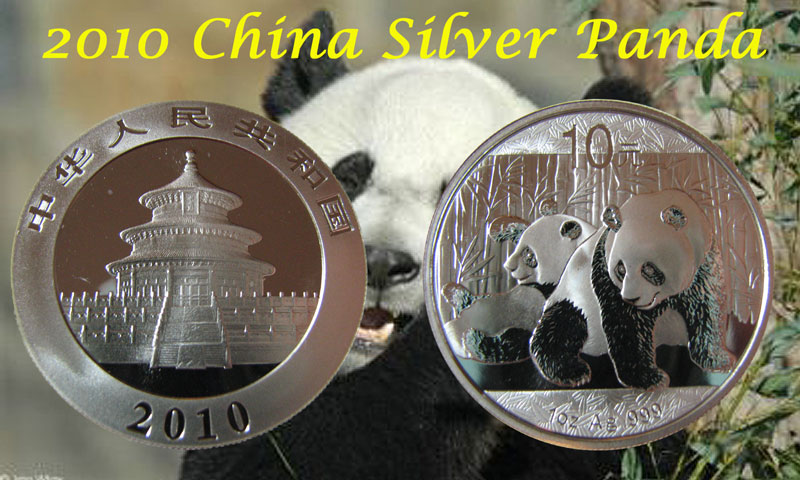 There have been three generations of Pandas and a single “different” issue. Generations are based on content and changes in design. The claim is that 2010 is the last year of the current generation since there may be a slight change in the works along with a significant increase in production. The People’s Bank, which governs the creation of coins in China, is planning for a 10-fold increase in production. It is conjectured that since the price of silver is so high that the premium they charge because of the popular designs can bring in more revenue. It is uncertain whether this will be a successful strategy because those who studied microeconomics will tell you that an increased supply without an increased demand will push the prices downward. The U.S. Mint discovered this a few years ago and reduced the number of products offered.
With the new information, one source, the generations have been described as:
| Generation | Weight | Content | Size |
|---|---|---|---|
| First Silver Panda Coins (1983-1985) | 27g | .900 fine | 38.6 mm |
| Sterling Silver Panda (1987) one year issue |
1 troy oz | .925 fine | 40 mm |
| Second Generation (1988-1999) | 1 troy oz | .999 fine | 40 mm |
| Third Generation (2000-2010) Change in artists |
1 troy oz | .999 fine | 40 mm |
| Fourth Generation | Projected for 2011: 10x increased production | ||
Recently, I picked up the 2010 Panda to keep my Third Generation collection complete. The Third Generation Panda designs are distinctive in being more realistic than previous designs with fine details as part of the design. Gone are the cartoon-like panda figures allowing this generation of panda designs to appeal to a wider audience. These are wonderful designs and something that shows off very well on the 40 mm silver planchet.
Support the Coin Collectors Blog
 Buy me a coffee
Thank you for your support!
Let Me Know What You Think
Are you going to the World's Fair of Money
Total Voters: 17
 Loading ...