
Weekly World Numismatic News for February 23, 2020
Aussie coin collectors are scouring through their change, looking for a Mule Dollar.
A woman from Melbourne found an Australian dollar coin where the obverse was different from the others. The lettering and portrait were smaller and had a doubled rim. The story went viral on social media.
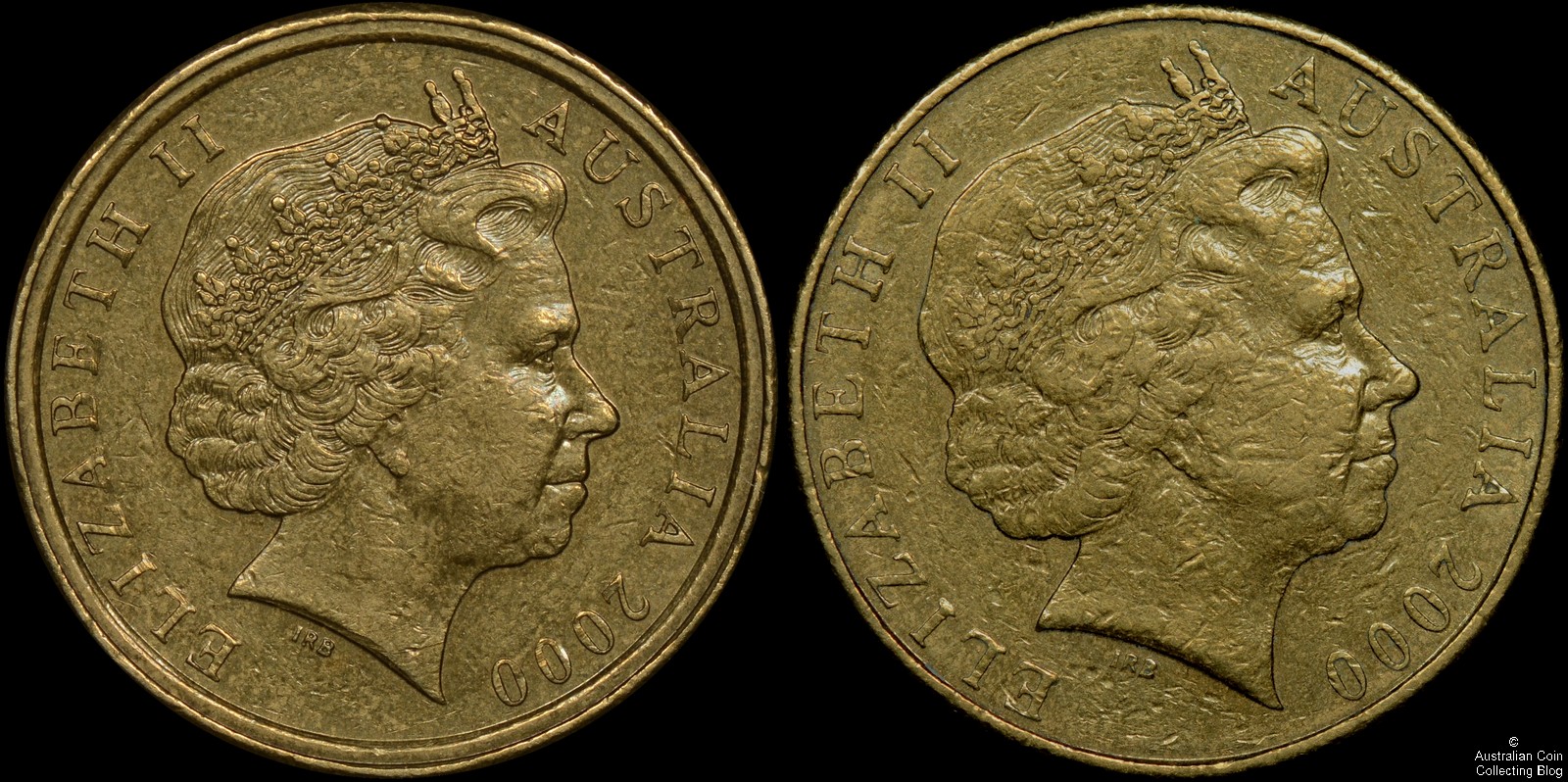
Comparing the $1 mule on the left to a regular $1 coin on the right
(Image courtesy of the Australian Coin Blog)
The mule was first discovered in 2003, according to the Australian Coin Blog. Known as the “2000 $1 / 10 cent Mules,” the coins were sent to Perth for use in the casinos. At the time, the collectors and other interested people withdrew thousands of dollar coins from casinos and banks looking for the coin.
Australian coin experts suspect that the error occurred when someone accidentally installed the wrong obverse die into the coin press. Rather than using the die to strike the 25 mm dollar coin, the die that should strike the 23.6 10 cents coin was used. The 1.4 mm difference gives the impression of a doubled edge on the coin.
There are no statistics as to how many of these coins are in circulation. Considering they keep appearing every few years, the discovery causes a frenzy, especially amongst casual observers. It would be like someone finding an “extra leaf” Wisconsin quarter.
And now the news…
 February 17, 2020
 → Read more at eastbaytimes.com
February 18, 2020 → Read more at rnz.co.nz
February 21, 2020 → Read more at dw.com
February 21, 2020 → Read more at news.justcollecting.com
February 21, 2020 → Read more at dailymail.co.uk
February 21, 2020 → Read more at houstonchronicle.com
→ Read more at eastbaytimes.com
February 18, 2020 → Read more at rnz.co.nz
February 21, 2020 → Read more at dw.com
February 21, 2020 → Read more at news.justcollecting.com
February 21, 2020 → Read more at dailymail.co.uk
February 21, 2020 → Read more at houstonchronicle.com
Week of New Money
In what has the potential to be an exciting week in numismatics, the US Mint and the Bureau of Engraving and Printing will be introducing newly designed money to the public.
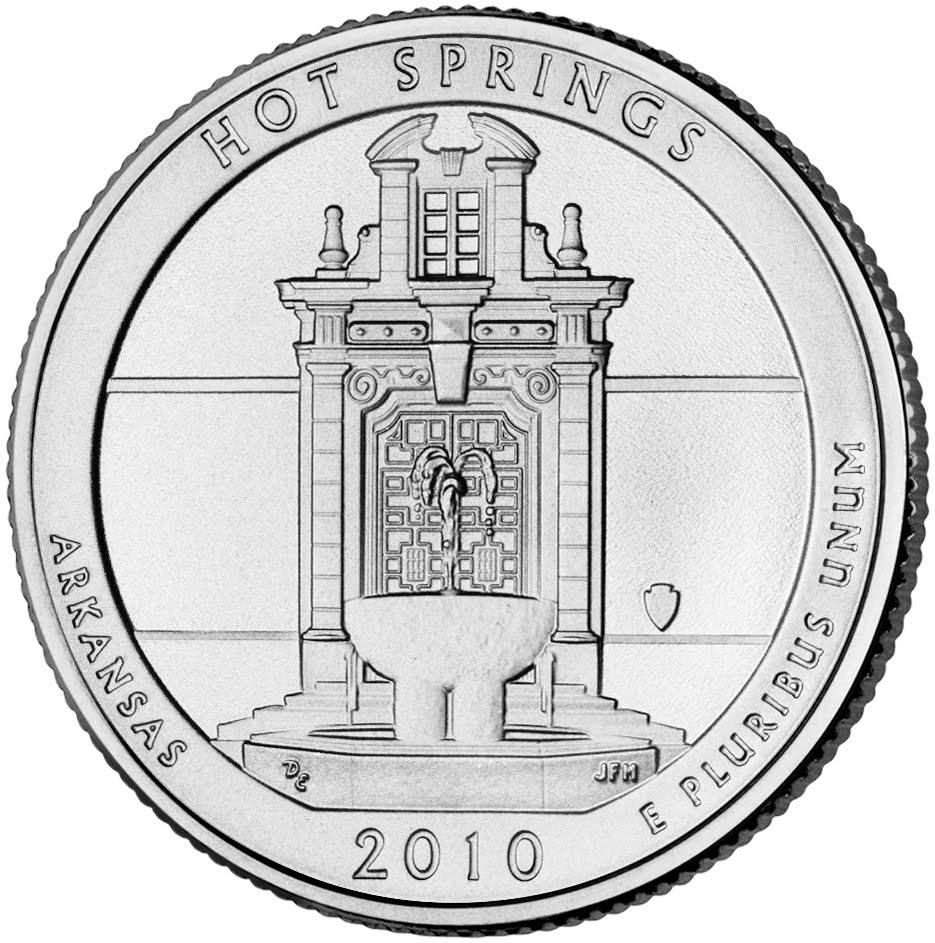 As part of the 2010 National Coin Week, on April 20, the U.S. Mint will launch the America the Beautiful Quarters™ Program with the release of the Hot Springs National Park Quarter. The ceremony will take place on the park’s 178th anniversary in front of the Administration Building at 10 A.M. Central Time (CT). A coin exchange will follow the event. The ceremony will be broadcast live on the web at americathebeautifulquarters.gov beginning at 9:55 A.M. (CT).
The United States Mint will hold a Coin Forum on Monday evening, April 19, at 5 P.M. (CT) at the Quapaw Bath House. The Coin Forum is an opportunity for the public to express their views about future coinage, and to learn about upcoming United States Mint coin programs and initiatives.
As part of the promotion for the launch, the US Mint has released B-Roll with images of the site, design footage showing the computer design of the coin, production footage including creating of the dies, and striking of the quarters.
 Then, on April 21 in the Treasury Cash Room, the Bureau of Engraving and Printing will unveil a newly designed $100 Note. The U.S. government redesigns currency in order to stay ahead of counterfeiters and protect the public. The BEP has not previewed the new design.
The unveiling of the $100 note is the first step in a global multi-government agency public education program implemented by the Department of the Treasury, the Federal Reserve Board and the U.S. Secret Service, to educate those who use the $100 note about its changes before it begins circulating. The $100 note is the highest value denomination of U.S. currency in general circulation, and it circulates broadly around the world.
Program will begin at 10 A.M. Eastern Time (ET) and will include Secretary of the Treasury Timothy Geithner, Chairman of the Board of Governors of the Federal Reserve System Ben Bernanke, Treasurer of the United States Rosie Rios, Director of the United States Secret Service Mark Sullivan. Education and media materials, including the B-roll, will be available at www.newmoney.gov.
Hot Springs Quarter courtesy of the US Mint
Cash Room images courtesy of the US Department of the Treasury
Call for Action!
The Ancient Coin Collectors Guild (ACCG) issued a press release calling for action by all collectors to petition the U.S. State Department’s Cultural Property Advisory Committee (CPAC) to not include ancient coins with the Memorandum of Understanding (MOU) with Italy that will claim them as State cultural heritage.
The State Department issued a Notice of Meeting of the Cultural Property Advisory Committee announcing that they will meet in open session on May 6, 2010 starting at 9:30 A.M. to discuss the Italy’s request to expand the MOU. Anyone wishing to attend the meeting must reserve a seat by calling (202) 632-6301 by April 22, 2010, 5:00 P.M. Eastern Time.
Anyone wishing to address the committee or provide written testimony must submit their comments in writing to the committee by faxing it to (202) 632-6300 for statements 5 pages or less. Those more than 5 pages must be mailed with 20 duplicates to Cultural Heritage Center, SA-5, Fifth Floor, Department of State, Washington, DC 20522-0505.
This is where you can help. ACCG is asking for collectors to send letters to the CPAC to oppose adding ancient coins that may be considered “Italian” (e.g., ancient Rome). Such a rule would make almost all Roman and early Greek coins contraband, even if they entered the U.S. from other countries without documentation. Have you ever walked the bourse floor and seen piles of ancient coins in trays on dealers’ tables? These coins have been sold around the world for hundreds of years and not part of any antiquities collections belonging in a state collection.
With one ruling, the CPAC can seriously damage the hobby for everyone. Yes, EVERYONE! It may start with Italy, but where does it stop? Will Canada come after my collection of Canadian coins? What about the 1912 Russian banknotes my relatives brought with them when they landed at Ellis Island? Once this snowball begins to roll downhill, what is to prevent congress from declaring pattern coins as contraband? It reminds me of a numismatic version of the “First they came…” attributed Pastor Martin Niemöller about the inactivity of German intellectuals following the Nazi rise to power and the purging of their chosen targets.
ACCG will help you contact the CPAC using their free fax service at www.vcoins.com/fax.
If you need help constructing a letter, the fax service has suggested text. If you want something a little different, the following is what I sent:
Chair, Cultural Property Advisory Committee
United States Department of State
Annex 5
2200 C Street, NW
Washington, DC 20522-0505
Dear Ms. Reid:
I am a collector of historical coins and want to see that US collectors retain the same rights as collectors in the EU, where restrictions on the transfer of historical coins between EU countries are specifically forbidden. Please do not allow the rights of US citizens to be further infringed.
I have been advised by the Directors of the Ancient Coin Collectors Guild that renewal of the Memorandum of Understanding with Italy pertaining to importation of cultural property from Italy is being considered on May 6-7, 2010. Based on comments made during the recent interim hearing, it seems likely that a request will be made and considered to remove the exemption currently in place for ancient coins.
Coins of a type produced at mints in Italy during antiquity literally circulated throughout the known western world at that time as a result of the reach of the empires that occupied the land. Coins from these eras have been found from Britain to India as the empires grew. Because of this wide circulation, it is impossible to determine whether these coins came from Italy or were used in other areas of the those empires. For example, a hoard of copper Roman coins were found in Cardiff, Whales by someone searching with a metal detector in 2007. By removing the exemption currently in place for ancient coins, U.S. collectors would not be able to add any of this hoard to their collections.
The ACCG, the Numismatic Trade and the wider numismatic community have all presented, and will present, a wealth of justification for retaining the current exemption. This would allow Americans to continue to enjoy preserving, studying and displaying coins just like their fellow collectors in Italy and the rest of the European Union. I support the position of these organizations and oppose any attempt to restrict the importation of coins under the terms of this MOU.
Respectfully yours,
Scott Barman
I adopted this note from ACCG’s suggested text and the first paragraph is provided by ACCG from a form that was based on an answer I provided on the second page of the process.
Please help now! The ACCG has made it easy. Even if you use their suggested text or mine, act now. And when you are done, consider giving ACCG a donation to help with their effort. I did!
PCGS Photograde Raises the Bar
Professional Coin Grading Service keeps upping the ante on their PCGS Photograde service. In its latest release, PCGS has added more coin images, new series (e.g., Half Cents, Large Cents, and Half Dimes), and more coin imagess in lower grades. PCGS boasts that there are 1,450 images for Photograde covering almost all coin series. As part of the website service, PCGS now includes their Guidelines for Eye Appeal that includes images to supplement the text.
With the upgrades includes upgrades for the PCGS Photograde for the iPhone app and PCGS Photograde HD for Apple’s new iPad. Since I do not own an iPad (I rarely buy the first release of any product), my review is only for the iPhone app and the website.
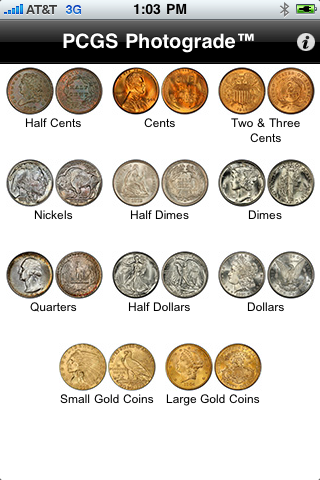 The first thing we find when starting the Photograde app is that it does not put the iPhone in landscape mode. In fact, the entire application will work in portrait or in landscape mode. While a this may sound like a trivial change, iPhone users will tell you that being able to control the how the app is viewed can make the difference between being useful and a nice-to-have app. Being able to be used in portrait mode means I can just hold the iPhone without having to reposition while I use the image to compare with the coin I am looking at. This subtle change is a big plus for this app.
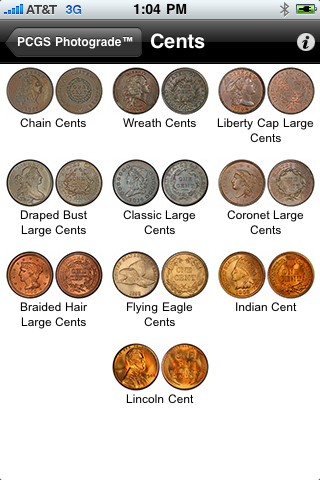 Added to the application were images for half cents and large cents with great images of the coins in the various grades. Even if I will never own a Chain Cent, it is nice to have a clear picture of one to carry around while I walk the bourse floor. Half Cent collectors will also benefit for the adding of those coins. Like all of the other series, the images are clear and can be magnified on the iPhone using pinch motions.
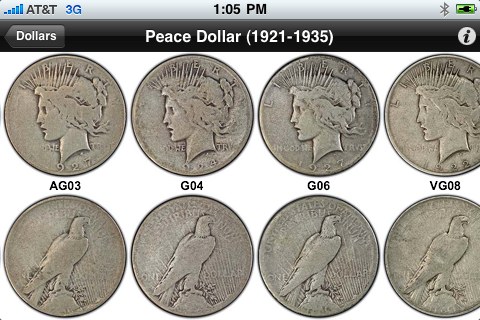 Another nice addition is more coins in lower grades, even for a series like the Jefferson Nickels.. Those who collect coins in lower grades can now determine what the grade of their coin is. Those of us who sometimes buy lower grades because of the higher grade coins are not as affordable, it gives us an idea of how each coin would grade so we can buy it at a fair price.
Speaking of eye appeal, I found PCGS’s page about eye appeal very interesting. While I like the description, the pictures leave much to be desired. Apparently, PCGS thinks that everyone finds toned coins attractive. With all due respect to PCGS and those fans of toned coins, I am not someone who finds them attractive. Toning is environmental damage. It is the oxidation of the medals (primarily silver) caused by exposure to the elements whether by chance or on purpose. Thus I find the Morgan Dollar they call “Amazing” to be quite a bit less than amazing. In fact, almost all of the coins in the page are toned which I do not find appealing. I understand I may be in the minority in this discussion, but PCGS should recognize that there are collectors with similar views and maybe should consider toned and untoned coins for this section.
Still, the modern coins have been completely omitted from the applications and the website. Jefferson Nickels do not include mint state grading images of the current design, quarters and halves do not include the bicentennial images, and the quarters do not show the obverse of the State Quarters design. As for the dollars, the images end with the Peace Dollars. As I said in the first two reviews, given that there were some circulation of the Eisenhower and Susie B’s as well as striking issues with the Eisenhower dollar, it would be nice to have an image reference of these coins.
PCGS keeps making very good improvements to the website and the iPhone application. For this upgrade, I give both the website and iPhone app a grade of MS68, a premium grade for their new additions but less than perfect for the continued omission of post-1964 coins. PCGS can up this score by adding modern dollars and make it a perfect 70 by adding all modern coin series.
US Mint May Cancel Collectible Bullion
While speaking at a public forum during the recent American Numismatic Association’s National Money Show, US Mint Director Ed Moy said that it is possible that the Mint will not produce collector American Eagle coins. The US Mint cancelled the American Eagle Proof program “[because] of unprecedented demand for American Eagle Gold and Silver Bullion Coins.”
It is being reported that the demand for gold and silver bullion coins remain high making it possible that collector American Eagle coins may become extinct in 2010. Moy was quoted as saying:
I will tell you that in the last five weeks or so, we caught up to gold demand. And so with that, we’ve been storing gold coins. We’re still waiting to see if there’s going to be another spike in the near future. Silver unfortunately is still red hot.
As I had previously noted, the US Mint reported a 40-percent reduction in the coins they produced in 2009 costing 1.1-percent more than it did to produce more coins in 2008 while claiming that they introduced new efficiencies in their business process. Then why did the reporters who attended this forum not ask Moy why the resources could not be added to the production of Eagles?
Why is the numismatic press not pressing Moy for answers? Moy is an appointed official of the United States government. It is the job of the fourth estate to keep politicians accountable for the jobs they do on behalf of the American people. Unfortunately, it appears that numismatic journalists have abrogated their responsibility to serve their readers.
Israel to Issue Jerusalem of Gold Bullion Coin
 In their last catalog, the Israel Coins and Medals Corporation, the exclusive manufacturer and distributor of coins and medals issued by the Bank of Israel, announced the “Jerusalem of Gold” bullion coin series, an annual series that will depict famous Jerusalem landmarks. The coin will contain one troy ounce of .9999 pure gold and will have a face value of 20 New Sheqalim. There will be a maximum mintage of 3,600 coins.
According to the ICMC catalog, “The coin will bear a roaring lion with a beautiful curved tail, take from a 2,800-year-old ancient seal dating from the 8th century BCE, discovered in archeological digs at Armageddon (Megiddo). The roaring lion is the symbol of Jerusalem and the Kingdom of Judah and it has appeared on Israel circulation coins, the 5 Lira Coin of 1978 and the Half Sheqel Coin of 1980.
“The reverse of the first coin will picture the Tower of David, located near Jaffa Gate in the Old City of Jerusalem. The Tower of David was constructed during the second century BCE and rebuilt in succession by the Christian, Muslim, Mamluk and Ottoman conquerors of Jerusalem. It is a well-known landmark, housing a museum and hosting varied cultural events associated with the history of Jerusalem.”
Coins are schedule to be released on Jerusalem Day, May 12, 2010. The price was not provided in the catalog.
Image courtesy of the Israel Coins and Medals Corp. scanned from their catalog.
Support the Coin Collectors Blog
 Buy me a coffee
Thank you for your support!
Let Me Know What You Think
Are you going to the World's Fair of Money
Total Voters: 17
 Loading ...