
Weekly World Numismatic News for February 2, 2020
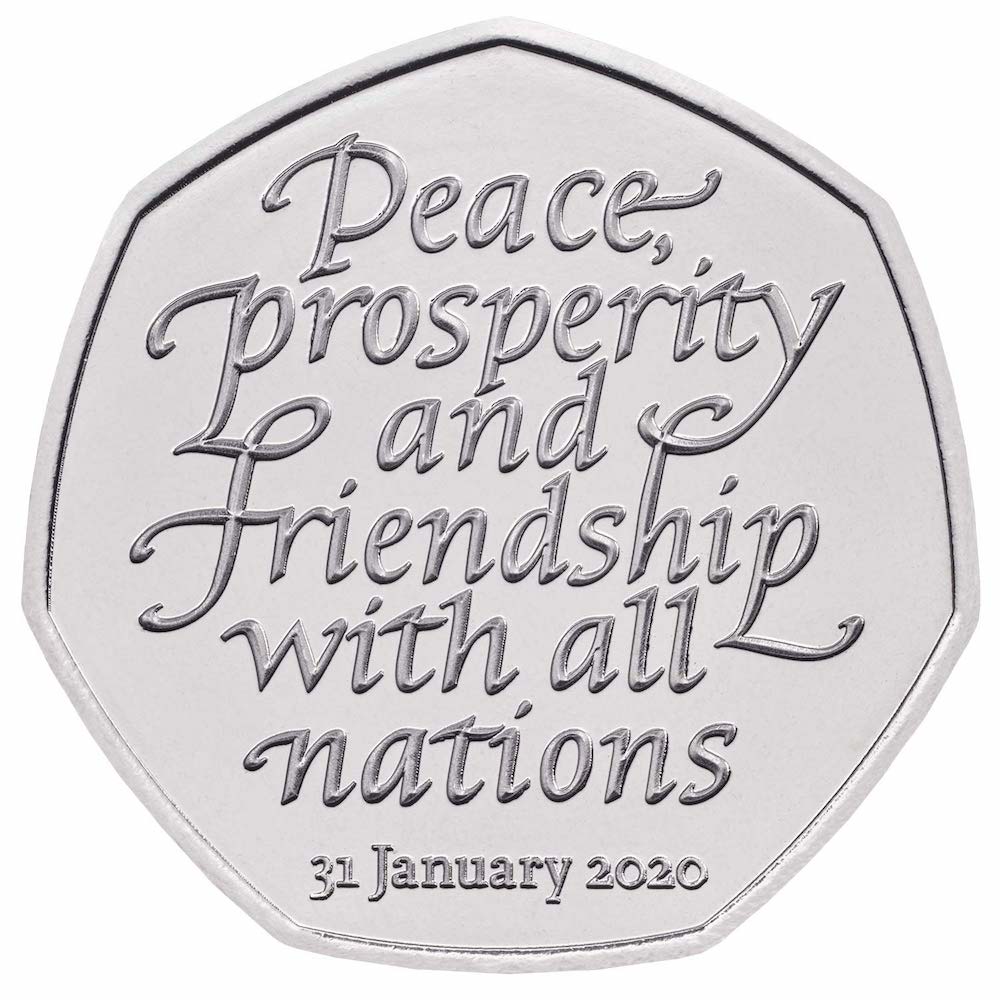
Reverse of the 2020 Brexit coin (Image courtesy of the Royal Mint)
The grammar police are those people who expect everyone to read and write in proper form. They want everything from signs to notices to be grammatically correct. There is no compromise because compromise leads to illiteracy.
These are the claims by novelist Philip Pullman who as called for a boycott of the Brexit 50p coin because it leaves out the Oxford comma.
For those who are not grammar snobs, the Oxford comma is also known as the serial comma. It is the comma placed after the second-to-last (penultimate) item of a list before the conjunction. Its use first appeared in 1894 in Hart’s Rules for Compositors and Readers at the University Press, Oxford. Hart’s Rules has been the defacto standard for English usage since its publication.
The 'Brexit' 50p coin is missing an Oxford comma, and should be boycotted by all literate people.
— Philip Pullman (@PhilipPullman) January 26, 2020
Oxford University Press has updated the rules over the years with the last version published in 2002. Now called The Oxford Style Manual, it does not waiver in its proper use of the Queen’s English. Thus, people like Pullman cling onto it to create an air of superiority.
When there were rumors that the use of the Oxford comma was going to be eliminated from the style guide, reportedly one such snob said, “Are you people insane? The Oxford comma is what separates us from the animals.” The rumors were not true.
Sometimes, the lack of a serial comma can cause problems. In 2014, someone sued a Maine company because the absence of a comma caused an alleged misinterpretation of workplace policies.
But this argument is over a coin.
What is worse is that the phrase used on the coin is being picked apart by grammar snobs everywhere. The phrase on the reverse of the coin, “Peace, prosperity and friendship with all nations,” was adapted from Thomas Jefferson’s First Inaugural Address. As Jefferson was outlining the principles of his administration, Jefferson included, “peace, commerce, and honest friendship with all nations, entangling alliances with none.” With its ties to Jefferson, some suggest its usage will (GASP!) Americanize the Queen’s English!
I thought that the argument over coin designs in the United States is ridiculous. The Brits have surpassed even the most half-witted commentary from the United States.
And now the news…
 January 27, 2020
 → Read more at theguardian.com
January 27, 2020 → Read more at thevintagenews.com
January 27, 2020 → Read more at timesofisrael.com
January 28, 2020 → Read more at bbc.com
January 29, 2020 → Read more at jezebel.com
February 2, 2020 → Read more at dailymail.co.uk
February 2, 2020 → Read more at bbc.com
February 2, 2020 → Read more at connexionfrance.com
February 8, 2020 → Read more at kolotv.com
→ Read more at theguardian.com
January 27, 2020 → Read more at thevintagenews.com
January 27, 2020 → Read more at timesofisrael.com
January 28, 2020 → Read more at bbc.com
January 29, 2020 → Read more at jezebel.com
February 2, 2020 → Read more at dailymail.co.uk
February 2, 2020 → Read more at bbc.com
February 2, 2020 → Read more at connexionfrance.com
February 8, 2020 → Read more at kolotv.com
Re-Review: PCGS Photograde Online or iPhone
On Friday, I connected my iPhone to my computer and opened iTunes to sync everything together. During my sync, iTunes reported that there were application updates. One of the updates was the PCGS Photograde for the iPhone application. Since PCGS upgraded the application and PCGS Photograde website, so quickly after its initial release, I thought an update on the review was in order.
 On both the website and the iPhone app, the home page now has entries for “Two & Three Cents” coins and divided the gold into “Small Gold Coins” and “Large Gold Coins.” The full look of the screen looks good and gives the website and iPhone app the impression that it is more complete. Seeing these new images suggests that PCGS added coins from the 19th century coins. But when tapping on the image for the Cents, I saw a full screen of cents starting wit the “Liberty Cap Large Cents” through the Lincoln cent. Not only did PCGS add 19th century coins but they went back to the first coins issued by the US Mint. After looking at the images, I confirmed that my favorite 1794 cent looks like PCGS’s 1796 cent that they grade PO-1.
 After seeing how far back the images go, it was time to find out how modern PCGS gets. Because of size limitation, the iPhone app does not include years of issue, but the website does. On the website, says that the Lincoln Cent runs 1909 to Date, yet all of the coins imaged were pre-1959 wheat-back cents. There were no images of the Memorial cents nor images of the lowered relief coins. For those looking to put together high grade modern sets it is a serious omission.
In fact, after checking other coin images, all of the images of coins that are in circulation today do not have images of modern coins. Jefferson Nickels do not include mint state grading images of the current design, quarters and halves do not include the bicentennial images, and the quarters do not show the obverse of the State Quarters design. As for the dollars, the images end with the Peace Dollars. As I said in the first review, given that there were some circulation of the Eisenhower and Susie B’s as well as striking issues with the Eisenhower dollar, it would be nice to have an image reference of these coins.
 The new images of the added coins are beautiful in all grades. Users of this applications will have a great tool for determining the grade of coins. However, I have the same complaint I made the last time on the use of toned coins. I understand some collectors like toned coins, but the toning does detract from seeing the subtle differences in between high grade coins.
PCGS has taken a great tool and made it even better. I like the iPhone application for being portable when I attend coins shows. For this upgrade, I give both the website and iPhone app a grade of MS67, a premium grade for their new additions but less than perfect for the omission, especially for not including the Eisenhower and Susan B. Anthony dollars.
Crack Out!
Over on the Collectors Society forums, a member cracked out encapsulated coins and posted videos showing how he did this. While I do not advocate cracking coins out of slabs nor do I condone it, the following videos show one person’s method.
Cracking a coin out of a PCGS holder:
Cracking a coin out of a NGC holder:
Regardless of the method you use, please do not hurt the coin. It would be terrible to see a coin destroyed during a crack-out!
Reform Needed at the CCAC
Last week I had a public discussion with Gary Marks, a member of the Citizens Coinage Advisory Committee about my comments about the CCAC on CoinNews.net. My initial comments were based on an article that Mr. Marks says misrepresents the work of the CCAC. After following up with asking for more information, Mr. Marks produced a quote buried in a document on the CCAC website that was lacking context. It is evident that Mr. Marks does not fully understand the issue.
The Citizens Coinage Advisory Committee is supposed be a conduit for the public to have input to the coin design process. The CCAC is supposed to work with the US Mint to create coin designs that represents the best of the best. It is a committee that is to do what President Theodore Roosevelt did as part of his “pet crime.”
New York Yankees limited partner John McMullen once said, “Nothing is more limited than being a limited partner of [George Steinbrenner].” McMullen has not tried to pry information from the CCAC and the US Mint!
Openness of the federal government was first codified in the Freedom of Information Act signed by President Lyndon B. Johnson on July 4, 1966. At the time, it was referred to as the “Sunshine Laws.” Before the growth of the computer age, the purpose was to make documents that were not sensitive or classified available to the public. Presidents Bill Clinton, George W. Bush, and now Barack Obama have mandated their administrations to expand the availability of government information as electronic capabilities have improved.
On January 20, 2009, the first day of the Obama Administration, President Obama signed the Memorandum for the Heads of Executive Departments and Agencies which said that “agencies should adopt a presumption in favor of disclosure, in order to renew their commitment to the principles embodied in FOIA, and to usher in a new era of open Government.” By August, the White House issued the Transparency and Open Government memo telling agencies that they have 120 days to report to the Office of Management and Budget how they would make the processes more open.
Rather than making the process more open as the President requested, the CCAC and the US Mint appears to be stuck in the mindset of the electronic world before the invention of the World Wide Web.
Although the meetings are open to the public, knowing when the meetings are being held is almost a state secret. Although announcements are made via a press release by the US Mint—of course everyone follows the US Mint’s press releases—the CCAC website has no information as to when meetings are held. Rather, the front page says to call a Washington, DC telephone number to listen to a recorded message about the meeting. Meeting announcements are not posted on the web site. Neither are the agendas in advance of the meeting. Instead of following the President’s executive order to be more open, the CCAC makes meeting announcements are technically legal but violates the spirit of open government.
Even using the 20th century forms of communications, the CCAC is not updating their website. At this time, minutes have not been posted for the last four meetings. Not that it matters because the information is sparse and really does not explain what the CCAC is doing.
There is also nothing worth reading on their Press Room page.
Anyone attending the CCAC meetings are handed a package of papers with an agenda, support letters, and even images of the proposed designs being discussed. These packages contain a phenomenal amount of information that when combined with the sparse minutes provides a better insight into what the CCAC has discussed. But these packages are not available to the public. If you know someone attending the meeting, you can ask them to obtain an extra copy. When I called the US Mint to ask to receive a package, I was told that it could not be done but I could receive copies of the coin images if I signed a copyright release. More than a year ago, I submitted a request for the release. After my application was rejected because I could not provide a company name, I was told I would have to sign a form for each request.
Most of the meetings are held at the US Mint’s Headquarters in Washington, DC. On occasion, meetings have been held during the American Numismatic Association’s Summer Seminar, Worlds Fair of Money, and recently the Florida United Numismatics show. While I would like to attend these events, I have a full time job, not in numismatics, that keeps me close to home. However, if I had access to the meeting package and a way of listening to the conversation, I would be able to make educated judgements on their work without having to rely on a second hand source like a non-numismatic newspaper.
Even if the CCAC continues to use 20th century communications, the Department of the Treasury does have the capability of creating a teleconference bridge that can be outbound only and recorded. This teleconference bridge will allow people who are not local to the meetings to listen to the meeting. In my “Real Life”™ job, I have used this service. It requires the bureau to request the service in advance.
After the meeting, the audio can be posted on the website so that anyone who could not participate during the time of the meeting could download the audio and listen at another time.
If the CCAC and US Mint wants to step into the 21st century, there are Internet-based audio services that can be used with greater capacity than the Treasury’s teleconferencing service.
Would it be too much to ask for the CCAC to have a Really Simple Syndication (RSS) feed? RSS feeds allows for better communication by my RSS reader letting me know when the site has created updates by watching the RSS feed. RSS is really simple. There are a number of programs to help create feeds and services that help publish feeds. As the webmaster for my local coin club, I provide an RSS feed when the website changes. I also use it to remind members of upcoming meetings.
Also, it is possible to integrate Google search into the CCAC website to provide search capabilities to visitors. There is no cost for this service.
If the CCAC participated in the Open Government initiative ordered by the President and made its deliberations more open to the citizens, maybe there would be a better understanding between the committee and the citizens they are supposed to represent.
Found DC in VA
I finally found a DC quarter in the DC area. I am working on a new project in Alexandria, Virginia and stopped by a local grocery store after work. Before shopping, I stopped by the in-store coffee stand for a warm beverage where I was handed a DC quarter in change. Although I was able to purchase these quarters at the US Mint headquarters building, this is the first one I found in change.
Almost a year after their issue, I am beginning to see 2009 quarters and the Lincoln Bicentennial Cents in circulation. I have yet to find 2009 nickels and dimes in change. With a production of 84.64 million nickels and 146 million dimes are the lowest mintage totals since the 1950s.
The US Mint’s Annual Report says that production of circulating coinage was down 70-percent and it is not anticipated that their primary customer, the Federal Reserve, would increase their purchasing of new coins. It might be more difficult to find 2009 and 2010 coins in pocket change.
More Twittering
As many knows, the US Mint’s public view of technology barely makes it to the end of the 20th century. While other government sites have used the change in administration to refresh their websites, the US Mint is now beginning a “study” as to what they should do. The way the US Mint’s administration manages themselves, it would surprise me if they change their website before the end of the current administrative term.
Miraculously, the US Mint does offer RSS feeds. Of the four feeds they offer, two have been updated on a quasi-regular basis. The US Mint Press Release/Public Statement feed is updated when the Mint ’s press office publishes another release. They also have a Product Information Update feed when new items appear in the online catalog.
After finding a service that will take an RSS feed and post it on Twitter, I decided to add the ability to take the US Mint’s RSS feeds and post them to the blog’s Twitter feed, @coinsblog. If you do not understand how to use RSS, you can either follow me on Twitter or see the tweets on the left side of this page where it shows my last five tweets.
If the US Mint is not going to take advantage of technology to keep you informed, I will do what I can to bring the information to you.
Support the Coin Collectors Blog
 Buy me a coffee
Thank you for your support!
Let Me Know What You Think
Are you going to the World's Fair of Money
Total Voters: 17
 Loading ...