
Weekly World Numismatic News for October 6, 2019
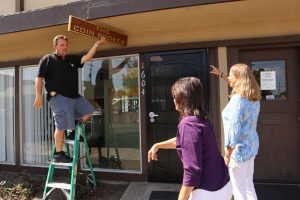
Rebecca Clay Pippin’s husband Jason Pippin hangs the Coin Broker’s sign on their new storefront at 1604 Laurel St. in San Carlos. (Image courtesy of the San Mateo Daily Journal)
Meanwhile, in Worcester, Massachusetts, the owner of Lincoln Stamp and Coin Company announce the shop will be closing at the end of October. Owner David J. Ephraim cited that he could not continue to pay rent in Worcester, “operating on a slim profit margin, and collectors are an aging group, with few younger customers walking through the door.”
Both situations demonstrate the same problems with different solutions. Commercial rents are too high. Commercial insurance is too high. Security costs are too high. And many of these businesses are trying to survive on thin margins.
The Coin Broker solved its problem by moving to a new location. Although moving is time consuming, costly, and filled with emotion, the story makes it seem like they are ready to turn the page and continue.
For Lincoln Stamp and Coin, Ephriam is not as bullish on the market. His business does not see enough younger collectors, his regulars are either retired or dying, and those collecting are buying on the Internet.
Two stories with the same underlying problems. Two different solutions. But the hobby continues with one less place that collectors can go to buy coins.
And now the news…
 September 28, 2019
The Bank of Jamaica (BOJ) estimates that at least J$100 million in one- 10- and 25-cent coins, the ‘red’ money, is ‘lost in circulation’ in the Jamaican economy, and has partnered with GraceKennedy (GK) Money Service in a recovery drive.  → Read more at jamaica-gleaner.com
September 30, 2019A national treasure hunt has been launched, and Australia is very much at the centre. The coins are marked to celebrate all things iconic to Australia: the meat pie, a boomerang, Vegemite, and a Hills Hoist, just to name a few. → Read more at katherinetimes.com.au
October 2, 2019Most people use banks as a place to either borrow money or store it. But some lucky coin enthusiasts have found a unique way to get money out of the bank: bringing home rolls of coins and searching through them for ones worth more than their face value. → Read more at cnbc.com
October 2, 2019When Jim Beer opened the Coin Broker in Palo Alto’s Town & Country Village shopping center some 40 years ago, he was retiring as a civil engineer and looking to → Read more at smdailyjournal.com
October 3, 2019PM Narendra Modi released the commemorative coins of Rs 150 denomination to celebrate Mahatma Gandhiji’s 150 th birthday. The event took place in Ahmedabad, Gujarat on October 2, 2019 when the Prime Minister reached the Sabarmati Riverfront to participate in the proceedings of the Swacch Bharat Divas program. → Read more at businessinsider.in
October 4, 2019A steamship that sank in 1840 after colliding with another ship off the coast of South Carolina contains a trove of rare gold coins, according to the dive team salvaging the wreck. → Read more at foxnews.com
October 5, 2019WORCESTER — The bidding board is still covered with coins and envelopes are full of stamps, but the buzz is gone from Lincoln Stamp and Coin Co. The venerable business that was once the place to go for people looking for a special stamp or unique coin, is selling off its inventory and closing its doors, probably for good. → Read more at telegram.com
October 6, 2019Metal detectorists have made many amazing discoveries down the years in Britain, with a great hoard of 2,600 coins just revealed last month. But there are strict rules regarding archaeological finds made by detectorists. → Read more at ancient-origins.net
Celebrating History with a Caveat Emptor
A few moments ago, on the west side of the Capitol, Barack Obama was sworn in as the 44th President of the United States. On a specially built platform, President Obama put his hand on the same bible that Abraham Lincoln used at is inauguration in 1861 and was sworn in by John Roberts, Chief Justice of the Supreme Court. Millions millions of people watching on the National Mall and around the world heard President Obama take the oath of office:
I Barack Hussein Obama do solemnly swear that I will faithfully execute the Office of President of the United States, and will to the best of my Ability, preserve, protect and defend the Constitution of the United States. So help me G-D.
Whether you voted for President Obama or not, this is a historical moment that everyone should savor. We wish the new president well and hope he will pursue the right policies to better this country.
Numismatically, President Obama’s election has caused opportunists to come out of the woodwork with numismatic collectibles that potential collectors should think twice about before purchasing. We have seen the advertisements on television, in magazines, and as fliers in other mail. They are advertised as “exclusive” and “limited editions” with prices set at one price, but if act today, you can receive the coins at a lower price.
If you buy these coins, please remember that these vendors are colorizing business strikes made by the US Mint and are worth their face value. Coins are colorized or thinly plated with less with less than a few cents of gold. Although the work is made with real coins, they are numismatically worthless. Similar collectibles for other events have not increased in value. In some cases they worth less than their issue price.
The US Mint warns that the coins are not official US Mint products and not endorsed by the Mint.
Please enjoy the view of history from where ever you are. But please consider another collectible to honor this history. Pins, buttons, clothing, hats, copies of The Washington Post from the day of the inauguration are wonderful alternatives that you can appreciate for years to come.
My First 2009 Coin
Last year, I did not see a coin with a 2008 date until April. Even with the Federal Reserve giving priority to circulating 50 State Quarters during their first two weeks of issue, it was a while before I found one in change. I wondered how long it would take to find a 2009 coin in my pocket. This year, the wait lasted until January 13.
On Tuesday, January 13, I attended the meeting of Montgomery County Coin Club, where I was inaugurated as president for my second term. Our treasurer works near the US Mint’s headquarters. He used his lunch break to visit the headquarters to purchase a number of the Hawaii quarters and the new Native American $1 Coin from the change machines in the building’s lobby.
Before the meeting started, I handed our treasurer a $1 Federal Reserve Note and he handed me a $1 coin. With the coin in my pocket, I can proclaim receiving a 2009 in change! Ok… it may be cheating, but it is still a 2009 coin and it did not cost me more than face value to obtain it.
 This was the first time I saw the design rather than the line drawing. The obverse of the coin continues to have the Glenna Goodacre designed portrait of Sacagawea, the Shoshone Indian guide for Meriwether Lewis and William Clark, carrying her infant son, Jean Baptist. The only difference between the previous versions and the new obverse is that the date and mint mark were moved to the edge along with E Pluribus Unum and 13 stars.
For 2009, the Native American $1 Coin Act (Public Law 110-82 [text] [pdf]) required the redesign of the reverse to honor Native Americans and the important contributions made by Indian Tribes and individual Native Americans in United States history. This year, the design represents the “Three Sisters Agriculture,”
 “Three Sisters” agriculture is the practice of growing corn, beans, and squash in the same mound enhanced the productivity of each plant. This simple concept lead to the accepted practice of crop rotation that is used today to maintain the production in modern farms. This helped Native American produce food and sell their knowledge to the early European colonists to ensure their survival.
In hand, it is an excellent design. The details of the image is simple, yet complete that gives the coin a great look. Even the change in the font used for “United States of America” near the edge enhances give the coin the feel of Native American art work. US Mint Sculpture-Engraver Norman E. Nemeth should be commended for his wonderful work.
Images courtesy of the US Mint.
Getting the Public Involved with Coin Designs
It is interesting to watch what other mints do with circulating and commemorative coinage. Each mint is governed by its own laws and regulations that are very different than the coin design process required of the US Mint. While the US Mint is very regulated, other mints have the flexibility to create interesting coins and do it in a way that involves the public. One mint that is using its flexibility is Great Britain’s Royal Mint.
The Royal Mint is a crown corporation answerable to the Queen. While the Queen has the final authority of all Royal Mint activities, the Mint is required to consult with the Chancellor of the Exchequer (a position equivalent to the US’s Secretary of the Treasury) and the Prime Minister. Although this gives the Royal Mint a lot of flexibility, the Royal Mint uses their power judiciously—as they showed last year by redesigning British circulating coinage for the first time in 40 years, after decimalization.
With the London 2012 Olympic and Paralympic games a few years away, the Royal Mint is preparing by starting the design process. To commemorate the games, the Royal Mint is planning issue 50 pence coins with 27 different reverse designs representing the different sports that are part of the games. The obverse will continue to use the portrait of Queen Elizabeth II designed by Ian Rank-Broadley. But rather than go through a traditional design competition by having a competition amongst artists, the Royal Mint is opening the design competition up to the entire nation.
The competition is open to residents of the United Kingdom. Those interested should go to the Royal Mint’s special website for entry information. Design winners will receive a gold version of their coin, get to see their coin being produced at the Royal Mint, and receive a £1,000 prize (currently about $1,473). The following video was produced by the Royal Mint and features Chief Engraver Matt Bonaccorsi:
Along with the regular competition, the Royal Mint is holding two other competition for students. There will be a design competition for children aged 6 to 12 years and a design competition for children aged 13 to 19 years old. The younger competition winner will not receive cash and the school where the winner of the older competition attends will receive £10,000.
Deadline for the competition is the end of April. It will be interesting to see how the process progresses. It looks like the Royal Mint has an interesting idea to get the country involved. I will be watching to see how successful they are with this program. Maybe the US coin bureaucracy can learn something from this venture.
First Coin Bill of the 111th Congress
One day after the convening of the 111th Congress, Rep. Sheila Jackson Lee (D-TX) introduced H. R. 255, NASA 50th Anniversary Commemorative Coin Act even though NASA’s 50th Anniversary was in 2008. The bill was referred to the House Financial Services Committee.
Since a similar bill introduced in the second session of the 110th congress did not pass, Rep. Jackson Lee introduced it for consideration in the new congress. Currently, the bill has two co-sponsors and may not have the support to pass in NASA’s 51st year.
This is the first coin bill of the 111th congress. I am sure that there are more to come!
Brian Williams Collects Challenge Coins
Challenge coins are medals that bears an organization’s logo or emblem that are carried by the members and given to outsiders as an honor. In the United States, challenge coins are part of military tradition that started during World War I when Ivy League students went to war and created these coins as an act of camaraderie. Legend has it that one coin saved the life of a pilot.
According to legend, a pilot was shot down behind enemy lines and captured by German soldiers. Sine the pilot kept the coin in a pouch around his neck, the Germans did not confiscate his coin. That evening, the pilot was kept in a French-German town that was bombarded in the evening by allied forces. The pilot escaped during the bombing. During the next day, the pilot came upon a French military unit who was told to watch for German soldiers posing as citizens. To prevent from being arrested and executed by the French soldiers, the pilot showed them his challenge coin. One of the soldiers recognized the insignia and delayed the execution until they were able to verify the pilot’s identity. Once the story spread, a tradition was born!
Challenge coins were named on the tradition of the challenge. When a member draws his or her challenge coin and slaps it on the table, others must produce their challenge coin. If someone does not have their challenge coin, that person must buy a round of drinks for the group. The challenge is used as a morale builder amongst the group.
NBC Nightly News broadcast a story about the production of challenge coins at the Highland Mint in Melborne, Florida. The story noted that commemorative coins are a “half-billion dollar a year business.” At the end of the story, reporter Roger O’Neil challenged Brian Williams with an NBC challenge coin. Williams not only showed his challenge coin, but showed off a collection of challenge coins he received during his career. Watch the story:
Visit msnbc.com for Breaking News, World News, and News about the Economy
I wonder if Brian Williams collects other coins?
Support the Coin Collectors Blog
 Buy me a coffee
Thank you for your support!
Let Me Know What You Think
Are you going to the World's Fair of Money
Total Voters: 17
 Loading ...