
Weekly World Numismatic News for July 14, 2019
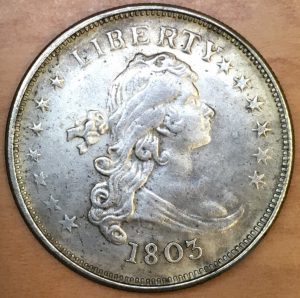
Counterfeit 1803-dated dollar found in Hong Kong for $3. It is not part of the story but makes for a good accompanying image.
Skog, 68, advertised in Numismatic News sending lists of available coins to interested collectors. Reports say that Skog, who used the alias Ron Peterson, sold $57,000 worth of counterfeit coins. On his arrest, his list contained 275 counterfeit coins which would have sold for over $200,000.
A source said that Numismatic News cooperated with investigators when a reader alerted them about the problem.
I am reporting this in very stark terms so that if anyone is searching the Internet for information about coin collecting, I want you to know that this situation is not typical of the hobby.
Like any industry, there are a lot of outstanding people and a few that ruin the reputation for others. Skog is not typical of the vast majority of the dealers I have met. Although there are dealers I disagree with on many different issues when it comes to numismatics, the state of the hobby, or their approach, I do not think they are bad people.
Not all mail order dealers are bad people either. For some, it is a hobby. They use the proceeds from buying and selling through ads placed in the numismatic media to enhance their collections. The same is true of some of the people who sell on eBay. Sure, there may be issues with some eBay sellers that give the rest a bad name, but there are more honorable people than those trying to scam you.
Finally, Numismatic News is an outstanding publication and an excellent source for stories about the hobby. While its future is uncertain, while it is still publishing, I have no problems recommending it as a reliable source. A scammer like this could have done this using any other publication. There is nothing about Numismatic News to place them at fault.
Unfortunately, stuff happens. When it does, it was nice to hear that the community banded together to stop someone from hurting other members.
And now the news…
 July 8, 2019
HISTORIANS are baffled after a mysterious African coin that could date as far back as the 8th century was found in Australia. The copper coin could mean Captain Cook – famous as the first Eur…  → Read more at thesun.co.uk
July 8, 2019Scientists are perplexed at the origins and provenance of two very ancient and unusual Roman coins that turned up like a bad penny in the 20th century. A Quincussis – the correct scientific name of this strange find — has thus far only been mentioned in texts dedicated to the coinage of ancient times and at most only a drawing was reported, but no one has ever seen one, until one was presented to Dr Roberto Volterri of the Rome University for analyses and then its twin surfaced. → Read more at ancient-origins.net
July 9, 2019A Burnsville coin dealer who admitted selling counterfeit coins was sentenced Tuesday to 30 months in prison. Barry Ron Skog, 68, pleaded guilty to the counterfeit coin scheme Feb. 21. → Read more at twincities.com
July 9, 2019Greek customs officers caught a Turkish citizen attempting to smuggle 1,055 ancient coins across the border from Turkey on Tuesday, the Greek Reporter news site reported. The coins were hidden in seven water bottles concealed at the bottom of a bag containing food, it said. → Read more at ahvalnews.com
July 9, 2019A federal judge in St. Paul sentenced a former Burnsville coin dealer Tuesday to 2½ years in prison for fraud in the sale of bogus collectible coins. Barry Ron Skog, 68, owned the Burnsville Coin Co., which advertised the sale of collectible “numismatic” coins. → Read more at startribune.com
Mint Hires New Deputy Director
The US Mint announced that Andrew D. Burnhart has been selected as the new Deputy Director of the Mint to begin on Friday, May 23—just in time to be paid for the Memorial Day holiday.
“Andy has more than 20 years of experience in senior executive positions,” said Mint Director Edmund Moy. “His expertise in organizational change will help the United States Mint achieve its strategic goals and become a more results-oriented organization.”
Burnhart had previously was General Manager for the Washington Suburban Sanitary Commission (WSSC) with is responsible for water and sewer services to Montgomery and Prince George’s counties, the Maryland counties surrounding Washington, DC. Aside from the accolades published in the press release, the Burnhart-lead WSSC raised water and sewer rates by more than 8-percent this year for an infrastructure plan that has been in discussions for the last few years.
When the rate increased was proposed, the Burnhart-lead WSSC refused to provide access to budget data to the Montgomery County Inspector General, one of the government owners of WSSC. Montgomery County has paid $2.3 billion to WSSC over the last three years.
Officials of Montgomery and Prince George’s counties have criticized the management of WSSC for not providing the requested information alleging a cover-up over spending practices. They have also questioned the timing for implementing the infrastructure plan in the light of economic reality.
Burnhart announced his intent to leave WSSC at shortly after Montgomery County’s Inspector General query and right before the rate increase was announced.
Whitman Returns to Canada
Whitman Publishing sent out an email notice announcing that they will be selling a complete line of folders for Canada coins. With a shipping date of May 23, Whitman’s 12 new folders will include large cents, small cents (2 folders), 25 cents (5 folders), and dollars (4 folders).
The announcement did not mention folders for the 5 cents, 10 cents, and two dollar (Toonie) coins.
When I started collecting Canadian coins a few years ago, I first went to Whitman for folders and albums. That is when I found that Whitman discontinued producing Canadian coin folders. I bought a few used folders from the secondary market, but were disappointed with their quality. After a search and then having a conversation with a Canadian coin dealer, I found Gardmaster Coin Albums.
Pockets in Gardmaster albums are in a slider that fits into sleeves within the album page. Slide the strip from the page, place the coin in the correct pocket, and slide the strip back into the page. Coins remain secured within the album. Gardmaster says the materials are archival safe.
Gardmaster albums use a snap-lock system to keep the pages secured. Although the album is not as attractive as the Whitman or other albums, the system is highly effective. If you don’t like their album, the pages will fit into almost any binder.
After having problems with the variable size of early US large cents fitting in the “standard size” Whitman folders, I bought a blank Gardmaster US Cents folder for that collection.
Although I have my favorite place to buy Gardmaster albums, others sell them in context to replace old Harco Coinmaster albums.
I highly recommend Gardmaster albums for the Canadian coin collector and others looking for a different type of album.
Double Eagle, Boy Scout, and Key Bills
In a rare display of overwhelming bipartisan support, the House of Representatives passed three numismatic related bills. One was the Saint-Gaudens Double Eagle Ultra-High Relief Bullion Coin Act that was passed 415-0 (18 not voting) that will allow the US Mint to strike the high relief 24-karat gold coins featuring the Augustus Saint-Gaudens Double Eagle design.
On a vote of 403-8 (22 not voting), the House passed H.R. 5872, Boy Scouts of America Centennial Commemorative Coin Act. If passed by the Senate and signed by the President, this bill will authorize the Mint to strike one dollar proof and uncirculated silver coins to commemorate the 100th Anniversary of Scouting in the United States in 2010. The bill stipulates that the coins can be only struck at one Mint facility and would be distributed starting February 8, 2010. A $10 surcharge will be added to the price of the coins that will be paid to the National Boy Scouts of America Foundation.
Scouting started in 1907 in England. To celebrate the 100th anniversary of the scouting movement, the Royal Mint produced a beautiful commemorative coin and associated products.
In 1814, Baltimore attorney Francis Scott Key joined Colonel John Stuart Skinner aboard the HMS Tonnant to negotiate a prisoner exchange for Dr. William Beanes, a Maryland resident who was captured during the British attack on Washington, DC. After Key and Skinner dined with the ship’s senior officers, the three men were not allowed to return to Baltimore. That evening, the British spent part of 25-hours bombing Fort McHenry in the Baltimore Harbor.
In the morning, Key awoke to the view of the flag still flying over Fort McHenry. This inspired Key to write the four-stanza poem “The Defense of Fort McHenry“ which he said should be sung to the tune of The Anacreontic Song.
Over the years, the poem’s popularity would gain and then wane. On July 27, 1889, Secretary of the Navy Benjamin F. Tracy signed a general order making “The Star-Spangled Banner” the official song to be played when raising the flag.
In 1916, President Woodrow Wilson signed an executive order to have the “Star-Spangled Banner” be played by the military and for other “appropriate occasions.” After a controversy brewed when a cartoon announced, “Believe It or Not, America has no national anthem,” President Herbert Hoover signed the law making it the official National Anthem in 1931.
To honor the bicentennial of the War of 1812 and Key’s poem that became our national anthem, the House passed H.R. 2894, Star-Spangled Banner and War of 1812 Bicentennial Commemorative Coin Act. The bill calls for one-ounce proof and uncirculated silver coins designed to be “emblematic of the War of 1812 and particularly the Battle for Fort McHenry that formed the basis for the ‘Star-Spangled Banner’.“ Coins will be issued during 2012. The $10 surcharge will be paid to the Maryland War of 1812 Bicentennial Commission to help in its role of providing education, research, and celebrating the bicentennial of the War of 1812.
All of these bills must be passed by the Senate and signed by the President before they become law.
Save 15-percent on World Catalogs
Krause Publications, the publisher of the Standard Catalog of World Coins series of guides, is now offering a 15-percent discount on all purchases of coin and currency books from their online store through May 30. Use Promo Code NNWB58 during checkout to receive the savings.
The is for information only. I have no connection with Krause Publications nor am I being paid for this announcement.
2009 Saint-Gaudens Double Eagle Moves Forward
Today, I noticed that the US Commission of Fine Arts posted the final minutes from their April 17, 2008 meeting. The CFA is part of the coin design bureaucracy that is required to approve, reject, or recommend changes to coin designs. These minutes approve of the 2009 Double Eagle gold coin US Mint Director Edmund Moy proposed the design to the Citizens Coin Advisory Committee.
The CFA approval reads as follows:
Confirmation of recommendation on the 2009 Double Eagle Gold $20 ultra-high relief coin based on 1907/08 design by Augustus Saint-Gaudens. Mr. [Thomas E.] Luebke [Secretary] said that the proposal had been circulated to the Commission members for a vote prior to the Commission meeting due to the U.S. Mint&rsqou;s tight production schedule and the similarity of the proposal to a historic coin design; he asked the Commission to confirm the recommendation. He said that the Mint’s proposal was to reissue a coin from 1907 designed by Augustus Saint-Gaudens: the original high-relief design was minted for one year, then adapted by the Mint to a low-relief coin that was issued from 1908 to 1932. The only proposed changes to the 1907 design would be to update the minting year, which will continue to be rendered in Roman numerals; to add a rim which will improve the production process; and to add the phrase “In God We Trust” which was historically included on the coin from 1908 onward. Upon a motion by Mr. [Earl A.] Powell [Chairman] with second by Ms. [Dianna] Balmori, the Commission confirmed its recommendation to approve the updated design with the comment that the Roman numerals for the issue date be as similar as possible to the original design in scale, spacing, and character.
As for the necessary legislation to allow the Mint the produce these coins, H.R. 5614 passed the House of Representatives on May 15 with a unanimous vote. The Senate’s version, S. 2924, is still in committee.
Support the Coin Collectors Blog
 Buy me a coffee
Thank you for your support!
Let Me Know What You Think
Are you going to the World's Fair of Money
Total Voters: 17
 Loading ...